Search This Blog

Showing posts with label civic virtue. Show all posts

Thursday, January 29, 2026

Civic Virtue and the Republic

Many posts have discussed volunteering and civic virtue.

 Robert P. George at AEI:

The Constitution was famously defended by Madison in Federalist No. 51 as “supplying, by opposite and rival interests, the defect of better motives.” He made this point immediately after observing that the first task of government is to control the governed, and the second is to control itself. He allowed that “a dependence on the people is, no doubt the primary control on the government, but experience has taught mankind the necessity of auxiliary precautions.” But even in this formulation, our constraints and institutions do not stand alone; indeed, they are presented as secondary. What is primary and entirely necessary is healthy and vibrant political culture — “a dependence on the people” to keep the rulers in line.

As the ablest scholar and political theorist of the founding generation, John Adams understood as well as anyone the general theory of the Constitution. He knew that a healthy political culture was vital to ensuring that rulers stay within the bounds of their legitimate authority and act as servants of the common good and of the people they rule. Adams famously remarked that “our Constitution is made for a moral and religious people” and “is wholly inadequate to the government of any other.”
...


This year, we mark the anniversary of a document that acknowledged certain truths to be self-evident, among them that all men are endowed by God with unalienable rights. From the moment of our country’s Founding, the authors of our constitutional and political order saw their project as premised on the notion that the citizenry — though diverse in ethnicity and creed — shared some fundamental premises about human nature and the human person. Now, though, the foundational components meant to form good, moral, and reasonable citizens are frail; they wield less influence in our society and in our politics than they did in the past. Our bonds are weakening; our civic fabric fraying.

If we are experiencing a period of American decline, it’s not because of the constitutional order and political system whose 250th anniversary we celebrate this year. The decline is attributable, rather, to the degradation of what Edmund Burke famously referred to as the essential “little platoons” of society: those building blocks of virtue, from families to voluntary associations, that work together to form an informed and virtuous citizenry. With the elements necessary to foster a healthy and vibrant democratic culture debilitated, is it any wonder that public confidence in our ability to keep our republic is so shaky?

Monday, July 7, 2025

Distrust

Many posts have discussed public trust in institutions and political leaders.

Daniel Cox at the Survey Center on American Life:

Americans have a generally low regard for many of their political institutions, and most say they mistrust elected officials to act in the public interest. Nearly three-quarters (74 percent) of Americans say elected officials mostly want to benefit themselves, while only one in four (25 percent) say officials care more about improving the country.

The belief that elected officials are more focused on their own personal gain than on improving the country is widespread among the public, cutting across lines of education, race, ethnicity, gender, and age. Democrats are especially cynical: Nearly eight in 10 (79 percent) say elected officials are only in it for themselves, a view held by 64 percent of Republicans.

In his recent election, Trump may well have benefited from Americans’ low esteem for public officeholders. Few Americans believe Trump is honest or trustworthy, but many do not believe he is any worse than the average public official. Close to half (47 percent) of Americans say Trump is less trustworthy than most other elected government officials. But collectively, more Americans say he is more trustworthy (33 percent) or no different (20 percent). Even Americans with moderately negative views of Trump—specifically, those with a somewhat unfavorable opinion of him—do not view him as especially untrustworthy. Most (56 percent) say he is no different from the average elected government official.

Sunday, March 16, 2025

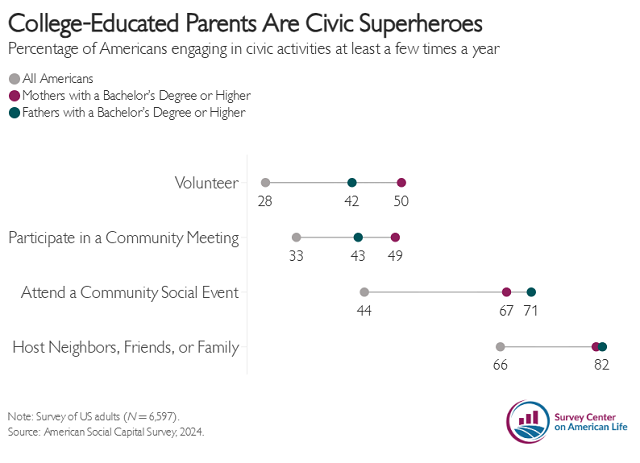
College-Educated Parents and Civic Life


Not all Americans have been as quick to abandon public spaces and communal activities. A recent report from the Survey Center on American Life found that college-educated parents remain very involved in their communities, spending much more time engaged in civic activities than other Americans. The report, Disconnected: The Growing Class Divide in American Civic Life, documents a range of activities that college-educated mothers engage in at higher rates than other Americans.

...

Becoming a parent does not instantly make someone a more caring or empathetic person. In fact, some research suggests the opposite. But for engaged caregivers, the experience of raising children fundamentally alters the incentives for being community-minded. Parents are incentivized to get to know their neighbors, take care of local parks and playgrounds, and support local schools—and they have shown a tendency to act on these incentives. They take more of an interest in local affairs and participate more regularly in community events and activities.


Saturday, November 2, 2024

Madison and Virtue

 Many posts have discussed civic virtue.

James Madison, June 20, 1788

 But I go on this great republican principle, that the people will have virtue and intelligence to select men of virtue and wisdom. Is there no virtue among us? If there be not, we are in a wretched situation. No theoretical checks—no form of government can render us secure. To suppose that any form of government will secure liberty or happiness without any virtue in the people, is a chimerical idea. If there be sufficient virtue and intelligence in the community, it will be exercised in the selection of these men. So that we do not depend on their virtue, or put confidence in our rulers, but in the people who are to choose them.

Saturday, August 24, 2024

Religion and Civic Life

Many posts have discussed the role of religion in American life.   

 Daniel A. Cox and Sam Pressler at The Survey Center on American Life:

If America was a nation of joiners when Alexis de Tocqueville toured America in the 1830s, it is certainly not today. Most Americans are not joining groups. Despite the decline in religious membership over the past three decades, Americans are still more likely to be members of religious organizations (33 percent) than of any other group.
...

Religious organizations are the only group that more than 10 percent of Americans with high school degrees or less education join (27 percent). Indeed, Americans with a high school degree or less are at least three times more likely to belong to a religious group than to join any other type of group. Yet their college-educated peers are significantly more likely to be members of religious congregations (39 percent).

There are pronounced educational gaps in religious membership among and within racial groups. Black Americans join religious organizations at higher rates than all other racial groups. However, black Americans have the largest educational divide in religious membership: Nearly half (47 percent) of black Americans with college degrees belong to religious groups, compared to just 30 percent of blacks with high school degrees or less. Hispanics, in contrast, have the lowest religious membership rates of any racial or ethnic group. Just 31 percent of Hispanics with college degrees identify with religious groups, while only 24 percent of Hispanics with high school degrees or less are members.

...

Americans who belong to a church or place of worship generally have more people they can count on for help and support than the religiously unaffiliated have. However, the religious membership gap in Americans’ social support networks is largest among those with less formal education. Among Americans without a college education, members of a place of worship are much more likely than nonmembers to have multiple people who can take them to a doctor’s appointment (63 percent vs. 49 percent), give them a lift (67 percent vs. 55 percent), loan them $200 (53 percent vs. 42 percent), offer them a place to stay (59 percent vs. 46 percent), or help them move (68 percent vs. 54 percent).

Among Americans with a four-year college degree, those who belong to a church or place of worship do not have the same advantages over nonmembers. For instance, among Americans who are members of a church or place of worship, those with a college degree are not much more likely than those without one to have multiple people who would offer them a place to stay if needed (74 percent vs. 68 percent).

Americans who are members of a religious congregation have more extensive friendship networks. Nearly half (48 percent) of Americans who belong to a place of worship report they have at least five close friends. In contrast, 35 percent of Americans without a religious community have this many close friendships. Compared to members of religious congregations, nonmembers are twice as likely to report having no close friends (20 percent vs. 10 percent).

The educational divide in friendship is significantly diminished among Americans who belong to a place of worship. More than one in four (27 percent) Americans with a high school degree or less who do not belong to a church or place of worship have no close friends. Meanwhile, 11 percent of college graduates who are not attached to a church or place of worship say they have no close friends. The educational gap is half this large among church members: Those with a high school degree or less are only somewhat more likely than those with a college degree to report having no close friendships (15 percent vs. 7 percent).


Friday, April 19, 2024

Garfield on Congress


In April 1877, Representative (and future President) James A. Garfield wrote at The Atlantic:
And this leads me to say that now, more than ever before, the people are responsible for the character of their Congress. If that body be ignorant, reckless, and corrupt, it is because the people tolerate ignorance, recklessness, and corruption. If it be intelligent, brave, and pure, it is because the people demand those high qualities to represent them in the national legislature. Congress lives in the blaze of “that fierce light which beats against the throne.” The telegraph and the press will to-morrow morning announce at a million breakfast tables what has been said and done in Congress to-day. Now, as always, Congress represents the prevailing opinions and political aspirations of the people. The wildest delusions of paper money, the crudest theories of taxation, the passions and prejudices that find expression in the senate and house, were first believed and discussed at the firesides of the people, on the corners of the streets, and in the caucuses and conventions of political parties.

The most alarming feature of our situation is the fact that so many citizens of high character and solid judgment pay but little attention to the sources of political power, to the selection of those who shall make their laws. The clergy, the faculties of colleges, and many of the leading business men of the community never attend the township caucus, the city primaries, or the county convention; but they allow the less intelligent and the more selfish and corrupt members of the community to make the slates and “run the machine” of politics. They wait until the machine has done its work, and then, in surprise and horror at the ignorance and corruption in public office, sigh for the return of that mythical period called the “better and purer days of the republic.” It is precisely this neglect of the first steps in our political processes that has made possible the worst evils of our system. Corrupt and incompetent presidents, judges, and legislators can be removed, but when the fountains of political power are corrupted, when voters themselves become venal and elections fraudulent, there is no remedy except by awakening the public conscience and bringing to bear upon the subject the power of public opinion and the penalties of the law. The practice of buying and selling votes at our popular elections has already gained a foot-hold, though it has not gone as far as in England.

Saturday, April 13, 2024

Tocqueville on Juries

From  Democracy in America [eds. J. P. Mayer and Max Lerner, trans., George Lawrence, Harper & Row, 1966, pp. 249-53]

To regard the jury simply as a judicial institution would be taking a very narrow view of the matter, for great though its influence on the outcome of lawsuits is, its influence on the fate of society itself is much greater still. The jury is therefore above all a political institution, and it is from that point of view that it must always be judged. ..

The jury system as understood in America seems to me as direct and extreme a consequence of the dogma of the sovereignty of the people as universal suffrage. They are both equally powerful means of making the majority prevail.

Juries, especially civil juries, instill some of the habits of the judicial mind into every citizen, and just those habits are the very best way of preparing people to be free.

Juries teach men equity in practice. Each man, when judging his neighbor, thinks that he may be judged himself. That is especially true of juries in civil suits; hardly anyone is afraid that he will have to face a criminal trial, but anybody may have a lawsuit.

Juries teach each individual not to shirk responsibility for his own acts, and without that manly characteristic no political virtue is possible.

Juries invest each citizen with a sort of magisterial office; they make all men feel that they have duties toward society and that they take a share in its government. By making men pay attention to things other than their own affairs, they combat that individual selfishness which is like rust in society.

Juries are wonderfully effective in shaping a nation’s judgment and increasing its natural lights. That, in my view, is [the jury system’s] greatest advantage. It should be regarded as a free school which is always open and in which each juror learns his rights, comes into daily contact with the best-educated and most-enlightened members of the upper classes, and is given practical lessons in the law, lessons which the advocate’s efforts, the judge’s advice, and also the very passions of the litigants bring within his mental grasp. I think that the main reason for the practical intelligence and the political good sense of the Americans is their long experience with juries in civil cases.

I do not know whether a jury is useful to the litigants, but I am sure it is very good for those who have to decide the case. I regard it as one of the most effective means of popular education at society’s disposal.

Thursday, April 11, 2024

Civic Virtue


Brooks, Arthur C. "America's Crisis of Civic Virtue." Journal of Democracy 35, no. 2 (2024): 23-39. https://doi.org/10.1353/jod.2024.a922831.
Civic virtue is the set of personal qualities associated with a civil or political order. It is a shared set of behavioral norms and basic moral rules that make the order's functioning possible. Tocqueville believed that this undergirded the American experiment with democracy and free enterprise, which could not be guaranteed by laws and coercion, but  only by voluntary adherence to virtuous behaviors such as honesty and civility.9

Some of the Founders doubted whether ordinary Americans possessed sufficient civic virtue for democratic self-government. In January 1776, six months before independence was declared, John Adams wrote fretfully to Mercy Otis Warren that "there is So much Rascallity, so much Venality and Corruption, so much Avarice and Ambition, such a Rage for Profit and Commerce among all Ranks and Degrees of Men even in America, that I sometimes doubt whether there is public Virtue enough to support a Republic."10 In 1788, James Madison agreed that a lack of civic virtue would doom the republic: "To suppose that any form of government will secure liberty or happiness without any virtue in the people, is a chimerical idea."11 He believed, however, that ordinary Americans were sufficiently wise and virtuous to use the democratic system to choose good leaders, for immediately after uttering these words, he added: "If there be sufficient virtue and intelligence in the community, it will be exercised in the selection of these men. So that we do not depend upon their virtue, or put confidence in our rulers, but in the people who are to choose them."

Civic virtue promotes trust within a society; then we can be confident that outward honesty and civility will be reciprocated by others. This trust is akin to what Robert Putnam famously called "social capital" in this journal in 1995.12 Social capital comes in two forms: bonding and bridging. The former creates solidarity and trust between people who are alike based on a shared identity (the in-group), but not with those who do not share this identity (the out-group). While bonding social capital can create a strong sense of belonging, it does not necessarily foster public trust due to its tendency to foster an "us-versus-them" mentality. By contrast, bridging social capital acts like a glue that holds differing groups together, thus breaking down barriers and fostering trust between people who are not alike.

As political theorist Kevin Vallier notes, trust through bridging social capital takes several forms—social, legal, and political. Social trust refers to the confidence we have that our fellow citizens will generally not take advantage of us.13 This refers to friends and family, of course, but also to strangers in the marketplace. Legal trust refers to institutions such as law enforcement and the courts. Political trust is placed in government officials, elected and nonelected, who are assumed not to use their special access to power to enrich themselves and their friends, or to disadvantage their enemies.

Francis Fukuyama argues that the trust instantiated in social capital (especially bridging capital), mediated by civic virtue, makes voluntary exchange and democratic governance possible.14 When people trust others—even strangers—to be fundamentally honest and civil, they feel more free to carry out economic transactions with reasonable confidence, and can take part in elections with similar confidence that the voting will not be rigged.

This, scholars have found, can initiate a virtuous cycle in which trust in others' virtue stimulates market exchange and democracy, which in turn raise trust. This cycle then raises societal well-being overall. Research by Sonja Zmerli and Ken Newton shows that when markets are backed by property rights, and when social norms encourage mutually beneficial exchanges among strangers, general trust grows.15 In addition, well-functioning markets make corruption less attractive by opening a path to wealth that is more lucrative, and less risky, than efforts to get rich by abusing public office.

The idea that trust promotes capitalism, which in turn further raises trust, is supported by empirical evidence. Analyzing data gathered from eighty countries during the years 1990 through 2020, economist Johan Graafland finds that: 1) civic virtues of honesty and civility reinforce free markets and vice-versa; 2) trust lies behind civic virtues, the rule of law, and thus democracy; 3) civic virtues are positively related to citizens' feelings of life satisfaction; and 4) the rule of law increases well-being by means of trust and civic virtues.16

Saturday, March 23, 2024

Faith and Norms

Madison in Federalist 55:

As there is a degree of depravity in mankind which requires a certain degree of circumspection and distrust, so there are other qualities in human nature which justify a certain portion of esteem and confidence. Republican government presupposes the existence of these qualities in a higher degree than any other form. Were the pictures which have been drawn by the political jealousy of some among us faithful likenesses of the human character, the inference would be, that there is not sufficient virtue among men for self-government; and that nothing less than the chains of despotism can restrain them from destroying and devouring one another.

Russell Moore at Christianity Today:

Ironically, some of the very people who advance the myth of a “Christian America,” in which the American founders are retrofitted as conservative evangelicals, now embrace a view that both the orthodox Christians and the deist Unitarians of the founding era would, in full agreement, denounce. From The Federalist Papers to the debates around the Constitution and the Bill of Rights, virtually every Founding Father—even with all their differences on the specifics of federalism—would argue that constitutional procedures and policies alone were not enough to conserve a republic: Moral norms and expectations of some level of personal character were necessary.

 Do these norms keep people of bad character from ascending to high office? Not at all. Hypocrites and demagogues have always been with us. What every generation of Americans have recognized until now, though, is that there is a marked difference between some leaders not living up to the character expected of them and leaders operating in a space where there aren’t expectations of personal character. You might hire an accountant to do your taxes, only later to find that he’s a tax fraud and an embezzler. That’s quite different from hiring an open fraud because you’ve concluded that only chumps obey the tax laws.

 That’s because no leader of any community, association, or nation is an abstract collection of policies. We select leaders to make decisions about matters that haven’t happened yet, or that might not even be contemplated. A dentist who screams profanities at opponents and promises a practice built around “revenge and retribution” and the tearing down of all the norms of modern dentistry is not someone you should trust with a drill in your mouth. How much more so when it comes to entrusting a person with nuclear codes.

Moreover, what conservatives in general, and Christians in particular, once knew is that what is normalized in a culture becomes an expected part of that culture. Defending a president using his power to have sex with his intern by saying, “Everybody lies about sex” isn’t just a political argument; it changes the way people think about what, in the fullness of time, they should expect for themselves. This is what Daniel Patrick Moynihan famously called “defining deviancy down.”

Saturday, August 26, 2023

Friendship and Civic Life

 Daniel A. Cox at the Survey Center on American Life:

Friendship predicts community involvement and civic participation. Sixty percent of Americans with at least six close friends say they have attended a local event or community meeting at least a few times in the past 12 months compared to only 33 percent of those with no close friends. Whether it’s going to the library, eating at a restaurant, or spending time at a bar, Americans with larger friend groups do all these things more often. Having more close friends also increases one's likelihood of talking to strangers. Seventy percent of Americans with at least six close friends report having had a conversation with a stranger at least a few times in the last 12 months. Americans with more close friends volunteer in their communities more often too.


Wednesday, May 17, 2023

Religion and Civic Participation

From PRRI:
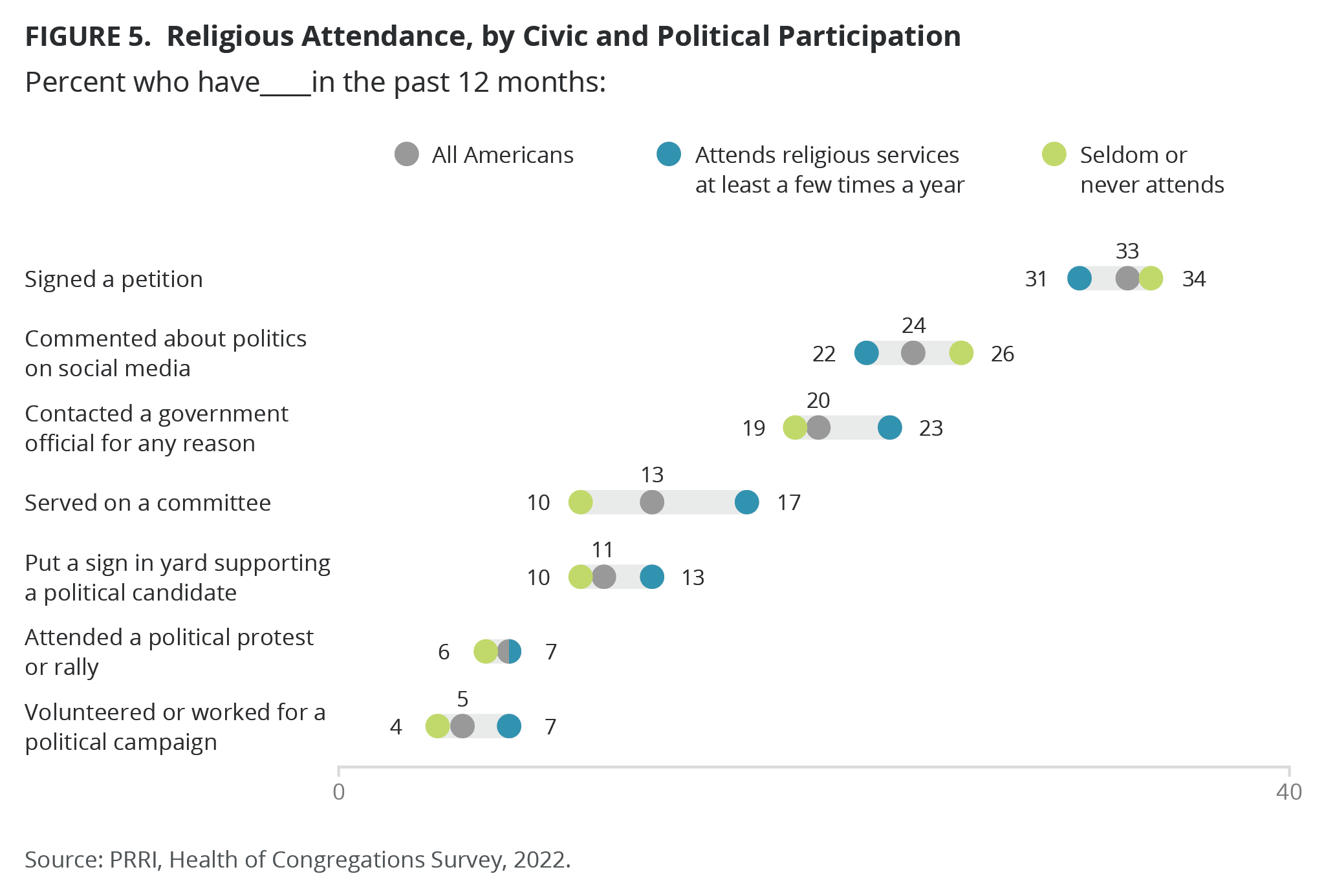
When asked about their civic and political participation in the past year, one-third of Americans (33%) said they signed a petition either in person or online; 24% said they commented about politics on a message board or internet site, including social media; 20% said they contacted a government official; 13% said they served on a committee for a civic, nonprofit, or community organization or event; 11% said they put a sign in their yard or a bumper sticker on their car supporting a candidate for political office; 7% said they attended a political protest or rally; and just 5% said they volunteered or worked for a political campaign.

Americans who attend church at least a few times a year are notably more likely than those who seldom or never attend church to have contacted a government official (23% vs. 19%), served on a committee (17% vs. 10%), put up a sign supporting a political candidate (13% vs. 10%), or volunteered for a political campaign (7% vs. 4%). By contrast, Americans who attend church more frequently are less likely than those who seldom or never attend to have commented about politics (22% vs. 26%).

White Americans participate in civic and political activities more than nonwhite Americans do. For example, white Americans are more likely to have signed a petition (35%) or contacted a government official (24%) than both Black Americans (29% and 15%, respectively) and Hispanic Americans (26% and 14%, respectively). White Americans are also more likely than Black Americans to have commented about politics (27% vs. 15%) and are more likely than Hispanic Americans to have served on a committee (14% vs. 10%) or put a sign in their yard supporting a candidate (12% vs 8%).

When examining religious attendance together with race and civic and political participation, white churchgoers are notably more likely than white non-churchgoers to have served on a committee (17% vs. 12%), but are less likely to have commented about politics (24% vs. 29%). Black churchgoers are more likely than Black non-churchgoers to have contacted a government official (20% vs. 11%), served on a committee (19% vs. 7%), or volunteered for a political campaign (9% vs. 3%). Hispanic churchgoers are also more likely than Hispanic non-churchgoers to have contacted a government official (20% vs. 11%), served on a committee (15% vs. 6%), or put up a sign supporting a candidate (12% vs. 5%). Churchgoers of other racial groups are more likely than non-churchgoers of other races to have served on a committee (20% vs. 7%) or volunteered for a political campaign (12% vs. 3%).[5]


Thursday, February 16, 2023

Citizen Science and the Great Backyard Bird Count


Julia Rubin at AP:
It’s a given that when the Great Backyard Bird Count begins Friday, Steve and Janet Kistler of Hart County, Kentucky, will be joining in. They’ve done so every year since the now-global tradition began 25 years ago.

For Moira Dalibor, a middle-school math teacher a couple hours away in Lexington, this will be the first count. She’s leading a group of students and parents to an arboretum for an exercise in data-gathering.

They’re expected to be among hundreds of thousands of people around the world counting and recording over four days. Last year, about 385,000 people from 192 countries took part in the Great Backyard Bird Count, or GBBC.

In India, which had the highest participation outside the U.S. last year, tens of thousands of people submitted bird checklists — a 28% increase from 2021.

This global data goes into the eBird database used by scientists for research on bird populations, which have declined sharply overall in past decades. It’s part of a rise in “citizen science” projects in which volunteers collect data about the natural world for use by researchers.


Thursday, November 10, 2022

Being a Good Member of Society

Many posts have discussed topics such as civic duty and partisan polarization.

Laura Silver at Pew:

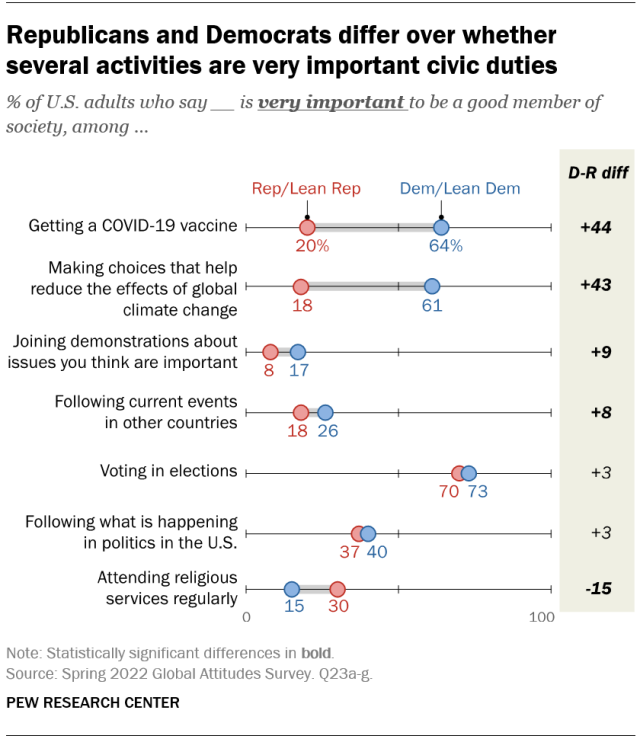
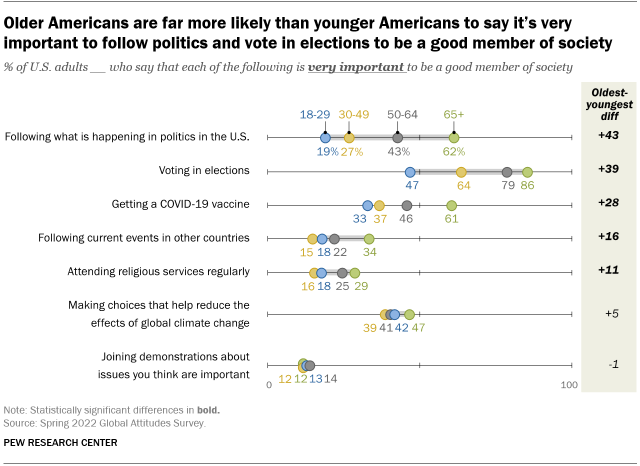
Around seven-in-ten U.S. adults (69%) say it’s very important to vote in elections to be a good member of society – more than say the same about any of the other activities included in a Pew Research Center survey conducted earlier this year. 


Young and old differ on some points.


Monday, June 6, 2022

Religion, Virtue, and Guns

 David French:

It’s now common to see men and women armed to the teeth, open-carrying during anti-lockdown protests and even outside public officials’ homes. This is when the gun is used to menace and intimidate. It’s displayed not as a matter of defense but rather as an open act of defiance. It’s meant to make people uncomfortable. It’s meant to make them feel unsafe.

This transition from defense to defiance can destabilize our democracy. The concept of self-defense is rooted in a high view of human life. In his Second Treatise of Civil Government, John Locke described a “fundamental law of nature” (his description of the “will of God”) that man be “preserved as much as possible” yet “when all cannot be preserved, the safety of the innocent is to be preferred.”

Indeed, scripture makes multiple allowances for self-defense, in both the Old and New Testaments. While I respect Christian pacifism, I simply don’t see it required by the biblical text. My own view is that the refusal to protect innocent life can constitute a grave moral wrong. If a violent man came after my family, and I did not do everything in my power to stop his attack—even if it meant killing him to save my wife and kids—then I would have failed a profound obligation as a husband and father.

Defiance is different. It’s rooted in the will to power. It is designed to implant fear, not to save lives but to exert control. It contradicts a core value of a classically-liberal society, that change comes through courts and the ballot box, not through intimidation and fear.

It’s even more disturbing to see that spirit of armed defiance so closely correlated with the religious right. The decision of Christians to provoke their fellow citizens into feeling palpable, physical fear of armed violence is deliberately malicious and cruel.

If you’ve read me at all, you know that I’m constantly talking about the relationship between rights and responsibilities. If, as Thomas Jefferson wrote in the Declaration of Independence, governments are “instituted among men” to secure our unalienable rights, then it is our responsibility to exercise those rights for a virtuous purpose. Otherwise, our constitutional experiment may fail.


Tuesday, April 26, 2022

Public Virtue

David French at The Dispatch:
Now let’s move to the two sentences from Adams—two sentences that help explain our broken nation and our broken politics. We’ve weathered many of the challenges that Jefferson worried about, including the threat of tyranny. And now we’re facing the crisis that concerned Adams.

Writing eleven years after the ratification of the Constitution, Adams wrote to the officers of the First Brigade of the Third Division of the Militia of Massachusetts to outline the responsibilities of the citizens of the new republic. The letter contains the famous declaration that “our Constitution was made only for a moral and religious People. It is wholly inadequate to the government of any other.” But I’m more interested in the two preceding sentences:
Because We have no Government armed with Power capable of contending with human Passions unbridled by morality and Religion. Avarice, Ambition, Revenge or Galantry, would break the strongest Cords of our Constitution as a Whale goes through a Net.
Put in plain English, this means that when public virtue fails, our constitutional government does not possess the power to preserve itself. Thus, the American experiment depends upon both the government upholding its obligation to preserve liberty and the American people upholding theirs to exercise that liberty towards virtuous purposes.

Saturday, March 26, 2022

Gen Z and the Future of Faith


At the Survey Center on American Life, Daniel A. Cox has a report titled  "Generation Z and the future of faith in America,"
Key Points
Compared with previous generations, Gen Zers report being much less involved in regular religious activities during their childhood. Formative religious experiences that were once common, such as saying grace or attending Sunday school, have become more of the exception than the norm.
In a change from the past, most Americans raised without religion do not find it later in life. Today, nearly two-thirds (65 percent) of Americans who report having no childhood religious affiliation say they still are unaffiliated as adults, rivaling that of established religious traditions.
Religious disaffiliation can strain family relationships and may lead to feelings of loneliness and distrust, especially for those who have left more conservative religious traditions, such as evangelical Protestantism.

Read the PDF.

The story of religious change in America, especially religious disaffiliation, is often cast as the result of independent decisions made by a rising generation living by a different set of values.But new evidence paints a much more complicated picture than the traditional narrative of generationally driven disaffiliation. Young adults today have had entirely different religious and social experiences than previous generations did. The parents of millennials and Generation Z did less to encourage regular participation in formal worship services and model religious behaviors in their children than had previous generations. Many childhood religious activities that were once common, such as saying grace, have become more of the exception than the norm.

We have long known the importance of formative religious experiences in setting the trajectory of faith commitments throughout life. For as long as we have been able to measure religious commitments, childhood religious experiences have strongly predicted adult religiosity. They still do. If someone had robust religious experiences growing up, they are likely to maintain those beliefs and practices into adulthood. Without robust religious experiences to draw on, Americans feel less connected to the traditions and beliefs of their parents’ faith.

There is little evidence to suggest that Americans who have disaffiliated will ever return. First, the age at which Americans choose to give up their families’ religion—most well before they turn 18—suggests that they have not established a deeply rooted commitment to a set of religious beliefs and practices. Disaffiliated Americans express significant skepticism about the societal benefits of religion, even more than those who have never identified with a religious tradition. They also strongly disagree with the majority of religious Americans, who believe in the importance of raising children in a religious faith. Moreover, having children does not appear to affect religious involvement. Unaffiliated parents are not any more likely to be religiously active than those without children, and most are unconvinced that religion serves as an important source of moral instruction.

Religious participation has typically been tightly connected to the timeline of important life events, such as getting married and having children. These events and experiences can serve as crucial opportunities for those who have left their childhood faith to reconnect to a religious community. But declining confidence in organized religion and a growing trend of secular relationships and marriages may make these seminal moments less likely to encourage Americans to return.

These changes have considerable personal and societal consequences. Individually, Americans who report leaving their formative religion report more significant personal hardship than those who were raised—and remain—religious. This is particularly true for Americans who disaffiliate from more conservative religious traditions; 39 percent of Americans raised evangelical Protestant but who no longer identify with the religion say they feel lonely or isolated from the people around them most or all the time. In contrast, only 23 percent of former Catholics say the same.

The decline of religion has implications for American civic and social life as well. Religious Americans are generally more socially and civically active. However, the frequency of religious participation—not one’s religious identity—appears to be the most important factor in determining the level of engagement in other social and civic activities. Americans who regularly attend services are far more engaged in community life than are those who seldom or never attend religious services.

And although higher education has been shown to be strongly associated with an increased propensity toward joining social groups and civic associations, religion still appears to play a significant function. There is evidence that education level and religious involvement both augment participation in community life. College-educated Americans who are religious tend to exhibit the highest levels of civic engagement.

Monday, January 31, 2022

Civic Value of Churches and Faith


Many posts have discussed the role of religion in American life.

Giovanna Dell'Orto. at LAT
Across the U.S., historic urban churches built decades ago to accommodate hundreds or thousands of worshipers have struggled with shrinking flocks and rising preservation costs. Many are finding new ways to use their buildings that let them keep the sacred places viable while serving the neighborhoods they’ve anchored for decades.
In Minneapolis, landmark churches have hosted everything from food pantries and Finnish language classes to tai chi practices and group discussions on reparations.

Elsewhere in the country, they’ve rented space for preschools, bringing in much-needed revenue, and made their buildings available for free to community group gatherings as diverse as nutrition clinics and arts workshops.

Historic religious buildings are not just civic and cultural landmarks but crucial social centers, with noncongregants making up an estimated 90% of the people served, according to Bob Jaeger, president of Partners for Sacred Places. The nonprofit helps religious institutions nationwide make plans and raise money to repurpose their spaces for a different era.
“Congregations have enormous civic value but are often underused,” he said.

Surveys show that the United States is growing more secular, with churchgoing and membership on the decline. Fewer souls in pews mean less money coming in to pay for staffing, maintenance and programs, forcing many smaller congregations to sell their buildings.

The COVID-19 pandemic has exacerbated those problems by further shrinking attendance. It has also heightened the need for food, housing, job and educational ministries among both the faithful and broader communities.

Scott Jaschik at Inside Higher Ed:

Ilana M. Horwitz’s new book focuses on the one in four American high school students who are “raised with religious restraint”—they orient their lives around God and try to behave in ways that they believe will please God. Her book is based on 10 years of survey data and 200 interviews.

She finds that these religious students excel in high school and college. Generally, these students are more likely to graduate from college; boys from lower-middle-class families especially benefit. But girls—especially from middle- and upper-class families—question the value of attending religious colleges and “undermatch” in their choices.

Horwitz shares the results of her work in God, Grades & Graduation: Religion’s Surprising Impact on Academic Success (just published by Oxford University Press). Horwitz is the Fields-Rayant Chair in Contemporary Jewish Life at Tulane University, but her book is primarily (as she explains below) about Christian students. She responded via email to questions about the book.
"... Why do religious adolescents earn better grades in secondary school than their less religious peers? In my book, I argue that schools and churches promote similar ideals—both institutions value kids who abide by the rules and respect authority figures. Intensely religious teens are precisely these types of kids—they are deeply conscientious and cooperative. As it turns out, the very dispositions that teens adopt to please God are also the dispositions that help them earn good grades."


Monday, January 24, 2022

Civic Education and Civic Virtue

 Albert Cheng and Jay Greene at National Affairs:

Civic education does not occur merely within the life of the school; it also occurs in homes, neighborhoods, the marketplace, religious institutions, and any other voluntary association in which individuals gather with others to unite around a common purpose. It is within the context of these communities that people learn to seek the interest of others instead of their own and to work together for their mutual flourishing. It is where they practice virtues like showing kindness, hospitality, and charity to others. It is also where they practice having the courage to defend their convictions or compromising to build coalitions with those whose views may not fully align with their own. These and other "habits of the heart," as the late sociologist Robert Bellah and his colleagues articulated nearly 40 years ago, are cultivated in all spheres of civil society. Schools are but one of the many institutions where this kind of formation happens.

Civic education, then, requires a kind of knowledge. But not merely civic knowledge, narrowly understood as knowledge of history and government institutions; it also requires knowledge of ultimate things — of truth, goodness, and beauty — so that a flourishing polis can be discerned.

Civic education likewise requires training in a kind of skill. But not merely civic skill, narrowly understood as possessing competencies in democratic procedures like voting, petitioning, assembling, or staying informed; it also requires cultivation of habits that give rise to the practices of good citizens. In sum, civic education requires the cultivation of civic virtue for making sense of civic knowledge and guiding the application of civic skills.


Saturday, January 15, 2022

Giving and Volunteering During the Pandemic

 Jeffrey M. Jones at Gallup:

Eighty-one percent of Americans say they donated money to a religious or other charitable organization in the past year, and 56% volunteered time to such an organization. After dipping in April 2020 during the early stages of the pandemic, charitable donations have rebounded and are essentially back to the level measured in 2013 and 2017 surveys.

Volunteer activity also dropped in 2020 but, in contrast to charitable giving, remains lower than it was in pre-pandemic surveys. While lower today than in recent years, the rate of volunteering has been at its current level in the past, most notably during the Great Recession.
...

With respect to donations, the bounce back from 2020 appears to be confined mostly to secular giving. Forty-four percent of Americans say they gave money to religious organizations in the past year, unchanged from 2020, which was the lowest in Gallup's trend by a significant margin.

Meanwhile, 74% say they gave money to another charitable cause, up from 64% a year ago and essentially the same as the 75% who did so in 2013 and 2017.

Over time, as formal church membership has declined, so too have donations to religious organizations. The 44% of U.S. adults donating to a religious organization nearly matches the 47% who belong to a church, synagogue, mosque or temple.


Wednesday, November 3, 2021

A Force for Good?

From the Public Religion Research Institute:
About three in four Americans (74%) agree that America has always been a force for good in the world, including 19% who completely agree with this idea and a majority (55%) who mostly agree. One in four (24%) disagree, including 17% who mostly disagree and 7% who completely disagree. In 2013, slightly more Americans (79%) believed their country has always been a force for good in the world.

Republicans (92%) are more likely than independents (72%) and Democrats (67%) to agree with the idea that America has always been a force for good in the world. While there have not been significant changes among Republicans (90%) and independents (77%) since 2013, Democrats have become seven percentage points less likely to agree (67% today vs. 74% in 2013). Notably, nearly all Republicans who trust Fox News (94%) and far-right media outlets (96%) as their main sources of information agree with this idea.[1]

Overwhelming majorities of white Christian groups agree with this idea, including nearly nine in ten white evangelical Protestants (88%), white mainline (non-evangelical) Protestants (88%), and white Catholics (85%). Two-thirds or more of Hispanic Catholics (73%), other Christians (71%), Black Protestants (69%), and members of non-Christian religions (66%) also agree that America has always been a force for good in the world.[2] Religiously unaffiliated Americans (58%) are the least likely to hold this belief.