Search This Blog

Showing posts with label volunteering. Show all posts

Wednesday, March 11, 2026

Service and Career Readiness


To repeat the obvious: correlation is not causation.  Perhaps service does improve career readiness.  But there is a very plausible alternative explanation for these correlations.  Bright, ambitious kids know that service looks good on a college application or a resume.  That is, they serve because they are primed to succeed, not the other way around.

From Gallup:
A nationally representative survey of more than 3,000 U.S. youth ages 12-25, conducted by The Allstate Foundation and Gallup, finds that youth service is linked to positive outcomes in the areas of career readiness, connection and resilience.

Eighty-two percent of youth say they have participated in at least some form of service. Youth who serve report feeling prepared for a future career, connected to their community and able to handle whatever comes their way, with the greatest benefits seen among those who engage deeply or take on leadership roles.

The study also outlines practical steps for expanding opportunities and impact. The findings are based on a Gallup Panel web study conducted Nov. 17–Dec. 1, 2025, with a margin of error of ±2.5 percentage points.

From the report:

  • Engaging in service is linked to greater reported benefits in the areas of career readiness, connection and resilience. Key examples include:
  • Career readiness: Half of young people (52%) report that service activities had a somewhat (38%) or very (14%) positive impact on feeling prepared for a future career.
  • Connection: Seventy-nine percent of young people report that service activities had a somewhat (47%) or very (32%) positive impact on feeling connected to their community.
  • Resilience: Youth with service experience are more likely to say they can handle whatever comes their way (66% vs. 52%).


Friday, February 6, 2026

Giving and Volunteering

Many posts have discussed volunteering and civic virtue.

 Megan Brenan at Gallup:

Majorities of Americans continue to support charitable causes, with 76% reporting that they gave money to a religious or other nonprofit organization in the past year and 63% saying they volunteered their time to such an organization.

Americans’ current levels of charitable activities are somewhat different from what they were in 2021 during the COVID-19 pandemic. Financial contributions have eased slightly, registering five percentage points lower than in 2021, but volunteering is seven points higher now.

Meanwhile, a steady 17% of U.S. adults say they gave blood in the past 12 months.

...

In recent years, as U.S. adults have become less likely to identify with a religion, they have also become less likely to report that they donate money to a religious group. The 41% of Americans saying in 2025 that they donated to a religious organization is the lowest to date, down 21 points from the initial measurement in 2001, including three points since 2021. At the same time, volunteering for a religious organization has been less variable, and it has ticked up four points to 39% in the latest poll, approaching its pre-pandemic level.


Sunday, March 16, 2025

College-Educated Parents and Civic Life


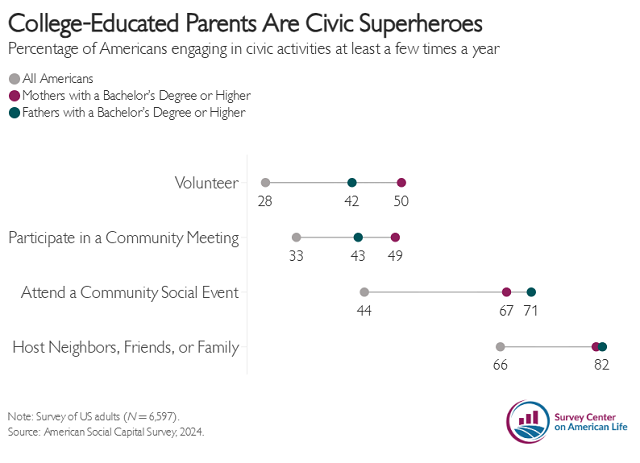
Not all Americans have been as quick to abandon public spaces and communal activities. A recent report from the Survey Center on American Life found that college-educated parents remain very involved in their communities, spending much more time engaged in civic activities than other Americans. The report, Disconnected: The Growing Class Divide in American Civic Life, documents a range of activities that college-educated mothers engage in at higher rates than other Americans.

...

Becoming a parent does not instantly make someone a more caring or empathetic person. In fact, some research suggests the opposite. But for engaged caregivers, the experience of raising children fundamentally alters the incentives for being community-minded. Parents are incentivized to get to know their neighbors, take care of local parks and playgrounds, and support local schools—and they have shown a tendency to act on these incentives. They take more of an interest in local affairs and participate more regularly in community events and activities.


Tuesday, March 11, 2025

What Would Tocqueville Say About Asssociations Today?

Many posts have discussed volunteering and civic virtue.

Daniel Stid at AEI:

Tocqueville’s concern about the government’s domestication of nonprofits would no doubt increase after learning how many of them rely on public funding from different levels of government (over and above the subsidy they get via the tax code). A recent Urban Institute survey found that “in 2022, 68 percent of nonprofits received government grants or contracts and 29 percent of nonprofits’ revenue came from government agencies.” In cities like New York, many nonprofits supporting individuals and families needing intensive social services have come to rely on government grants and contracts for most of their budgets. Tocqueville would be hard-pressed to regard these entities as associations forming democratic citizens. Rather, he would see them as vendors and appendages of the government that inexorably find themselves beholden to their paymasters.

Tocqueville’s doubts about nonprofits’ autonomy and ability to help shape citizens would spike further given the limited role that these organizations play in most Americans’ day-to-day lives. Today, full-time professionals and paid staff, not volunteers and concerned citizens, form the rank and file of most major nonprofits. What was once fittingly called the voluntary sector is now, for most of those who participate regularly in its activities, better described as their place of employment. Indeed, recent appeals by nonprofit sector advocates to government policymakers have come to place the primary emphasis not on the aggregate impact of nonprofits’ missions but rather on the size and economic importance of the nonprofit workforce — now nearly 10% of all private sector jobs in the country.

As Americans’ involvement with associations has diminished markedly, so, in turn, has the power of these associations to help form citizens capable of sustaining democracy in America. In “Bowling Alone,” Robert Putnam famously traced Americans’ declining demand for civic engagement in the second half of the 20th century — and the collapse of community it produced. The first quarter of this century has seen these patterns of civic disengagement continue to accelerate. The recent landmark report of the Generosity Commission, for example, highlighted how rates of everyday charitable giving have trended downward. Nearly two-thirds of American households donated to charity in 2008. By 2018, fewer than half did.

In “Diminished Democracy,” Theda Skocpol illuminated less familiar but equally important shifts and shortcomings in the supply of civil associations. She documented the steady demise, starting in the 1960s, of the national, federated, cross-class and volunteer-driven associations that had long structured Americans’ civic lives. A different set of associations arose in their stead — issue-driven advocacy and activist groups led by professional staff in Washington, D.C. In these entities, paid staff managed the work while the participation of ostensible “members,” i.e., those on mailing lists for fundraising solicitations, remained largely passive. These new advocacy groups did achieve some victories, but Skocpol concluded that “vital links in the nations’ associational life have frayed, and we need to find creative ways to repair those links if America is to avoid becoming a country of managers and manipulated spectators rather than a national community of fellow democratic citizens.”

Monday, December 30, 2024

Jimmy Carter and the Post-Presidency


John S. Gardner at The Guardian:
The Founders never planned for a post-Presidency. Or if they did, they thought of Cincinnatus returning to the plow, his civic duties done, as President Washington retired to Mount Vernon in 1797 when his term ended.

In Washington’s final illness, doctors applied leeches. Modern medicine –including the innovative and successful treatment for brain cancer that Jimmy Carter received in 2015 – has invented a post-Presidency, and the question is how to occupy it.

Truman and Eisenhower resumed private lives, Kennedy assassinated, LBJ left office in poor health, Nixon resigned, Ford wrote memoirs and dabbled in the corporate world. Just as Carter reinvented the Vice Presidency by giving large roles and a West Wing office to Walter Mondale, Carter had a chance to reinvent the post-Presidency, and he did. The Carter Center, the focus of his efforts, served as a platform for his many interests, including human rights, democracy promotion, conflict resolution, and health – all concentrated around the “alleviation of human suffering”.

Most Americans, on right and left, believe that Jimmy Carter used this influence overwhelmingly for good. If an enduring image of work for Ronald Reagan is cutting brush on his ranch, that for Carter is a few extra nails in his mouth as he strikes a hammer to another nail on one of his numerous house building projects for Habitat for Humanity (an organization founded in nearby Americus, Georgia, by a longtime friend of Carter’s), which eventually garnered the name “Jimmy Carter Work Project”. There have been 36 of them over the years, many abroad, including in Mexico (Carter read the Bible in Spanish as part of his daily devotions), with over 4,000 houses built and over 100,000 volunteers.

Wednesday, December 25, 2024

Charitable Giving in USA and OECD Countries

Many posts have discussed charity.

 From Gallup:

The Data: Charitable giving is down in 2024 in the U.S. and across many other wealthy economies that make up the Organisation for Economic Co-Operation and Development (OECD).

United States: A majority of Americans (56%) say they have donated money to a charity in the past month, which is down slightly from their level of giving in recent years but still outpaces the OECD median of 39%. Charitable giving in the U.S. has been higher than the OECD average for nearly two decades.

Multiple Line Chart: Charitable giving.

Sunday, August 25, 2024

College-Educated Parents and Civic Life

Many posts have discussed economic and educational inequality. The effects of inequality reach many corners of American life. 

 Daniel A. Cox and Sam Pressler at The Survey Center on American Life

One group stands out for its relatively high levels of civic effort and community care: college-educated parents. Fully half (50 percent) of college-educated mothers and more than four in 10 (42 percent) college-educated fathers report volunteering in their community at least a few times a year. Nearly three in 10 (27 percent) college-educated mothers volunteer at least once or twice a month.

More than two-thirds of mothers and fathers with college degrees report they attend community social events at least a few times a year. Close to half (48 percent) of college-educated mothers and a slightly smaller share (43 percent) of college-educated fathers participate in community meetings at least a few times a year. The educational gap in hosting neighbors, family, and friends is somewhat smaller but still significant. Half of college-educated mothers (50 percent) and fathers (48 percent) report entertaining guests at their home at least once or twice a month.


Thursday, February 15, 2024

Hanging Out

Derek Thompson at The Atlantic:
To get a crystal-clear picture of how hanging out has dissipated in America, I spent the past week spelunking inside the American Time Use Survey, an annual government poll of how people in the U.S. spend their days. Economists at ATUS carefully track time spent socializing—meaning face-to-face interaction—for more than a dozen demographics.

Broadly, real-world socializing has declined for both men and women, for all ages, for all ethnicities, and for all levels of income and education. Although COVID-19 clearly increased time alone, these trends predate the pandemic. The steepest declines have been among young people, poor people, and Black Americans. Women and 20-somethings enjoy the most social time in a given week, and low-income, middle-aged, unmarried men seem to get together the least. For most groups, the decline was staggered before accelerating after 2015. Beyond in-person hanging, several other forms of socialization have declined by about a third in the past 20 years, including the share of Americans who volunteer and the share of Americans who attend religious services over the weekend.
...

The evidence that young people have replaced friend time with phone time is strong. As Twenge wrote in her book Generations, it’s not just that teens overall seem to have funneled their social lives into their smartphones. Even more telling, the groups with the largest increase in phone use, such as liberal 12th-grade girls, also saw the largest declines in hanging out with friends, strongly suggesting a direct relationship. For those who don’t accept that correlative evidence, we also have a 2019 randomized experiment from NYU and Stanford researchers who found that paying people to deactivate Facebook increased the time they spent socializing with friends. (It also increased the time they watch TV.)

Sunday, December 3, 2023

Civic Opportunity

de Vries, M., Kim, J.Y. & Han, H. The unequal landscape of civic opportunity in America. Nat Hum Behav (2023). https://doi-org.ccl.idm.oclc.org/10.1038/s41562-023-01743-1

The hollowing of civil society has threatened effective implementation of scientific solutions to pressing public challenges—which often depend on cultivating pro-social orientations commonly studied under the broad umbrella of social capital. Although robust research has studied the constituent components of social capital from the demand side (that is, the orientations people need for collective life in pluralistic societies, such as trust, cohesion and connectedness), the same precision has not been brought to the supply side. Here we define the concept of civic opportunity—opportunities people have to encounter civic experiences necessary for developing such orientations—and harness data science to map it across America. We demonstrate that civic opportunity is more highly correlated with pro-social outcomes such as mutual aid than other measures, but is unequally distributed, and its sources are underrepresented in the public dialogue. Our findings suggest greater attention to this fundamentally uneven landscape of civic opportunity.

Saturday, August 26, 2023

Friendship and Civic Life

 Daniel A. Cox at the Survey Center on American Life:

Friendship predicts community involvement and civic participation. Sixty percent of Americans with at least six close friends say they have attended a local event or community meeting at least a few times in the past 12 months compared to only 33 percent of those with no close friends. Whether it’s going to the library, eating at a restaurant, or spending time at a bar, Americans with larger friend groups do all these things more often. Having more close friends also increases one's likelihood of talking to strangers. Seventy percent of Americans with at least six close friends report having had a conversation with a stranger at least a few times in the last 12 months. Americans with more close friends volunteer in their communities more often too.


Sunday, July 9, 2023

Houses of Worship Are Unique in Civil Society

Jessica Grose at NYT:
I asked every sociologist I interviewed whether communities created around secular activities outside of houses of worship could give the same level of wraparound support that churches, temples and mosques are able to offer. Nearly across the board, the answer was no.

Phil Zuckerman, a professor of sociology and secular studies at Pitzer College, put it this way: “I can go play soccer on a Sunday morning and hang out with people from different races and different class backgrounds, and we can bond. But I’m not doing that with my grandparents and my grandchildren.” A soccer team can’t provide spiritual solace in the face of death, it probably doesn’t have a weekly charitable call and there’s no sense of connection to a heritage that goes back generations. You can get bits and pieces of these disparate qualities elsewhere, he said, but there’s no “one-stop shop” — at least not right now.

Jeffrey M Jones at Gallup:

U.S. church attendance has shown a small but noticeable decline compared with what it was before the COVID-19 pandemic. In the four years before the pandemic, 2016 through 2019, an average of 34% of U.S. adults said they had attended church, synagogue, mosque or temple in the past seven days. From 2020 to the present, the average has been 30%, including a 31% reading in a May 1-24 survey.

The recent church attendance levels are about 10 percentage points lower than what Gallup measured in 2012 and most prior years.

David French at NYT:

Evangelicals are a particularly illustrative case. About half of self-identified evangelicals now attend church monthly or less often. They have religious zeal, but they lack religious community. So they find their band of brothers and sisters in the Trump movement. Even among actual churchgoing evangelicals, political alignment is often so important that it’s hard to feel a true sense of belonging unless you’re ideologically united with the people in the pews around you.

Thursday, February 16, 2023

Citizen Science and the Great Backyard Bird Count


Julia Rubin at AP:
It’s a given that when the Great Backyard Bird Count begins Friday, Steve and Janet Kistler of Hart County, Kentucky, will be joining in. They’ve done so every year since the now-global tradition began 25 years ago.

For Moira Dalibor, a middle-school math teacher a couple hours away in Lexington, this will be the first count. She’s leading a group of students and parents to an arboretum for an exercise in data-gathering.

They’re expected to be among hundreds of thousands of people around the world counting and recording over four days. Last year, about 385,000 people from 192 countries took part in the Great Backyard Bird Count, or GBBC.

In India, which had the highest participation outside the U.S. last year, tens of thousands of people submitted bird checklists — a 28% increase from 2021.

This global data goes into the eBird database used by scientists for research on bird populations, which have declined sharply overall in past decades. It’s part of a rise in “citizen science” projects in which volunteers collect data about the natural world for use by researchers.


Saturday, February 19, 2022

Youth Civic Engagement

From the Brennan Center:
Civic engage­ment is a key indic­ator of adult­hood. Young adults respond to the social and polit­ical issues of the day in a vari­ety of ways. After the police killings of George Floyd and Breonna Taylor in 2020, young people demon­strated against racial injustice in more than 10,000 peace­ful protests around the coun­try.

foot­note1_g6xcuor1 That fall saw record numbers of youth turn out for the pres­id­en­tial elec­tion; half of eligible voters ages 18–29 parti­cip­ated, compared with 39 percent in 2016. foot­note2_3ycctnz2 Climate change like­wise cata­lyzed young people, as nearly 30 percent of Gener­a­tion Z and Millen­ni­als made dona­tions, contac­ted public offi­cials, volun­teered, or protested, surpass­ing Gener­a­tion X and Baby Boomers. foot­note3_pisb­s1c3 Young people are commonly assumed to be disen­gaged, disil­lu­sioned, and unin­ter­ested in civic life. These trends chal­lenge that propos­i­tion.

Research­ers have consist­ently found that early civic engage­ment is mutu­ally bene­fi­cial to young people and to the communit­ies in which they parti­cip­ate. For example, devel­op­mental psycho­lo­gist Parissa Ballard and colleagues found that early civic engage­ment is asso­ci­ated with posit­ive health outcomes later in life. Voting, volun­teer­ing, and activ­ism in young adult­hood were related to improved mental health, greater educa­tional attain­ment, and higher personal and house­hold incomes. foot­note4_n49aljr4 Beyond these indi­vidual bene­fits, young adults are import­ant contrib­ut­ors to their local communit­ies. Tufts University’s Center for Inform­a­tion and Research on Civic Learn­ing and Engage­ment (CIRCLE) projec­ted that in the 2020 elec­tion cycle, young adults would play a partic­u­larly import­ant role in the pres­id­en­tial battle­ground states Wiscon­sin, North Caro­lina, and Flor­ida, as well as in Senate races in Color­ado, Maine, and Montana and congres­sional races in Iowa’s 1st District, Maine’s 2nd, and Geor­gi­a’s 7th. foot­note5_9alq4i75 The youth vote proved decis­ive in several states where the margin of victory was less than 50,000 votes, includ­ing Arizona, Geor­gia, and Pennsylvania. foot­note6_um60jqh6

National legis­la­tion and educa­tional policy reflect the import­ance of prepar­ing young people to become engaged and parti­cip­at­ory members of soci­ety. Recog­niz­ing the mutual bene­fits of community service for the advance­ment of communit­ies and the well-being of young people, Congress passed the National and Community Service Act of 1990 and the National and Community Service Trust Act of 1993. The first law created the Commis­sion on National and Community Service to support school-based service-learn­ing programs, volun­teer and service programs in higher educa­tion, youth corps, and national service models; the second merged the commis­sion with the National Civil­ian Community Corps to estab­lish the Corpor­a­tion for National and Community Service, to support volun­teer and service oppor­tun­it­ies for all Amer­ic­ans. In 2009 Congress passed the Edward M. Kennedy Serve Amer­ica Act, reau­thor­iz­ing and expand­ing national and community service legis­la­tion to support lifelong volun­teer­ism and community service. Through these acts, Congress has emphas­ized the need for civic engage­ment, which helps youth become informed citizens as well as active members of their communit­ies through­out their life­time.

School curricula rein­force the expect­a­tion that young people will become engaged citizens. Accord­ing to the Center for Amer­ican Progress, 40 states and the District of Columbia require a civics course for high school gradu­ation, and 16 states require a civics exam to gradu­ate. However, only Mary­land and the District of Columbia require community service for all high school gradu­ates. foot­note7_eslmnjr7

1 Armed Conflict Loca­tion & Event Data Project (here­in­after ACLED), Demon­stra­tions and Polit­ical Viol­ence in Amer­ica: New Data for Summer 2020, Septem­ber 2020, https://acled­data.com/2020/09/03/demon­stra­tions-polit­ical-viol­ence-in-amer­ica-new-data-for-summer-2020/.
foot­note2_3ycctnz
2
 Center for Inform­a­tion and Research on Civic Learn­ing and Engage­ment (here­in­after CIRCLE), “Half of Youth Voted in 2020, an 11-Point Increase from 2016,” April 29, 2021, https://circle.tufts.edu/latest-research/half-youth-voted-2020–11-point-increase-2016.
foot­note3_pisb­s1c
3
 Alec Tyson, Brian Kennedy, and Cary Funk, “Gen Z, Millen­ni­als Stand Out for Climate Change Activ­ism, Social Media Engage­ment with Issue, ” Pew Research Center, May 26, 2021, https://www.pewre­search.org/science/2021/05/26/gen-z-millen­ni­als-stand-out-for-climate-change-activ­ism-social-media-engage­ment-with-issue/.
foot­note4_n49aljr
4
 Parissa J. Ballard, Lind­say T. Hoyt, and Mark C. Pachucki, “Impacts of Adoles­cent and Young Adult Civic Engage­ment on Health and Socioeco­nomic Status in Adult­hood, ” Child Devel­op­ment 90, no. 4 (2019): 1138–54, https://doi.org/10.1111/cdev.12998.
foot­note5_9alq4i7
5
 CIRCLE, “Youth Elect­oral Signi­fic­ance Index (YESI), ” last updated August 18, 2020, https://circle.tufts.edu/yesi2020.
foot­note6_um60jqh
6
 CIRCLE, “Elec­tion Week 2020: Young People Increase Turnout, Lead Biden to Victory, ” Novem­ber 25, 2020, https://circle.tufts.edu/latest-research/elec­tion-week-2020#young-voters-and-youth-of-color-powered-biden-victory.
foot­note7_eslmnjr
7
 Sarah Shapiro and Cath­er­ine Brown, “The State of Civics Educa­tion,

Saturday, January 15, 2022

Giving and Volunteering During the Pandemic

 Jeffrey M. Jones at Gallup:

Eighty-one percent of Americans say they donated money to a religious or other charitable organization in the past year, and 56% volunteered time to such an organization. After dipping in April 2020 during the early stages of the pandemic, charitable donations have rebounded and are essentially back to the level measured in 2013 and 2017 surveys.

Volunteer activity also dropped in 2020 but, in contrast to charitable giving, remains lower than it was in pre-pandemic surveys. While lower today than in recent years, the rate of volunteering has been at its current level in the past, most notably during the Great Recession.
...

With respect to donations, the bounce back from 2020 appears to be confined mostly to secular giving. Forty-four percent of Americans say they gave money to religious organizations in the past year, unchanged from 2020, which was the lowest in Gallup's trend by a significant margin.

Meanwhile, 74% say they gave money to another charitable cause, up from 64% a year ago and essentially the same as the 75% who did so in 2013 and 2017.

Over time, as formal church membership has declined, so too have donations to religious organizations. The 44% of U.S. adults donating to a religious organization nearly matches the 47% who belong to a church, synagogue, mosque or temple.


Tuesday, March 31, 2020

Civic Virtue and the 1918-19 Pandemic

Michael Apfeldorf at the Library of Congress.
In 1918, the United States faced one of the worst public health challenges in its history. An influenza pandemic – also known as the Spanish flu – infected an estimated 500 million people worldwide, killing 20-50 million people, including hundreds of thousands of Americans.
In response to that crisis, the American Red Cross mobilized countless Americans to assist their fellow citizens. Historical primary sources provide examples of civic virtue–that is, of citizens dedicating themselves to the common welfare, even at the cost of their own interests.
Precautions taken in Seattle, Wash., during the Spanish Influenza Epidemic would not permit anyone to ride on the street cars without wearing a mask. 260,000 of these were made by the Seattle Chapter of the Red Cross which consisted of 120 workers, in three days.

“Need Red Cross Workers to Make More Flu Masks,” The Seattle star., October 26, 1918

The Public Health Nurse She answers humanity’s call : Your Red Cross membership makes her work possible
...Some possible sources include:


Thursday, January 16, 2020

Youth, Politics, Protest, and Community Service

Samuel J. Abrams at RealClearEducation writes that students have only modest interest in politics and protest.
Six decades of data from UCLA’s Higher Education Research Institute (HERI) supports this line of thinking.
HERI has regularly presented a list of “objectives” to be achieved in college to incoming students who were asked if they were “essential” or “very important.” When asked about “keeping up to date with political affairs,” for instance, 57% of students on average thought this was essential or very important throughout the 1960s. This figure dropped significantly in the 1970s to 46% and a few points lower to an average of 43% in the 1980s.
By the 1990s, interest in politics waned even more to 37% and from 2000 to the 2015, the number slipped a few points more to 35% – a figure 20 points lower than the 1960s. By 2015, the figure ticked up a bit with the generational change on campus, and by 2017, the figure climbed to 48%....
HERI went further and asked the same students about performing volunteer or community service work. This is, of course, a different way to have political influence and the data show that there has been a steady increase from 1990, when only 17% believed that there was a “very good chance’ that they will engage in service, compared to 37% in 2017 –an increase of almost 118%.
Finally, incoming students were also asked about whether they intended to “participate in student protests or demonstrations” between 1967 and 2015, and that number has remained low over the past five decades. Only about 6% of incoming students on average said that there is a “very good chance” that they will protest. This figure vacillated between about 3.5% and 8% – but never crossed the 9% line, revealing that incoming college students are not inclined to be as radically engaged as the media often portrays them – and they weren’t so inclined even in the 1960s when the U.S. was going through massive socio-political change. Moreover, these protest statistics have barely changed even when other measures of political and social engagement have significantly shifted over time.

Tuesday, December 3, 2019

Giving Tuesday

Jessie Li at Axios:
Most Americans have donated their time and their money to social causes and charities in the last year, according to an Axios-SurveyMonkey poll on philanthropy that breaks down the most popular charitable giving causes.
The bottom line: Education tops the list of causes Americans have supported, followed by human services and health — but they give less to the arts and international affairs.

The big picture: Education is the top cause for both millennials (46%) and Gen X (42%). Gen Z supports health causes most (47%), while Boomers support religion (41%) more than other causes.
International affairs ranks last in giving for all age groups, with only 6% of Americans saying that they’ve donated to related causes in the last 12 months.
A June report from Giving USA:
Amid a complex climate for charitable giving, American individuals, bequests, foundations and corporations gave an estimated $427.71 billion to U.S. charities in 2018, according to Giving USA 2019: The Annual Report on Philanthropy for theYear 2018.
Total charitable giving rose 0.7% measured in current dollars over the revised total of $424.74 billion contributed in 2017. Adjusted for inflation, total giving declined 1.7%. (Please see below for a more detailed breakdown of the numbers for each philanthropic source and sector.)
...
A number of competing factors in the economic and public policy environments may have affected donors’ decisions in 2018, shifting some previous giving patterns. Many economic variables that shape giving, such as personal income, had relatively strong growth, while the stock market decline in late 2018 may have had a dampening effect. The policy environment also likely influenced some donors’ behavior. One important shift in the 2018 giving landscape is the drop in the number of individuals and households who itemize various types of deductions on their tax returns. This shift came in response to the federal tax policy change that doubled the standard deduction. More than 45 million households itemized deductions in 2016. Numerous studies suggest that number may have dropped to approximately 16 to 20 million households in 2018, reducing an incentive for charitable giving.

Wednesday, July 17, 2019

Religion: "Nothing in Particular"


Ryan Burge at Religion News Service:
The 2016 Cooperative Congressional Election Study asked respondents if they had engaged in one of five activities: attended a local political meeting, put up a political yard sign, donated money to a candidate/campaign, volunteered for a political campaign or given blood.

Guess which group was the least likely to check any of those boxes?
The “nothing in particulars.”
According to the CCES 2018, nearly two-thirds of the “nothing in particulars” had participated in none of the five activities in the past 12 months. That was the highest of any of the groups in the survey.
Education, rather than religion, might play a role. It is possible that lower levels of education may account for lower levels of social capital and civic involvement.
However, at each level of education, the “nothing in particular” group is less likely to engage in activities than the American public at large.
 In sum, we have a group that currently comprises 20%  of all Americans, and is growing at an unbelievably rapid pace. This group has the lowest level of education of any religious group, and “nothing in particulars” are less likely to engage in political or social activity than the average American.
As a social scientist, I find this represents a troubling confluence of factors.
By all measures, “nothing in particulars” appear to be a growing segment of society that is “checked out.” They don’t obtain high levels of education, they don’t get involved in the political process and they don’t affiliate with a religious group. In addition, they are three times more likely to say their political partisanship is “other” as well. They are adrift in modern society, refusing to be labeled by a religious group or a political party.

Saturday, July 6, 2019

What Makes a Good Citizen?

John Gramlich at Pew:

In a Pew Research Center survey in early 2018, around three-quarters of Americans (74%) said voting in elections was very important to what it means to be a good citizen, and around seven-in-ten said the same about paying taxes (71%) and always following the law (69%). But Democrats and Republicans – as well as younger and older adults – didn’t see eye to eye on all the traits and behaviors associated with good citizenship.
In addition to voting, paying taxes and following the law, a majority of Americans said several other traits were very important to good citizenship, including serving on a jury if called (61%); respecting the opinions of others who disagree (61%); and participating in the U.S. census every decade (60%). (The survey was conducted before the Commerce Department announced it would add a question about citizenship to the 2020 census – a decision blocked by the Supreme Court last week.)
Smaller shares said it was very important to good citizenship for Americans to volunteer to help others (52%), know the Pledge of Allegiance (50%), follow what happens in government and politics (49%) and protest when government actions are believed to be wrong (45%).
And although there will be plenty of them out on July Fourth, displaying the American flag ranked at the bottom of the list: A little over a third of U.S. adults (36%) viewed this as very important to good citizenship, though an additional 26% said it was somewhat important.

Thursday, February 28, 2019

Demographic Difference on Civic Participation

Nearly six-in-ten Americans (57%) participate in some type of community group or organization, including about one-in-ten (11%) who say they participate in four or more community groups, according to a new analysis of data from a December 2017 Pew Research Center survey.
...
 Generally, adults who are better educated and wealthier are more likely to be involved in some community or other group. A majority of college graduates are active in at least one community group, while only half of those with a high school education say the same (70% vs. 48%). And two-thirds of those who have a household income of at least $75,000 say they are active in at least one community group, compared with 47% of those with a household income of $30,000 or less.

There also are some differences along age and racial/ethnic lines. Notably, adults who have reached retirement age are more likely to be involved – two-thirds of Americans ages 65 and older say they participate in at least one community organization, compared with 55% of younger adults. And blacks (62%) and whites (59%) are more likely than Hispanics (49%) to say they are active in at least one community group.
Among religious groups, about six-in-ten Protestants (61%) say they participate in at least one group, with 12% saying they are active in four or more organizations. And about seven-in-ten Jews (72%) say they participate in at least one community group or organization, including a quarter (24%) who participate in four or more. By comparison, fewer Catholics (53%) and religiously unaffiliated adults (51%) say they participate in one or more community groups