Search This Blog

Showing posts with label employment. Show all posts

Monday, September 7, 2026

Thermostatic Opinion on Labor Unions

Many posts have discussed labor unions.

 Lydia Saad at Gallup:

Nearly half of Americans (47%) want labor unions in the U.S. to have more influence than they do today, a record high in the past quarter century and roughly double the 23% who want unions to have less influence. Another 26% want unions’ influence to remain the same.

The share wanting greater union influence is up four percentage points from 2023 after rising almost continuously from a record-low 25% in 2009. Over the same period, the percentage wanting unions to have less influence has fallen from 42% to a record-low 23%.


Wednesday, March 11, 2026

Service and Career Readiness


To repeat the obvious: correlation is not causation.  Perhaps service does improve career readiness.  But there is a very plausible alternative explanation for these correlations.  Bright, ambitious kids know that service looks good on a college application or a resume.  That is, they serve because they are primed to succeed, not the other way around.

From Gallup:
A nationally representative survey of more than 3,000 U.S. youth ages 12-25, conducted by The Allstate Foundation and Gallup, finds that youth service is linked to positive outcomes in the areas of career readiness, connection and resilience.

Eighty-two percent of youth say they have participated in at least some form of service. Youth who serve report feeling prepared for a future career, connected to their community and able to handle whatever comes their way, with the greatest benefits seen among those who engage deeply or take on leadership roles.

The study also outlines practical steps for expanding opportunities and impact. The findings are based on a Gallup Panel web study conducted Nov. 17–Dec. 1, 2025, with a margin of error of ±2.5 percentage points.

From the report:

  • Engaging in service is linked to greater reported benefits in the areas of career readiness, connection and resilience. Key examples include:
  • Career readiness: Half of young people (52%) report that service activities had a somewhat (38%) or very (14%) positive impact on feeling prepared for a future career.
  • Connection: Seventy-nine percent of young people report that service activities had a somewhat (47%) or very (32%) positive impact on feeling connected to their community.
  • Resilience: Youth with service experience are more likely to say they can handle whatever comes their way (66% vs. 52%).


Sunday, September 14, 2025

The Economic Value of College

    The share of Americans who say college is "very important" plummeted over the past decade, new Gallup polling finds.

    Why it matters: College may not live up to the American Dream that it promised in the past, and there are other pathways for success becoming more appealing for Gen Z, but in terms of lifetime earnings, a college degree is actually still incredibly important.

    The big picture: There are plenty of reasons for the decline in perceived value among Americans.School is expensive, student loan debt is often onerous and job security for those with degrees has diminished— even more so with the advent of AI. Plus, at the moment new graduates are seeing higher unemployment rates.
    There's also growing interest and appeal for young adults in the skilled trades — becoming plumbers, electricians, etc. — especially as AI appears to threaten white collar work.

    Between the lines: There's also been loud criticism, particularly from conservatives, over the political leanings of universities, criticized as "elitist" "woke" "leftist," etc.Yet both Democrats and Republicans express far less support for higher education than they did more than a decade ago.

    By the numbers: In 2013, 68% of Republicans said a college education was very important; this year that number fell to 20%, per Gallup.There's an even split between Republicans who say it's "not too important" (39%) and those who say it's "fairly important" (39%).Democrats went from 83% who said college was "very important" to 42%. Most, however, describe college as "fairly important."

    Where it stands: College grads earn more than twice what high-school graduates make.The median income in a household headed by someone with at least a bachelor's degree was $132,700 last year — that's more than double the $58,410 median income of a household led by a high-school grad, according to Census income data released last week.

    And earnings for college-led households have pulled away from the pack — rising more than 6% over the past two decades, compared with a 3% increase for high school graduates.


Thursday, September 4, 2025

Tariffs Harm Manufacturing Employment

Many posts have dealt with tariffs and trade.

Terry Lane at Investopedia:

One benefit of U.S. tariffs on foreign imports is that they are supposed to spur an increase in domestic manufacturing. So far, tariffs seem to be having the opposite effect.

A closely followed survey of manufacturers indicated that the sector contracted for the sixth straight month in August, despite some signs of improvement. However, the data also showed that manufacturers struggle to handle the impact of tariffs while contending with higher prices for materials and lower spending from cautious buyers.

The Institute of Supply Management (ISM) manufacturing sector Purchasing Managers’ Index (PMI) improved to 48.7 in August, but still fell short of the 50 mark that indicates growth.1 The data showed that high input prices and elevated supply pressures from tariffs helped to wipe out improvements in new orders and employment levels.

“Uncertainty around tariff policy is limiting activity,” wrote Wells Fargo economists Shannon Grein and Tim Quinlan.2 “While the higher costs associated with tariffs are a challenge, the uncertainty around where tariffs ultimately land is likely more so limiting current activity today.”

Tuesday, August 5, 2025

Employment Class Divide

 Many posts have discussed economic and educational inequality. The effects of inequality reach many corners of American life.

Emily Peck at Axios:

College-educated women, particularly mothers, triumphed in the work force in recent years; for those without a degree, the story is less rosy.

Why it matters: The difference is likely about job quality — women with degrees can land positions with paid leave and flexibility that allow them to manage parenting and paid work (a responsibility that they're more likely to shoulder).
Those without degrees are not as lucky and are more likely to wind up in low-paying, service-sector roles with inconsistent schedules.

By the numbers: The share of college-educated women age 25-44 working full time increased to 73%, from 64%, over the past two decades, per an analysis of Census data shared exclusively with Axios, by Third Way, a center-left think tank.Non-college women's participation in the workforce meanwhile has essentially stagnated, only increasing by a single percentage point to 53% over that same period.

Zoom in: Mothers with college degrees are driving these advances.The share working full-time spiked to 68% in 2024, from 57% in 2004; while not budging for moms who didn't finish college.

The big picture: The rise of remote work has been particularly pivotal for women, allowing them to stay employed and still get parenting done — take children to the doctor, drop them off at the bus, etc.

Friction point: The education divide is even worse for men.The share of men without college degrees in the workforce has been declining for years, for different reasons — and not merely stagnating as it is for their women peers.

Between the lines: Unlike other advanced economies, the U.S. doesn't have any kind of nationwide paid family leave or sick leave offerings — instead it's left up to private businesses to decide what kinds of benefits to offer employees.


Saturday, August 2, 2025

BLS Firing


Ben Casselman and Tony Romm at NYT:
President Trump unleashed his fury about weakness in the labor market on Friday, saying without evidence that the data were “rigged” and that he was firing the Senate-confirmed Department of Labor official responsible for pulling together the numbers each month.

In a long post on social media, Mr. Trump said he had directed his team to fire Erika McEntarfer, the commissioner of the Bureau of Labor Statistics, who was confirmed on a bipartisan basis in 2024.

Emily Liddel, an associate commissioner for the bureau, confirmed late Friday that Dr. McEntarfer had been fired and that William Wiatrowski, the deputy commissioner, would serve as acting commissioner.

The president fired Dr. McEntarfer after the bureau released monthly jobs data showing surprisingly weak hiring in July and large downward revisions to job growth in the previous two months. Economists widely interpreted the report as evidence that Mr. Trump’s policies were beginning to take a toll on the economy, though the president insisted in a subsequent post that the country was “doing GREAT!”

From Friends of the BLS:

Today, President Trump called into question the integrity of the Employment Situation report that the BLS released this morning. He accused BLS Commissioner Erika McEntarfer of deliberately reporting false numbers to reflect poorly on this administration. This baseless, damaging claim undermines the valuable work and dedication of BLS staff who produce the reports each month. This escalates the President’s unprecedented attacks on the independence and integrity of the federal statistical system.

The President seeks to blame someone for unwelcome economic news. The Commissioner does not determine what the numbers are but simply reports on what the data show. The process of obtaining the numbers is decentralized by design to avoid opportunities for interference. The BLS uses the same proven, transparent, reliable process to produce estimates every month. Every month, BLS revises the prior two months’ employment estimates to reflect slower-arriving, more-accurate information.

This rationale for firing Dr. McEntarfer is without merit and undermines the credibility of federal economic statistics that are a cornerstone of intelligent economic decision-making by businesses, families, and policymakers. U.S. official statistics are the gold standard globally. When leaders of other nations have politicized economic data, it has destroyed public trust in all official statistics and in government science.

BLS operates as a federal statistical agency and is afforded autonomy to ensure the data it releases are as accurate as possible. To politicize the work of the agency and its workers does a great disservice not only to BLS but to the entire federal statistical system which this country has relied on for almost 150 years. We stand firmly behind the BLS, Commissioner McEntarfer, and the data they work hard to produce. Commissioner McEntarfer is a widely-respected economist who has devoted her career to public service. She has an impeccable record. Over ninety percent of U.S. Senators supported her confirmation.

We call on Congress to respond immediately, to investigate the factors that led to Commissioner McEntarfer’s removal, to strongly urge the Commissioner’s continued service, and ensure that the nonpartisan integrity of the position is retained. The statement from the President undermines these tenets and politicizes data which cannot and should not be used for political points.

The Friends of BLS Co-Chairs: William Beach, Erica L. Groshen and Paul Schroeder

The Friends of BLS Steering Committee Members: Tom Beers, Demetra Nightingale, Mary Jo Mitchell, Steve Pierson, Ken Poole, Aaron Sojourne


Wednesday, July 9, 2025

The Perverse Consequences of Workplace Raids


Nigel Duara and Jeanne Kuang at CalMatters:
While one stated purpose of worksite raids is to remove illegal competition from the labor marketplace, the reality is far messier: Studies have found that immigration raids don’t do much to raise wages – and actually deflate them. Even after a raid, employers are no more likely to use federal immigration verification tools like E-Verify during hiring.
...

Every new job between 2022-2024 was not, in fact, filled by undocumented immigrants. Studies show actually deporting workers en masse from industries that rely on undocumented labor does little for U.S. workers. Giovanni Peri, a UC Davis economist who has studied the economic impacts of deportations in the 1930s and during the Obama administration, has found doing so actually reduces job opportunities for American-born workers.

That’s in part because many American workers, even those outside of immigrant-heavy industries, rely on the services generated by low-wage, undocumented labor — the costs of which would rise with mass deportations.
“Losing some of these workers and jobs that Americans are moving out of, it shrinks the local economy and there’s a reduction in jobs for Americans,” he said.

There is no evidence, Peri said, that in the face of mass deportations, immigrant-heavy industries would raise their wages to hire American workers instead.

“If there is such a world, it has not been the reality in the U.S. in a long time,” he said.

What does tend to happen, according to a study last year by economists at the Federal Reserve Bank of Dallas, is that raids lead to more job turnover while showing little net change in the employment rate.

“Actions that target employers – audits, investigations, fines, and criminal charges – have larger effects than raids, which target workers,” the study authors wrote.


Sunday, September 29, 2024

Gender Differences

 Mike Allen at Axios:

A flood of data reveals a little-discussed, future-defining trend: Men and women are going separate ways.The split is clear in politics, religion, education and the labor market, Axios' Erica Pandey reports.

Why it matters: For the next generation, gender is becoming the biggest predictor of how you think, act and vote.

"There's a much broader story here," says Daniel Cox, director of the Survey Center on American Life. "Even after all the votes are tallied and we've moved on from the 2024 election, we're not going to have resolved any of the cultural and relational tension between young men and young women."
  • "You see it in politics: Women are turning left. Men are turning right.
  • You see it in religion: For the first time ever recorded in the U.S., young men are more religious than young women.
  • You see it in education: There are 2.4 million more women on U.S. college campuses than men, the American Institute for Boys and Men (AIBM) notes. Those degrees are often resulting in higher-wage jobs for women in big cities.
  • You see it in the labor market: Wages and labor force participation have increased since the 1980s for college-educated men and women, and for working-class women. But they have stagnated for working-class men, who are also now significantly less likely to be employed than four decades ago, according to AIBM's analysis.
  • You see it in visions for the future: Men are more likely than women to want marriage and kids, according to Pew Research Center.

Wednesday, August 7, 2024

Tech Optimism

Some petroleum is light crude oil just below the ground, which gushes forth if you dig a deep enough hole in the dirt. Other petroleum is trapped far beneath the earth or locked in sedimentary shale rocks, and requires deep drilling and elaborate fracking or high-heat pyrolysis to be usable. When oil prices were low prior to the 1973 embargo, only the cheaper sources were economically viable to exploit. But during periods of soaring prices over the decades since, producers have been incentivized to use increasingly expensive means of unlocking further reserves.

The same dynamic applies to data—which is after all the plural of the Latin datum. Some data exist in neat and tidy datasets—labeled, annotated, fact-checked, and free for download in a common file format. But most data are buried more deeply. Data may be on badly scanned handwritten pages; may consist of terabytes of raw video or audio, without any labels on relevant features; may be riddled with inaccuracies and measurement errors or skewed by human biases. And most data are not on the public internet at all.

An estimated 96% to 99.8% of all online data are inaccessible to search engines—for example, paywalled media, password-protected corporate databases, legal documents, and medical records, plus an exponentially growing volume of private cloud storage. In addition, the vast majority of printed material has still never been digitized—around 90% for high-value collections such as the Smithsonian and U.K. National Archives, and likely a much higher proportion across all archives worldwide.

Yet arguably the largest untapped category is information that’s currently not captured in the first place, from the hand motions of surgeons in the operating room to the subtle expressions of actors on a Broadway stage.
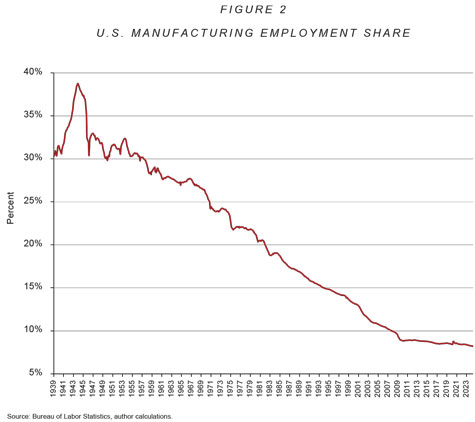
Between the end of the Second World War and 1980, manufacturing employment as a share of total employment fell from around one-third of all jobs to one in five. Today, that number is down to less than one in 10.

  •  

Though economic nationalists argue that this trend was caused by globalization, in reality the primary driver (by a large margin) was technological change: Advances in technology, which led to substantial gains in manufacturing productivity, displaced many middle-skill, middle-wage manufacturing workers.
These labor-market disruptions were not confined to manufacturing: New technologies also eliminated the need for many middle-wage administrative, office, clerical, construction, and manufacturing-production jobs. Instead of an administrative assistant, many white-collar workers now have Microsoft Outlook and voicemail. Instead of depositing a check by handing it to a cashier, people use ATMs or their smartphones, or make and receive payments electronically.

But as disruptive as this wave of technological change was, the past several decades have been a net positive for American households. In fact, the story of the last half-century is mostly a story of upward mobility.


Friday, July 12, 2024

Benefits of Immigration


 Pia M. Orrenius,Ana Pranger, Madeline Zavodny, and Isabel Dhillon at AEI:
The current U.S. immigration surge is unprecedented. The influx flew under the radar for some time, dismissed simply as pent-up immigration from when the borders essentially closed during the pandemic. But this year’s Congressional Budget Office (CBO) budget and economic outlook brought new attention to the migrant inflow and its expected economic effects.

By incorporating previously unavailable data on migration along the southwest border into the government’s economic and fiscal outlook, the macroeconomic implications of such high levels of migration come into focus.

The labor force in 2033 will be larger by 5.2 million people, mostly because of higher net immigration, according to CBO estimates. As a result of the immigration surge, GDP will be higher by about $8.9 trillion and federal government tax revenues by $1.2 trillion over the 2024-34 period. Deficits will be lower by $900 billion.


Monday, April 29, 2024

Federal Workforce

 CBO:

  • The Department of Defense employs 34 percent of the federal civilian workforce. Those employees work in hundreds of different occupations, but the most common are information technology worker, program analyst, and contract manager.
  • The Department of Veterans Affairs employs 19 percent of the federal civilian workforce. Because that department operates roughly 1,300 health care facilities for veterans, about 60 percent of its employees work in various medical professions, the most common of which is nursing.
  • The Department of Homeland Security employs 9 percent of the federal civilian workforce. The most common job in that department is inspector for the Transportation Security Administration, which accounts for 22 percent of the department’s employees.


Compared with private-sector employees, the average compensation costs for federal employees in 2022 were greater among workers whose education culminated in a bachelor’s degree or less, but lower among workers with more education.


Wednesday, April 24, 2024

FTC Bans Noncompetes


A Tuesday release from the Federal Trade Commission:
Today, the Federal Trade Commission issued a final rule to promote competition by banning noncompetes nationwide, protecting the fundamental freedom of workers to change jobs, increasing innovation, and fostering new business formation.

“Noncompete clauses keep wages low, suppress new ideas, and rob the American economy of dynamism, including from the more than 8,500 new startups that would be created a year once noncompetes are banned,” said FTC Chair Lina M. Khan. “The FTC’s final rule to ban noncompetes will ensure Americans have the freedom to pursue a new job, start a new business, or bring a new idea to market.”

The FTC estimates that the final rule banning noncompetes will lead to new business formation growing by 2.7% per year, resulting in more than 8,500 additional new businesses created each year. The final rule is expected to result in higher earnings for workers, with estimated earnings increasing for the average worker by an additional $524 per year, and it is expected to lower health care costs by up to $194 billion over the next decade. In addition, the final rule is expected to help drive innovation, leading to an estimated average increase of 17,000 to 29,000 more patents each year for the next 10 years under the final rule.

Last year, the Authors Guild supported the proposed rule:

The FTC’s proposed rule would deem clauses that prohibit workers (including independent contractors) from working with others after the conclusion of their current engagements to be a violation of Section 5 of the FTC Act. Clauses that prevent authors and journalists from publishing similar works with others, or from working with competitors, are common in writing agreements, including book, journalism, and freelance contracts. In most cases, courts have found these clauses to be invalid, but authors often lack the resources or desire to get into a legal battle with their publishers and are unlikely to sue. If the FTC’s rule is enacted, authors could simply reject such clauses as invalid, pointing to the FTC rule.

The Authors Guild has long objected to non-compete clauses and advised their removal in our contract reviews. These clauses, which are purportedly designed to protect publishers’ investments by preventing authors from selling the same or substantially similar work to another publisher, are often too broad. Authors are routinely asked to agree not to publish other works that might “directly compete with” the book under contract or “be likely to injure its sale or the merchandising of other rights.” Even more broadly, they may be asked not to “publish or authorize the publication of any material based on the Work or any material in the Work or any other work of such a nature such that it is likely to compete with the Work.”


Tuesday, January 9, 2024

Dynamics of Families after Nonmarital Birth

 Dynamics of Families After a Nonmarital Birth

By Angela Rachidi

American Enterprise Institute

January 08, 2024

Abstract

Despite known links between poverty rates and unmarried parenthood, we know little about how changes in family situations after a nonmarital birth affect poverty. This study explores Future of Families and Child Wellbeing Study data to document changes to the relationship status, employment status, and education level of a cohort of unmarried mothers who gave birth in urban areas in the late 1990s and the implications for poverty rates over a 15-year follow-up period. For children born to unmarried parents in urban areas, official poverty rates improved modestly in the 15 years after the birth, with maternal employment, education gains, and marriage corresponding to lower poverty rates on average over time. Using the success sequence as a framework, poverty rates were dramatically (and statistically) lower when mothers who were unmarried at the time of childbirth subsequently married, worked full-time, and had at least a high school education, suggesting the achievement of success-sequence milestones can lead to lower child poverty even after the birth of a child outside marriage

Sunday, September 10, 2023

Dechurching

Daniel K. Williams at The Atlantic:
The reasons people who identify as Christian and hold Christian beliefs choose not to attend church vary. For some, dissatisfaction with their church options and the behavior of church members is a key factor in their decision to leave church, but for a sizable number of others, there is no single catalyst; they simply fall out of the habit of going, according to Davis and Graham’s research. The hectic pace of contemporary life, complete with Sunday work schedules, makes it difficult for some people to attend church if they want to keep their jobs.

According to the Bureau of Labor Statistics, on an average weekend day, 29 percent of the workforce is at work. Restaurants, supermarkets, convenience stores, and retail outlets are staffed each Sunday morning by a lot of people who might identify as Christian but who definitely won’t be at church that day.
The result is that a lot of people who still identify as Christian no longer go to church. Even as early as 2014, the Pew Research Center’s Religious Landscape Study found that 30 percent of self-identified Southern Baptists “seldom” or “never” attended church—and that was before the “great dechurching” accelerated after the disruptions of the coronavirus pandemic. The exodus of millions of Americans from churches will have a profound influence on the nation’s politics, and not in the way that many advocates of secularism might expect. Rather than ending the culture wars, the battle between a rural Christian nationalism without denominational moorings and a northern urban Social Gospel without an explicitly Christian framework will become more intense.

Friday, July 7, 2023

Military Recruitment

 Ben Kesling at WSJ:

The children of military families make up the majority of new recruits in the U.S. military. That pipeline is now under threat, which is bad news for the Pentagon’s already acute recruitment problems, as well as America’s military readiness.

“Influencers are not telling them to go into the military,” said Adm. Mike Mullen, the former chairman of the Joint Chiefs of Staff, in an interview. “Moms and dads, uncles, coaches and pastors don’t see it as a good choice.”

After the patriotic boost to recruiting that followed 9/11, the U.S. military has endured 20 years of war in Iraq and Afghanistan with no decisive victories, scandals over shoddy military housing and healthcare, poor pay for lower ranks that forces many military families to turn to food stamps, and rising rates of post-traumatic stress disorder and suicide.
...

Only 9% of young people ages 16-21 said last year they would consider military service, down from 13% before the pandemic, according to Pentagon data.

...

The lowest-ranking troops make less than $2,000 a month, although pay is bolstered by benefits including healthcare, food and housing, leaving them few out-of-pocket expenses.

Families or those who live off base can find expenses outstrip income. More than 20,000 active-duty troops are on SNAP benefits, otherwise known as food stamps, according to federal data.


Tuesday, March 21, 2023

Unions, Policy Advocacy, and Public Relations


Abstract:

We develop new facts relating news coverage, interest groups, and events in the legislative histories of minimum wage increases. First, we create and validate a database of news articles that includes coverage of minimum wages and organized labor. Second, we show that policy changes predict increases in news coverage that connects organized labor and minimum wages, in particular when those articles reference high-profile interest groups and research output. Third, these policy events lead coverage of organized labor to shift towards articles about minimum wages. We observe that the minimum wage’s popularity with the public makes this shift qualify as “good PR,” an assessment that is supported by sentiment analysis of articles about organized labor. This public relations channel can thus help rationalize why interest groups engage in policy advocacy.

Sunday, January 22, 2023

Few Young Adults Aspire to Careers in Public Service

Many posts have discussed public administration and public service.

On January 11-18, 2023, Generation Lab and Axios surveyed 824  young people, 18-29 years old, about career aspirations and priorities. 

  • Small, medium, and large businesses were roughly equally desired places to work (28%, 27%, and 31% respectively)
  • Nearly half of youth prioritize personal fulfillment and happiness, while only 8% prioritize societal impact
  • Just 14% of young people want to spend most of their career in government and non-profit sector.


Sunday, October 30, 2022

Work and Social Capital

Brent Orrell, Daniel A. Cox, Jessie Wall at the Survey Center on American Life:

To understand better the social nature of the American workplace, we surveyed 5,037 American adults in June 2022. We asked them about workplace friendships, relationships with supervisors, workplace social capital investments, and feelings of satisfaction, appreciation, and loneliness. The answers to these questions help highlight and clarify work as a social environment and activity and what that environment and activity mean for workers, employers, and managers.

Our data suggest the workplace is an important generator of social capital, with spillover effects for personal, family, and community life. More than half of Americans have met a close friend through their work or a spouse’s work, and those who have strong relationships at work tend to have strong social connections with their family and people in their community. However, not everyone contributes to or benefits from workplace social capital equally, with disparities arising along gender and educational lines. College-educated women and men with no college education represent the positive and negative poles of workplace social capital.

These findings mirror recent research that has identified a growing social disparity in the lives of Americans with and without a college degree. On nearly every metric, the college-educated are reporting more sustained engagement across a wide variety of social outlets. As a previous AEI report said, “College graduates live increasingly different lives than those without a college degree. They are more socially connected, civically engaged, and active in their communities than those without a degree.”[13] It seems this disparity exists on the job as well.

Educational disparities are also associated with different outcomes in social capital development between workers and supervisors. College-educated workers are most able to take advantage of rich networks of relationships to access opportunities on the job, from mentoring to skill building to personal support.

Americans with close workplace friends are generally more satisfied with their job, more often feel engaged and excited about their work, and are less likely to be looking for new career opportunities. They are also more invested in and satisfied with their community outside of work. Where social capital at work is missing, which is the case especially for noncollege-educated men, loneliness and dissatisfaction prevail.

However, increasing investments at work also appear to be associated with a preoccupation with work that can become “workism.” The college-educated population, and women in particular, reap benefits from being the social capital catalysts, but they also report increased anxiety, stress, and dependence on work for personal identity. The close of this report discusses barriers to social capital development in the workplace, including imposter syndrome, crude or insensitive humor, code-switching, workplace tenure, and remote work.

Monday, September 5, 2022

Support for Unions

Gallup polls have been surveying Americans’ attitudes toward labor unions for nearly 90 years. Last week, the most recent Gallup survey found that union support was higher than it has been since the mid-1960s. Nearly three-quarters (71 percent) of respondents said they approved of labor unions.

Why?

Nearly three decades ago, a pair of researchers used statistical techniques to analyze decades of union approval polling. They wanted to find out why union support changed over time. Like previous research, they discovered that the state of the economy mattered. Specifically, Americans soured on unions when there was high unemployment — and were more supportive of unions when labor markets were tight.
The survey evidence suggests that this may still be true. Gallup surveys show a dramatic dip in union support between 2009 and 2012 — the last sustained period of high unemployment in the United States. Indeed, in 2009 support for organized labor fell below 50 percent for the first and only time in the Gallup series.
...

People are more likely to think unions are valuable when inequality seems high. Even in 2012, when overall support for organized labor was much lower than today, a strong majority agreed that “labor unions are necessary to protect the working person,” according to a Pew poll. People see unions as a counterweight to corporate power, fighting on behalf of average workers. Recent scholarship suggests local context matters: Rising economic inequality in one’s Zip code corresponds with greater support for labor unions. As the percentage of wealthy residents in one neighborhood climbs, so too does support for strengthening union

So why have unions gotten so much weaker?

Research points to the interrelated forces of automation, offshoring, and employer and political opposition as the key reasons the labor movement is weaker than it has been for a century. These underlying factors suggest rising popularity alone will not transform the fortunes of organized labor.

Sunday, June 26, 2022

Fathers

At AEI, W. Bradford Wilcox and colleagues write:
The decline of marriage and the rise of fatherlessness in America remain at the center of some of the biggest problems facing the nation: crime and violence, school failure, deaths of despair, and children in poverty.

The predicament of the American male is of particular importance here. The percentage of boys living apart from their biological father has almost doubled since 1960—from about 17% to 32% today; now, an estimated 12 million boys are growing up in families without their biological father.1 Specifically, approximately 62.5% of boys under 18 are living in an intact-biological family, 1.7% are living in a step-family with their biological father and step- or adoptive mother, 4.2% are living with their single, biological father, and 31.5% are living in a home without their biological father.2

Lacking the day-to-day involvement, guidance, and positive example of their father in the home, and the financial advantages associated with having him in the household, these boys are more likely to act up, lash out, flounder in school, and fail at work as they move into adolescence and adulthood. Even though not all fathers play a positive role in their children’s lives, on average, boys benefit from having a present and involved father.


 1. Numbers are calculated based on the 2019 American Community Survey, and Lydia R. Anderson, Paul F. Hemez, and Rose M. Kreider, “Living Arrangements of Children: 2019,” Current Population Reports, P70-174, U.S. Census Bureau, Washington, DC, 2021.

2. Ibid.