Search This Blog

Showing posts with label veterans. Show all posts

Saturday, August 1, 2026

Trusting Veterans

Many posts have discussed veterans.

Ellen Maese at Gallup:

Seven in 10 U.S. adults say they have a great deal or quite a lot of confidence in military veterans, according to new research from With Honor and Gallup. That confidence extends to elected leadership, with 77% saying they would trust a person with military experience a great deal or a fair amount to perform well as an elected official. Trust in leaders with military experience spans party groups, with majorities of Democrats (70%), independents (73%) and Republicans (91%) expressing this view.

The findings come as With Honor Action reports that 752 veterans across the political spectrum have run or are running for Congress in the 2026 cycle — a 47% increase from 2024 and the highest number the organization has tracked since it began monitoring veteran candidates in 2018.


Friday, October 10, 2025

Americans Like Veterans


Jeffrey M. Jones at Gallup:
Americans view prior military service more positively than prior government or business experience when considering political candidates’ credentials.

Fifty-five percent of U.S. adults say that military service on a candidate’s resume makes it much (16%) or somewhat (39%) more likely they’ll vote for that person, compared with 7% who say it discourages them from doing so. Thirty-eight percent say it makes no difference to their vote.

Americans are about as likely to value prior government experience (52%, including 16% much more likely). However, significantly more view government experience negatively (15%) when assessing candidates, giving military service a clear edge when considering the net benefit (percentage more likely minus percentage less likely).


Friday, January 10, 2025

Federal Workers

Many posts have discussed federal employment and bureaucracy.

Drew DeSilver at Pew:

The Department of Veterans Affairs employs more than 486,000 people, giving it by far the largest payroll of the 18 Cabinet-level departments (noting that OPM counts the Army, Navy and Air Force departments separately). Most of these employees work for the Veterans Health Administration, which operates the VA’s extensive network of hospitals, clinics and nursing homes.

The smallest Cabinet-level department, with 4,245 workers, is the Department of Education. Trump, like many previous Republican presidents, has proposed abolishing the department entirely.

Among independent agencies, the largest employer is the Social Security Administration, with more than 59,000 workers. That’s more than the combined total of five Cabinet-level departments: Education, Energy, Labor, State, and Housing and Urban Development.

Monday, November 11, 2024

Veterans of Afghanistan


Three years ago, Marine Corps veteran William Galston wrote at Brookings:
In the wake of the chaotic U. S. withdrawal from Afghanistan last August, many observers believed that the memory would quickly fade as Americans shifted their attention back to domestic issues. It now appears that this judgment was premature. Our hasty retreat from a 20-year war contributed to the decline of confidence in President Biden’s over competence and his ability to handle the duties of commander-in-chief. And on Veterans’ Day, More in Common, an organization that seeks to identify the cause of and cures for our polarized politics and society, made public its survey of the impact of the withdrawal on our veterans and on our society.

The findings of this survey are disturbing. Afghanistan veterans number about 775 thousand, many with multiple tours of duty. They are angry about the withdrawal, 73% feel betrayed, and 67% feel humiliated.

Two-thirds of all Americans, and more than 7 in 10 veterans, believe that “Veterans of the war in Afghanistan are going to have a hard time processing the end of the war,” and 56% of veterans do not believe that “American society will move on quickly from the end of the war.”

I fear that the veterans are right. Seventy-six percent of Afghanistan veterans say that they sometimes feel “like a stranger in my own country.” Overcoming this sense of estrangement will not be easy, especially because only one-third of Americans report belonging to social circles that include any of these veterans. Ever since the abolition of the draft and the establishment of all-volunteer armed forces, political observers have worried about the consequences of a tiny fraction of society doing the fighting for the rest of us. So far, anyway, the social impact of ending the Afghan war reinforces these fears.

This said, the non-veteran portion of American society has hardly been left untouched. Seven in ten veterans believe that “American did not leave Afghanistan with honor,” and 57% of all Americans agree. As we saw in the late 1970s, similar sentiments about the end of the war in Vietnam had a powerful impact on our politics, beginning with a pervasive sense of American decline and ending with the election of a president in 1980 who was determined to reverse this decline and who campaigned on the slogan “Let’s Make America Great Again.”

Left unaddressed, these sentiments can undermine veterans’ lives and inject a slow-acting poison into the body politic.

Sunday, September 15, 2024

National Cemetery Administration

Many posts have discussed the US military.

At WP, Casey Cep profiles Ronald E. Walters, Principal Deputy Under Secretary for Memorial Affairs (PDUSMA) for the National Cemetery Administration (NCA).  According to the VA: he helps lead 155 national cemeteries in providing dignified burial services for military Veterans and eligible family members. 
The work Walters does would be admirable no matter how well he did it, but, as it turns out, he and his colleagues do their work better than any other organization in the country. Not just better than other cemeteries and funeral homes — better than any other organization, period. Seven consecutive times, the NCA has received the highest rating of any entity, public or private, in the American Customer Satisfaction Index. Developed at the University of Michigan’s Ross School of Business, the ACSI has been the gold standard for measuring consumer experiences for the past 30 years; its satisfaction scores range from zero to 100, with Costco pulling a whopping 85, Apple a respectable 83, McDonald’s a middling 71 and Facebook an underwhelming 69. The average ACSI score for federal agencies is 68, but the NCA most recently scored a 97 — the highest rating in the survey’s history, except for the last time the NCA participated, when it also scored 97.

...

Color guards, taps, marble headstones, military escorts, flags draped over coffins: So many of the traditions we associate with burying fallen heroes were standardized in the aftermath of the Civil War, when more than a half-million Americans had been killed and their loved ones struggled to make sense of their grief. Few people remember today that the occasion for Lincoln’s Gettysburg Address was the consecration of the national cemetery at that battlefield, where some 3,000 men were respectfully laid to rest and the president declared: “The world will little note, nor long remember what we say here, but it can never forget what they did here. It is for us the living, rather, to be dedicated here to the unfinished work which they who fought here have thus far so nobly advanced.”
The national cemeteries were part of an effort to unite the living in the pursuit of a lasting peace, creating a space where the soldiers whose lives had been sacrificed for the preservation of the Union could be glorified — to honor their memory, and also to ensure that no American would forget the wages of war. It was the first time in history that a country had gathered its war dead this way for reburial, a practice the United States continued throughout its foreign conflicts. The largest repatriation effort came after World War II, when President Harry S. Truman promised next of kin that they would get to decide where their loved ones would be buried, no matter how difficult it was to identify them, no matter how far from home they died. Well more than half the men who perished fighting alongside Staff Sgt. Ferris — more than 170,000 veterans — were returned to the United States for interment after the armistice. The effort to bring the others home has never ended.

Friday, August 16, 2024

Medal of Honor, Medal of Freedom

People who know little about the military often confuse the Medal of Honor with other awards.  From the Congressional Medal of Honor Society

 The Medal of Honor is the nation’s most prestigious military decoration. Other medals with similar names are awarded by the United States, but the Medal of Honor is the highest award presented to individuals who have gone above and beyond on the battlefield.

The Congressional Gold Medal is an award bestowed by the United States Congress. It is Congress’s highest expression of national appreciation for distinguished achievements and contributions by individuals, institutions, or groups. It can be awarded to anyone Congress deems worthy.

Since 1963, the Presidential Medal of Freedom has been an award bestowed by the president of the United States to recognize people who have made “an especially meritorious contribution to the security or national interests of the United States, world peace, cultural or other significant public or private endeavors.”

LAT columnist Robin Abcarian in 2021:

 Trump has used the country’s highest civilian honor to reward his most fervent supporters — angry, divisive partisans like Rush Limbaugh (who coined the term “feminazi”), Rep. Jim “Shouty” Jordan and, of course, his favorite cow-suing congressman, Rep. Devin Nunes.

Just as he has done with the presidency, Trump has debased the Medal of Freedom.

Wednesday, June 19, 2024

Juneteenth and the Army

From the US Army:
ABERDEEN PROVING GROUND, Md. — Juneteenth is known as America’s “second” Independence Day because it commemorates the end of slavery in America. The holiday also represents the beginning of the fulfillment of America’s promise of life, liberty, and the pursuit of happiness for Black Americans.

President Abraham Lincoln issued The Emancipation Proclamation on Jan. 1, 1863, declaring “that all persons held as slaves” within the rebellious states “are, and henceforward shall be free.” However, Texas resisted the Emancipation Proclamation for more than two years.

On June 19, 1865, U.S. Army Maj. Gen. Gordon Granger arrived in Galveston, Texas, to enforce the Emancipation Proclamation and free the last enslaved Americans in Texas from bondage. This day became known as “Juneteenth”, or “Jubilee Day,” “Freedom Day,” or “Emancipation Day.”

Juneteenth is considered the longest-running Black American holiday. Over the years and through successive waves of migration, Juneteenth celebrations spread to the rest of Texas and eventually the country at large.

The Juneteenth Day of Observance officially became the 11th federal holiday in 2021 and is the first new federal holiday since the recognition of Rev. Dr. Martin Luther King Jr.’s birthday in 1983.

“Juneteenth represents not only the commemoration of the end of slavery in America more than 150 years ago, but the ongoing work to bring true equity and racial justice into American society,” said U.S. President Joseph R. Biden before the signing of the Juneteenth National Independence Day Act on June 17, 2021.

APG Soldiers, civilians advocate for equality in Harford County

Juneteenth is an integral part of Army life. It is a time to reflect on the crucial role the Army played in the Emancipation Proclamation and ending segregation in the U.S.

On July 26, 1948, President Harry Truman signed Executive Order 9981, which ended segregation in the military. This order marked a significant moment in the civil rights movement. It was also one of the first instances where a U.S. president used an executive order to implement a civil rights policy.

Locally, APG Soldiers and civilians were instrumental in the desegregation of Harford County by leading efforts to desegregate local restaurants, facilitate school integration, and advocate for fair and open housing in the 1960s, said Patricia D. Cole, President of the Havre de Grace Colored School Museum and Cultural Center, Inc.

These efforts included peaceful protests, speeches, and involvement in lawsuits. For example, Cole said many Soldiers and civilians were involved in the Route 40 protests, advocating for the desegregation of restaurants and other public accommodations.

In the 1960s, George S. Pettit, an APG scientist, filed a lawsuit to enable his son A. Dwight Pettit to attend Aberdeen High School. After a two-year legal battle, the Pettit family won the lawsuit, allowing A. Dwight Pettit to attend Aberdeen High School instead of Havre de Grace Consolidated, a segregated school for Black students. Today, A. Dwight Pettit is a prominent Baltimore lawyer.

Cole said in 1961, APG leaders facilitated meetings between local restaurant owners and civil rights leaders to advocate for removing racial exclusions in restaurants along Route 40.

“This effort was crucial as Black Vietnam veterans returning home faced significant challenges in finding housing off the post,” Cole said.

This Juneteenth, take time to reflect on what it means to be free, celebrate the resiliency of Black Americans, and honor those who fought and sacrificed to ensure the Constitution fulfilled its promise to all Americans.

Monday, April 29, 2024

Federal Workforce

 CBO:

  • The Department of Defense employs 34 percent of the federal civilian workforce. Those employees work in hundreds of different occupations, but the most common are information technology worker, program analyst, and contract manager.
  • The Department of Veterans Affairs employs 19 percent of the federal civilian workforce. Because that department operates roughly 1,300 health care facilities for veterans, about 60 percent of its employees work in various medical professions, the most common of which is nursing.
  • The Department of Homeland Security employs 9 percent of the federal civilian workforce. The most common job in that department is inspector for the Transportation Security Administration, which accounts for 22 percent of the department’s employees.


Compared with private-sector employees, the average compensation costs for federal employees in 2022 were greater among workers whose education culminated in a bachelor’s degree or less, but lower among workers with more education.


Friday, November 10, 2023

World War II Veterans Will Soon Be Gone


From the National WWII Museum:

Every day, memories of World War II are disappearing from living history. The men and women who fought and won this great conflict are now in their 90s or older; according to US Department of Veterans Affairs statistics, 119,550 of the 16.1 million Americans who served in World War II are alive as of 2023. 


Monday, May 29, 2023

A MEMORIAL DAY REMINDER THAT PUERTO RICO IS PART OF THE UNITED STATES


Sunday, May 21, 2023

Fake Story about Vets and Migrants

 Many posts have discussed myths and misinformation.

Aidan McLaughlin at Mediaite:

The New York Post dropped a bombshell report last week: amid a nationwide influx of migrants, nearly two-dozen homeless veterans were kicked out of hotels where they were being temporarily housed in order to make room for migrants in upstate New York.

The story, which was based on a claim by a veterans advocate, got the front page treatment: “VETS KICKED OUT FOR MIGRANTS,” bellowed the Post last Saturday. “Outrage as upstate hotels tell 20 homeless veterans to leave.”

It was a juicy story that could have been cooked up in Roger Ailes’s rage-fear lab: Red-blooded American veterans put out on the street to make way for foreign invaders!

The story rocketed around the right-wing ecosystem. New York Post columnist Miranda Devine said President Joe Biden “should burn in hell for this.” House Speaker Kevin McCarthy called it “shameful.” Donald Trump Jr. declared, “Fuck Democrats.” Nikki Haley said the tale was “Liberal insanity at work.”

Naturally, Fox News covered the story enthusiastically, treating it as gospel on nearly every program. On Outnumbered, one of Fox’s most popular daytime programs, hosts pinned blame for the very local story on Biden.

It proves he “doesn’t mean it” when he says “God bless the troops” at the end of his speeches, one host said. “Why is Joe Biden doing this?” another asked. “Because it is intentional… he is a globalist. He’s more concerned about the needs of the U.N., about the World Economic Forum than he is about his own American citizens.”

Then, the story fell apart.

First, the hotels that veterans were supposedly booted from told Mid-Hudson News they had no idea what the advocate, YIT Foundation Executive Director Sharon Finch, was talking about. Then, a local Republican New York lawmaker dug into her claims and concluded that she lied.

Small local publications are in trouble, but they provide vital information. 


Friday, February 10, 2023

Veterans in Congress 2023

Katherine Schaeffer at Pew:
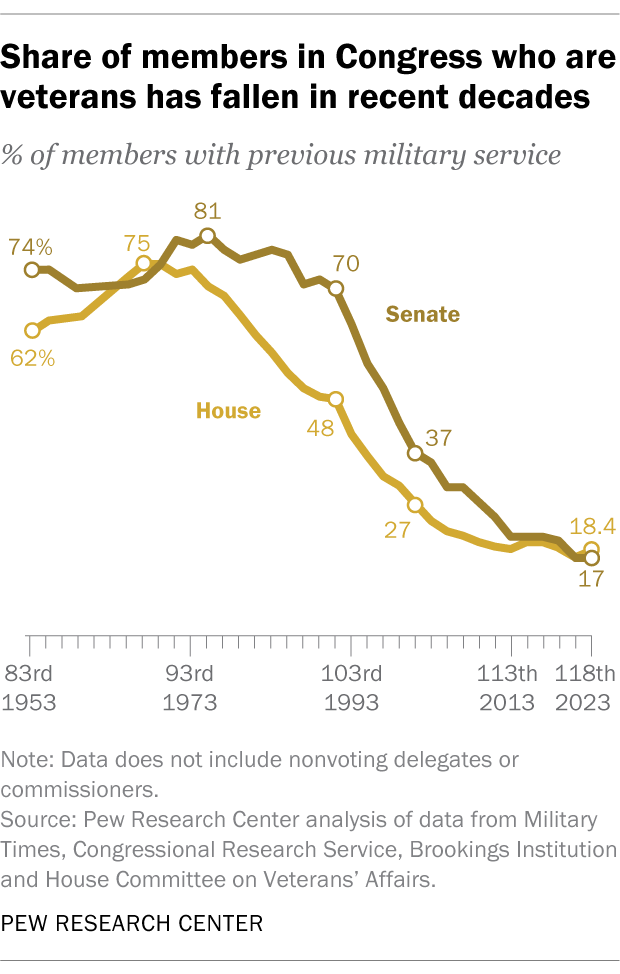
Far fewer members of Congress now have personal military experience than in the past. In the current Congress, 97 members have served in the military at some point in their lives – among the lowest numbers since at least World War II, according to Military Times. There are almost three times as many Republican veterans in the 118th Congress as Democratic veterans (72 vs. 25). Roughly similar shares of current representatives (18.4%) and senators (17%) have served in the military.

Since the second half of the 20th century, there has been a dramatic decrease in members of Congress with military experience. Between 1965 and 1975, at least 70% of lawmakers in each legislative chamber had military experience. The share of members with military experience peaked at 75% in 1967 for the House and at 81% in 1975 for the Senate.

While relatively few members of Congress today have military experience, an even smaller share of Americans do. In 2021, about 6% of U.S. adults were veterans, according to the U.S. Census Bureau – down from 18% in 1980, not long after the end of the military draft era.


Monday, December 12, 2022

The American Concept of the Veteran

 Rebecca Burgess at Law & Liberty:

The concept of the veteran as we’ve come to experience it today appears to be a thoroughly American experiment, but one that has, remarkably, gone largely if not entirely unnoticed. This is despite America having participated in numerous wars, despite the generational reverence still felt decades later for the “Greatest Generation,” and despite what Admiral Mike Mullen once termed in the midst of the Iraq and Afghanistan wars as “a sea of good will” among the American public toward Post-9/11 veterans.

We ought not to be so oblivious to this history, and to its richness in showcasing the centrality of military veterans to the development of the American nation, even to political and constitutional ideas.

The veteran is, first and foremost, an experiment in civil-military relations and egalitarian democratic society. But veterans—and the questions that arise both from reincorporating ex-soldiers into civil society, and from wrestling with who cares (and to what extent) for their wounds and needs—have without doubt influenced and shaped American government, along with its public and private institutions, society, and culture. For one, the government lobbyist, today so central—and so reviled—a figure to the American legislative system, was invented, perfected, and perpetuated, by military veterans.

Thursday, October 20, 2022

Former Brass Working for Antidemocratic Governments

Craig Whitlock and Nate Jones at WP:
More than 500 retired U.S. military personnel — including scores of generals and admirals — have taken lucrative jobs since 2015 working for foreign governments, mostly in countries known for human rights abuses and political repression, according to a Washington Post investigation.

In Saudi Arabia, for example, 15 retired U.S. generals and admirals have worked as paid consultants for the Defense Ministry since 2016. The ministry is led by Crown Prince Mohammed bin Salman, the kingdom’s de facto ruler, who U.S. intelligence agencies say approved the 2018 killing of journalist Jamal Khashoggi, a Post contributing columnist, as part of a brutal crackdown on dissent.

Saudi Arabia’s paid advisers have included retired Marine Gen. James L. Jones, a national security adviser to President Barack Obama, and retired Army Gen. Keith Alexander, who led the National Security Agency under Obama and President George W. Bush, according to documents obtained by The Post under Freedom of Information Act lawsuits.

Others who have worked as consultants for the Saudis since Khashoggi’s murder include a retired four-star Air Force general and a former commanding general of U.S. troops in Afghanistan.
...

Brandon Brockmyer, POGO’s director of investigations and research, said retired senior military officers often testify before Congress and appear on television to debate national security, but rarely divulge whether they are on a foreign government’s payroll.

“The public is working on the assumption that their sole loyalty is to the United States,” he said. “The public has the right to know whether and how a foreign power has access to their expertise.”

Craig Whitlock and Nate Jones at WP:
Under federal ethics rules, military personnel who manage weapons programs or major defense contracts must observe a “cooling off” period of one or two years before they can accept jobs from companies they did business with while in uniform. The regulations, which also apply to other federal officials who interact with government contractors, are intended to prevent conflicts of interest and self-dealing. In some cases, officials face a lifetime ban from taking such jobs.

But the conflict-of-interest rules do not apply in the same way to retired U.S. troops who want to work for a foreign government. While they must obtain federal approval for the job, they are allowed to negotiate foreign employment before they retire, whenever they want, even with countries where they have been stationed for the U.S. military.


Thursday, November 11, 2021

Veterans Day 2021

Katherine Schaeffer at Pew:
In 2018, about 7% of U.S. adults were veterans, down from 18% in 1980, according to the Census Bureau. This drop coincides with decreases in active-duty personnel. Over the past half-century, the number of people on active duty has dropped significantly, from 3.5 million in 1968, during the military draft era, to about 1.4 million (or less than 1% of all U.S. adults) in today’s all-volunteer force. The draft ended in 1973.

...

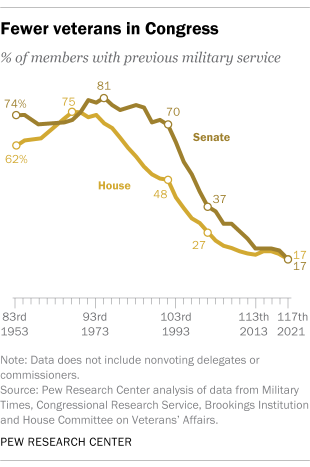
As the share of Americans who are veterans has declined, so has the share of legislators who have previously served in the military. In the current Congress, 17% of lawmakers in both houses had prior military service, down drastically from just a few decades ago.

The share of senators who are veterans reached a post-Korean War peak of 81% in 1975, while the share among House members peaked in 1967 at 75%. However, in recent elections, both Democrats and Republicans have made special efforts to recruit veterans for congressional contests, and the newly elected freshman class includes 15 such lawmakers.


...


Sunday, June 6, 2021

D-Day 2021

Today is the 77th anniversary of the D-Day invasion.

VOA reports:

With D-Day veterans now mostly in their mid-90s or older, there are likely only a few hundred veterans still alive, said April Cheek-Messier, the president of the U.S. National D-Day Memorial Foundation.

"If you think about the fact that there are 16 million who served during World War II, there are only around 325,000 World War II veterans still living today, and of that, a very small percentage would be D-Day veterans, and we don't know the exact number, but you can imagine they would probably only be in a few hundred," Cheek-Messier told Fox News.

Only one veteran now remains from the French commando unit that joined U.S, British, Canadian and other Allied troops in storming Normandy's code-named beaches, the AP reported.


Tuesday, April 6, 2021

Profile of Veterans

Katherine Schaeffer at Pew:

Gulf War-era veterans now account for the largest share of all U.S. veterans, having surpassed Vietnam-era veterans in 2016, according to the VA’s 2018 population model estimates. VA estimates for 2021 indicate there are 5.9 million American veterans who served during the Vietnam era and 7.8 million who served in the Gulf War era, which spans from August 1990 through the present. There are also around 240,000 World War II veterans and about 933,000 who served during the Korean conflict, the VA estimates. Some veterans served through multiple eras but are counted only in their earliest era. Roughly three-quarters (78%) of veterans in 2021 served during wartime, and 22% served during peacetime. (Veterans with wartime and peacetime service are only counted in wartime.)
...

As with trends in the U.S. population overall, the veteran population is expected to become more racially and ethnically diverse. Between 2021 and 2046, the share of veterans who are non-Hispanic White is expected to drop from 74% to 62%. The share of veterans who are Hispanic is expected to double from 8% to 16%, while the share who are Black is expected to increase slightly from 13% to 15%..

Friday, March 12, 2021

Veterans in Congress, 2021

 Katherine Schaeffer at Pew:

Far fewer members of Congress now have direct military experience than in the past. In the current Congress, 91 members served in the military at some point in their lives – the lowest number since at least World War II, according to Military Times. There are more than twice as many Republican veterans (63) in the new Congress as Democrats (28). Equal shares of senators and representatives (17%) have served in the military.

While the number and share of veterans in Congress overall have decreased, the newly elected freshman class includes 15 such lawmakers.

Looking at the longer term, there has been a dramatic decrease in members of Congress with military experience since the late 20th century. Between 1965 and 1975, at least 70% of lawmakers in each legislative chamber had military experience. The share of members with military experience peaked at 75% in 1967 for the House and at 81% in 1975 for the Senate.

While relatively few members of Congress today have military experience, an even smaller share of Americans do. In 2018, about 7% of U.S. adults had military experience, down from 18% in 1980, not long after the end of the military draft era.

Friday, January 22, 2021

Notes on the Insurrection


Tom Dreisbach and Meg Anderson at NPR:
As a violent mob descended on the U.S. Capitol on Jan. 6, lawmakers and aides hid wherever they could, waiting for the military and police to arrive. But many of those who stormed the Capitol were military veterans themselves, who had once sworn to protect the Constitution. In fact, an NPR analysis has found that nearly 1 in 5 people charged over their alleged involvement in the attack on the U.S. Capitol appear to have a military history.

NPR compiled a list of individuals facing federal or District of Columbia charges in connection with the events of Jan. 6. Of more than 140 charged so far, a review of military records, social media accounts, court documents and news reports indicate at least 27 of those charged, or nearly 20%, have served or are currently serving in the U.S. military. To put that number in perspective, only about 7% of all American adults are military veterans, according to the U.S. Census Bureau.

Amy Worden and Marisa Iati at WP:

A Pennsylvania woman accused of helping to steal a laptop from House Speaker Nancy Pelosi’s office during the attack on the U.S. Capitol in Washington was ordered released from detention Thursday and placed in her mother’s custody.

Riley June Williams, 22, must stay in the home she shares with her mother and abide by other conditions of release, including avoiding contact with any witnesses or victims of the Jan. 6 Capitol storming. Federal Magistrate Judge Martin Carlson said he was releasing Williams in part because she had no prior criminal record, but he warned her that her mother, Wendy Williams, could be criminally charged if she fails to report to the court any violations of the conditions of release.

Unofficial transcript:

Miss Williams, when we met on Tuesday, one of the first things I did was advise you of your constitutional rights. And then I took steps to protect those rights by appointing aggressive, effective counsel to represent you here. That recital of rights wasn't just some hollow invocation of abstract principles. It was affirmation of the rights guaranteed to you by the United States Constitution. And it strikes me that that guarantee says something extraordinary and extraordinarily good about our Constitution. You are embraced by a presumption of innocence.

You are entitled to the assistance of counsel. You have a right to remain silent. All of these matters guaranteed to you by the Constitution, a constitution that protects the rights of those who are accused of transgressing society's rules. Some of the most basic of those rules are set forth in our Constitution. And one of the fundamental pillars of that constitution is the peaceful transition of power. That obligation that all citizens have to facilitate the peaceful transfer of power, it has been honored by generations of Americans for two hundred and thirty two years, it has become so commonplace that we often think very little of it.

But as President Reagan said in his inaugural, that process is a miracle. The allegations that bring you before me involve conduct that allegedly took place on January 6th of this year as Congress was endeavoring to fulfill its constitutional obligation to certify the will of the people and the votes of the Electoral College. You are cloaked in a presumption of innocence with respect to these matters. But the allegations set forth in the complaint relate to conduct that was antithetical to these constitutional values, conduct that involved a riot, a mob that sought to replace constitutional norms with the howling of a crowd.

We know now that the mob failed and the Constitution prevailed. The Constitution prevailed on January 6th of this year because Congress, stepping over the wreckage of its capital, met. and confirmed the vote of the Electoral College, setting the stage for the latest peaceful transition of power in this country yesterday. In the wake of those events on January 6th, it strikes me that the Constitution prevailed yet again in the wake of those events, the men and women of federal law enforcement, including the federal investigator and the assistant US attorney, the federal prosecutor involved in this case, fulfilled a duty that they had under the Constitution. They have sworn an oath under the Constitution to protect and defend that Constitution against all enemies, foreign and domestic.

And in pursuit of that constitutional obligation, a series of investigations have been launched into the matters that took place on January 6th. And those investigations have brought us here today together. It also occurs to me, Miss Williams, in a very personal and direct way, that the Constitution has is and will be prevailing in your case. As I noted a few moments ago when we first met, I invoked the Constitution on your behalf and I took steps to protect your constitutional rights by appointing counsel for you, your counsel.

Fulfilling the role of the Constitution contemplated has aggressively represented your interests here today. Wouldn't you agree, Miss Oelrich? [The judge at this point turns to the court appointed public defender in this case]. Wouldn't you agree, Miss Oelrich, that you have aggressively represented your client's interests here today?

Yes, Your Honor, I spent the last two days doing a lot of investigating. 

[And the judge turns to the prosecutor] On behalf of the United States, it is my view that over the past two days, you and your colleagues here and elsewhere have endeavored to fulfill your constitutional obligation to provide equal justice under the law to ensure the protection of individual rights and liberties while ensuring adherence to the rule of law.[

[And then the judge turns back to the defendant, Miss Williams, he says] so Miss Williams, in a very real and direct sense, you are being released today because the Constitution has prevailed, because your counsel has fulfilled her constitutional obligation and because the United States is also fulfilling its constitutional duty to strike hard blows but fair blows in the pursuit of justice. So, Miss Williams, I share that thought with you as you leave here today, that your freedom today, conditioned as it is by the orders that I have entered as a result of the prevailing of the Constitution.

And I'll leave you with this final thought, Miss Williams. The judge closes with us. The Constitution prevails here today and the Constitution will always prevail in this country.