Search This Blog

Showing posts with label United States. Show all posts

Monday, May 29, 2023

A MEMORIAL DAY REMINDER THAT PUERTO RICO IS PART OF THE UNITED STATES


Saturday, August 29, 2020

COVID Responses: International Perspectives


 Kat Devlin and Aidan Connaughton at Pew:
Countries’ approaches to combat the spread of the coronavirus have varied throughout Europe, North America, Australia, Japan and South Korea, but most publics in these regions believe their own country has done a good job of dealing with the outbreak, according to a new Pew Research Center survey of 14 advanced economies. Overall, a median of 73% across the nations say their country has done a good job of handling novel coronavirus, which has reached nearly every corner of the globe, infected more than 20 million people worldwide and resulted in the deaths of several hundred thousand.
But the pandemic has had a divisive effect on a sense of national unity in many of the countries surveyed: A median of 46% feel more national unity now than before the coronavirus outbreak, while 48% think divisions have grown. This includes 77% of Americans who say they are further divided than prior to the pandemic, while just 18% believe the country to be more united.
The US and UK are notable outliers:
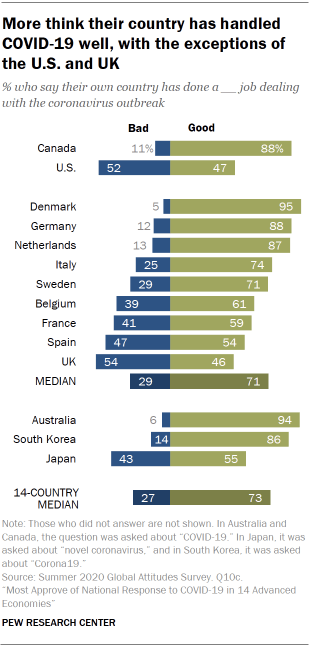
More think their country has handled COVID-19 well, with the exceptions of the U.S. and UKIn two countries – the United Kingdom and the United States – people are divided in their beliefs when it comes to rating their government’s performance responding to the coronavirus. These two nations also have high levels of political polarization on views of the government’s handling of this crisis. In the U.S., 76% of Republicans and independents who lean to the Republican Party say the government has done a good job, while just a quarter of Democrats and Democratic leaners agree, a 51 percentage point difference. A majority of right-leaning Britons (55%) give a positive rating to their country’s handling of the pandemic, led by Prime Minister Boris Johnson’s Conservative government, but just 26% on the left hold the same opinion.


Deaths per 100,000

Belgium..................86.55
United Kingdom.....62.53
Spain.......................62.09
Italy ........................58.70
USA........................55.57
France.....................45.68
Netherlands.............36.25
Canada,,,,,,,,,,,,,,,,,,,,24.70
Germany.................11.20
Denmark ................10.76
Australia...................2.40
Japan.........................0.99
Korea, South.............0.62


Saturday, January 25, 2020

Comparative Corruption

From Transparency International:
The United States has received its lowest score in eight years on the Corruption Perceptions Index (CPI) released today by Transparency International, dropping two points to score 69 out of 100. The Index draws from over a dozen independent expert assessments and surveys to measure perceptions of public sector corruption in 180 countries and territories. Scores on the CPI range from zero (very corrupt) to 100 (not corrupt).
Read the report

Gary Kalman, Director of the new U.S. office of Transparency International, said the following:
Weaknesses in our laws are being exploited by a growing list of bad actors at home and abroad. From foreign despots to terror networks, drug cartels to human traffickers, some of the world’s most destructive forces are benefitting from gaps in U.S. law. Multiple corruption scandals in the last year alone have shown that transnational corruption is often facilitated, enabled, or perpetuated by countries toward the top of the Index, including the United States. Fortunately, bipartisan legislation currently before Congress, the ILLICIT CASH Act and the Corporate Transparency Act, would go a long way toward stopping these interests from using the U.S. as a laundromat for their dirty cash.”

Sunday, October 25, 2009

A Comprative Perspective from Uganda

Our book has a regular boxed feature comparing the United States and other nations. In this vein, Ugandan journalist Rodney Muhumuza has some thoughtful reflections after a lengthy American stay:

Asked to say something about politics in Uganda — and it happened often — my typical response would be something close to this: “I was born in 1981, five years before Yoweri Museveni came to power after a guerrilla war. He is the only president I have known, and I am a grown man.” Probed further, I might add: “I love my country very much. But I am still waiting for the day we will have a peaceful transfer of power.”

It was the kind of routine that was delivered with devastating steadiness. Four days before I left America, an American economist named Duncan Chaplin interviewed me for a radio station that broadcasts online for a Kenyan audience. Everything seemed to go well until he asked me to compare the Ugandan and American political situations. I did not know what to say. “There is nothing to compare,” I said, by which time he had realised that it was not a particularly good question. My point had been made.

The United States settled this issue in 1801. John Adams had lost a tough, nasty presidential election to Thomas Jefferson. He was bitter about his defeat, but when the hour came, he packed his bags and went home. It never occurred to him to do otherwise.


Monday, October 19, 2009

Autism and Canadian-American Differences

In chapter 5, we discuss cultural differences between the United States and Canada. In a provocative essay on autism policy, Malcolm Stanley touches on this theme. Stanley recently moved south of the border and found that it was easier to get help for his autistic daughter in the United States. He explains:

Canada is founded on principles of peace, order and good government.

In Ontario, this translates into a benchmarks program that will withdraw therapeutic services from children with autism who do not show a sufficiently timely response to therapy. It is apparently a bureaucratic issue of the proper management of government spending.

If presented with a young Helen Keller, one wonders whether Ontario government-provided therapy services would be withdrawn. Would Keller ever have achieved her eureka moment if, instead of persistently holding Keller's hand under the pump, her therapist had been told to move on to another child with a more visible return on therapeutic investment?

... Counterintuitively, things are different in the United States. A nation founded upon the principles of life, liberty and the pursuit of happiness brings a persistent faith in the individual to the question of how to provide for autistic children. A simple trip of a moving truck has transformed the status of our daughter from that of an inconvenient provincial liability to that of a valued citizen with the right to demand assistance in her essential pursuit of happiness.