Search This Blog

Showing posts with label Britain. Show all posts

Wednesday, April 29, 2026

King Charles on America

 Many posts have discussed the Founding.

Ironically, the British monarch echoed the No Kings rallies in the US.

From King Charles's Address to Congress:

The Founding Fathers were bold and imaginative rebels with a cause. Two hundred and fifty years ago, or, as we say in the United Kingdom ‘just the other day,’ they declared Independence. By balancing contending forces and drawing strength in diversity, they united 13 disparate colonies to forge a nation on the revolutionary idea of ‘life, liberty and the pursuit of happiness.’ They carried with them, and carried forward, the great inheritance of the British Enlightenment – as well as the ideals which had an even deeper history in English common law and Magna Carta.

These roots run deep, and they are still vital. Our Declaration of Rights of 1689 was not only the foundation of our constitutional monarchy, but also provided the source of so many of the principles reiterated, often verbatim, in the American Bill of Rights of 1791.

And those roots go even further back in our history: the U.S. Supreme Court Historical Society has calculated that Magna Carta is cited in at least 160 Supreme Court cases since 1789, not least as the foundation of the principle that executive power is subject to checks and balances.

This is the reason why there stands a stone, by the River Thames at Runnymede where Magna Carta was signed in the year 1215. This stone records that an acre of that ancient and historic site was given to the United States of America by the people of the United Kingdom, to symbolize our shared resolve in support of liberty, and in memory of President John F. Kennedy.

Distinguished members of the 119th Congress, it is here in these very halls that this spirit of liberty and the promise of America’s founders is present in every session and every vote cast.

Not by the will of one, but by the deliberation of many, representing the living mosaic of the United States. In both of our countries, it is the very fact of our vibrant, diverse and free societies that gives us our collective strength, including to support victims of some of the ills that, so tragically, exist in both our societies today.

Tuesday, February 3, 2026

US as Adversary

Many posts have discussed foreign policywar powers and the US military.

Mike Allen at Axios: 

Imagine a world where ties to the U.S. feel like a burden, not a benefit to free society."How America First Risks Becoming America Alone," an essay in this weekend's Wall Street Journal, says American allies — soured by President Trump's treatment — are "searching for alternatives to what increasingly feels like an abusive relationship."

  • 📊 Positive views of the U.S. are declining worldwide, the essay notes:Brits who view the U.S. unfavorably doubled in the past two years to 64%. (YouGov)
  • In Germany, 71% view the U.S. as an "adversary." (German polling firm Forsa)
  • Across Europe, just 16% view the U.S. as an ally. (European Council on Foreign Relations)
  • Nearly two-thirds of Canadians, Mexicans and Brazilians hold unfavorable views of the U.S., "and view their neighbor as a bigger threat than China."


Data: European Council on Foreign Relations. Chart: Axios Visuals

Wednesday, June 8, 2022

Reagan at Westminster

 Forty years ago today, President Reagan spoke to the British Parliament:

No, democracy is not a fragile flower. Still it needs cultivating. If the rest of this century is to witness the gradual growth of freedom and democratic ideals, we must take actions to assist the campaign for democracy.
...

The objective I propose is quite simple to state: to foster the infrastructure of democracy, the system of a free press, unions, political parties, universities, which allows a people to choose their own way to develop their own culture, to reconcile their own differences through peaceful means.

This is not cultural imperialism, it is providing the means for genuine self-determination and protection for diversity. Democracy already flourishes in countries with very different cultures and historical experiences. It would be cultural condescension, or worse, to say that any people prefer dictatorship to democracy. Who would voluntarily choose not to have the right to vote, decide to purchase government propaganda handouts instead of independent newspapers, prefer government to worker-controlled unions, opt for land to be owned by the state instead of those who till it, want government repression of religious liberty, a single political party instead of a free choice, a rigid cultural orthodoxy instead of democratic tolerance and diversity?
...

During the dark days of the Second World War, when this island was incandescent with courage, Winston Churchill exclaimed about Britain's adversaries, ``What kind of a people do they think we are?'' Well, Britain's adversaries found out what extraordinary people the British are. But all the democracies paid a terrible price for allowing the dictators to underestimate us. We dare not make that mistake again. So, let us ask ourselves, ``What kind of people do we think we are?'' And let us answer, ``Free people, worthy of freedom and determined not only to remain so but to help others gain their freedom as well.''

Sir Winston led his people to great victory in war and then lost an election just as the fruits of victory were about to be enjoyed. But he left office honorably, and, as it turned out, temporarily, knowing that the liberty of his people was more important than the fate of any single leader. History recalls his greatness in ways no dictator will ever know. And he left us a message of hope for the future, as timely now as when he first uttered it, as opposition leader in the Commons nearly 27 years ago, when he said, ``When we look back on all the perils through which we have passed and at the mighty foes that we have laid low and all the dark and deadly designs that we have frustrated, why should we fear for our future? We have,'' he said, ``come safely through the worst.''

Well, the task I've set forth will long outlive our own generation. But together, we too have come through the worst. Let us now begin a major effort to secure the best -- a crusade for freedom that will engage the faith and fortitude of the next generation. For the sake of peace and justice, let us move toward a world in which all people are at last free to determine their own destiny.

Saturday, August 29, 2020

COVID Responses: International Perspectives


 Kat Devlin and Aidan Connaughton at Pew:
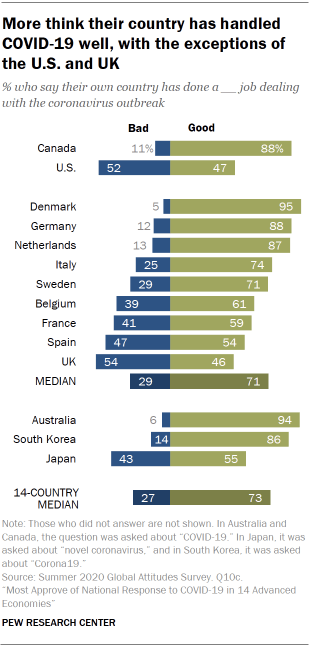
Countries’ approaches to combat the spread of the coronavirus have varied throughout Europe, North America, Australia, Japan and South Korea, but most publics in these regions believe their own country has done a good job of dealing with the outbreak, according to a new Pew Research Center survey of 14 advanced economies. Overall, a median of 73% across the nations say their country has done a good job of handling novel coronavirus, which has reached nearly every corner of the globe, infected more than 20 million people worldwide and resulted in the deaths of several hundred thousand.
But the pandemic has had a divisive effect on a sense of national unity in many of the countries surveyed: A median of 46% feel more national unity now than before the coronavirus outbreak, while 48% think divisions have grown. This includes 77% of Americans who say they are further divided than prior to the pandemic, while just 18% believe the country to be more united.
The US and UK are notable outliers:
More think their country has handled COVID-19 well, with the exceptions of the U.S. and UKIn two countries – the United Kingdom and the United States – people are divided in their beliefs when it comes to rating their government’s performance responding to the coronavirus. These two nations also have high levels of political polarization on views of the government’s handling of this crisis. In the U.S., 76% of Republicans and independents who lean to the Republican Party say the government has done a good job, while just a quarter of Democrats and Democratic leaners agree, a 51 percentage point difference. A majority of right-leaning Britons (55%) give a positive rating to their country’s handling of the pandemic, led by Prime Minister Boris Johnson’s Conservative government, but just 26% on the left hold the same opinion.


Deaths per 100,000

Belgium..................86.55
United Kingdom.....62.53
Spain.......................62.09
Italy ........................58.70
USA........................55.57
France.....................45.68
Netherlands.............36.25
Canada,,,,,,,,,,,,,,,,,,,,24.70
Germany.................11.20
Denmark ................10.76
Australia...................2.40
Japan.........................0.99
Korea, South.............0.62


Tuesday, October 1, 2019

US, UK, and Canada on Universal Basic Income

R.J. Reinhart at Gallup:
A recent survey by Gallup and Northeastern University finds a slight majority of Americans opposed to a universal basic income (UBI) program as a way to support workers displaced by AI adoption. Conversely, about three-fourths of residents in the U.K. and Canada favor the idea.
These findings come from a Gallup/Northeastern survey of over 10,000 adults in Canada, the U.K. and the U.S. conducted from April to June 2019. By some estimates, up to 50% of jobs are expected to be automated within the next decade. An OECD study across 21 countries suggests that while only 9% of jobs are currently at high risk of automation, low-skilled workers are most vulnerable to job displacement.
The way that colleges, universities, governments and businesses can respond to this disruption is the topic of a recent report by Gallup and Northeastern University detailing the results of the three-country survey. The probability-based survey was conducted online with 4,394 Americans, 3,049 Canadians and 3,208 U.K. adults.
In the survey, UBI was defined for respondents as a government-instituted program that would provide every adult with a specific amount of money each year. These funds would serve as income support for people who lose their jobs or occupations because of advances in artificial intelligence. UBI programs have been endorsed by U.S. Democratic presidential candidate Andrew Yang, as well as high-profile business leaders such as Richard Branson and Mark Zuckerberg.
  • 43% of Americans support a universal basic income program
  • 77% of U.K. adults and 75% of Canadians also support UBI
  • Majorities in all three countries support taxing tech companies to fund it

Sunday, November 25, 2018

Leaders and Children

Every president since bachelor James Buchanan has had children. (Harding never acknowledged having children, but he had at least one out of wedlock.) In fact, two of John Tyler's grandchildren are alive today.

The contrast with European leaders is notable, as Ted Malloch suggests at Intellectual Takeout:
Emmanuel Macron, the newly elected French president, has no children; German chancellor Angela Merkel has no children.
British prime minister, Theresa May has no children; Italian prime minister Paolo Gentiloni has no children; Holland’s prime minister, Mark Rutte, Sweden’s Stefan Löfven, Luxembourg’s Xavier Bettel, and Scotland’s, first minster Nicola Sturgeon — all have no children.
The list goes on… Latvia’s childless president is Raimonds VÄ“jonis, Lithuania’s childless president is Dalia GrybauskaitÄ—, and Romania’s childless president is Klaus Werner Iohannis. And, Jean-Claude Juncker, president of the European Commission too, has no children and is family-less.
So to put it rather bluntly: a grossly disproportionate number of the people making serious decisions about Europe’s future have no direct personal sibling, child or grandchildren’s interests at stake in that future. They are not part of a family and have come to see all their attention focused on one dominant and all-powerful social unit to which they pay obeisance and give their complete and devoted attention: The State.
The demographics look problematic. Among native Europeans, the birthrate is currently between 0.2 and 1.1. Europe is not replicating itself and will, if trends are extrapolated—cease to exist.

Thursday, March 15, 2018

Lies and Silence

At WP, Josh Dawsey, Damian Paletta and Erica Werner report that Trump bragged about lying to an ally's head of government.
President Trump boasted in a fundraising speech Wednesday that he made up information in a meeting with the leader of a top U.S. ally, saying he insisted to Canadian Prime Minister Justin Trudeau that the United States runs a trade deficit with its neighbor to the north without knowing whether that was the case.
Trudeau came to see me. He’s a good guy, Justin. He said, ‘No, no, we have no trade deficit with you, we have none. Donald, please,’ ” Trump said, mimicking Trudeau, according to audio of the private event in Missouri obtained by The Washington Post. “Nice guy, good-looking guy, comes in — ‘Donald, we have no trade deficit.’ He’s very proud because everybody else, you know, we’re getting killed.
“ ... So, he’s proud. I said, ‘Wrong, Justin, you do.’ I didn’t even know. ... I had no idea. I just said, ‘You’re wrong.’ You know why? Because we’re so stupid. … And I thought they were smart. I said, ‘You’re wrong, Justin.’ He said, ‘Nope, we have no trade deficit.’ I said, ‘Well, in that case, I feel differently,’ I said, ‘but I don’t believe it.’ I sent one of our guys out, his guy, my guy, they went out, I said, ‘Check, because I can’t believe it.’
‘Well, sir, you’re actually right. We have no deficit, but that doesn’t include energy and timber. … And when you do, we lose $17 billion a year.’ It’s incredible.”
The Office of the United States Trade Representative says the United States has a trade surplus with Canada.
 Peter Baker at NYT:
Britain’s tough response in holding Russia responsible for a poisoning attack on its soil increased the pressure on President Trump to join with a NATO ally in taking action, even as he has been reluctant to retaliate for Moscow’s intervention in the 2016 election in the United States.
Mr. Trump, who was visiting Missouri on Wednesday, has not personally addressed the attack since London assigned blame to Russia and left it instead to aides to express public solidarity with Prime Minister Theresa May after she expelled 23 Russian diplomats, canceled high-level contacts and vowed to impose more sanctions.
The White House issued a boilerplate statement saying the attack was bad.
But for whatever reason, Mr. Trump avoided saying so personally in public, much as he has generally avoided condemning Russia for its election meddling. He has allowed top advisers to denounce Moscow for its interference in American democracy, but when it comes to his own Twitter posts or comments, he has largely stuck to equivocal language, seemingly reluctant to accept the consensus conclusion of his intelligence agencies and intent on voicing no outrage or criticism of President Vladimir V. Putin of Russia, for whom he has expressed admiration.

Sunday, June 11, 2017

The Top Fifth

Richard V. Reeves writes at The New York Times:
In Britain, it is politically impossible to be prime minister and send your children to the equivalent of a private high school. Even Old Etonian David Cameron couldn’t do it. In the United States, the most liberal politician can pay for a lavish education in the private sector. Some of my most progressive friends send their children to $30,000-a-year high schools. The surprise is not that they do it. It is that they do it without so much as a murmur of moral disquiet.
...
The United States is the only nation in the world, for example, where it is easier to get into college if one of your parents happened to go there. Oxford and Cambridge ditched legacy preferences in the middle of the last century. The existence of such an unfair hereditary practice in 21st-century America is startling in itself. But I have been more shocked by the way that even supposedly liberal members of the upper middle class seem to have no qualms about benefiting from it.
...
Things turn ugly, however, when the upper middle class starts to rig markets in its own favor, to the detriment of others. Take housing, perhaps the most significant example. Exclusionary zoning practices allow the upper middle class to live in enclaves. Gated communities, in effect, even if the gates are not visible. Since schools typically draw from their surrounding area, the physical separation of upper-middle-class neighborhoods is replicated in the classroom. Good schools make the area more desirable, further inflating the value of our houses. The federal tax system gives us a handout, through the mortgage-interest deduction, to help us purchase these pricey homes. For the upper middle classes, regardless of their professed political preferences, zoning, wealth, tax deductions and educational opportunity reinforce one another in a virtuous cycle.

Tuesday, February 7, 2017

Trump Is Undermining America's International Standing

Der Spiegel:
Germany must stand up in opposition to the 45th president of the United States and his government. That's difficult enough already for two reasons: Because it is from the Americans that we obtained our liberal democracy in the first place; and because it is unclear how the brute and choleric man on the other side will react to diplomatic pressure. The fact that opposition to the American government can only succeed when mounted together with Asian and African partners -- and no doubt with our partners in Europe, with the EU -- doesn't make the situation any easier.

So far, Germany has viewed its leadership role -- at least the leadership understanding of Chancellor Angela Merkel and Finance Minister Wolfgang Schäuble -- as one that is by all means in opposition to the interests of other European countries. Whether Schäuble's austerity policies or Merkel's migration policies, it all happened without much co-coordination and with considerable force. It is thus somewhat ironical that it is Germany, the country that is politically and economically dominant in Europe, that will now have to fill in many of the gaps created by America's withdrawal from the old world order, the one referred to by former German Foreign Minister Joschka Fischer as "Pax Americana." At the same time, Germany must build an alliance against Donald Trump, because it otherwise won't take shape. It is, however, absolutely necessary.

It is literally painful to write this sentence, but the president of the United States is a pathological liar. The president of the U.S. is a racist (it also hurts to write this). He is attempting a coup from the top; he wants to establish an illiberal democracy, or worse; he wants to undermine the balance of power. He fired an acting attorney general who held a differing opinion from his own and accused her of "betrayal." This is the vocabulary used by Nero, the emperor and destroyer of Rome. It is the way tyrants think.
Patrick Maguire reports at The Guardian:
Almost two-thirds of the British public believe Donald Trump is a threat to international stability and a clear majority believe he will be a bad president, according to an Opinium/Observer poll conducted during his tumultuous second week in office.
The study reveals Britons have an overwhelmingly negative view of the divisive US president, who in the fortnight since his inauguration has signed a string of executive orders imposing draconian immigration measures, professed to backing torture and rowed publicly with the leaders of Mexico, Iran and Australia. In addition to the 64% who believe he represents a threat to international stability, the words most commonly associated by Britons with the divisive US president are dangerous (50%), unstable (39%), and bigot (35%). A further 56% believe he is untrustworthy.
It also reveals that more than four in 10 people (44%) believe Trump will be an awful president, with a further one in ten believing he will be below average. A mere 6% believe Trump will be a great president.
Stephen Castle reports at The New York Times:
Invited just days after his inauguration to make a state visit to Britain, President Trump is expected to travel to London this year to meet Queen Elizabeth II amid all the pomp and ceremony the British can muster.
But on Monday it seemed that Mr. Trump may have to do without one of the frequent trappings of such a visit — an invitation to address Parliament — after the speaker of the House of Commons, John Bercow, publicly opposed such an appearance, citing his “opposition to racism and sexism.”
The comments will embarrass both the British and American governments and add to the controversy over a planned state visit that has attracted opposition in Britain, where more than 1.8 million people have signed a petition urging the government to cancel Mr. Trump’s trip.
Bercow's statement:
What I will say is this. An address by a foreign leader to both House of Parliament is not an automatic right. It is an earned honour. Moreover, there are many precedents for state visits to take place to our country which do not include an address to both Houses of Parliament. That’s the first point.
In relation to Westminster Hall, there are three key holder to Westminster Hall: the speaker of the House of Commons, the speaker of the House of Lords and the lord great chamberlain. Ordinarily we are able to work by consensus and the hall would be used for a purpose such as an address or another purpose by agreement of the three key holders.
I must say to the honourable gentleman, to all who signed his early day motion and to others with strong views about this matter on either side of the argument, that before the imposition of the migrant ban I would myself have been strongly opposed to an address by President Trump in Westminster Hall. After the imposition of the migrant ban by President Trump I am even more strongly opposed to an address by President Trump in Westminster Hall.
So far as the Royal Gallery is concerned, again I operate on advice, I do not perhaps have as strong a say in that matter. It is in a different part of the building [ie, in the House of Lords, not the Commons], although customarily an invitation to a visiting leader to deliver an address there would be issued in the names of the two speakers. I would not wish to issue an invitation to President Trump to speak in the Royal Gallery.
And I concluded by saying to the honourable gentleman this. We value our relationshjip with the United States. If a state visit takes place, that is way beyond beyond and above the pay grade of the Speaker.
However, as far as this place [the House of Commons] is concerned, I feel very strongly that our opposition to racism and to sexism and our support for equality before the law and an independent judiciary are hugely important considerations in the House of Commons.

Tuesday, May 12, 2015

Global Polling Problems

Many posts have discussed the mounting problems facing public opinion research. The polls greatly underestimating the showing of Likud in Isreal and the Tories in Britain.  At FiveThirtyEight, Nate Silver sees a pervasive problem:
Perhaps it’s just been a run of bad luck. But there are lots of reasons to worry about the state of the polling industry. Voters are becoming harder to contact, especially on landline telephones. Online polls have become commonplace, but some eschew probability sampling, historically the bedrock of polling methodology. And in the U.S., some pollsters have been caught withholding results when they differ from other surveys, “herding” toward a false consensus about a race instead of behaving independently. There may be more difficult times ahead for the polling industry.

Sunday, August 24, 2014

The Brits on the Burning of Washington

The British Embassy tweets about the 200th anniversary of the burning of Washington:


Friday, March 8, 2013

American Views of Other Countries

Gallup reports:
Americans show widely diverse attitudes toward a group of 22 countries around the world, ranging from a 91% favorable rating for Canada to a 9% favorable rating for Iran.
The broad ways in which Americans rate these countries follow predictable patterns. Americans are most positive about countries that are democracies and U.S. allies, and least positive about countries that are seen as threats to the U.S., those that are involved in major turmoil, and those that are not traditional democracies.
Americans are more favorable than unfavorable about only seven of the 22 countries tested, underscoring that there are a number of countries around the world that engender negative reactions from the American public.
A Gallup analysis shows that in Americans' minds, these countries are generally divided into three groups. Americans tend to view Iraq, Afghanistan, Pakistan, and Saudi Arabia in similar ways, such that those who rate one of these countries high or low tend to rate the others in the same direction. Likewise, Americans tend to rate a group of six democratic allies -- Canada, Germany, Great Britain, India, Israel, and Japan -- similarly.

Sunday, September 2, 2012

Guns and American Exceptionalism

Our chapter on civic culture talks about cultural differences between the United States and other nations, citing crime and gun control as examples.  Dylan McLean, of the State University of New York at Buffalo, has a new paper on the topic.  Here is the abstract:
This paper attempts to extend three leading schools of thought on the nature of Canadian and American political differences to other countries with a common English heritage, namely Australia and New Zealand. In so doing it will use the political-culture surrounding gun regulation and gun ownership to critically evaluate these theories. The theories of Can-Am differences of interest in this paper are Lipset’s ‘Origins Thesis,’ the ‘deep structures’ approach from Grabb and Curtis, and the legal-culture approach taken by Kaufman. The theories will be reviewed and the possible ways they may be extended will be outlined. The cases under review are Australia, Canada, New Zealand, the United Kingdom, and the United States. For each of these cases three questions will be asked and broadly reviewed: 1) what does the current firearms regulatory environment look like, 2) what historical path led to the contemporary environment, and 3) what does firearm ownership represent to the citizens of these countries. The answers to these questions will show that gun control is most severe in the United Kingdom and Australia, while it is least restrictive in the United States. It will also be shown that the gun culture is most developed, by a fairly wide margin, in the United States. The findings will lend strong support to Lipset’s thesis, moderate support for Kaufman’s work, and no support for the deep structures approach. America is clearly exceptional on this issue and it is quite possible that, as Lipset would suggest, this American exceptionalism has its roots in the American Revolution. Also, the values that gun ownership represents for many Americans are the same values that Lipset suggests makes American political-culture unique. Americans stand apart from the commonwealth countries in the contemporary relationship of firearms with self defense and with the tendency to attach symbology to guns and gun ownership which is not directly related to their instrumental purposes. For example, it is common for Americans to tie concepts such as freedom, liberty, and individualism with their decision to own guns. It will be shown that this is clearly not the case in the members of the commonwealth realm to be examined here. This paper presents the broad outline of a research agenda which will likely prove to be quite fruitful and it displays the value of extending theories of Canadian and American differences to other countries with a similar heritage.