Search This Blog

Showing posts with label education. Show all posts

Sunday, May 31, 2026

Religion and Education

Many posts have discussed the role of religion in American life.


Saturday, May 9, 2026

Neighbors and Inequality

Many posts have discussed social capitalvolunteering and civic virtue.

Daniel A. Cox, Jae Grace, Avery Shields, "Strangers Next Door: The Decline of Neighborhood Socializing and the Class Divide in Belonging," AEI 5/5/26 

Key Points
  • Since 2012, the percentage of young adults who talk to their neighbors at least a few times per week dropped from 51 percent to 25 percent. Among seniors, the decline was only seven points (63 percent to 56 percent).
  • Compared with Americans without a degree, college-educated Americans are more likely to have worked with their neighbors to improve a condition in their community (46 percent vs. 34 percent), spent a social evening with a neighbor (58 percent vs. 46 percent), and exchanged texts or emails with a neighbor (65 percent vs. 45 percent).
  • Forty-nine percent of Americans who attend religious services weekly talk to their neighbors regularly, compared with only 31 percent of Americans who never attend religious services.
Executive Summary

The 2025 American Neighbor Survey explores the various ways in which Americans are—and are not—interacting with the people in their immediate communities. In the past decade, the frequency of neighborly interactions has plummeted. This withdrawal has been particularly prevalent among young adults, while seniors have remained more consistently in touch with their neighbors. College-educated Americans also experience stronger neighborhood ties. Compared with Americans who have a high school degree or less, college graduates are more trusting of their neighbors, socialize with them more frequently, and are quicker to rely on them for help in times of need. The report also examines the association between attending religious services and the health of neighborhood ties, finding that more frequent attendees are more engaged neighbors.

Wednesday, February 4, 2026

Disappearing Data

"Every record has been destroyed or falsified, every book has been rewritten, every picture has been repainted, every statue and street and building has been renamed, every date has been altered. And that process is continuing day by day and minute by minute."   -- George Orwell, 1984

Shifra Dayak and Anna Kramer at NOTUS:

NOTUS verified dozens of instances of lapsed federal data to capture the range of information that is no longer being collected, has been paused or is now not available to the public. This is only a small sample of the data collection the Trump administration has made changes to:The Department of Agriculture terminated a report on household food security in September, claiming it was “redundant, costly, politicized, and extraneous.” Feeding America said it relied on this survey to guide its programs.

  • The Centers for Disease Control and Prevention stopped releasing data on maternal and infant mortality in April 2025 after the administration placed all of the agency staff managing the Pregnancy Risk Assessment Monitoring System on administrative leave. The data collection resumed in at least some states in July 2025, but recent data contains gaps.
  • Trump directed the Justice Department last year to suspend a Biden-era database tracking misconduct by federal law enforcement officers.
  • The administration removed questions on gender identity from the National Crime Victimization Survey, the National Health Interview Survey and other surveys. Homeless shelters, mental health hotlines and substance use recovery programs all used this data for policymaking and planning.
  • The Department of Homeland Security ended public access in October to its public safety and infrastructure dataset, called Homeland Infrastructure Foundation-Level Data.
  • The National Center for Education Statistics missed a mandated deadline to release its annual report on the condition of the American education system, and the materials released were lacking in data compared to previous years.
  • The Health and Human Services Department’s 2024 National Survey on Drug Use and Health omitted information about drug use based on race and ethnicity. HHS laid off the team that collected the data, though the agency is reportedly working with a contractor to resume its collection.
  • The Internal Revenue Service, the Department of Education and the Substance Abuse and Mental Health Services Administration no longer allow researchers to apply to access and study their data.
  • The Bureau of Labor Statistics produces fewer calculations for its producer price index program and has cut down where it collects data from.
Some of these cuts were made without any public fanfare, like the administration’s decision to end DAWN. [Drug Abuse Warning Network]  In other cases, agencies slipped the news into routine announcements. And occasionally, like when the White House mandated that questions about gender identity be removed from federal surveys, the administration touted the deletions as quelling “gender ideology extremism.”

Monday, September 29, 2025

Disappearing Data

"Every record has been destroyed or falsified, every book has been rewritten, every picture has been repainted, every statue and street and building has been renamed, every date has been altered. And that process is continuing day by day and minute by minute."   -- George Orwell, 1984

 Liza Featherstone at TNR:

To declare that Trump has been right and the scientists have been wrong about climate change is so counterfactual that it requires a massive suppression of available data. Good thing Trump has thought of that. Through a combination of layoffs and weird directives, his administration has dramatically reduced its ability to collect data on industrial pollution that causes climate change, extreme weather caused by climate change, greenhouse gases contributing to climate change—really any facts related to the climate crisis. To take just one example, an effort launched by the Biden administration to collect emissions data was canceled by Trump on his first day in office. The same could be said about his Tylenol claims; lucky for him he has made significant cuts to autism research.

...
Trump’s commitment to falsehood—and to eradicating facts at their roots—is not limited to science and public health. This summer he claimed that his policies were leading America into “another golden age” and that economic growth under his presidency “shatters expectations.” The data said otherwise: Whether you’re talking about job growth, inflation, or just about any other measure, the numbers did not chart in a direction favorable to the president. Here again, Trump is not willing to tolerate the facts: When the Bureau of Labor Statistics last month reported numbers that contradicted his sunny narrative, he fired the head of the agency
...
Trump’s administration has greatly reduced its own ability to collect and disseminate accurate information about crime, removing research staff, as well as impeding the public’s access to crime data, making it increasingly easy for Trump and his administration officials and supporters to freely fearmonger about any vulnerable minority.

 ...

This week, Trump’s Agriculture Department cut its annual food insecurity survey, so Americans won’t know how many people are going hungry as a result of Trump’s cuts to food stamps and other vital assistance programs, not to mention his inflationary tariffs.

...

We won’t know how badly our children are faring in school as a result of the massive cuts to K-12 education, since he has gutted the Department of Education’s research offices, including the irreplaceable National Center for Education Statistics.


Friday, August 15, 2025

Class Segregation

 Many posts have discussed economic and educational inequality. The effects of inequality reach many corners of American life.

David Brooks at NYT:

This experience has produced in me one central conviction about what ails America: segregation. Not just racial segregation — which at least in schools is actually getting worsebut also class segregation. I’m constantly traveling between places where college grads dominate and places where high school grads dominate, and it’s a bit like traveling between different planets.

Back in 2003, Theda Skocpol of Harvard published a book called “Diminished Democracy.” One of her arguments was that more Americans used to join cross-class community organizations like the Rotary or the Elks clubs. But gradually, highly educated people left them for professional organizations filled with others more like themselves. Skocpol wrote: “Once highly educated Americans would have been members and leaders of such cross-class voluntary federations. Now many barely know about them.”

That self-segregation was symptomatic. Many college-educated people were at the same time segregating themselves in neighborhoods where nearly everybody had college degrees into professions where everybody did, into social circles in which you can go weeks without meeting somebody from the working class. Last year a group of researchers published a study in the journal Nature in which they surveyed leaders in 30 fields, including law, media, politics and so on. They found that not only had nearly all of society’s power brokers gone to college, 54 percent of them went to the same 34 elite schools. That’s segregation on steroids.

Those of us in the college-educated class are good at segregating ourselves from others, but we’re astoundingly good at segregating our kids — simply by equipping them to join our ranks. Before kindergarten, the children of the affluent are much more likely to be in preschool. By sixth grade, students in the richest school districts are four grade levels above children in the poorest school districts. By high school, richer kids’ average reading skills are five years ahead of poorer kids’. By college, according to a 2017 study led by Raj Chetty, children from the richest 1 percent of earners were 77 times more likely to go to Ivy League schools than children from families making $30,000 a year or less. In his 2019 book, “The Meritocracy Trap,” Daniel Markovits writes that the academic gap between the affluent and less affluent is greater today than the achievement gap between white Americans and Black Americans in the final days of Jim Crow


Wednesday, June 4, 2025

Education and Parental Rights

Many posts have discussed education.

Robert P. George at AEI:
The progressive approach’s concrete implications—and perhaps indicative of the true intentions all along of some of those seeking to curtail parental rights—can be observed in recent efforts by progressive activists to erode parents’ control over children’s education in order to convert their children to social progressivism. Consider, for example, the recently argued US Supreme Court case Mahmoud v. Taylor, in which progressive activists asked the Court to uphold a decision by Montgomery County, Maryland’s public school system banning parents from opting their children out of programs promoting LGBTQ ideology at the pre-K and elementary school level.
...
The Supreme Court is, I believe, likely to side with the parents in Mahmoud and reaffirm that our Constitution protects not only the free-exercise rights of parents and their children, but also, and relatedly, the fundamental right of parents to direct the upbringing and education of their children. This is because the United States has a long tradition of articulating and upholding the natural law account of parental rights within our constitutional order. Indeed, beginning with the landmark case Pierce v. Society of Sisters, whose one-hundredth anniversary we celebrate this year, we can trace in our constitutional order an essentially unbroken line of efforts to uphold the natural law account of parental rights against myriad efforts to undermine it.

Pierce concerned a statute enacted by Oregon that sought to compel all children, including those enrolled in what had been state-recognized private schools, to attend public schools. The bill was aggressively promoted by the Ku Klux Klan. Its principal targets were Catholic parochial schools—many supporters of the law, such as Oregon’s Democratic governor Walter Pierce, hoped to see Catholic schools shut down and the children who would have attended those schools, many of them immigrants themselves or from immigrant families, incorporated into the dominant Anglo-Protestant culture through compulsory public education. Writing for a unanimous court, Justice James Clark McReynolds held that the law “unreasonably interfere[d] with the liberty of parents and guardians to direct the upbringing and education of children,” adding that “The child is not the mere creature of the State.”

Tuesday, May 20, 2025

Religion and Education in Europe and the United States

Many posts have discussed the role of religion in American life.

Ryan Burge:

If there’s anything I know will get a lot of engagement on social media it’s the simple relationship between education and religious attendance. I think that the assumption that most people have is that educated people tend to be less religious. Which is a viewpoint that I have thought about a lot over the last couple of years. I’m really fascinated by where that whole understanding came from. I think it may be the ghost of Karl Marx haunting us. That famous quote from the Communist Manifesto about how religion is “the opiate of the masses” has seemed to soak into the groundwater of the United States. I also think it was accelerated by the emergence of the New Atheist movement which energized a whole generation of young very online white males to refer to God as “skydaddy” and say that they “don’t need to believe in fairytales to get through life.”

Well, the understanding that American churches, synagogues, and mosques are filled with people who barely managed to finish high school is just empirically, demonstrably false. There’s no simpler way to say it than that. I have looked at almost every survey that contains a component about religion and analyzed the relationship between educational attainment and religious attendance and it’s never a negative relationship. Sometimes the slope of the line is basically flat, but more often than not - the trend line points upward.

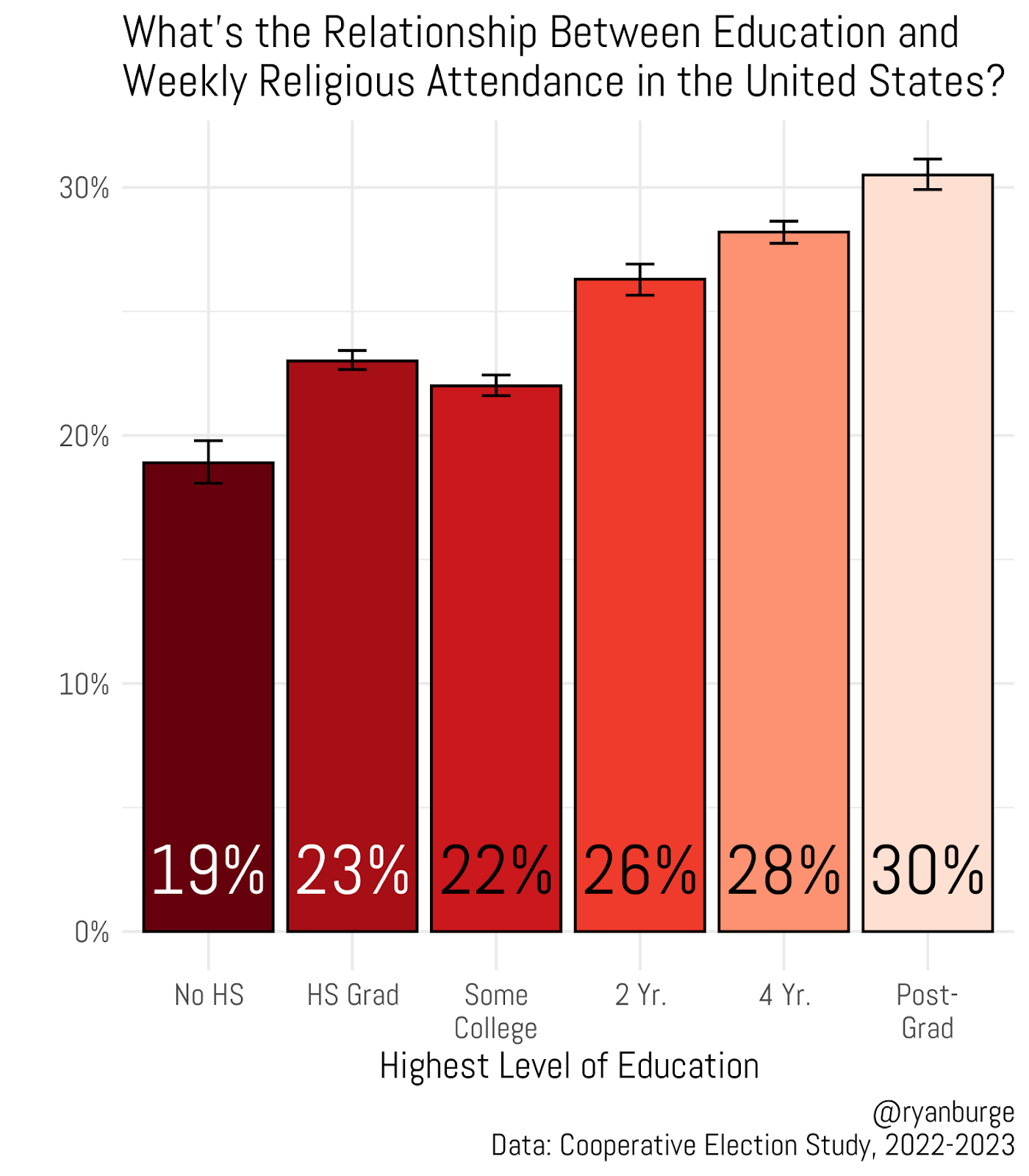
For example, this is data from the 2022 and 2023 Cooperative Election Study, which represents a sample of almost 85,000 people.
As you can plainly see, the relationship between weekly church attendance and education is a positive one. Among those with a high school diploma, only 23% indicate they attend church regularly. For those who have an associate’s degree, it’s 26%. It’s two points higher for people who completed a four year program and among those who went beyond an undergraduate education, 30% are weekly attenders.

...

But here’s a question that I wanted to answer in this post - does that same relationship exist in Europe? I’ve never tested it, but data from the European Social Survey makes it possible to do this type of analysis pretty easily. Their sample is from 24 European countries and the total number of respondents is about 40,000. I am looking at Wave 11, which is data collected in 2023 and 2024.

Obviously, the educational system in Denmark is not the same as Croatia, but the ESS offers a ‘unified’ education variable that seems to create a fairly standardized way to put people into consistent educational attainment categories.
Okay, well, this is different. Actually it’s almost the mirrored opposite of what we saw in the first graph from the United States. In this analysis the group of folks who were the most likely to be weekly religious attenders were people who had no formal education or stopped at primary school. Then the next most likely group to attend regularly were those who went to lower secondary school at 17%. And for those who stopped with upper secondary school it was three points lower than that.


Thursday, March 13, 2025

The Long Shadow of COVID, continued

Many posts have discussed COVID. Five years later, we are only now starting to grasp its long-term consequences.

Megan Brenan at Gallup:

Looking back on the COVID-19 pandemic’s impact on their school-age children, U.S. parents are more likely to report negative social and emotional issues than academic or physical health troubles.

Gallup’s latest update to its COVID-19 tracking poll finds that 45% of parents of school-age children say the pandemic has had a negative impact on their child’s social skills development. Half of them, 22%, report the social difficulty is ongoing, while the other half, 23%, say it has eased. Similarly, 42% of these parents say their child’s mental health has been negatively affected by the pandemic, including 21% who say the issue persists.

In terms of academics, at least three in 10 parents say the pandemic negatively impacted their child’s skills in math (36%), reading (31%) or science (30%), with roughly half of each group saying the effects are ongoing. Fewer parents (23%) say the pandemic negatively affected their child’s physical health.

Meanwhile, solid majorities of K-12 parents -- ranging from 56% to 69% -- say there was no effect on their child’s physical health or math, reading or science skills. Fewer say the same about their child’s social skills development (47%) and mental health (52%). No more than 10% of parents say their child was positively affected by the pandemic in any of the six areas measured.


Monday, February 3, 2025

Diploma Divide and Marriage

 Many posts have discussed economic and educational inequality. The effects of inequality reach many corners of American life.


Chambers, Clara and Goldman, Benjamin and Winkelmann, Joseph, Bachelors Without Bachelor's: Gender Gaps in Education and Declining Marriage Rates (January 01, 2025). Available at SSRN: https://ssrn.com/abstract=5086363 or http://dx.doi.org/10.2139/ssrn.5086363. Abstract:

Over the past half-century, the share of men enrolled in college has steadily declined relative to women. Today, 1.6 million more women than men attend four-year colleges in the U.S. This trend has not lowered marriage rates for college women, a substantial share of whom have historically married economically stable men without college degrees. Both historical evidence and cross-area comparisons suggest that worsening male outcomes primarily undermine the marriage prospects of non-college women. The gap in marriage rates between college-and non-college women is more than 50% smaller in areas where men have the lowest rates of joblessness and incarceration.


Friday, January 31, 2025

Racial Inequality, Educational Inequality, and Prison

 Many posts have discussed economic and educational inequality. The effects of inequality reach many corners of American life.

 Proceedings of the National Academy of Sciences (PNAS),

Falling racial inequality and rising educational inequality in US prison admissions for drug, violent, and property crimes
Christopher Muller https://orcid.org/0000-0003-3855-3375 muller@fas.harvard.edu and Alexander F. Roehrkasse https://orcid.org/0000-0003-4996-9317Authors Info & Affiliations
Edited by Paul DiMaggio, New York University, New York, NY; received September 4, 2024; accepted December 15, 2024
January 21, 2025
122 (4) e2418077122
https://doi.org/10.1073/pnas.2418077122


Abstract
Using administrative and survey data, we show that there has been a sea change in the contours of American imprisonment. At the end of the twentieth century, inequality in the prison admission rates of Black and White Americans was comparable to inequality in the prison admission rates of people with and without a college education. However, educational inequality is now much greater than racial inequality in prison admissions for all major crime types. Violent offenses have replaced drug offenses as the primary driver of Black prison admissions and Black–White inequality in the prison admission rate. The prison admission rate of Black Americans has fallen, but the prison admission rate of White Americans with no college education has dramatically increased for all offense categories. These findings, which are robust to adjustments for changing selection into college attendance, contribute to a growing body of evidence documenting narrowing racial inequality and widening educational inequality in Americans’ life chances.

Friday, December 6, 2024

Test Scores


American students’ math scores took a bigger hit from the pandemic than their peers overseas, according to a closely watched international exam.

U.S. fourth- and eighth-grade students’ math performance on a big worldwide test fell between 2023 and 2019, the last time the test was administered. America’s rankings slipped relative to other countries.

The exam, called the Trends in International Mathematics and Science Study or TIMSS, is a broad math and science assessment of fourth- and eighth-graders from the U.S. and dozens of other countries.

Research has linked school closures to greater learning loss, and the U.S. had a higher duration of at least partial school closures than many other countries, including all of Europe, according to a Unesco analysis. Still, at least one other big exam of high-schoolers, released last year, suggested U.S. learning loss wasn’t worse than its peers.

The stakes are high. Test scores predict economic success both for countries and individual students.

“I would call these declines sharp, steep,” Peggy Carr, commissioner of a statistical agency at the U.S. Department of Education, said in a call with reporters about the test data. The pandemic drops deepen slides that had already started, she said. “Something that we should be concerned about is that this isn’t just the impact of the pandemic.

U.S. scores were no better than when the tests were first given in 1995. In math, the recent declines wiped out years of gains. American science scores have fallen since 2015, although the latest drops from 2019 weren’t statistically significant.

Friday, September 6, 2024

School Shootings

 Many posts have discussed firearms and gun control.

CBS News:

Two students and two teachers at Apalachee High School in Winder, Georgia, were shot and killed and nine other people were hospitalized with gunshot wounds Wednesday.

The deadly incident on Sept. 4 was the 218th time a gun was fired or brandished at a school so far in 2024, data shows. The total number of shootings includes any incident where people are shot at, injured, or killed, regardless of how many individuals are involved.
...

A CBS News analysis of data from the K-12 Shooting Database shows that of the more than 200 incidents as of Sept. 4 — which include gang violence, domestic incidents and accidents, among other causes — 10 were in Georgia, including the Apalachee High School shooting.


Tuesday, August 27, 2024

Education and Soft Power

Amy Zegart at Foreign Affairs:
If education and innovation are key to the United States’ ability to project power, then the country’s prospects are on shaky ground. American K–12 education is in crisis. Students today are scoring worse on proficiency tests than they have in decades and falling behind their peers abroad. U.S. universities are struggling, too, as they face greater global competition for talent and chronic federal underinvestment in the basic research that is vital for long-term innovation.

In 2023, math and reading scores among American 13-year-olds were the lowest in decades, according to the National Assessment of Educational Progress. Half of U.S. students could not meet their state’s proficiency requirements. And scores on the ACT, the popular college admissions test, declined for the sixth year in a row, with 70 percent of high school seniors not meeting college readiness benchmarks in math and 43 percent not meeting college readiness benchmarks in anything. Notably, these trends began before the COVID-19 pandemic.

While students in the United States fall behind, students in other countries are surging ahead. According to the Program for International Student Assessment, which tests 15-year-olds worldwide, in 2022 the United States ranked 34th in average math proficiency, behind Slovenia and Vietnam. (Reading and science rankings were higher but barely cracked the top ten and top 20, respectively.) More than a third of U.S. students scored below the baseline math proficiency level, which means they cannot compare distances between two routes or convert prices into a different currency. At the top end, only seven percent of American teens scored at the highest level of math proficiency, compared with 12 percent of test takers in Canada and 23 percent in South Korea. Even pockets of excellence inside the United States don’t fare well internationally. Massachusetts was the top-scoring U.S. state in math in 2022 but would rank just 16th in the world if it were a country. Most U.S. states rank near the global median. And the lowest-scoring state, New Mexico, is on par with Kazakhstan.

Saturday, August 24, 2024

Religion and Civic Life

Many posts have discussed the role of religion in American life.   

 Daniel A. Cox and Sam Pressler at The Survey Center on American Life:

If America was a nation of joiners when Alexis de Tocqueville toured America in the 1830s, it is certainly not today. Most Americans are not joining groups. Despite the decline in religious membership over the past three decades, Americans are still more likely to be members of religious organizations (33 percent) than of any other group.
...

Religious organizations are the only group that more than 10 percent of Americans with high school degrees or less education join (27 percent). Indeed, Americans with a high school degree or less are at least three times more likely to belong to a religious group than to join any other type of group. Yet their college-educated peers are significantly more likely to be members of religious congregations (39 percent).

There are pronounced educational gaps in religious membership among and within racial groups. Black Americans join religious organizations at higher rates than all other racial groups. However, black Americans have the largest educational divide in religious membership: Nearly half (47 percent) of black Americans with college degrees belong to religious groups, compared to just 30 percent of blacks with high school degrees or less. Hispanics, in contrast, have the lowest religious membership rates of any racial or ethnic group. Just 31 percent of Hispanics with college degrees identify with religious groups, while only 24 percent of Hispanics with high school degrees or less are members.

...

Americans who belong to a church or place of worship generally have more people they can count on for help and support than the religiously unaffiliated have. However, the religious membership gap in Americans’ social support networks is largest among those with less formal education. Among Americans without a college education, members of a place of worship are much more likely than nonmembers to have multiple people who can take them to a doctor’s appointment (63 percent vs. 49 percent), give them a lift (67 percent vs. 55 percent), loan them $200 (53 percent vs. 42 percent), offer them a place to stay (59 percent vs. 46 percent), or help them move (68 percent vs. 54 percent).

Among Americans with a four-year college degree, those who belong to a church or place of worship do not have the same advantages over nonmembers. For instance, among Americans who are members of a church or place of worship, those with a college degree are not much more likely than those without one to have multiple people who would offer them a place to stay if needed (74 percent vs. 68 percent).

Americans who are members of a religious congregation have more extensive friendship networks. Nearly half (48 percent) of Americans who belong to a place of worship report they have at least five close friends. In contrast, 35 percent of Americans without a religious community have this many close friendships. Compared to members of religious congregations, nonmembers are twice as likely to report having no close friends (20 percent vs. 10 percent).

The educational divide in friendship is significantly diminished among Americans who belong to a place of worship. More than one in four (27 percent) Americans with a high school degree or less who do not belong to a church or place of worship have no close friends. Meanwhile, 11 percent of college graduates who are not attached to a church or place of worship say they have no close friends. The educational gap is half this large among church members: Those with a high school degree or less are only somewhat more likely than those with a college degree to report having no close friendships (15 percent vs. 7 percent).


Tuesday, November 14, 2023

Strike Threat Against a Union

Emily Peck at Axios:
Labor unrest is so intense this year that even labor unions are facing internal staff rebellions.

Driving the news: The field staff of the National Education Association (NEA), the teachers' union, voted unanimously on Monday to authorize a strike.

State of play: The NEA is the largest union in the country, representing about 3 million education professionals from pre-school to graduate school — and its tiny staff of 48 employees has been without a contract since May 2023.
  • The vote by the Association of Field Service Employees is the latest sign of the strong labor resurgence. The AFL-CIO is facing similar issues with the union that represents its staff.
  • Unless the parties reach a deal this week, a two-day strike would begin Friday at midnight with a picket line in Atlanta at an NEA conference in Atlanta.

Wednesday, November 1, 2023

Home Schooling

Many posts have discussed education.

Laura Meckler and Peter Jamison at the  Washington Post:
In March 2020, an involuntary form of home schooling — remote learning — was thrust upon American families everywhere. Millions could not wait to get their kids back to school, but for hundreds of thousands of others, the idea of teaching their kids at home was appealing. A surge in home schooling became one of the lasting impacts of the pandemic.

Yet there has been scant reliable data on the magnitude of the growth or the nature of the new home-schoolers. As part of a year-long series, The Washington Post set out to understand who the new home-schoolers are, where they live, how many there are and why they made these choices.
This research has included more than 100 interviews and two groundbreaking data projects: the collection and analysis of six years of enrollment and home-schooling registration figures in nearly 7,000 school districts, and a national poll of home-school parents.

The results paint a picture of home schooling as the fastest growing part of the U.S. education system, embraced by families more diverse than ever before, who are engaged in new and different ways of home education from the home-schoolers who preceded them.
In the first year of the pandemic, home schooling surged. Although small declines followed in the next two years, the number of children in home schooling remained 45 percent higher in the 2022-23 academic year than it was in 2017-18, based on data collected by the Post.

In 18 states, The Post was able to compare the growth of home schooling to enrollment in public and private schools over six years. In those states, the number of home-school students rose 51 percent between 2017-18 and 2022-23 — far exceeding a 7 percent rise in private school enrollment and a 4 percent decline in public school enrollment. That makes home schooling the fastest growing form of education, by a lot

Sunday, October 29, 2023

California Update: Losing Population, Flunking Computer Science

New data from the U.S. Census shows that around 820,000 people moved out of California and 550,000 out of New York in 2022. They join more than 8 million Americans who moved states in 2022.

Why it matters: The rising cost of living is pushing people out of expensive coastal areas, and the trend doesn't look likely to change in coming years: four in ten Californians and and three in ten New Yorkers say they're considering moving out of state.
  • Many of those moving are headed to Florida or Texas, the states with the largest influxes in 2022.
  • But Texans worried about the "California-ing" of their state may not need to worry: Democrats are much more likely to move to blue states, while Republicans move to red states.
Carolyn Jones at CalMatters:
Five years ago, California embarked on an ambitious plan to bring computer science to all K-12 students, bolstering the state economy and opening doors to promising careers — especially for low-income students and students of color.

But a lack of qualified teachers has stalled these efforts, and left California — a global hub for the technological industry — ranked near the bottom of states nationally in the percentage of high schools offering computer science classes.

“I truly believe that California’s future is dependent on preparing students for the tech-driven global economy. You see where the world is going, and it’s urgent that we make this happen,” said Allison Scott, chief executive officer of the Kapor Foundation, an Oakland-based organization that advocates for equity in the technology sector.

Scott was among those at a conference in Oakland this week aimed at expanding computer science education nationally. While some states — such as Arkansas, Maryland and South Carolina — are well on their way to offering computer science to all students, California lags far behind. According to a 2022 report by Code.org, only 40% of California high schools offer computer science classes, well below the national average of 53%.

California’s low-income students, rural students and students of color were significantly less likely to have access to computer science classes, putting them at a disadvantage in the job market, according to a 2021 report by the Kapor Center and Computer Science for California.


Thursday, October 5, 2023

Life Expectancy and Education

 Anne Case and Angus Deaton:at Brookings:

The widening gap in death rates between Americans with and without a four-year college degree shows the U.S. economy is failing working class people, suggests a paper discussed at the Brookings Papers on Economic Activity (BPEA) conference on September 28.

The U.S. economy, as measured by conventional metrics such as growth in gross domestic product (GDP), has recently outperformed other advanced economies. But mortality data paint a different picture, according to “Accounting for the Widening Mortality Gap between American Adults with and without a BA.”

“GDP may be doing great, but people are dying in increasing numbers, especially less-educated people,” Anne Case, one of the authors, said in an interview with The Brookings Institution. “A lot of the increasing prosperity is going to the well-educated elites. It is not going to typical working people.”

She and co-author Angus Deaton, the winner of the 2015 Nobel Prize in economics, both of Princeton University, analyzed U.S. death certificate information, including the age of death, cause of death, and educational attainment. They found that life expectancy for the college educated in 2021 was eight-and-a-half years longer than for the two-thirds of American adults without a bachelor’s degree. That’s more than triple the 1992 gap of about two-and-a-half years.

... 

 Deaths of despair were the leading driver of the widening mortality gap over the past 30 years, but the gap also widened for most other major causes of death, the paper notes. Cancer mortality, for instance, has declined overall but it has declined more for people with college degrees.

The mortality gap widened explosively during the pandemic, according to the paper. Both COVID-19 deaths and deaths of despair were more common among people without college degrees, who were more likely to work in public-facing jobs, use public transportation, and live in crowded quarters.

“People with BAs have Zoom. People without BAs don’t have Zoom; they have to go to work,” Deaton said.