Search This Blog

Showing posts with label American exceptionalism. Show all posts

Friday, July 10, 2026

Fewer Believe God Granted America a Special Role

 Many posts have discussed patriotism and American exceptionalism. Religion is part of the story.

From PRRI:

Just 44% of Americans agree with the idea that God has granted America a special role in human history, compared with a slim majority who disagree (52%). Agreement with this idea was relatively high in the early and mid-2010s, around 60 percent. Beginning in 2020, however, agreement dropped significantly to 40% and has since remained relatively stable in the low-to-mid 40s through 2026.

The partisan gap on American exceptionalism has widened sharply over the past decade. While Republican agreement that God has granted America a special role has remained relatively stable — dipping from 75% in 2012 to 63% in 2022, with about seven in ten agreeing today — Democratic support has collapsed, falling from 60% to just 27%. Independents declined as well, hitting a low of 35% in 2020 before a modest recovery to 40% in 2026.
In 2012, majorities of nearly all religious groups agreed that God has granted America a special role in human history. Today, only four religious subgroups hold this view. Most Latter-day Saints (80%), white evangelical Protestants (75%), Hispanic Protestants (64%), and Black Protestants (52%) agree that God has a special role for America. By contrast, less than half of every other major religious group agrees with this statement, including 49% of white Catholics, 47% of white mainline/ non-evangelical Protestants, 44% of Hispanic Catholics, 34% of Jewish Americans, 32% of other non-Christians, and only 21% of religiously unaffiliated Americans. Since 2022, white evangelical Protestants (from 68%) and religiously unaffiliated Americans (from 16%) have become more likely to agree. 


Friday, June 26, 2026

Stripes at 45: A Patriotic Movie

  Many posts have discussed patriotism and American exceptionalism.

Stripes premiered 45 years ago today.  Two years ago, Rich Cohen wrote at WSJ:

Released in 1981, “Stripes” is the story of a burnout named John Winger who, seeking direction, joins the Army. It was the first summer after the election of Ronald Reagan, whose campaign had been powered by the eerily familiar slogan, “Let’s Make America Great Again!” It was a time of high inflation, simmering tension with a communist rival and deep polarization in our politics.

In other words, a moment much like our own, which might explain why Murray’s speech still speaks so powerfully to my own teenage kids. I can’t think of a better statement of what ails us and what still makes America and Americans exceptional.

“We’re not Watusi,” Murray tells his fellow grunts in a moment of disunity and crisis. “We’re not Spartans. We’re Americans, with a capital ‘A,’ huh? You know what that means? Do ya? That means that our forefathers were kicked out of every decent country in the world. We are the wretched refuse. We’re the underdog. We’re mutts!…But there’s no animal that’s more faithful, that’s more loyal, more lovable than the mutt.”

Murray played it for laughs, and it was funny, but it was serious too. It celebrates our tolerance, stick-to-it-ness and ethnic jumble. It’s John Winthrop’s City on a Hill remade in the shadow of “Saturday Night Live.” I rank it with FDR’s First Inaugural and Lincoln at Gettysburg. It’s the speech we need today.

...

 This silly speech in a silly movie expressed a powerful truth. The Germans of World War II were all the same because they were all the same. We are all the same because we are all different. Which means those differences don’t really matter. Our ancestors came to this country to leave all that B.S. behind. It was the American creed rephrased in the vernacular. It was beautiful. 

Only later did I fully appreciate that Murray, along with screenwriters Harold Ramis and Len Blum, had given us a great gift: a way to love our country without feeling gullible, sentimental or corny.

Thursday, June 11, 2026

Poll on America at 250

 Many posts have discussed patriotism and American exceptionalism.

GARY FIELDS, LINLEY SANDERS and NICHOLAS RICCARDI at AP:
The survey from The Associated Press-NORC Center for Public Affairs Research highlights many Americans’ feeling of unease over the future of its representative government — particularly among young people. It presents a jarring contrast as communities around the country commemorate the nation’s 250th anniversary.

Only about one-quarter of Americans say the U.S. stands above all other countries in the world, the new poll found, while 44% say it’s one of the greatest countries in the world, along with some others. About 3 in 10 say there are better countries than the U.S., an increase from 19% in an AP-NORC poll conducted in June 2016.

Americans remain divided about whether diversity is an essential feature of the U.S.'s identity, and agreement about other aspects of the country’s underlying character appears to be eroding, the survey found. Americans are less likely to see a democratically elected government as “extremely” or “very” important to the United States’ identity as a nation than they were just a few years ago. About two-thirds of U.S. adults now say a democratically elected government is highly important to the U.S.’s identity as a nation, down from 80% in 2021.

...

Toung adults are much less likely than older Americans to believe the U.S. is special, compared with other nations, the poll found.

About 4 in 10, 44%, of U.S. adults under 30 say there are other countries better than the U.S., compared with 22% of U.S. adults ages 60 and older.

Fewer, too, see democracy as a key element of the U.S.’s identity. Only about half of Americans under 30 believe this, compared with 81% of those 60 and older.

Thursday, July 3, 2025

The Greatest Country?

Many posts have discussed patriotism and American exceptionalism.

 Karlyn Bowman at AEI:

In 1955, the Gallup Organization asked Americans to suppose they were talking in a general way about the United States and other countries. The organization then asked which of three statements came closer to the respondent’s point of view. Two-thirds chose the response that the United States was the “greatest country in the world, better than all other countries in every possible way.” Thirty-one percent believed the US was “a great country but so are certain other countries.” And finally, 1% said that in many other respects, certain other countries were better than the US.

A version of this question has been asked occasionally by pollsters ever since. A 1998 survey of parents done for Public Agenda found 84% believed the United States was “a unique country that stands for something special in the world,” while 13% said the US is “just another country whose system is no better or worse than other countries.”

In 2011, the Pew Research Center began asking another version. That year, 38% responded that “the U.S. stands above all other countries in the world,” while 53% said the U.S. was “one of the greatest countries in the world, along with some others.” Eight percent said there were other countries that were better than the U.S. The 38% response has been trending downward unevenly, and in 2024, using a different methodology, 20% said the US stands above, while 55% said there were other countries that were also great. Twenty-four percent said there were other countries that were better, three times as many as had given that response in 2011

The Chicago Council for Global Affairs presents a binary choice: “Some people say the United States has a unique character that makes it the greatest country in the world. Others say that every country is unique, and the United States is no greater than other nations.” In 2012, 70% chose greatest country response, while 29% opted for the “no greater than other nations.” In 2023, the last time they asked the question, there was a big change in the no greater response: almost as many, 47%, chose it while 52% chose the greatest country. The Chicago Council looked at the responses by generations and found that majorities of the oldest generation, the Baby Boomers, and Gen X-ers all opted for the greatest response. Millennials, born in 1981 and beginning to come of age in the mid-1990s, were different. Just 40% of Millennials chose this response, and 59% opted for the no greater one. Other pollsters show the same generational differences with Millennials and younger generations more skeptical than their elders about the US’s role. The Council noted that racial and ethnic differences to the question were small.


Thursday, July 25, 2024

The Founders and Current Events

 Many posts have discussed the Founding.

David Frum at The Atlantic:

Two political myths inspired the dreams and haunted the nightmares of the Founders of the American republic. Both these foundational myths were learned from the history and literature of the ancient Romans.

Cincinnatus was the name of a man who, the story went, accepted supreme power in the state to meet a temporary emergency and then relinquished that power to return to his farm when the emergency passed. George Washington modeled his public image on the legend of Cincinnatus, and so he was depicted in contemporary art and literature—“the Cincinnatus of the West,” as Lord Byron praised him in a famous poem of the day.

Against the bright legacy of Cincinnatus, the Founders contrasted the sinister character of Catiline: a man of depraved sexual appetites who reached almost the pinnacle of power and then exploited populist passions to overthrow the constitution, gain wealth, and pay his desperately pressing debts. Alexander Hamilton invoked Catiline to inveigh against his detested political adversary, Aaron Burr:
He is bankrupt beyond redemption except by the plunder of his country. His public principles have no other spring or aim than his own aggrandisement … If he can, he will certainly disturb our institutions to secure to himself permanent power and with it wealth … He is truly the Cataline of America.

Jessica Gavora at The Atlantic:

The notion that America is an idea has always lifted up our country, and for good reason. The fact that America was founded on the principles of the Declaration of Independence and the governing limits of the Constitution makes us unique among nations. Most countries trace their origins to tribal identity. But America has its origins in the revolutionary idea that the government cannot deny men and women an equal opportunity to life, liberty, and the pursuit of happiness. Both our friends and foes have recognized this difference. No less than Joseph Stalin railed against American “exceptionalism” when our workers refused to join in solidarity with his murderous revolution of the proletariat.

Tuesday, February 6, 2024

Reagan Birthday

 Ronald Reagan was born on this date in 1911.  From his 1992 address to the Republican National Convention:

And whatever else history may say about me when I’m gone, I hope it will record that I appealed to your best hopes, not your worst fears, to your confidence rather than your doubts. My dream is that you will travel the road ahead with liberty’s lamp guiding your steps and opportunity’s arm steadying your way.

My fondest hope for each one of you — and especially for the young people here — is that you will love your country, not for her power or wealth, but for her selflessness and her idealism. May each of you have the heart to conceive, the understanding to direct, and the hand to execute works that will make the world a little better for your having been here.

May all of you as Americans never forget your heroic origins, never fail to seek divine guidance, and never lose your natural, God-given optimism.

And finally, my fellow Americans, may every dawn be a great new beginning for America and every evening bring us closer to that shining city upon a hill.

Friday, December 15, 2023

American Exceptionalism 2024

 Joseph Nye Jr. at Project Syndicate:

As the 2024 presidential election approaches, three broad camps are visible in America’s debate over how the United States should relate to the rest of the world: the liberal internationalists who have dominated since World War II; the retrenchers who want to pull back from some alliances and institutions; and the America Firsters who take a narrow, sometimes isolationist, view of America’s role in the world.

Americans have long seen their country as morally exceptional. Stanley Hoffmann, a French-American intellectual, said that while every country considers itself unique, France and the US stand out in believing that their values are universal. France, however, was limited by the balance of power in Europe, and thus could not pursue its universalist ambitions fully. Only the US had the power to do that.

The point is not that Americans are morally superior; it is that many Americans want to believe that their country is a force for good in the world. Realists have long complained that this moralism in American foreign policy interferes with a clear analysis of power. Yet the fact is that America’s liberal political culture made a huge difference to the liberal international order that has existed since WWII. Today’s world would look very different if Hitler had emerged victorious or if Stalin’s Soviet Union had prevailed in the Cold War.
American exceptionalism has three main sources. Since 1945, the dominant one has been the legacy of the Enlightenment, specifically the liberal ideas espoused by America’s founders.

...

A second strand of American exceptionalism stems from the country’s Puritan religious roots. Those who fled Britain to worship God more purely in the new world saw themselves as a chosen people. Their project was less crusading in nature than anxious and contained, like the current “retrencher” approach of fashioning America as a city on a hill to attract others....

The third source of American exceptionalism underlies the others: America’s sheer size and location has always conferred a geopolitical advantage. Already in the nineteenth century, De Tocqueville noted America’s special geographical situation.


Tuesday, July 4, 2023

Zelensky and American Exceptionalism

 Volodymyr Zelensky at WSJ:

A decade ago the current boss of Russia wrote that “America is not exceptional.” What he did later shows what he really meant. Many tyrants in human history have claimed global influence, but none of them could inspire the rest of the world to strive for the best in human nature. That’s why today’s Russian tyrants, like all tyrants, are fundamentally weak and their regime will crumble over time. When any tyrant hates America and denies its exceptional role in the struggle for freedom, he recognizes his own inevitable defeat. To Russian tyranny I say the world needs more, not less, American exceptionalism.

In 2013, Trump sided with Putin:

And it really makes him look like a great leader, frankly. And when he criticizes the president [Obama]  for using the term "American exceptionalism," if you're in Russia, you don't want to hear that America is exceptional. And if you're in many other countries, whether it's Germany or other places, you don't want to hear about American exceptionalism because you think you're exceptional. So I can see that being very insulting to the world.

And that's basically what Putin was saying is that, you know, you use a term like "American exceptionalism," and frankly, the way our country is being treated right now by Russia and Syria and lots of other places and with all the mistakes we've made over the years, like Iraq and so many others, it's sort of a hard term to use.

 But other nations and other countries don't want hear about American exceptionalism. They're insulted by it. And that's what Putin was saying.

Saturday, November 20, 2021

Did God Grant America a Special Place?

From PRRI:
Compared to 2013, significantly fewer Americans today believe that God has granted America a special role in human history. In 2013, nearly two-thirds of Americans (64%) agreed with this statement, compared to only 29% who disagreed. Today, belief in this statement has dropped a massive 20 percentage points, to 44%, with a majority of Americans (53%) now disagreeing that God has granted America a special role in human history.

Republicans (68%) are twice as likely as Democrats (33%) to agree that God has granted America a special role in human history. Independents (40%) are slightly less likely to think this way than all Americans are. Notably, belief in this statement has dropped across all partisan groups since 2013, including 25 percentage points among Democrats (from 58% to 33%), 23 percentage points among independents (from 63% to 40%), and nine percentage points among Republicans (from 77% to 68%).

Among all religious groups, white evangelical Protestants (75%) are the most likely to agree that God has granted America a special role in human history, a significant decline from 84% in 2013. Two-thirds of Black Protestants (67%) and 55% of other Christians also agree with this idea, as do half of Hispanic Catholics (50%). Less than half of white mainline (non-evangelical) Protestants (46%) and white Catholics (46%) agree, substantial decreases from 75% and 60%, respectively, in 2013, while even fewer members of non-Christian religions (29%) and religiously unaffiliated Americans (18%) think this way. Unaffiliated Americans also declined significantly, from 40% in 2013.[3]

Wednesday, November 3, 2021

A Force for Good?

From the Public Religion Research Institute:
About three in four Americans (74%) agree that America has always been a force for good in the world, including 19% who completely agree with this idea and a majority (55%) who mostly agree. One in four (24%) disagree, including 17% who mostly disagree and 7% who completely disagree. In 2013, slightly more Americans (79%) believed their country has always been a force for good in the world.

Republicans (92%) are more likely than independents (72%) and Democrats (67%) to agree with the idea that America has always been a force for good in the world. While there have not been significant changes among Republicans (90%) and independents (77%) since 2013, Democrats have become seven percentage points less likely to agree (67% today vs. 74% in 2013). Notably, nearly all Republicans who trust Fox News (94%) and far-right media outlets (96%) as their main sources of information agree with this idea.[1]

Overwhelming majorities of white Christian groups agree with this idea, including nearly nine in ten white evangelical Protestants (88%), white mainline (non-evangelical) Protestants (88%), and white Catholics (85%). Two-thirds or more of Hispanic Catholics (73%), other Christians (71%), Black Protestants (69%), and members of non-Christian religions (66%) also agree that America has always been a force for good in the world.[2] Religiously unaffiliated Americans (58%) are the least likely to hold this belief.


Thursday, February 11, 2021

Attitudes on Patriotism and American Exceptionalism

Daniel A. Cox at the Survey Center on American Life:

Despite a lackluster federal response to the COVID-19 outbreak and a violent assault on the US Capitol, Americans remain firm in their belief that American culture and the American way of life are superior to others. More than half (53 percent) of Americans say that the world would be much better off if more countries adopted American values and the American way of life. Approximately four in 10 (42 percent) disagree with this statement.

There is even greater agreement among the public that the US has always been a force for good in the world. Nearly three-quarters (73 percent) of Americans agree, while about one in four (24 percent) reject the idea that the US has been consistently virtuous in its actions abroad.

Fewer Americans believe the US has a special relationship with God. Nearly half (45 percent) the public believe that God has granted the country a special role in human history. Roughly half (49 percent) of Americans disagree.

There are massive generational differences in views about American exceptionalism. Young adults are far more likely to challenge notions that the US serves as a moral beacon. Less than half (46 percent) of young adults (age 18 to 29) believe the world would be better off if more countries adopted American values and lifestyle. In contrast, seven in 10 (70 percent) seniors (age 65 or older) agree with this statement. Young adults are also far less inclined to believe the US continues to be a force for good in the world.

Overall, most Americans feel proud about their national identity. More than six in 10 say they are extremely proud (34 percent) or very proud (28 percent) to be an American. But this sentiment masks considerable cleavages among the public along the lines of race, political affiliation, and generation.

There are sizable generational divisions in feelings of pride about being American. Older Americans express much more pride in their nationality than do younger Americans. In fact, seniors are more than twice as likely to say they are extremely proud to be American than are young adults (55 percent vs. 23 percent).

No religious group expresses greater pride in their national identity than white evangelical Protestants. More than three-quarters of white evangelical Protestants say they are very or extremely proud to be an American; half (50 percent) say they are extremely proud. More than four in 10 white Catholics (46 percent) and white mainline Protestants (43 percent) also report being extremely proud about their national identity. Considerably fewer Hispanic Catholics (29 percent), black Protestants (27 percent), members of non-Christian religious traditions (26 percent), and religiously unaffiliated Americans (20 percent) report they are extremely proud to be American.

Saturday, November 14, 2020

Polarization and COVID in Comparative Perspective


Many posts  have discussed partisan polarization and its relationship to various social characteristics.

Michael Dimock and Richard Wike at Pew note that other countries have political fissures.
But the 2020 pandemic has revealed how pervasive the divide in American politics is relative to other nations. Over the summer, 76% of Republicans (including independents who lean to the party) felt the U.S. had done a good job dealing with the coronavirus outbreak, compared with just 29% of those who do not identify with the Republican Party. This 47 percentage point gap was the largest gap found between those who support the governing party and those who do not across 14 nations surveyed. Moreover, 77% of Americans said the country was now more divided than before the outbreak, as compared with a median of 47% in the 13 other nations surveyed.

Much of this American exceptionalism preceded the coronavirus: In a Pew Research Center study conducted before the pandemic, Americans were more ideologically divided than any of the 19 other publics surveyed when asked how much trust they have in scientists and whether scientists make decisions solely based on facts. These fissures have pervaded nearly every aspect of the public and policy response to the crisis over the course of the year. Democrats and Republicans differ over mask wearing, contact tracing, how well public health officials are dealing with the crisis, whether to get a vaccine once one is available, and whether life will remain changed in a major way after the pandemic. For Biden supporters, the coronavirus outbreak was a central issue in the election – in an October poll, 82% said it was very important to their vote. Among Trump supporters, it was easily the least significant among six issues tested on the survey: Just 24% said it was very important.

Why is America cleaved in this way? Once again, looking across other nations gives us some indication. The polarizing pressures of partisan media, social media, and even deeply rooted cultural, historical and regional divides are hardly unique to America. By comparison, America’s relatively rigid, two-party electoral system stands apart by collapsing a wide range of legitimate social and political debates into a singular battle line that can make our differences appear even larger than they may actually be. And when the balance of support for these political parties is close enough for either to gain near-term electoral advantage – as it has in the U.S. for more than a quarter century – the competition becomes cutthroat and politics begins to feel zero-sum, where one side’s gain is inherently the other’s loss. Finding common cause – even to fight a common enemy in the public health and economic threat posed by the coronavirus – has eluded us.

Wednesday, July 29, 2020

Patriotism and Pandemic

At WP, William Booth interviews Lancet editor Richard Horton:
Q: In your book, you write, “The story of covid-19 in the United States is one of the strangest paradoxes of the whole pandemic. No other country in the world has the concentration of scientific skill, technical knowledge and productive capacity possessed by the U.S. It is the world’s scientific superpower bar none. And yet this colossus of science utterly failed to bring its expertise successfully to bear on the policy and politics of the nation’s response.”
A: That’s true.

Q: What happened?

A: This is hard. I love America. But it can be very parochial. I think the fact that America sees itself as the greatest country in the world means that it sees itself as impregnable. That view informs not just a response to a pandemic, but attitudes to climate change and other threats.

I don’t think many American public health scientists and government advisers read those papers we published. If they did, I don’t think that they took them seriously. I think there was a very serious miscalculation of the risk by American public health scientists.

I know Tony Fauci well, and his entire career has been forged on the fight against AIDS. He’s a brilliant scientist. He is a brave man. But something went wrong here. I wish I could give you a clear answer as to why, but I can’t. I really can’t explain it.

Saturday, February 23, 2019

"Truly American"


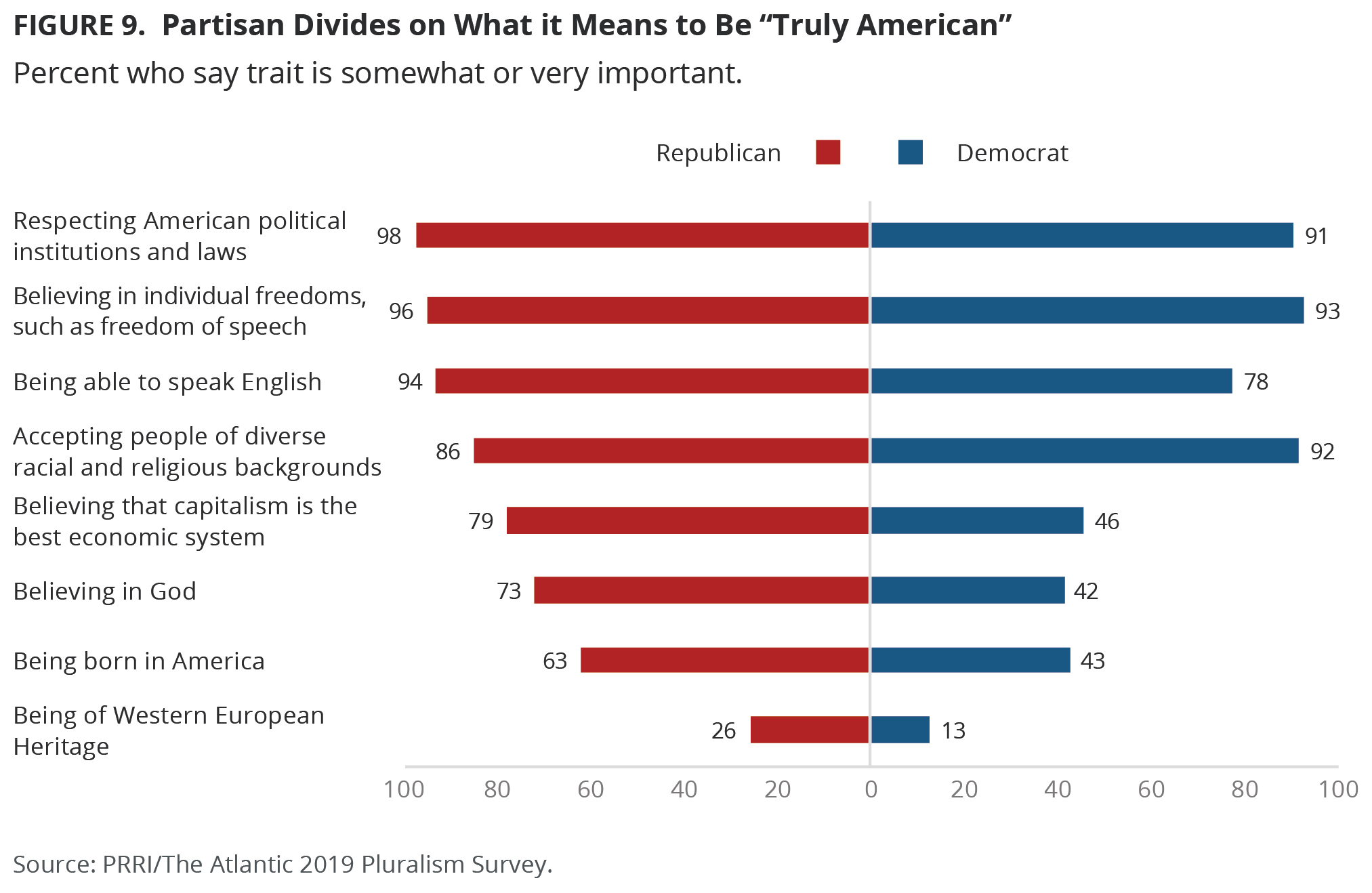
At the Public Religion Research Institute, Maxine Najle and Robert P. Jones report on survey data:
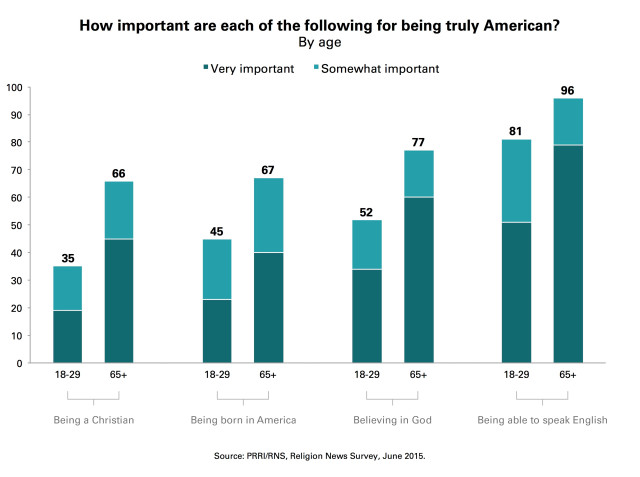
When asked how important certain characteristics or beliefs are to being “truly American,” Americans overwhelmingly agree that a few characteristics are fundamental to being American, but are more divided on others. The vast majority of Americans agree that believing in individual freedoms, such as freedom of speech (91%), respecting American political institutions and laws (90%), accepting people of diverse racial and religious backgrounds (86%), and being able to speak English (83%) are somewhat or very important to being American.
Americans are more divided on other characteristics. A majority (56%) of Americans agree that believing that capitalism is the best economic system is somewhat or very important for being truly American, while 38% say this is not too important or not at all important. A slim majority (52%) of Americans agree that believing in God is somewhat or very important for being American. However, only 39% say that being a Christian is somewhat or very important for being truly American, while a majority (56%) say it is not too important or not at all important.
Half (50%) of Americans say that being born in America is somewhat or very important for being truly American, while 46% say this is not too important or not at all important. However, Americans decisively reject the notion that Western heritage is fundamental to a truly American identity: only 17% say that being of Western heritage is somewhat or very important for being American, while most (78%) agree that this is not very important or not at all important.

Saturday, January 19, 2019

Generation Z: Yea on Liberalism, Nay on American Exceptionalism

Kim Parker, Nikki Graf And Ruth Igielnik at Pew:
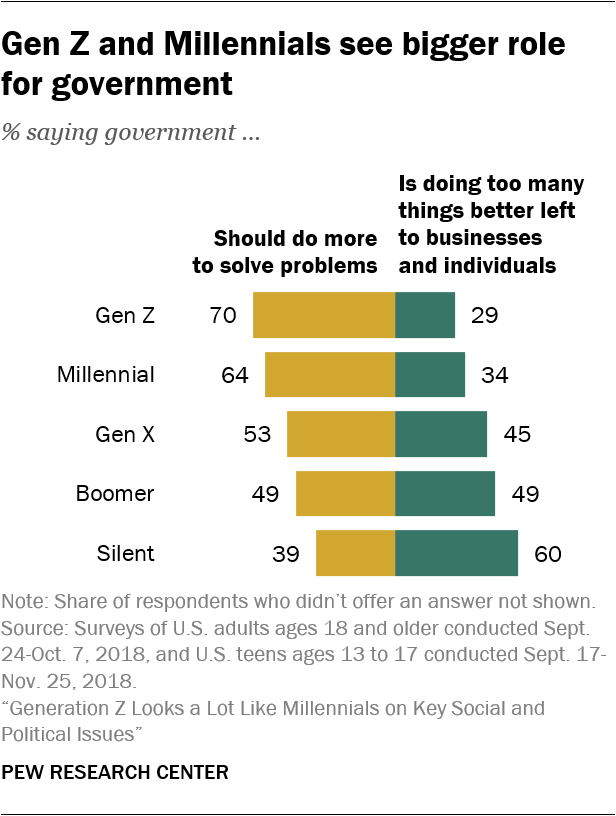
No longer the new kids on the block, Millennials have moved firmly into their 20s and 30s, and a new generation is coming into focus. Generation Z – diverse and on track to be the most well-educated generation yet – is moving toward adulthood with a liberal set of attitudes and an openness to emerging social trends...while majorities in Gen Z and the Millennial generation say government should do more to solve problems, rather than that government is doing too many things better left to businesses and individuals, Gen Xers and Boomers are more evenly divided on this issue. For their part, most Silents would like to see a less activist government.
Gen Z and Millennials see bigger role for government


And the younger generations are less likely to think that America is better than other countries:


Definitions
  • Generation Z (born 1997-2005)
  • Millennials (born 1981-96)
  • Generation X (born 1965-80)
  • Baby Boomers (born 1946-64) 
  • Silent Generation (born 1928-45)

Friday, October 12, 2018

American Politics for International Students 2018

Ways in which America is different 


I. RELIGION

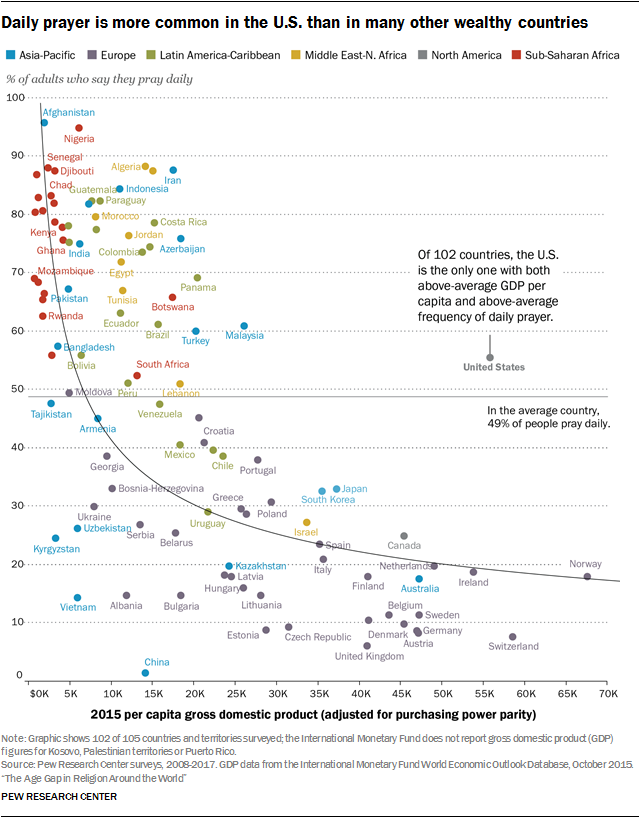
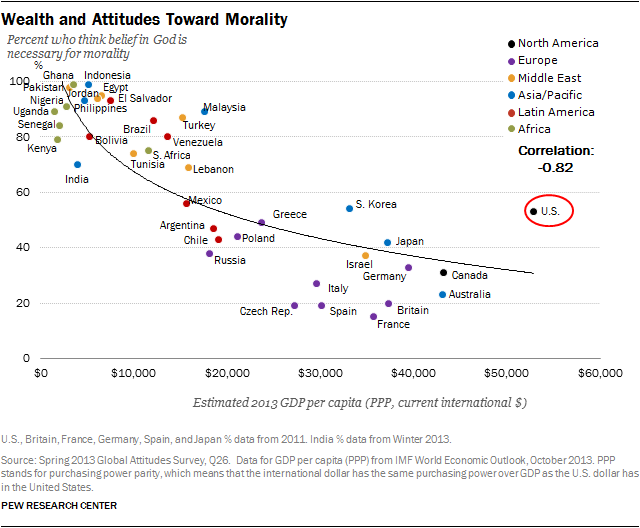
There are other rich countries.  There are other religious countries. The US is rich and religious.


"Of all the dispositions and habits which lead to political prosperity, religion and morality are indispensable supports." -- George Washington, 1796  Farewell Address

Similarly, see percentage who think that belief in God is necessary for morality:


Being "truly American:

Chart-3-Important-Factors-Being-American-by-Generation
II. PATRIOTISM

"Nothing is more annoying ... than this irritable patriotism of the Americans. A foreigner will gladly agree to praise much in their country, but he would like to be allowed to criticize something, and that he is absolutely refused."  -- Tocqueville, Democracy in America


More than six in ten (62%) Americans believe that God has granted America a special role in human history, while roughly one-third (33%) disagree. Views have not shifted significantly in recent years. In 2012, an identical number of Americans (62%) agreed that the U.S. was granted a special role in human history. There are sharp differences on this question by political ideology and religious affiliation.
Conservatives are nearly twice as likely as liberals to agree that God has granted the U.S. a special role in human history—80% of conservatives and only 45% of liberals agree with this statement. Half (50%) of liberals reject the notion that the country has a divinely sanctioned role in human history.
White evangelical Protestants are unique among religious Americans in their affirmation of American exceptionalism. More than eight in ten (83%) white evangelical Protestants agree that God has granted the country a special role in human history. Seven in ten non-white Protestants (73%) and Catholics (70%) and a majority (56%) of white mainline Protestants also believe in a divinely chosen role for the U.S. In contrast, a majority (53%) of religiously unaffiliated Americans disagree that God granted the U.S. a special role, compared to fewer than four in ten (39%) who agree.
...
More than eight in ten (83%) Americans say that it is important to publicly show support for the U.S. by doing things such as displaying the American flag; only 14% of the public disagree. Across political and religious spectrums, Americans embrace the importance of public demonstrations of patriotism.
THE 45TH PRESIDENT IS QUITE ODD, SINCE HE BELIEVES IN NEITHER AMERICAN EXCEPTIONALISM NOR THE CENTRAL PRINCIPLE OF THE DECLARATION.


III. INDIVIDUALISM AND THE WELFARE STATE


The self-made man:  Alexander Hamilton as immigrant and American hero.


IV.  INSTITUTIONS AND ELECTIONS

Ranking Presidents

The Separation of Powers

Congress and Bicameralism:


Federalism:  about 89,000 governments and about 513,000 elected officials

Federalism and ballot complexity

Voter turnout

Partisan Polarization

Parties and Campaigns:


"Those who profess to favor freedom and yet deprecate agitation, are men who want crops without plowing up the ground, they want rain without thunder and lightning. They want the ocean without the awful roar of its many waters." --Frederick Douglass

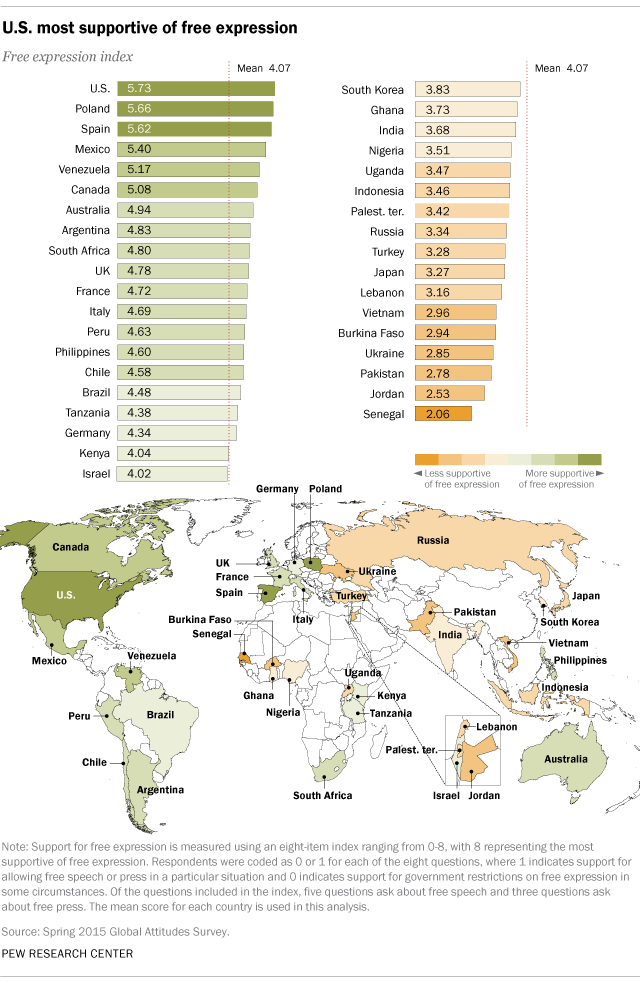
Free Speech:  the Unusual First Amendment

Support for Free Expression


Tuesday, April 17, 2018

“We’ve seen this movie before, just never in English.”

Gideon Rose at Foreign Affairs:
Centralization of power in the executive, politicization of the judiciary, attacks on independent media, the use of public office for private gain—the signs of democratic regression are well known. The only surprising thing is where they’ve turned up. As a Latin American friend put it ruefully, “We’ve seen this movie before, just never in English.”

The United States has turned out to be less exceptional than many thought. Clearly, it can happen here; the question now is whether it will. To find an answer, the articles in this issue’s lead package zoom out, putting the country’s current troubles into historical and international perspective.

Some say that global democracy is experiencing its worst setback since the 1930s and that it will continue to retreat unless rich countries find ways to reduce inequality and manage the information revolution. Those are the optimists. Pessimists fear the game is already over, that democratic dominance has ended for good.

Sunday, July 2, 2017

Public Opinion on American Greatness

A majority of the public (85%) says either that the United States “stands above all other countries in the world” (29%) or that it is “one of the greatest countries, along with some others” (56%). Only 14% of Americans say there are “other countries better than the U.S.” These views have changed little in recent years.
As in the past, Republicans are more likely than Democrats to say the U.S. “stands above” all other nations, according to the survey, conducted June 8-18. About four-in-ten Republicans and Republican-leaning independents (41%) say the U.S. stands above other countries, compared with 19% of Democrats and Democratic leaners. This is nearly identical to the partisan gap on this question in the fall of 2015.


Tuesday, May 9, 2017

Nationalism and Patriotism

Daniel Krauthammer at The Weekly Standard:
The distinction between nationalism and patriotism is often overlooked. Unlike the United States, most countries were nations long before they became states. And nationalism has traditionally been an ideology that advocates the aggrandizement of particular national groups​—​not whole countries inclusive of minority ethnicities and nationalities. The word nationalism was first used in this sense in 1772 by the philosopher Johann Gottfried Herder, and it came to be embraced as an animating ideology by Germans in their response to the ideals and invasions of the French Revolutionary era. They rejected the liberal ideas of political citizenship and universal rights and instead embraced a unifying vision of a German volk rooted in ethnicity, language, blood, and mythology. German nationalism predated the creation of the German state by a century.

Patriotism, on the other hand, is a concept whose etymology and history is closely linked with ancient Greek and Roman ideas of membership in a political community. It is a term for devotion and commitment not to the ethnic group into which one is born, but to a political state of which one is a citizen. It does not exclude minorities within that state, nor does it extend to members of a common national group outside that state. An ethnic German living in Poland as a Polish citizen in 1939, for instance, could have fought against the Nazi invasion as a Polish patriot, but not as a Polish nationalist. Likewise, the defense of a political republic can be patriotic even if it undermines nationalist goals. The Wehrmacht officers who broke their oath and tried to kill Hitler in 1944, for example, are regarded as German patriots, not nationalists.

Monday, March 6, 2017

Survey: American Identity

A recent poll  by The Associated Press-NORC Center for Public Affairs Research:
  • Sixty-five percent of Americans say diversity makes the United States stronger, up from 56 percent in an AP-NORC poll taken last June. Only 11 percent say it makes the country weaker, and 23 percent think it has no effect.
  • Along with a positive view of diversity, Americans see immigration in a largely positive light, although they are less welcoming to refugees.
  • Nearly 6 in 10 say the United States should be a country with an essential American culture and values that immigrants take on when they arrive, but just as many say that most recent immigrants retain their own customs, rather than assimilate.
  • Americans say legal immigration provides more advantages than disadvantages, and two-thirds think the benefits outweigh any risks. The public is closely split on whether the possible harm from welcoming refugees outweighs potential advantages.
  • Six in 10 Americans say legal immigration boosts the reputation of the United States as a land of opportunity and benefits companies with technical expertise.
  • A third of the public agrees that the United States stands above all other countries in the world, while 56 percent of the public say the United States is one of the greatest countries in the world along with some others. Just 11 percent think there are other countries that are better.
  • Nearly 8 in 10 Americans are proud of the country’s armed forces, while less than 3 in 10 have pride in how groups in society are treated and in the Social Security system.
  • More than three-quarters consider a fair judicial system and rule of law, Constitutional freedoms and liberties, and the ability to achieve the American dream as central tenets of the country’s identity. Half say the mixing of cultures is important, and fewer think the country’s identity is tied to Christian values and European traditions. However, 7 in 10 consider the use of English to be important.
  • More than half of Americans say political polarization is extremely or very threatening to the United States. Nearly as many consider political leaders, economic inequality, and illegal immigration as important threats to the American way of life. Four in 10 say influence from foreign governments jeopardizes the country, but only 15 percent say that about legal immigration.
...
Most Americans fear the United States is losing its national identity, with 7 in 10 saying so compared to just 3 in 10 who say the country’s identity is secure. Young people are particularly likely to say the country is losing its identity (77 percent) compared to those age 60 and older (66 percent). This is one issue where Democrats, independents, and Republicans are in agreement: about 7 in 10 of each of these groups says the country is losing its identity.