Search This Blog

Showing posts with label baby boom. Show all posts

Monday, August 10, 2026

Boomers Cling to Wealth and Power

The first of the Baby Boomer generation turns 80 this year, with the fourth and likely last of the Baby Boomer Presidents well-into his second term. Leadership will eventually pass to younger generations. But Boomers still hold much of the wealth and many of the offices, and they appear in no hurry to hand things over. A brief look at generational inheritance.
...
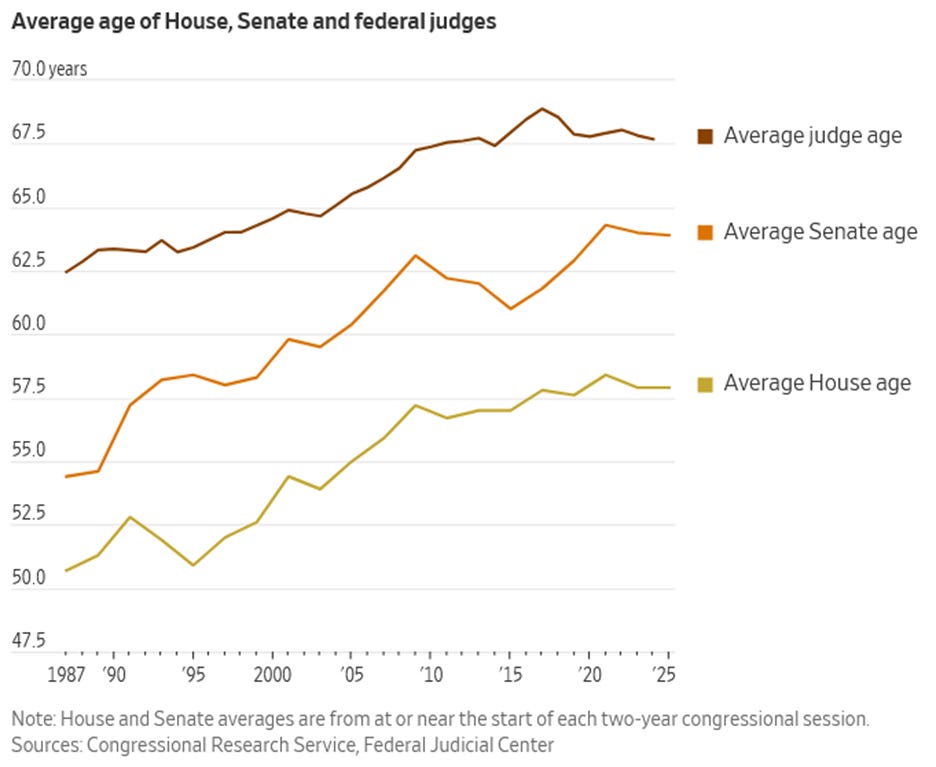
Decades of rising earnings and asset values left Baby Boomers and older Americans holding nearly two-thirds of assets. And the wealth has outlasted the traditional handoff: Americans are living and working longer, while judges, Senators, House members and CEOs are markedly older than they were a generation ago.


Older generations are also sticking around longer in government & business… the average age of judges, Senators, House members & CEOs climbed for four decades and remains at or near record highs.

Saturday, October 25, 2025

Boomers

 Many posts have discussed demographic trends, especially the decline of births and the aging of the population.


A 2018 campaign video:


Sunday, April 10, 2022

Generations, Cold War Memories, and Russia

Philip Bump at WP:
I guess we're far enough along with this newsletter that I can make a confession: I am a member of Generation X.... We were the youngest Americans to experience the Cold War firsthand. Again, not really; I at no time flew a U-2 plane over Kamchatka or anything. But when we played good guy/bad guy games, the bad guys were Russians and not terrorists.

And now we come to a chart. This is via the Economist, which conducts regular, detailed polling with YouGov. (An aside: It's really great polling with lots of questions and trends over time. Go look.)
How to read this chart? Fairly simple. I wanted to balance sympathy for Ukraine on one side with sympathy for Russia on the other, but the “neither”s made that slightly more complicated. So I made “neither” the middle point, preserving (I hope!) the sense of balance.

You should perceive, then, that sympathy for Ukraine is far higher with older Americans than younger ones. Younger Americans still sympathize with Ukraine on net, but it's far more lopsided as you get older.

Bringing me to my thesis. Part of reading a chart, of course, is understanding the implications of the chart. So: This is a graph of familiarity with the Cold War.

I can't prove that empirically here, but the dates line up. If you are 29 or younger, you were born in 1993 or later, meaning after the Soviet Union collapsed in 1991. If you are aged 30 to 44, you were probably born sometime between 1978 and 1992, meaning that you probably no more than a preteen when that collapse occurred. Perhaps you similarly grew up with Russians as America's default enemy, but not in the same way.

Saturday, January 19, 2019

Generation Z: Yea on Liberalism, Nay on American Exceptionalism

Kim Parker, Nikki Graf And Ruth Igielnik at Pew:
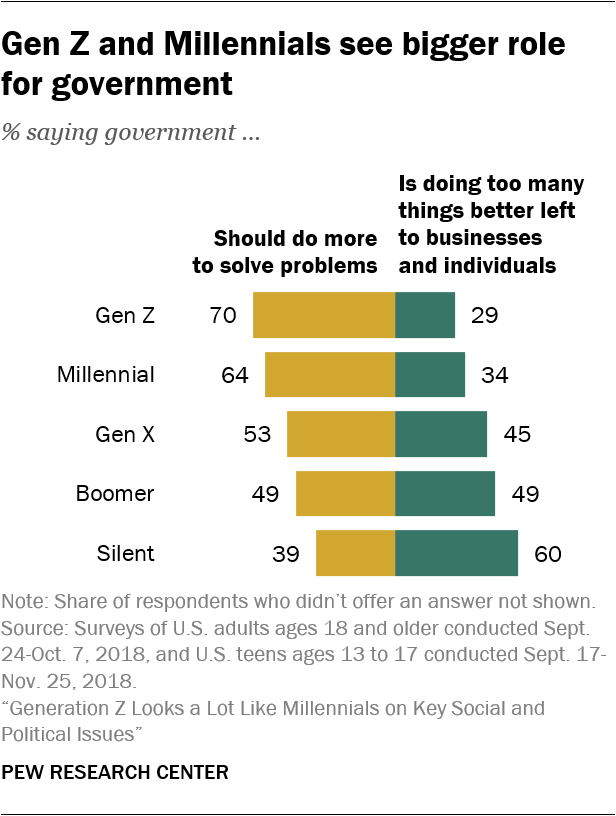
No longer the new kids on the block, Millennials have moved firmly into their 20s and 30s, and a new generation is coming into focus. Generation Z – diverse and on track to be the most well-educated generation yet – is moving toward adulthood with a liberal set of attitudes and an openness to emerging social trends...while majorities in Gen Z and the Millennial generation say government should do more to solve problems, rather than that government is doing too many things better left to businesses and individuals, Gen Xers and Boomers are more evenly divided on this issue. For their part, most Silents would like to see a less activist government.
Gen Z and Millennials see bigger role for government


And the younger generations are less likely to think that America is better than other countries:


Definitions
  • Generation Z (born 1997-2005)
  • Millennials (born 1981-96)
  • Generation X (born 1965-80)
  • Baby Boomers (born 1946-64) 
  • Silent Generation (born 1928-45)

Sunday, June 25, 2017

Aging America

The nation’s population has a distinctly older age profile than it did 16 years ago, according to new U.S. Census Bureau population estimates released today.

New detailed estimates show the nation’s median age — the age where half of the population is younger and the other half older — rose from 35.3 years on April 1, 2000, to 37.9 years on July 1, 2016.
“The baby-boom generation is largely responsible for this trend,” said Peter Borsella, a demographer in the Population Division. “Baby boomers began turning 65 in 2011 and will continue to do so for many years to come.”

Residents age 65 and over grew from 35.0 million in 2000, to 49.2 million in 2016, accounting for 12.4 percent and 15.2 percent of the total population, respectively.

These latest estimates present changes among groups by age, sex, race and Hispanic origin at the national, state and county levels between April 1, 2010, and July 1, 2016. The estimates also present changes over the same period among groups by age and sex for Puerto Rico and its municipios.

Wednesday, November 30, 2016

Dying Whites

A release from the University of New Hampshire:
More whites died than were born in a record high 17 states in 2014 compared to just four in 2004, according to new research from the Carsey School of Public Policy at the University of New Hampshire. Some 121 million people representing 38 percent of the U.S. population reside in these states: California, Pennsylvania, Florida, Arizona, Massachusetts, New Jersey, New Hampshire, Mississippi, Arkansas, Delaware, Nevada, Maine, Alabama, Connecticut, New Mexico, West Virginia and Rhode Island.
The research found that non-Hispanic white deaths now exceed births in a growing number of states because more whites are dying and fewer white babies are being born. These demographic changes in the white population result from a rising number of older adults, fewer women of childbearing age and lower fertility rates. Because these trends are difficult to reverse many of these states are likely to see white deaths continue to exceed births.
As white population increase has diminished it has been offset by minority population gains, the researchers found. In particular, births exceed deaths by a considerable margin among the Latino population because it is younger, has a larger proportion of women of childbearing age and higher fertility rates. The combination of these demographic trends is increasing the diversity of the U.S. population. According to Census Bureau projections, whites will make up less than half of the U.S. population (47 percent) by 2050. In contrast, the youthful Latino population is projected to be 29 percent of the U.S. population by 2060.
“These demographic trends have major policy implications,” the researchers said. “The largely white older population will grow rapidly as baby boomers continue to age, increasing demands on the healthcare and retirement systems. In addition, the youthful minority population will require major investments in education and training if the U.S. is to maintain a productive workforce in an increasingly competitive technological and global labor market. The competing demands will create considerable potential for disagreements regarding funding priorities.”
The full report can be found here: https://carsey.unh.edu/publication/white-deaths

Wednesday, June 15, 2016

Boomers

Olivia B. Waxman writes at Time:
“I think the Boomers were raised in probably one of the most patriotic periods of the country,” says sociologist Frederick R. Lynch, 70, author of One Nation Under AARP: The Fight Over Medicare, Social Security & America’s Future and professor of Government at Claremont McKenna College.
And even the most divisive moments of American history experienced by Boomers—and there were a lot of those—served in some ways to unite the generation through personal experience with the civil rights, antiwar, and women’s movements of the ’60s and ’70s.
“We got out of World War II and thought ‘we are the greatest in history,’ then we got to college and realized that lot of the stuff we were told in high school is a lie,” Lynch argues. “I think the Vietnam War also made Boomers more wary about meddling in other countries. No more Vietnams.”
...
Later in their lives, however, the generation began to splinter more, especially along economic lines—after all, by the time they were entering the workforce in large numbers, the prosperity of their childhoods was beginning to ebb. “Educated, well off baby boomers tended to do well under globalization; blue-collar, less educated boomers got hit hard beginning in the 1970s when industrial plants moved overseas or imported cheap labor,” Lynch explains. “In the 1980s and 1990s, downsizing and re-engineering hit white collar workers, and the practices of hiring more part-time, contract employees took shape. Eventually, these practices hit all generations, but boomers were the first to get caught up at ground zero of this transition.

Monday, June 29, 2015

Majority Minority

The Census reports:
Millennials, or America’s youth born between 1982 and 2000, now number 83.1 million and represent more than one quarter of the nation’s population. Their size exceeds that of the 75.4 million baby boomers, according to new U.S. Census Bureau estimates released today. Overall, millennials are more diverse than the generations that preceded them, with 44.2 percent being part of a minority race or ethnic group (that is, a group other than non-Hispanic, single-race white).

These latest population estimates examine changes among groups by age, sex, race and Hispanic origin nationally, as well as in all states and counties, between April 1, 2010, and July 1, 2014.
Even more diverse than millennials are the youngest Americans: those younger than 5 years old. In 2014, this group became majority-minority for the first time, with 50.2 percent being part of a minority race or ethnic group.

Reflecting these younger age groups, the population as a whole has become more racially and ethnically diverse in just the last decade, with the percentage minority climbing from 32.9 percent in 2004 to 37.9 percent in 2014.

Five states or equivalents were majority-minority: Hawaii (77.0 percent), the District of Columbia (64.2 percent), California (61.5 percent), New Mexico (61.1 percent) and Texas (56.5 percent). Among the remaining states, Nevada is the closest to crossing this threshold, with a population 48.5 percent minority. More than 11 percent (364) of the nation’s 3,142 counties were majority-minority in 2014. Five reached this milestone during the year beginning July 1, 2013: Russell, Ala.; Newton, Ga.; Eddy, N.M.; Brazoria, Texas; and Suffolk city, Va.

Monday, June 15, 2015

The Seniors Are All Right

At The New York Times, Dionne Searcey and Robert Gebeloff find that seniors are doing okay, thanks to Social Security, traditional pensions, and higher labor force participation, among other things.
People on the leading edge of the baby boom and those born during World War II — the 25 million Americans now between the ages of 65 and 74 — have emerged as particularly well positioned in the nation’s economic timeline. While there are plenty of individual exceptions, as a group they are better off financially than past generations and may well enjoy a more successful old age than future ones, even those merely a decade younger.
...
In the past, the elderly were usually poorer than other age groups. Now, they are the last generation to widely enjoy a traditional pension, and are prime beneficiaries of a government safety net targeted at older Americans. They also have profited from the long rise in real estate prices that preceded the recession. As a result, more seniors now fall into the middle class — defined in this case between the 40th and 80th income percentile — than ever before.
Median income for people 75 years and older has also risen, but not as much as it has for people in the 65-to-74 age group.
...
Some researchers have found that the economic success of seniors is masking an even deeper gulf in income inequality between the upper tier and everyone else than what is evident in the overall statistics.
“It’s not so much that older people are experiencing unseemly gains in income,” said Alicia H. Munnell, director of the Center for Retirement Research at Boston College. “It’s more that middle-aged people are not seeing income growing or even keeping pace with inflation.”
Nearly half of seniors ages 65 and up consider themselves in excellent or good shape financially, according to a Pew survey last month, in contrast to younger baby boomers, who view their circumstances less favorably.
...
As recently as the late 1990s, only one in five Americans in their late 60s had a job. Now, that number has jumped to almost one in three. And unlike in their parents’ generation, more women are earning paychecks than in the past, contributing to household income.
...
The median assets of people ages 65 to 74 doubled between 1989 and 2013, a far greater gain than other age groups experienced. And while there has been a decline from the peak since 2007, largely because of the real estate bust, this age group lost less than others.

Wednesday, November 19, 2014

Fading Whites

Demographer William Frey writes at Politico about changing demographics:

But in the longer run, demography seems inevitably tilted in favor of racial minorities, whose ranks are swelling throughout the country and who have the potential to disrupt the nation’s current political fault lines. And that’s not to say that Democrats will necessarily be the prime beneficent of this demographic shift, either, despite the conventional wisdom. In Texas, for instance, 22 percent of the population in the state’s deep-red, metropolitan suburbs are Hispanic—which could be why GOP presidential candidate Mitt Romney took 36-37 percent of Hispanic vote in that state with 27 percent in other states. One of the most pressing questions for candidates and strategists on both sides in 2016 will be how to leverage this groundswell to their advantage. Because if they can’t adapt now, politicos might soon be looking at another challenge: How to keep the coming wave from relegating their party to the sidelines, no more than a relic of majority-white America.

Thursday, July 17, 2014

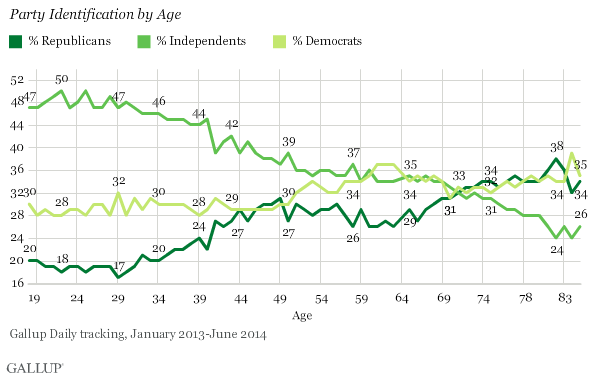
Party Identification by Age

Many posts have discussed the effects of age and generation on voting.  Putting together daily tracking surveys from  January 2013 through June 2014, Gallup reports party identification by age:

Party Identification by Age

Saturday, May 10, 2014

Aging

The Census reports:
The nation's 65-and-older population is projected to reach 83.7 million in the year 2050, almost double in size from the 2012 level of 43.1 million, according to two reports released today from the U.S. Census Bureau. A large part of this growth is due to the aging of baby boomers (individuals born in the United States between mid-1946 and mid-1964), who began turning 65 in 2011 and are now driving growth at the older ages of the population.
The first new report, An Aging Nation: The Older Population in the United States, looks at the demographic changes to the 65-and-older population that will comprise 21 percent of the U.S. population in 2050 and the impact that these changes will have on the composition of the total population. A second report, The Baby Boom Cohort in the United States: 2012 to 2060, focuses on the shifting size and structure of the baby boom population. These briefs use data from the 2012 national projections of the U.S. population.
"The United States is projected to age significantly over this period, with 20 percent of its population age 65 and over by 2030," said Jennifer Ortman, chief of the Census Bureau's Population Projections Branch. "Changes in the age structure of the U.S. population will have implications for health care services and providers, national and local policymakers, and businesses seeking to anticipate the influence that this population may have on their services, family structure and the American landscape."
Census Bureau statistics have already shown growth in health care-related industries. In 2011, the Census Bureau's County Business Patterns statistics showed the health care and social assistance sector as one of the largest in the U.S. with about 819,000 establishments. This sector includes home and health care services, community care facilities for the older population, and continuing care retirement communities, which all showed an increase of 20 percent or more in their number of employees between 2007 and 2011. New 2012 County Business Patterns statistics will be available by the end of May.
...
Other findings include:

Saturday, October 5, 2013

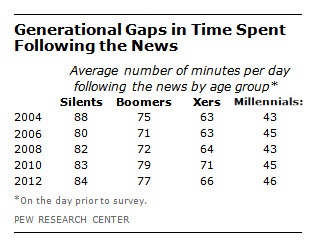
News and Generations

At Poynter, Andy Kohut writes:
News organizations have been confronting the problem of a shrinking audience for more than a decade, but trends strongly suggest that these difficulties may only worsen over time. Today’s younger and middle-aged audience seems unlikely to ever match the avid news interest of the generations they will replace, even as they enthusiastically transition to the Internet as their principal source of news.
Pew Research longitudinal surveys find that Gen Xers (33-47 years old) and Millennials (18-31 years old), who spent less time than older people following the news at the outset of their adulthood, have so far shown little indication that that they will become heavier news consumers as they age.

Notably, a 2012 Pew Research national poll found members of the Silent generation (67-84 years old) spending 84 minutes watching, reading or listening to the news the day before the survey interview. Boomers (48-66 years old), did not lag far behind (77 minutes), but Xers and Millennials spent much less time: 66 minutes and 46 minutes, respectively.
The truly troubling trend for the media is that Pew Research surveys give little indication that news consumption increases among members of the younger age groups as they get older. For example, in 2004 Xers reported following the news about as often as they did in 2012 (75 minutes versus 77 minutes). The eight-year trend for Millennials was equally flat (63 minutes versus 66 minutes).


Saturday, August 11, 2012

History and the Ryan Choice

Mitt Romney has chosen Rep. Paul Ryan (R-WI)  as his running mate.  This choice is historically significant in at least three respects.

1.  Romney is Mormon and Ryan is Catholic, so Romney-Ryan will be the first ticket in history without a Protestant.  Indeed, despite the longtime dominance of WASPs in American society, no white Protestant heads any of the branches of American government.  President Obama is African American.  Vice President Biden and Speaker John Boehner are Catholic.  Senate Majority Leader Harry Reid is Mormon.  No Protestant currently sits on the Supreme Court.  And if one counts the Federal Reserve as a "fourth branch" of sorts, the same holds true:  Fed Chair Ben Bernanke is Jewish.

2.  For the first time since 1932, neither ticket will include a military veteran -- another sign of the growing gap between the military and the rest of society. (Only 21 percent of members of Congress are veterans.)

3.  Ryan was born on January 29, 1970, so he is the first nominee of either party born after the 1960s.  If we define the "baby boom" as consisting of those born between 1946 and 1964 (definitions vary), then he is the first post-boomer nominee.  (Sarah Palin, born 1964, just barely qualifies as a boomer.)

Thursday, June 7, 2012

Age and Politics

At Next Avenue, Frederick Lynch writes:
In 1967, Time named boomers its Person of the Year. But today, self-critical boomer pundits and politicians have contributed to stereotypes of 48-to-66-year-olds as a profligate, selfish generation fixated on short-term gratification while running up mountainous debts that jeopardize not only their future, but also their children’s and grandchildren’s. (See the Next Avenue blog post: The Dirty Little Secret About Baby Boomer Debt.)

The term "boomer" has become an epithet of derision. Books and websites with “boomer” in the title usually flop. Advertisers shun the term “baby boomer” even while targeting this relatively rich demographic that controls $2 trillion in annual spending, according to eMarketer.com.

It’s about time that boomers “rebrand” themselves loudly and proudly, proclaiming their positive legacy of social and cultural change.

The boomers’ Greatest Generation parents are celebrated for enduring the Great Depression and for saving democracy in World War II. However, as Leonard Steinhorn argues in The Greater Generation, boomers receive far less credit for  “fighting the war at home” against racism, sexism and homophobia.


The Census Bureau has released a menu-driven, interactive Web page permitting users to access for any state a series of graphs showing percentages of adults who voted and registered in every congressional and presidential election between 1996 and 2010. Here are data showing that voting and registration rates tend to increase with age. In 2010, only 21 percent of 18-to 24-year old citizens voted, compared with 61 percent of those 65 and older.