Search This Blog

Showing posts with label health care. Show all posts

Sunday, July 26, 2026

Make America Sick Again

Many posts have discussed myths and misinformation.The greatest spreader of vaccine misinformation is the Secretary of Health and Human Services.

Teddy Rosenbluth at NYT:
The United States has now recorded more cases of measles in 2026 than in any other year since the virus was declared eliminated in 2000, a grim sign that the country may be headed toward a new era in which the disease regularly sickens thousands every year.

On Friday, the Centers for Disease Control and Prevention announced that there have been 2,318 confirmed cases of measles so far this year. The case count toppled the record set last year, when measles infected more than 2,200 Americans and killed two unvaccinated children. More measles cases have been reported in the United States in the last two years than in all the years from 2000 through 2024 combined.

Reversing course on measles would require a nationwide push to improve vaccination rates, a prospect that experts said seemed unlikely under the leadership of Health Secretary Robert F. Kennedy Jr. He has halted funding for vaccine hesitancy research, downplayed the risks of measles and spearheaded a hunt for evidence that vaccines are unsafe.

In November, a panel of international experts will meet to determine whether the United States has lost its elimination status, which has long been viewed as one of the country’s crowning public health achievements.

Americans now have to deal with a salmonella outbreak affecting eggs, on top of everything else.

Midwest Poultry Services is recalling close to 1.6 million white shell eggs and brown cage-free shell eggs produced in Texas, the Food and Drug Administration announced Wednesday. The eggs in question have the potential to be contaminated with Salmonella enteritidis, and were being sold at Kroger stores in Texas and Louisiana, as well as Brookshire Grocery stores in Oklahoma, Arkansas, Mississippi, and New Mexico.

The company has stopped distributing eggs produced on its Texas farms, according to the FDA. Salmonella enteritidis is a bacterium that can survive on the shell of an egg or inside it, and could cause symptoms including cramps, diarrhea, nausea, vomiting, chills, ⁠fever, and headaches.

The salmonella scare comes after an explosive diarrhea outbreak hit the country from tainted lettuce produced by Taylor Farms. That produce contained cyclospora, a one-celled parasite, and has affected at least 41 states with over 12,000 possible cases. On top of that, the New World screwworm, a flesh-eating parasite, has infested cattle in Texas and spread to other states, causing an estimated $1 billion in damages.

The Trump administration has cut a lot of the programs that prevented these types of outbreaks in the past, and now the country seems to be dealing with one food crisis after another. Elon Musk’s DOGE cut a monitoring program for the screwworm and gutted the team at the Centers for Disease Control and Prevention responsible for responding to cyclospora outbreaks. Hopefully, the salmonella issue remains isolated, although the administration hasn’t inspired much confidence thus far.

Sunday, June 7, 2026

Disease Resurgence

Many posts have discussed myths and misinformation.The greatest spreader of vaccine misinformation is the Secretary of Health and Human Services.

Maggie Astor and Dani Blum at NYT:
Doctors around the country say they are seeing more cases of serious, sometimes life-threatening illnesses that vaccines have long kept at bay, including whooping cough and bacterial infections that can cause pneumonia or meningitis.

The concern among doctors comes on the heels of a resurgence of measles nationwide, fueled by distrust in vaccines that grew during the Covid-19 pandemic, and that Health Secretary Robert F. Kennedy Jr. and President Trump have amplified. Public health experts have long seen measles as a harbinger: Because it is so exceptionally contagious, it can be the first disease to spike as vaccination rates broadly decline, and a sign of more to come.

For some of these diseases, national data show clear and substantial increases in recent years; for others, the increases are small, or there are anecdotal indications from doctors on the ground of increases that public statistics don’t currently confirm.
...

The onslaught of preventable illness and other health risks can feel overwhelming, doctors said. So can navigating the medical misinformation some patients recite.

“It just feels like you’re a tiny little boat with a giant tidal wave coming at you,” said Dr. Erin Charles, a regional pediatric hospitalist at Seattle Children’s Hospital. “And you might convince one family here and there.”

Many parents continue to refuse vaccines even after their child has been hospitalized with a vaccine-preventable illness, doctors said. Dr. Kirk said she had never had a parent in that situation tell her they had changed their mind and would have their child vaccinated on the standard schedule. Dr. Hofto said she could sometimes persuade families, but often not.
An episode of The Pitt takes on the antivax loonies.

Wednesday, January 28, 2026

Nursing Homes and Pay-to-Play Politics


Kenneth P. Vogel and Christina Jewett at NYT:
The nursing home industry was on a roll last summer.

It had just won a 10-year moratorium on a rule initiated during President Joseph R. Biden Jr.’s administration to require increased staffing levels in an effort to reduce neglect among residents, which had led to injuries and deadly infections.

Nonetheless, some in the industry, warning that the rule would have substantially increased costs, wanted to make it go away permanently.

So nursing home executives turned to a tool that has proved successful in getting President Trump’s attention: money.

Starting in early August, the industry began making donations that over the course of weeks would eventually total nearly $4.8 million to MAGA Inc., a super PAC devoted to Mr. Trump and run by his allies.

Later that same month, a handful of nursing home executives who had given the biggest donations joined industry lobbyists at Mr. Trump’s golf club in suburban Washington to plead their case, according to campaign finance filings and people familiar with the meeting.

Over light lunch fare, the contingent “urged the president to formally repeal the harmful minimum staffing mandate, which would have surely forced providers throughout the country to close their doors to new residents — or possibly close their doors altogether,” Bill Weisberg, the founder and chief executive of Saber Healthcare Group, recounted in a text message to The New York Times.

Less than one month after the lunch meeting, Trump administration lawyers quietly stopped defending the pending staffing rule in court against challenges from the industry.

Complete victory came a couple of months after that, when the White House approved a full revocation. The Department of Health and Human Services announced the repeal in a statement that echoed industry talking points, which have emphasized the industry’s difficulty in hiring enough staff, especially in rural areas

Monday, December 1, 2025

Silver Tsunami

 Many posts have discussed demographic trends, especially the decline of births and the aging of the population.

Emily Peck at Axios:

A silver tsunami is washing across our shores, as record numbers of Americans start hitting retirement age. The U.S. isn't ready.

...
About 45% of Americans will experience retirement-funding shortfalls if they retire at 65, according to Morningstar's projections from last year.
...
.Out-of-pocket medical expenses are escalating, the cost of in-home care is growing more than three times faster than inflation, and an increasing share of the elderly are spending more than a third of their income on real estate too.

...
Only about 14% of Generation X (those ages 45-60) have a pension plan, according to the National Institute on Retirement Security.

...
.On paper, retirement accounts might make older Americans appear wealthy. There are an increasing number of 401(k) millionaires, after all.

But with costs and debts rising — and lifespans lengthening — older Americans might run out of money, she says, or be forced to severely cut back spending. "We have shades of the retirement crisis right now."

Between the lines: There's massive inequality when it comes to retirement readiness — workers earning more than $150,000 a year contribute nearly 13 times more toward retirement than those earning under $50,000, a report out in November found.
...
...
About 56 million Americans age 65 and older receive Social Security benefits, per federal data.
The lowest-earning workers rely on it. Social Security is the primary source of income for retirees with household incomes below $50,000, according to Transamerica's 2025 retirement survey.

A cut of 20% to 25% in Social Security benefits would have a devastating impact on retirees who rely heavily or solely on those payments," said Kristi Martin Rodriguez, who leads the Nationwide Retirement Institute. "61% of current recipients say missing even half of a payment would leave them unable to survive financially."


Friday, October 17, 2025

Rose Research Fall 2025

Watch this clip from The Wire.

It is the best description of research, ever.

The big stuff:

Finding the literature: https://consensus.app/

Great resources at Honnold Library -- which students usually overlook! 
  • Nexis Uni: news sources and law journals
  • Political science journals
  • Dissertation abstracts (search for "California" and "redistricting" in abstracts, and you will see a couple of Rose Institute names)
The Internet Archive -- if there is a broken link to what you need, this site might help you find it. Especially helpful in finding pages that the administration has taken down:

California 

General State Policy and Politics
General Public Policy and Finance
National Elections, Parties, Campaign Finance

Crime

Tuesday, July 22, 2025

Blowing Up the Federal Debt

 Many posts have discussed federal deficits and the federal debt.

Sahil Kapur at NBC:
President Donald Trump’s “big, beautiful bill,” which he signed into law this month, will add $3.4 trillion to the U.S. national debt over the next decade, according to a report the nonpartisan Congressional Budget Office published Monday.

The report found that the law, which Republicans passed along party lines, will also “increase by 10 million the number of people without health insurance” by 2034.

The budget office scrutinized the final version of the bill after Republicans made a series of last-minute changes to cobble together the votes needed in the Senate; it passed 51-50. That revised version subsequently passed the House on a vote of 218-214. Trump enacted it on July 4.

The package extends Trump’s 2017 tax cuts while providing tax deductions for tips and overtime pay for the next four years. It includes hundreds of billions of dollars in new spending for the military and to carry out Trump’s mass deportation agenda. And it pays for some of that with cuts to Medicaid, SNAP benefits (which help low-income families purchase groceries) and clean energy funding.

The analysis found that the law’s net spending cuts of $1.1 trillion are outstripped by the $4.5 trillion in decreased revenue, compared with if the measure had not passed.

Thursday, July 17, 2025

Demographics, Inflation, Social Security, and Medicare

Many posts have discussed Social Security and Medicare.

James C. Capretta at AEI:

During the raucous debate surrounding the GOP-sponsored reconciliation bill, the trustees for Social Security and Medicare rather quietly released their annual reports on the status of the programs’ respective trust funds. Their projections once again show that it will not be easy to stabilize the fiscal outlook without closing the widening gap between how much is spent on these entitlement programs compared to the dedicated taxes and premiums collected to pay for them.

The core problem is a transformative demographic shift that was not anticipated when the programs were established. In 1935, when Congress approved the original Social Security law, and again in 1965, when Medicare was created, the expectation was that birth rates would remain close to their historical levels. That proved to be a costly misjudgment as family sizes began to fall sharply starting in the early 1960s and then continued to decline in the succeeding decades.

Further, while there was an expectation of improvement in average lifespans, the progress has been more rapid than anticipated.

Finally, with Medicare and Medicaid providing insurance coverage starting in the 1960s, demand for services rose precipitously, as did the prices charged by hospitals and doctors. With few exceptions, annual spending on health care has been rising more rapidly than incomes for most of the last half-century.


Saturday, July 12, 2025

Silencing Critics by Threatening Litigation

Filmmaker Mary Strause made a docuseries critical of UnitedHealth.  The companies used the threat of litigation to coerce streaming services to take it down.

David Enrich at NYT:

In legal letters and court filings, UnitedHealth has invoked last year’s murder of Brian Thompson, the chief executive of the company’s health insurance division, to argue that intense criticism of the company risks inciting further violence.

The tactics have had an impact. Amazon and Vimeo both removed Ms. Strause’s film. The Guardian postponed publishing an investigation of the company after UnitedHealth sued over a previous article it said was defamatory.

UnitedHealth joins a growing group of companies and wealthy individuals, including President Trump, who are using legal threats and lawsuits to deter or penalize criticism.

Over the years, there have been scattered examples of embattled companies — such as Purdue Pharma, the maker of the highly addictive painkiller OxyContin — deploying legal offensives against a broad spectrum of journalists and critics, said Lee Levine, a retired First Amendment lawyer who has defended news outlets, including The New York Times.

“Some version of this has been going on for a long, long time,” Mr. Levine said. But, he added, “the incidence of it has increased.”


Saturday, July 5, 2025

USAID


Daniella Medeiros Cavalcanti, et al., "Evaluating the impact of two decades of USAID interventions and projecting the effects of defunding on mortality up to 2030: a retrospective impact evaluation and forecasting analysis," The Lancet, June 30, 2025.
To the best of our knowledge, this study is the first to evaluate the impact of USAID funding—including all areas of its humanitarian and development assistance—on mortality, both overall and disaggregated by age and cause, over the past two decades and with projections to 2030. Our findings show that USAID-supported efforts have helped to prevent more than 91 million deaths across all age groups, including 30 million deaths among children. High levels of USAID funding were associated with a 15% reduction in all- age and all-cause mortality, a 65% reduction in mortality from HIV/AIDS, a 51% reduction from malaria, and a 50% reduction from neglected tropical diseases. Substantial decreases were also observed in mortality from tuberculosis, nutritional deficiencies, diarrhoeal diseases, lower respiratory infections, and maternal and perinatal conditions. By age group, the most pronounced reductions were seen in children younger than 5 years (32%). According to the forecasting models, the current steep funding cuts— coupled with the potential dissolution of the agency—could lead to more than 14 million additional deaths by 2030, averaging more than 2·4 million deaths per year. These deaths include 4·5 million among children younger than 5 years, or more than 700 000 deaths annually.

Sunday, June 1, 2025

How Not to Write a Government Report

Robert Kennedy's MAHA initiative issued a report full of bogus citations and AI-generated content.

As Jeffrey A. Singer, Terence Kealey, and Bautista Vivanco explain at Cato, it also makes a lot of foolish mistakes.

The second sentence of the introduction reads: “Today’s children are the sickest generation in American history in terms of chronic disease, and these preventable trends continue to worsen each year, posing a threat to our nation’s health, economy, and military readiness.” Yet death rates among children up to age five continue to fall, so they can’t be that sick. Could it be that more illnesses are being diagnosed today than in the past?

Sentences 3 and 4 simply repeat the message of sentences 1 and 2, while sentence 5 is nonsense: “Over the past century, U.S. GDP has grown over 30,000%.” Two of us may only be MDs, but we’re better at math than the MAHA Commission. In 1925, real GDP (2017 dollars) was about $977 billion. Real GDP (2017 dollars) in 2023 was about $22.7 trillion (according to the Bureau of Economic Analysis). The final figures for 2025 are not available yet, but 2023 serves as a useful benchmark. It’s easy to calculate that GDP has grown by 2,223 percent.

Page nine of the report claims over 40 percent of US children have a chronic health condition, citing the 2018–2019 National Survey of Children’s Health. But the survey doesn’t measure chronic conditions—it tracks current or lifelong conditions from a list that includes issues like “current anxiety problems,” “current conduct problems,” “current substance use disorder,” and “current concussion or head injury.” Many of these are temporary, and the combined prevalence reported in the survey is lower than the 40 percent figure used in the report.

Page 12 claims autism affected 1 to 4 in 10,000 children in the 1980s. But the 2007 source it cites warns that such estimates may understate prevalence due to factors like shifting criteria, increased awareness, and changing services.

On page 13, the report warns of the rise in childhood cancer rates but fails to mention that from 2001 to 2021, the cancer death rate for youth ages 0–19 years in the United States declined 24 percent, from 2.75 to 2.10 per 100,000.

The report claims on page 15 that “between 1997 and 2018, childhood food-allergy prevalence rose 88%,” based on survey data in which a parent or adult answered whether the child had a food or digestive allergy in the past year. But increased awareness over the past two decades likely led to more frequent recognition and reporting of symptoms that might have previously been overlooked or misattributed.

Even if we take the survey results at face value, the report selectively highlights only the alarming trend. It ignores the same survey’s findings that asthma attacks fell by 16.7 percent, hay fever and respiratory allergies dropped by 16 percent, and ear infections declined by 38 percent. Instead of reporting the absolute change—from 3.4 percent in 1997 to 6.4 percent in 2018—the report opts for the more dramatic “88% increase.”

Also on page 15, Footnote 43 is supposed to link the reader to an article titled “Prevalence of pediatric inflammatory bowel disease in the United States”; instead, the link directs us to a different piece titled “Model of Urgency for Liver Transplantation in Hepatocellular Carcinoma.”

Yet again on that page, the report claims celiac disease in children has increased fivefold since the 1980s but ignores that improved diagnostics and awareness likely contributed. One of its own cited studies states this clearly in the abstract.

On page 16, the commission claims that chemical exposure may be driving higher rates of chronic childhood disease, citing three sources. But none provides strong evidence to support that conclusion.

One is a literature review that clearly notes the lack of conclusive research on the effects of low-dose chemical mixtures. Another is an observational study focused on children with cancer in Nebraska, which offers no generalizable findings. The third is an editorial centered on animal and cell studies, not human children.

These are just a few inaccuracies we readily identified in the first 16 pages of the 72-page report. When a report is rushed and driven more by preconceived conclusions than by careful analysis, this is precisely the kind of quality one should expect.

Saturday, March 15, 2025

The Cost of Slashing PEPFAR

 Americans vastly overestimate the size of the US budget for foreign aid.  Trump is cutting it, with drastic consequences.

Nicholas Kristof at NYT:
As the world’s richest men slash American aid for the world’s poorest children, they insist that all is well. “No one has died as a result of a brief pause to do a sanity check on foreign aid funding,” Elon Musk said. “No one.”

That is not true. In South Sudan, one of the world’s poorest countries, the efforts by Musk and President Trump are already leading children to die.

Peter Donde was a 10-year-old infected with H.I.V. from his mother during childbirth. But American aid kept Peter strong even as his parents died from AIDS. A program started by President George W. Bush called PEPFAR saved 26 million lives from AIDS, and one was Peter’s.

Under PEPFAR, an outreach health worker ensured that Peter and other AIDS orphans got their medicines. Then in January, Trump and Musk effectively shuttered the U.S. Agency for International Development, perhaps illegally, and that PEPFAR outreach program ended. Orphans were on their own.

Without the help of the community health worker, Peter was unable to get his medicines, so he became sick and died in late February, according to Moses Okeny Labani, a health outreach worker who helped manage care for Peter and 144 other vulnerable children.

The immediate cause of death was an opportunistic pneumonia infection as Peter’s viral load increased and his immunity diminished, said Labani.

“If U.S.A.I.D. would be here, Peter Donde would not have died,” Labani said.
We worked with experts at the Center for Global Development who tried to calculate how many lives are at risk if American humanitarian assistance is frozen or slashed. While these estimates are inexact and depend on how much aid continues, they suggest that a cataclysm may be beginning around the developing world:

 An estimated 1,650,000 people could die within a year without American foreign aid for H.I.V. prevention and treatment.

Tuesday, December 10, 2024

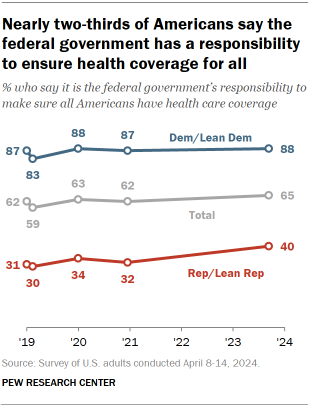
Americans Think the Federal Government Should Ensure Health Coverage

Saturday, November 23, 2024

Commuinicating Health Information

Many posts have discussed myths and misinformation -- especially about COVID and vaccines.

Health authorities who beat the pandemic worry about losing more trust from the people they worked to save. Doctors, scientists and public-health officials are asking themselves how they can win it back. Among their postelection revelations: Don’t underestimate or talk down to those without a medical degree.
...

“We weren’t really considering the consequences in communities that were not New York City,” the places where the virus wasn’t hitting as hard, former National Institutes of Health Director Francis Collins said at an event last year.

Authorities focused on ways to stop the disease and failed to consider “this actually, totally disrupts peoples’ lives, ruins the economy and has many kids kept out of school,” Collins said. The U.S. overall took the right approach, he said, but overlooking long-term consequences was “really unfortunate. That’s another mistake we made.”

Public-health officials wonder if they have sufficient clout for the next national emergency. “Science is losing its place as a source of truth,” said Dr. Paul Offit, an infectious-disease physician at Children’s Hospital of Philadelphia. “It’s becoming just another voice in the room.”

...

To counter such views, Jessica Malaty Rivera, an epidemiologist with hundreds of thousands of Instagram followers, shared information on the importance of vaccines and face masks. She dismissed unsupported claims as misinformation and described some of their purveyors as grifters.

Looking back, Rivera said her sometimes scolding messages weren’t helpful. “Everybody has been tempted by the slam dunk,” she said. “It’s not an effective way to communicate science. It’s just not.” She and others say they are dialing back the use of the word misinformation, saying it makes people feel they are being called liars or dumb.
Some Food and Drug Administration staffers have already stopped saying that vaccines are safe and effective, instead advising that the benefits outweigh the risks, a person familiar with the matter said. The change is intended to make clear that all medical interventions have risks, the person said, and to spike the argument that rare side effects mean vaccines aren’t safe.

Virologist Dr. Greg Poland said he advises scientists to communicate with humility and empathy, to speak as a compassionate physician would with a patient. “We’re not dogmatic. We’re not about forcing people,” he said. “We’re about imparting information.”

To build trust in vaccines, Poland, who is also a Presbyterian minister, speaks to conservative churches and civic groups. He tells them he will be truthful and transparent and then explains how vaccines work and how scientists arrive at a consensus.

Poland said he stays until he has answered every last question.

Thursday, August 15, 2024

DEI and Health Care

Many posts have dealt with racial issues.

Black men and women are at least two times as likely as white Americans to die from strokes. Hospitals around the country have long sought to bring those numbers down.

Now, the Cleveland Clinic, a prestigious hospital system, is being accused of illegally discriminating on the basis of race for operating a program to prevent and treat strokes and other conditions among minority patients.

The allegation pushes the fight against race-based programs into untested legal territory, arguing that healthcare providers can’t use racial and ethnic demographics to target treatment, preventive care or patient education.

Activist groups have challenged private- and public-sector diversity efforts in education, employment and contracting, often using civil rights laws originally drafted to protect minority populations. These efforts gained new prominence with last summer’s Supreme Court decision barring the use of race in college admissions and are reshaping institutional practices.

“Race discrimination is a defining feature” of the programs at the Cleveland Clinic, two activist groups allege in a complaint filed Wednesday with the civil-rights office of the federal Department of Health and Human Services.

Sunday, August 11, 2024

Euthanasia Opinion

 Rachael Yi at Gallup:

Americans’ current views on the legality of euthanasia, a procedure in which a physician intentionally acts to end the life of a patient, are similar to what they have been during the past decade. Just over seven in 10 Americans, 71%, believe doctors should be “allowed by law to end the patient’s life by some painless means if the patient and his or her family request it.”

At the same time, doctor-assisted suicide -- a term used to describe patients ending their own lives with the aid of a physician -- garners slightly less but still majority support. Sixty-six percent of Americans believe doctors should “be allowed by law to assist the patient to commit suicide” for terminal patients living in severe pain who request it.

Although both readings are consistent with support over the past decade, slightly fewer Americans between 1996 and 2014 thought doctor-assisted suicide should be legal. During that time, an average of 58% of Americans were in favor, compared with an average of 65% since 2014. Support for doctor-assisted suicide has risen from the trend low of 51% just in the past decade, while support for euthanasia has varied only modestly over the past three decades.


Friday, June 28, 2024

Support for Social Security and Healthcare Coverage

Many posts have discussed Social Security and health care.

Pew:

A large majority of voters (80%) – including 82% of Biden supporters and 78% of Trump supporters – say that in thinking about the long-term future of Social Security, benefits should not be reduced in any way.

However, Biden supporters are more likely than Trump supporters to say Social Security should cover more people with greater benefits.46% of Biden supporters favor expanding Social Security coverage and benefits, compared with 28% of Trump supporters.

Most Americans (65%) continue to say the federal government has a responsibility to make sure all Americans have health care coverage.

Democrats overwhelmingly (88%) say the federal government has this responsibility, compared with 40% of Republicans,

.

The share of Republicans who say the government has a responsibility to provide health coverage has increased 8 percentage points since 2021, from 32% to 40%.

There are wide income differences among Republicans in opinions about the government’s role in health care:56% of Republicans with lower family incomes say the government has a responsibility to provide health coverage for all, compared with 36% of those with middle incomes and 29% of higher-income Republicans.

When asked how the government should provide health coverage, 36% of Americans say it should be provided through a single national program, while 28% say it should be through a mix of government and private programs. These views have changed little in recent years.

Democrats continue to be more likely than Republicans to favor a “single payer” government health insurance program (53% vs. 18%).

Thursday, March 14, 2024

Myths and Misinformation About the Measles Vaccine

While most of the public correctly view the false claim that “The measles vaccine is more dangerous than the disease itself” as false, the findings echo previous KFF research showing that a majority express at least some uncertainty in their beliefs related to health claims. More than half of U.S. adults say this claim is either “probably false” (41%) or “probably true” (16%). Few (3%) say it is “definitely true” while four in ten (38%) are confident that the claim is “definitely false.”

Across partisans, levels of educational attainment, and race and ethnicity, fewer than five percent of adults say the claim is “definitely true,” meaning there are few ardent believers of this piece of misinformation. However, independents (37%) and Republicans (21%) are less likely than Democrats (59%) to be certain that the claim is “definitely false.” Those without a college degree (29%) are also less likely to say that the claim is definitely false than those with a college degree (55%).

While few adults say that this piece of misinformation is true, the public is split between saying it is “probably false” (41%) or “definitely false” (38%). Parents of children under age 18 are especially likely to say that this piece of information is “probably false” (50%). Having such a sizable group lean towards the correct answer, but be uncertain, may present an opportunity for intervention. Clear, accurate messaging from trusted sources, such as pediatricians, regarding the safety of the measles vaccine may solidify the public’s — and parents’ — correct inclination that the measles vaccine is not more dangerous than contracting the disease. This would allow parents to be more confident in their decisions when it comes to vaccinating their young children.

Wednesday, November 29, 2023

Life Expectancy Ticks Up in 2022

Mike Stobbe at AP:
U.S. life expectancy rose last year — by more than a year — but still isn’t close to what it was before the COVID-19 pandemic.

The 2022 rise was mainly due to the waning pandemic, Centers for Disease Control and Prevention researchers said Wednesday. But even with the large increase, U.S. life expectancy is only back to 77 years, 6 months — about what it was two decades ago.

Life expectancy is an estimate of the average number of years a baby born in a given year might expect to live, assuming the death rates at that time hold constant. The snapshot statistic is considered one of the most important measures of the health of the U.S. population. The 2022 calculations released Wednesday are provisional, and could change a little as the math is finalized.

Wednesday, November 15, 2023

American Men and Life Expectancy

 A release from the Harvard T.H. Chan School of Public Health

We’ve known for more than a century that women outlive men. But new research led by Harvard T.H. Chan School of Public Health and UC San Francisco shows that, at least in the United States, the gap has been widening for more than a decade. The trend is being driven by the COVID-19 pandemic and the opioid overdose epidemic, among other factors.

In a research paper, to be published online on November 13 in JAMA Internal Medicine, the authors found the difference between how long American men and women live increased to 5.8 years in 2021, the largest it’s been since 1996. This is an increase from 4.8 years in 2010, when the gap was at its smallest in recent history.

The pandemic, which took a disproportionate toll on men, was the biggest contributor to the widening gap from 2019-2021, followed by unintentional injuries and poisonings (mostly drug overdoses), accidents, and suicide.

“There’s been a lot of research into the decline in life expectancy in recent years, but no one has systematically analyzed why the gap between men and women has been widening since 2010,” said first author Brandon Yan, a UCSF internal medicine resident physician and research collaborator at Harvard Chan School.

Life expectancy in the U.S. dropped in 2021 to 76.1 years, falling from 78.8 years in 2019 and 77 years in 2020.

The shortening lifespan of Americans has been attributed in part to so-called “deaths of despair.” The term refers to the increase in deaths from such causes as suicide, drug use disorders, and alcoholic liver disease, which are often connected with economic hardship, depression, and stress.

“While rates of death from drug overdose and homicide have climbed for both men and women, it is clear that men constitute an increasingly disproportionate share of these deaths,” Yan said.

Using data from the National Center for Health Statistics, Yan and fellow researchers from around the country identified the causes of death that were lowering life expectancy the most. Then they estimated the effects on men and women to see how much different causes were contributing to the gap.

Prior to the COVID pandemic, the largest contributors were unintentional injuries, diabetes, suicide, homicide, and heart disease.

But during the pandemic, men were more likely to die of the virus. That was likely due to a number of reasons, including differences in health behaviors, as well as social factors, such as the risk of exposure at work, reluctance to seek medical care, incarceration, and housing instability. Chronic metabolic disorders, mental illness, and gun violence also contributed.

Yan said the results raise questions about whether more specialized care for men, such as in mental health, should be developed to address the growing disparity in life expectancy.

“We have brought insights to a worrisome trend,” Yan said. “Future research ought to help focus public health interventions towards helping reverse this decline in life expectancy.”

Yan and co-authors, including senior author Howard Koh, professor of the practice of public health leadership at Harvard Chan School, also noted that further analysis is needed to see if these trends change after 2021.

“We need to track these trends closely as the pandemic recedes,” Koh said. “And we must make significant investments in prevention and care to ensure that this widening disparity, among many others, do not become entrenched.”

Alan Geller, senior lecturer on social and behavioral sciences at Harvard Chan School, was also a co-author.

“Widening Gender Gap in Life Expectancy in the US, 2010-2021,” Brandon W. Yan, Elizabeth Erias, Alan C. Geller, Donald R. Miller, Kenneth D. Kochanek, Howard K. Koh, JAMA Internal Medicine, online November 13, 2023, doi: 10.1001/jamainternmed.2023.6041

Friday, October 6, 2023

Behold a Pale Horse