Search This Blog

Showing posts with label civil liberties. Show all posts

Friday, August 21, 2026

Dark Days at DHS

Many posts have discussed immigration

Vanessa Romo at NPR:

One of the last remaining checks on Immigration and Customs Enforcement and private-prison contractors running immigration detention centers has all but collapsed, leaving thousands of people trapped in a system with nearly nonexistent oversight, according to an NPR review.

The grievance system in immigration detention is designed to offer a safe channel to report violations of detention standards and seek redress, without fear of retaliation. It's often the only recourse for people to submit complaints about detention issues, including mistreatment, unsanitary conditions, medical neglect and sexual assault. But an NPR review of documents, available data and interviews with experts has found the system — which in the best of times was a complex patchwork — barely operates and even at times backfires for those using it. It is one of the few remaining safeguards for immigrants in federal custody after the Trump administration effectively dismantled other oversight offices.

...

Trying to enforce the rules of the grievance system has always been challenging, Chris Brundage, the former deputy of the now-closed Office of the Immigration Detention Ombudsman, told NPR.

That's partly because it's not one single set of standards that all operators must follow, Brundage said. "It's a patchwork system that has never worked as intended," he said, explaining that there are at least three different sets of detention standards that operators are working under, depending on when they signed their contracts. (Some operators are following guidelines established in 2011. Others, an updated version from 2016, and those with new contracts are following 2019 standards.)

...

The Office of Detention Oversight, created by Congress to conduct internal inspections, and the Immigration Detention Ombudsman's office tasked with investigating detainee deaths and other issues have had their budgets gutted and suffered massive layoffs. Both agencies sit within DHS. In the case of the ombudsman's office, one of the only places that detainees could turn to to challenge a grievance denial outside of the immediate detention facility, it was fully shuttered in May.

Another office whose budget has been slashed is the Office for Civil Rights and Civil Liberties, Brundage noted. In 2025, the administration slashed the CRCL staff from roughly 150 employees down to just a handful, effectively halting operations. The Government Accountability Project reported more than 500 active civil rights and detention-abuse complaints — including allegations of medical neglect, sexual abuse and dangerous conditions in immigration detention — were frozen or left uninvestigated.

...

"I think what happened when these offices were effectively gutted and shut down, you lost that … legitimacy. And legitimacy means that they're following the laws, regulations. But what happens if you don't have transparency into the process and you don't have accountability? Without those two things, that legitimacy erodes, " Brundage said.

Friday, November 28, 2025

Protection Against Denaturalization

Several  posts have discussed naturalization and denaturalization.  

 Denaturalization is in the news.

Faiza Patel, Margy O’Herron, and Kendall Verhovek at the Brennan Center:

Under the law today, the government may seek denaturalization proceedings either when naturalization is obtained illegally or disqualifying facts on citizenship applications are concealed. But throughout much of the 20th century, it was much easier to achieve.

More than 22,000 Americans lost their citizenship between 1907 and 1967 based on political affiliations, race, and gender, according to denaturalization scholar Patrick Weil. President Woodrow Wilson’s administration began denaturalizing German- and Asian-born citizens during World War I, along with anarchists and people who spoke out against the war. During World War II, a push for denaturalization of naturalized citizens from Germany, Italy, and Japan intensified. A primary target included members of the pro-Nazi German-American Bund for disloyalty and insufficient attachment to the principles of the Constitution.

After the war, the Second Red Scare took hold of a country fearful of domestic communism amid its emergence abroad. Sen. Joseph McCarthy of Wisconsin led witch hunts, with denaturalization often used as a tool against accused communists or sympathizers. Among those targets was Harry Bridges, an Australian-born, nationally known labor leader accused of being a communist, who faced an ultimately unsuccessful campaign to revoke his citizenship. The Supreme Court ruled in his favor, not once, but twice.

Throughout the 20th century, the Court’s jurisprudence evolved to protect naturalized citizens — even those with unpopular views during wartime — against efforts to strip them of citizenship. The Court established constraints on the government’s ability to revoke citizenship in a case challenging an attempt to denaturalize Russian-born William Schneiderman over ties to the Communist Party. The Court wrote, “We believe the facts and the law should be construed as far as is reasonably possible in favor of the citizen.” It also emphasized that citizenship should not be rescinded lightly: “[The United States] must sustain the heavy burden which then rests upon it to prove lack of attachment by ‘clear, unequivocal, and convincing’ evidence.”

A few years later, the Supreme Court warned against using denaturalization proceedings as a political weapon. “Ill-tempered expressions, extreme views, even the promotion of ideas which run counter to our American ideals, are not to be given disloyal connotations in absence of solid, convincing evidence that that is their significance,” the Court’s majority wrote. “Any other course would run counter to our traditions, and make denaturalization proceedings the ready instrument for political persecutions.”

In 1967, the Court found that under the 14th Amendment, the government cannot forcibly deprive a naturalized American of citizenship without the citizen’s consent, except when citizenship is “unlawfully procured.”

In the succeeding decades, denaturalizations declined significantly. Between 1990 and 2017, the Justice Department filed an average of just 11 cases per year. Only during the Obama administration did they climb, when new technology allowed the government to search decades of data for indicators of possible fraud. In 2016, the yearly average rose to 15. During the first Trump administration, the program expanded, increasing the average to 25 per year.

Yet the Supreme Court remained resistant to easing limits on denaturalization. In 2017, the Court unanimously ruled that citizenship was “unlawfully procured” only if the unlawful act, such as making a false statement, had a causal connection to the acquisition of citizenship. The Court wrote that a prosecutor should not be able to “scour her paperwork” and bring a charge because doing so would “give prosecutors nearly limitless leverage — and afford newly naturalized citizens precious little security.”

Monday, July 21, 2025

The Scopes Trial

Today is the 100th anniversary of the Scopes "monkey trial" verdict. James C. Foster at the Free Speech Center:
The Scopes “monkey trial” was the moniker journalist H. L. Mencken applied to the 1925 prosecution of a criminal action brought by the state of Tennessee against high school teacher John T. Scopes for violating the state’s Butler Act, which prohibited the teaching of evolution in public schools.

In the case Scopes v. State (1925), Scopes was found guilty and fined $100, but, on appeal, the Supreme Court of Tennessee, pointing to a technicality in the issuance of the fine, overturned Scopes’s conviction, while finding the Butler Act constitutional.

The trial involved A Civic Biology, a textbook by biologist George William Hunter. Today few people remember that the book's discussion of evolution was explicitly racist:
At the present time there exist upon the earth five races or varieties of man, each very different from the other in instincts, social customs, and, to an extent, in structure. These are the Ethiopian or negro type, originating in Africa; the Malay or brown race, from the islands of the Pacific; the American Indian; the Mongolian or yellow race, including the natives of China, Japan, and the Eskimos; and finally, the highest type of all, the Caucasians, represented by the civilized white inhabitants of Europe and America.

And in light of subsequent events, its discussion of eugenics sounds chilling:
Hundreds of families such as those described above exist to-day, spreading disease, immorality, and crime to all parts of this country. The cost to society of such families is very severe. Just as certain animals or plants become parasitic on other plants or animals, these families have become parasitic on society. They not only do harm to others by corrupting, stealing, or spreading disease, but they are actually protected and cared for by the state out of public money. Largely for them the poorhouse and the asylum exist. They take from society, but they give nothing in return. They are true parasites.

If such people were lower animals, we would probably kill them off to prevent them from spreading. Humanity will not allow this, but we do have the remedy of separating the sexes in asylums or other places and in various ways preventing intermarriage and the possibilities of perpetuating such a low and degenerate race. Remedies of this sort have been tried successfully in Europe and are now meeting with success in this country.

Sunday, June 29, 2025

What ICE Can and Cannot Do

 Many posts have discussed immigration.

Russell Contreras at Axios:

ICE is tasked with enforcing the nation's immigration laws anywhere within the nation's interior (the Border Patrol's jurisdiction is 100 miles into the interior, from any land or maritime border).
  • ICE agents can arrest anyone they suspect of being in the U.S. illegally. They can arrest U.S. citizens only if they see them "breaking laws."
  • To conduct raids or operations targeting suspects, ICE agents only need an "administrative warrant" — a warrant signed by a supervisor, not a judge, Rebekah Wolf, director of the American Immigration Council's Immigration Justice Campaign, tells Axios.
ICE agents can conceal their identities and refuse any request to disclose their personal information.
  • This has led to conflicts between people ICE agents have encountered, as well as allegations by Trump's administration that protesters have tried to dox agents involved in raids.
  • Wolf said officers in other agencies are required to identify themselves and provide badge numbers to prevent impersonators. ICE has no such requirement, and there have been reports of ICE impersonators harassing people, creating more chaos and uncertainty in some communities.
ICE doesn't have to collect evidence for cases and has few parameters around its use of force.
  • Because it's such a young agency, it hasn't faced many lawsuits and court challenges to its use-of-force policies, unlike other federal agencies such as the FBI, the Forest Service or the Bureau of Indian Affairs.
  • That's resulted in few directives aimed at limiting ICE agents' tactics.
  • ICE units can conduct pre-dawn raids, unannounced entries (with judicial or administrative warrants), and surveillance without many of the public accountability rules that serve as checks on local authorities.
ICE agents can't enter a private home unless they have a judicial warrant.
  • They still must adhere to the Constitution regarding the search and seizure limits protecting U.S. citizens.
  • Although ICE isn't supposed to place U.S. citizens in immigration detention, Cárdenas says its agents have been detaining U.S.-born Latinos and dismissing their proof of citizenship as fake before eventually letting them go.
  • This has led to allegations of racial profiling.
  • ICE did not immediately respond for comment on these episodes.
ICE also can't force a local law enforcement agency to join an operation, but police are obligated to keep order if protesters surround and ICE operation.


Monday, May 12, 2025

Suspending the Writ of Habeas Corpus

 Amy Coney Barrett and Neal Kaytal at the Constitution Center:

The Suspension Clause protects liberty by protecting the privilege of the writ of habeas corpus. It provides that the federal government may not suspend this privilege except in extraordinary circumstances: when a rebellion or invasion occurs and the public safety requires it.
...
The Clause does not specify which branch of government has the authority to suspend the privilege of the writ, but most agree that only Congress can do it. President Abraham Lincoln provoked controversy by suspending the privilege of his own accord during the Civil War, but Congress largely extinguished challenges to his authority by enacting a statute permitting suspension. On every other occasion, the executive has proceeded only after first securing congressional authorization. The writ of habeas corpus has been suspended four times since the Constitution was ratified: throughout the entire country during the Civil War; in eleven South Carolina counties overrun by the Ku Klux Klan during Reconstruction; in two provinces of the Philippines during a 1905 insurrection; and in Hawaii after the bombing of Pearl Harbor.


Wednesday, April 16, 2025

And When The Last Law Was Down

 The Trump administration is snatching people without due process.

Robert P. George on Twitter:
Every single one of us has a profound interest in government at every level strictly observing due process of law. All of us should be deeply concerned by any violation of anyone's due process rights, whether in criminal or administrative matters. We might like what government can more efficiently accomplish by disregarding proper legal procedures today. But we will rue the day we licensed such governmental misconduct when, tomorrow, a different government disregards legal procedures to achieve quickly results we abhor. The government in power, whatever it is, will not always be in power. There will "arise a pharaoh who remembered not Joseph." If we want due process for ourselves and in defense of things we cherish and believe in, we must insist on due process for everyone.

Prof. George quotes a famous line:

William Roper: “So, now you'd give the Devil the benefit of law!”
Thomas More: “Yes! What would you do? Cut a great road through the law to get after the Devil?”
Roper: “Yes, I'd cut down every law in England to do that!”
More: “Oh? And when the last law was down, and the Devil turned 'round on you, where would you hide, Roper, the laws all being flat? This country is planted thick with laws, from coast to coast, Man's laws, not God's. And if you cut them down--and you're just the man to do it--do you really think you could stand upright in the winds that would blow then? Yes, I'd give the Devil benefit of law, for my own safety's sake!”
Robert Bolt, A Man for All Seasons


Saturday, March 29, 2025

Rendering Innocent People


 The Trump administration is snatching people without due process.

Mother Jones reporter Noah Lanard spoke with families of those detained in a Salvadorian prison. In one case, the Trump administration accused their loved one of having a gang tattoo. The family says it’s a tattoo for autism awareness.


Friday, March 28, 2025

The Rights of Noncitizens


María Luisa Paúl at WP:
Legal scholars broadly agree that the U.S. Constitution protects all people within the country’s borders, not just citizens. That includes rights to free speech, freedom of religion and peaceful assembly under the First Amendment, as well as the right to due process.

In a 1953 decision, the Supreme Court maintained that “once an alien lawfully enters and resides in this country he becomes invested with the rights guaranteed by the Constitution to all people within our borders.” Over the following decades, the court extended those constitutional protections to any noncitizen within the country — including those who entered illegally.

But while noncitizens are generally protected from criminal or civil penalties for expressing political views, those same protections don’t always apply in the immigration context, where the government has broad discretion to detain or deport. The Supreme Court has sent mixed messages in its decisions.

“To be frank, it’s really a murky area,” said Tyler Coward, lead counsel for government affairs at the Foundation for Individual Rights and Expression (FIRE). “The Supreme Court has upheld, back during the Red Scare era, deportations of noncitizens for their involvement with Communist Party politics. But there are other Supreme Court cases where they do uphold noncitizens’ free speech rights.”
...

Noncitizens do not have the same legal protections in immigration court as citizens do in criminal court, Asad L. Asad, a sociology professor at Stanford University, wrote in 2019. For instance, they can be detained without a warrant and have no guaranteed right to a government-appointed attorney. The immigration judges overseeing their cases, Asad added, are “administrative judges under the executive — not judicial — branch of government and subject to replacement should they make decisions unaligned with the goals of the U.S. Attorney General.”

Still, noncitizens have the right to contact a lawyer, to remain silent, to refuse to consent to a search, to request bond and to appeal deportation orders, according to Espíritu. Just like American citizens, they also have a right to due process. Legal defense organizations are mobilizing to assist students and residents caught in the current sweep.

Sunday, January 23, 2022

Deliberating about Civil Asset Forfeiture

 From C-SPAN:

Britannica defines civil asset forfeiture as a “legal process that enables a government to seize property and other assets belonging to persons suspected of committing a crime.” This law enforcement tool has been used throughout United States history, dating back to the earliest days of the country and the nation’s foundation on English law. The Legal Information Institute at Cornell University describes the tool as having gained popularity during the Prohibition era, as the government sought to seize illegal alcohol and prevent further illicit production.

The tool once again grew in popularity through the 1980s’ War on Drugs. Legally, the tool was federally codified in the Comprehensive Crime Act of 1984, which allowed the government to “seize first, and defend the forfeiture in court later.” Since that decade, the use of the tool has been subject to robust debate regarding its appropriate use and potential safeguards. For example, the Department of Justice under the Obama Administration issued a 2015 order that eliminated most types of federal adoptions of state and local seizures. This order was then reversed by the Department of Justice in 2017 under the leadership of the Trump Administration.

Supporters of civil asset forfeiture describe its effectiveness in reducing potential crime and limiting the impact of organized crime groups. Opponents of the tool argue that law enforcement agencies have a clear bias and incentive to seize property, as law enforcement agencies are able to use the funds or proceeds from sales for regular operations. Regardless of perspective, the use of the tool has exponentially escalated since 2000.

This deliberation guides students through a review of both the historical and contemporary arguments for and against the use of the tool. After a careful review of multiple perspectives, students will determine whether federal, state, and local law enforcement officials should continue the practice of civil asset forfeiture.

Objectives and Outcomes
  • Students will be able to describe key vocabulary terms and concepts associated with the debate surrounding the continued use of civil asset forfeiture.
  • Students will be able to identify and explain aspects of the civil asset forfeiture debate including those of civil liberties, due process, criminal justice, and law enforcement.
  • Students will be able to evaluate arguments relating to the continued use of civil asset forfeiture and formulate an opinion on this question.

Tuesday, November 2, 2021

The Deadly Culture of Traffic Stops

 Mike McIntire and Michael H. Keller at NYT:

A hidden scaffolding of financial incentives underpins the policing of motorists in the United States, encouraging some communities to essentially repurpose armed officers as revenue agents searching for infractions largely unrelated to public safety. As a result, driving is one of the most common daily routines during which people have been shot, Tased, beaten or arrested after minor offenses.

Some of those encounters — like those with Sandra Bland, Walter Scott and Philando Castile — are now notorious and contributed to a national upheaval over race and policing. The New York Times has identified more than 400 others from the past five years in which officers killed unarmed civilians who had not been under pursuit for violent crimes.

Fueling the culture of traffic stops is the federal government, which issues over $600 million a year in highway safety grants that subsidize ticket writing. Although federal officials say they do not impose quotas, at least 20 states have evaluated police performance on the number of traffic stops per hour, which critics say contributes to overpolicing and erosion of public trust, particularly among members of certain racial groups.
Many municipalities across the country rely heavily on ticket revenue and court fees to pay for government services, and some maintain outsize police departments to help generate that money, according to a review of hundreds of municipal audit reports, town budgets, court files and state highway records.


Saturday, May 29, 2021

Ban Critical Race Theory?


Monday, May 4, 2020

Civil Rights and Civil Liberties on C-SPAN

From C-SPAN:
NEW LESSON: Civil Liberties and the Coronavirus (7 Clips)
The U.S. Constitution provides for a balance of power between the federal and state governments while protecting the rights of citizens. Securing those rights during a time of crisis can be challenging. With the stay-at-home orders that have been enacted in states across the country during this time, people are discussing the impacts on their lives. In this lesson, students will explore the powers granted to the federal and state governments and how they relate to specific constitutional amendments.
Below you will also find selections of resources relating to individual rights. These Lessons and Bell Ringers provide historical and modern context to rights found in the Constitution and expanded upon through laws and Supreme Court cases. For additional resources not listed below visit our Individual Rights and Liberties Featured Resources site.
Individual Rights and Liberties:
Individual Rights and Supreme Court Cases:

Tuesday, November 12, 2019

Internet Freedom

Adrian Shabaz and Allie Funk at Freedom House:
Freedom on the Net is a comprehensive study of internet freedom in 65 countries around the globe, covering 87 percent of the world’s internet users. It tracks improvements and declines in internet freedom conditions each year. The countries included in the study have been selected to represent diverse geographical regions and regime types. In-depth reports on each country can be found at freedomonthenet.org.
...
Of the 65 countries assessed, 33 have been on an overall decline since June 2018, compared with 16 that registered net improvements. The biggest score declines took place in Sudan and Kazakhstan followed by Brazil, Bangladesh, and Zimbabwe.
...

China confirmed its status as the world’s worst abuser of internet freedom for the fourth consecutive year. Censorship reached unprecedented extremes as the government enhanced its information controls in advance of the 30th anniversary of the Tiananmen Square massacre and in the face of widespread antigovernment protests in Hong Kong. In a relatively new tactic, administrators shuttered individual accounts on the hugely popular WeChat social media platform for any sort of “deviant” behavior, including minor infractions such as commenting on environmental disasters, which encouraged pervasive self-censorship. Officials have reported removing tens of thousands of accounts for allegedly “harmful” content on a quarterly basis. The campaign cut individuals off from a multifaceted tool that has become essential to everyday life in China, used for purposes ranging from transportation to banking. This blunt penalty has also narrowed avenues for digital mobilization and further silenced online activism.

Internet freedom declined in the United States. While the online environment remains vibrant, diverse, and free from state censorship, this report’s coverage period saw the third straight year of decline. Law enforcement and immigration agencies expanded their surveillance of the public, eschewing oversight, transparency, and accountability mechanisms that might restrain their actions. Officials increasingly monitored social media platforms and conducted warrantless searches of travelers’ electronic devices to glean information about constitutionally protected activities such as peaceful protests and critical reporting. Disinformation was again prevalent around major political events like the November 2018 midterm elections and congressional confirmation hearings for Supreme Court nominee Brett Kavanaugh. Both domestic and foreign actors manipulated content for political purposes, undermining the democratic process and stoking divisions in American society. In a positive development for privacy rights, the Supreme Court ruled that warrants are required for law enforcement agencies to access subscriber-location records from third parties.

Saturday, February 23, 2019

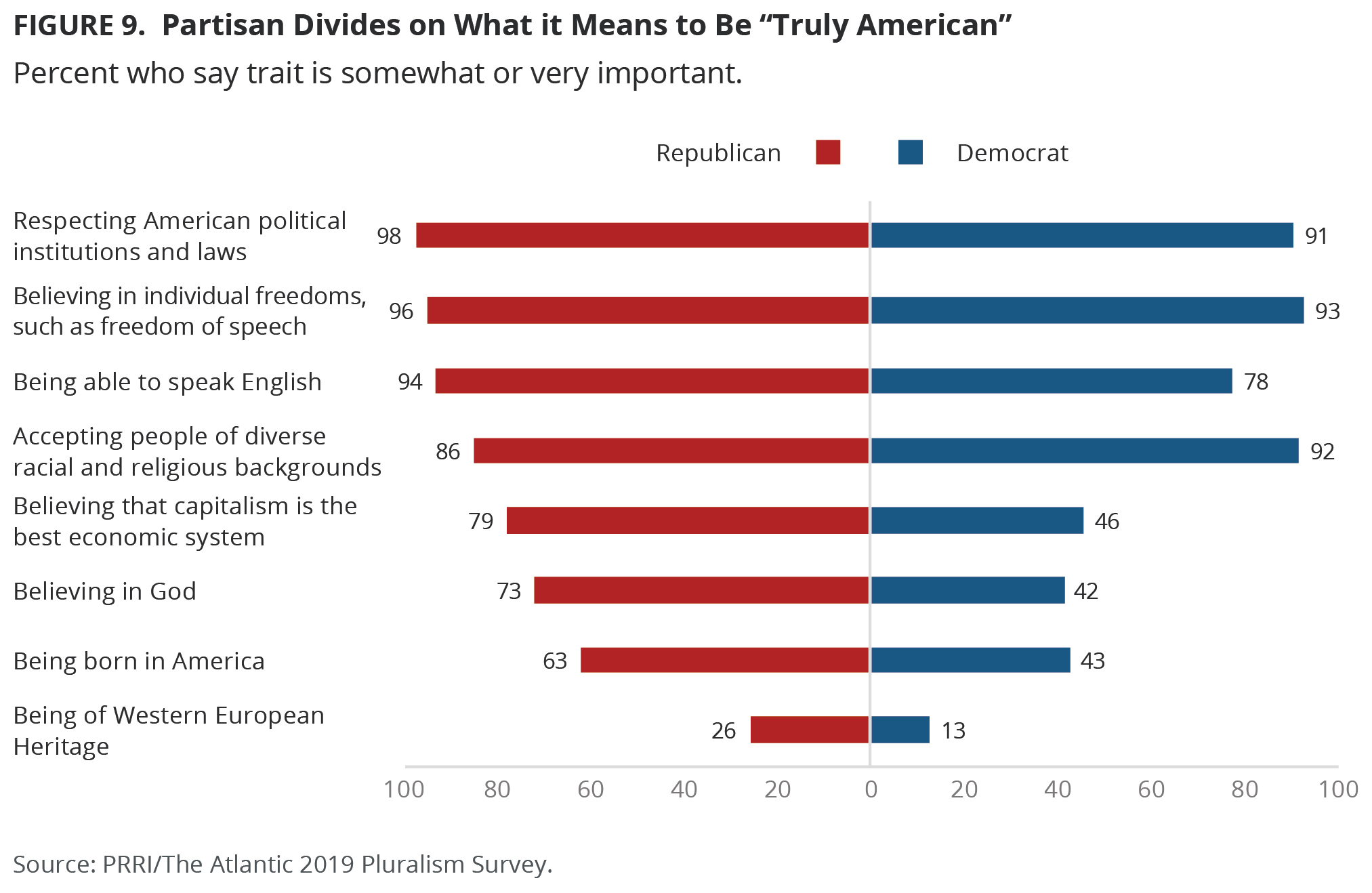
"Truly American"


At the Public Religion Research Institute, Maxine Najle and Robert P. Jones report on survey data:
When asked how important certain characteristics or beliefs are to being “truly American,” Americans overwhelmingly agree that a few characteristics are fundamental to being American, but are more divided on others. The vast majority of Americans agree that believing in individual freedoms, such as freedom of speech (91%), respecting American political institutions and laws (90%), accepting people of diverse racial and religious backgrounds (86%), and being able to speak English (83%) are somewhat or very important to being American.
Americans are more divided on other characteristics. A majority (56%) of Americans agree that believing that capitalism is the best economic system is somewhat or very important for being truly American, while 38% say this is not too important or not at all important. A slim majority (52%) of Americans agree that believing in God is somewhat or very important for being American. However, only 39% say that being a Christian is somewhat or very important for being truly American, while a majority (56%) say it is not too important or not at all important.
Half (50%) of Americans say that being born in America is somewhat or very important for being truly American, while 46% say this is not too important or not at all important. However, Americans decisively reject the notion that Western heritage is fundamental to a truly American identity: only 17% say that being of Western heritage is somewhat or very important for being American, while most (78%) agree that this is not very important or not at all important.

Monday, February 12, 2018

The Border Patrol Can Conduct Warrantless Searches of Most Americans

Daniel Dale at The Toronto Star:
A U.S. law gives the Border Patrol the right to board and search any vehicle within a “reasonable distance” of the country’s boundaries. A 1953 regulation defines “reasonable” as within 100 miles (160 kilometres).
Because “boundaries” include coasts, the “100-mile zone” includes entire states — all or almost all of New York, Connecticut, Delaware, Florida, Hawaii, Maine, Massachusetts, New Hampshire, New Jersey, Rhode Island and Vermont, the American Civil Liberties Union notes.
The zone also includes Houston and Los Angeles. All in all, well over half of Americans, more than 175 million people, live in a place where the Border Patrol believes it has the right to question people, search their vehicles and detain people it believes are unlawfully present.
The bus and train checks are not new. But they appear to be happening more often near the Canadian border than they did in the five years prior to Trump’s tenure. And they have attracted renewed scrutiny around the country as Trump touts his crackdown on illegal immigration and gives the Border Patrol more money and leeway.

Tuesday, October 10, 2017

Standing for the Pledge

Mike Hayes at Buzzfeed:
A Houston high school student who was suspended for several days after refusing to stand during the Pledge of Allegiance has filed a federal civil rights lawsuit against the school's principal and the school district.
On Monday, Oct. 2, Windfern High School student India Landry was sent to the school’s principal office for texting on her cell phone. While in the office, according to the complaint, the Pledge of Allegiance came on over the school’s intercom and Landry continued sitting.
When Principal Martha Strother asked Landry to stand, the 17-year-old declined. According to the complaint, Strother told Landry, “Well you’re kicked outta here.” Strother’s secretary also allegedly told Landry, “This is not the NFL.”
According to the complaint, Landry sat for the Pledge of Allegiance “around 200 times in class through six of more teachers without incident.”
Landry was sent home, and three days later she and her mother met with Strother. According to the complaint, Strother told them that Landry must stand for the pledge to be let back into school.
The next day, Friday, Oct. 6 — after KHOU Channel 11 aired a segment on Landry and the controversy — Landry was allowed back in school and told that she could sit during the pledge, according to the lawsuit.
Seventy-four years ago, the Supreme Court settled the issue in West Virginia v. Barnette (319 U.S. 624 (1943)).  Public schools cannot force students to take part in the Pledge, period. Justice Jackson delivered the opinion of the Court:
If there is any fixed star in our constitutional constellation, it is that no official, high or petty, can prescribe what shall be orthodox in politics, nationalism, religion, or other matters of opinion, or force citizens to confess by word or act their faith therein. If there are any circumstances which permit an exception, they do not now occur to us.

We think the action of the local authorities in compelling the flag salute and pledge transcends constitutional limitations on their power, and invades the sphere of intellect and spirit which it is the purpose of the First Amendment to our Constitution to reserve from all official control.

Wednesday, July 19, 2017

Sessions Expands Asset Forfeiture

Christopher Ingraham reports that Sessions wants to seize property of people not convicted of any crime:
Attorney General Jeff Sessions on Monday said he'd be issuing a new directive this week aimed at increasing police seizures of cash and property.
“We hope to issue this week a new directive on asset forfeiture — especially for drug traffickers,” Sessions said in his prepared remarks for a speech to the National District Attorney's Association in Minneapolis. "With care and professionalism, we plan to develop policies to increase forfeitures. No criminal should be allowed to keep the proceeds of their crime. Adoptive forfeitures are appropriate as is sharing with our partners."
Asset forfeiture is a disputed practice that allows law enforcement officials to permanently take money and goods from individuals suspected of crime. There is little disagreement among lawmakers, authorities and criminal justice reformers that “no criminal should be allowed to keep the proceeds of their crime.” But in many cases, neither a criminal conviction nor even a criminal charge is necessary — under forfeiture laws in most states and at the federal level, mere suspicion of wrongdoing is enough to allow police to seize items permanently.

Additionally, many states allow law enforcement agencies to keep cash that they seize, creating what critics characterize as a profit motive. The practice is widespread: In 2014, federal law enforcement officers took more property from citizens than burglars did. State and local authorities seized untold millions more.

Sunday, September 25, 2016

The State of the First Amendment

From the Newseum Institute
The State of the First Amendment survey, conducted by the Newseum Institute’s First Amendment Center, tests Americans’ knowledge of their core freedoms and samples their opinions on First Amendment issues of the day.
The results of this year’s survey show most Americans favor free speech, even over speech that offends, and support religious liberty, even in the face of terrorism. However, 39 percent of Americans could not name a single First Amendment freedom: religion, speech, press, assembly or petition.
The annual survey, which began in 1997 and this year was conducted in late May, showed that 86 percent of those responding in the national survey favored “protecting speech,” while just 10 percent favored limits aimed at “protecting people from hearing things that offend them.”
There also was strong support for free expression on college campuses: 57 percent said college students should be able to speak freely. The results dropped to 35 percent for students in high school.
Also, a follow-up survey done after the June 12 mass shooting in Orlando showed support for First Amendment protection for all religious faiths, regardless of how extreme or fringe the survey respondents might consider the beliefs of those faiths, actually increased, despite anti-Muslim rhetoric and reports of an ISIS connection that followed the worst mass shooting in U.S. history.
Gallup reports:
A majority of students at historically black colleges and universities (HBCUs), 56%, believe campus protesters should be able to deny the press access to protests. Those views contrast with the opinions of college students nationally, including black students at non-HBCU colleges, two-thirds of whom say the press should be allowed to cover campus protests.
The results are based on a Gallup poll conducted in partnership with the John S. and James L. Knight Foundation and the Newseum Institute that looks at HBCU students' views on First Amendment issues. The poll and its related report are a follow-up to a study released earlier this year that examines U.S. college students' and national adults' views of First Amendment freedoms.

Monday, July 20, 2015

Internment Camps

A onetime candidate for the Democratic presidential nomination (2004) proposes internment camps. TPM reports:
U.S. General Wesley Clark floated a plan Friday for dealing with so-called “lone wolf” terrorists on American soil: imprison them in internment camps before they get the chance to attack the U.S.

In an appearance on MSNBC to discuss the shootings at Chattanooga military sites, the retired general and former Democratic candidate for president said we should be dealing with “disloyalAmerican citizens who’ve been “radicalized” the same way the U.S. did during World War II – and called on allies to do the same.
“In World War II, if someone supported Nazi Germany at the expense of the United States, we didn’t say that was freedom of speech, we put them in a camp, they were prisoners of war,” Clark said.
He also said: “If these people are radicalized and they don’t support the United States and they are disloyal to the United States as a matter of principle, fine. It’s their right and it’s our right and obligation to segregate them from the normal community for the duration of the conflict.”