Search This Blog

Showing posts with label God. Show all posts

Sunday, July 12, 2026

Nonbelievers on Capitol Hill

Many posts have discussed the role of religion in American life.

Mark Z. Barabak at LAT:

[California Democratic House Member Jared] Huffman is the rare American — one of only about 10% or so — who flatly state they do not believe in God, or any higher power for that matter. What makes him rarer still is his place in Congress. Huffman, who represents a sprawling slice of Northern California, reaching from the Bay Area to the Oregon border, is one of just four members (out of more than 500) who are openly agnostic or religiously unaffiliated.

He is, by far, the most outspoken.

Huffman, who publicly revealed his nonreligious status in 2017, helped form the Congressional Freethought Caucus, which consists of about three dozen members of various religious stripe, each dedicated to the proposition that church and state should be distinct. He’s written a book, due out next month, raising an alarm and summoning Americans to fight the rising tide of Christian nationalism roiling our divided land.

An overwhelming favorite to win an eighth congressional term in November, Huffman, a Democrat, calls himself a humanist and described it this way:

“To me, it means good without God. It means you don’t need the inducement or fear of an afterlife to have a moral framework and to know your place in the universe. You’re sort of at peace with the reality that, as far as we know, this is it. You get one time around.
...

Ignoring the counsel of family, friends and political advisors who, to a person, warned against it, Huffman revealed his religious disbelief in a series of statements and interviews in November 2017. At the time, the only member of Congress to ever publicly come out as an atheist was Rep. Pete Stark, who announced his sentiments in 2007; though the Fremont Democrat was reelected twice, he was eventually defeated by a Democratic rival who turned his lack of faith against him.

That rival was Eric Swalwell; make of it what you will.

Huffman braced for political blowback. There was none, though he’s gotten death threats and plenty of admonishments he’s bound for Hell.

(Meantime, the congressional ranks of the religiously unaffiliated have grown to include Democratic Reps. Yassamin Ansari of Arizona and Emily Randall of Washington and Republican Rep. Abraham Hamadeh of Arizona.)

Gallup January 26, 2024:

Take these numbers with some skepticism.  In the poll, 70% said they would not vote for a convicted felon, but on Election Day, nearly half of voters did so. 


Monday, July 6, 2026

Myths, Misinformation, and the Founding


Many posts have discussed myths and misinformation. 
View on Threads

Tuesday, March 10, 2026

Morality and Bellief in God


Jonathan Evans at Pew:
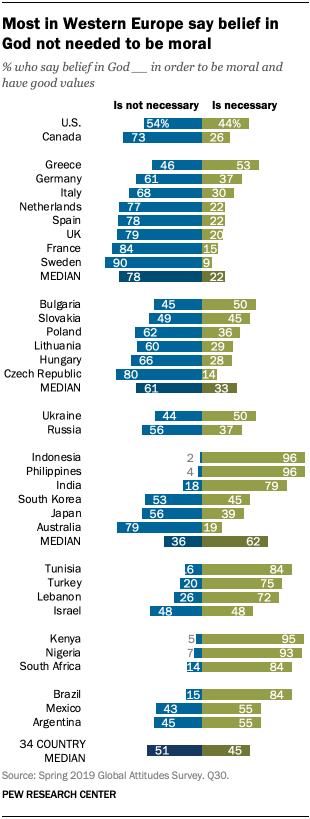
Nearly everyone in Indonesia (99%), as well as the vast majority of people in Kenya (94%), India (85%) and South Africa (80%), say it’s necessary to believe in God to be moral.

By contrast, in about a dozen countries, two-thirds of adults or more say it’s not necessary to believe in God to be moral. This includes the United States (68%), Poland (80%), Spain (84%) and Sweden (89%).

In some countries – including the U.S. – declining shares of people say it’s necessary to believe in God to be moral and have good values, according to the survey.

In the U.S., we’ve asked this question 18 times since 2002. That includes eight surveys conducted online using our American Trends Panel and 10 surveys conducted by telephone.


From 2002 through 2011, Americans were split fairly evenly or tilted toward the view that people need to believe in God to be moral and have good values.

Starting in 2014, however, Americans have been more likely to say the opposite – that belief in God is not necessary to be moral. Since 2020, about two-thirds of U.S. adults have taken this position.


Saturday, September 13, 2025

God Votes?

 Many posts have discussed the role of religion in American life.

What role do Americans think God played in the last two presidential elections? In a May 2025 survey, most U.S. adults say God played no role at all, while about a third say recent election results are part of God’s overall plan but don’t necessarily mean God approved of the winner’s policies. Very few say God chose the winners because of their policies.


Sunday, December 29, 2024

Patriotism and Generations

Many posts have discussed patriotism and the role of religion in American life.

Bruce Mehlman:

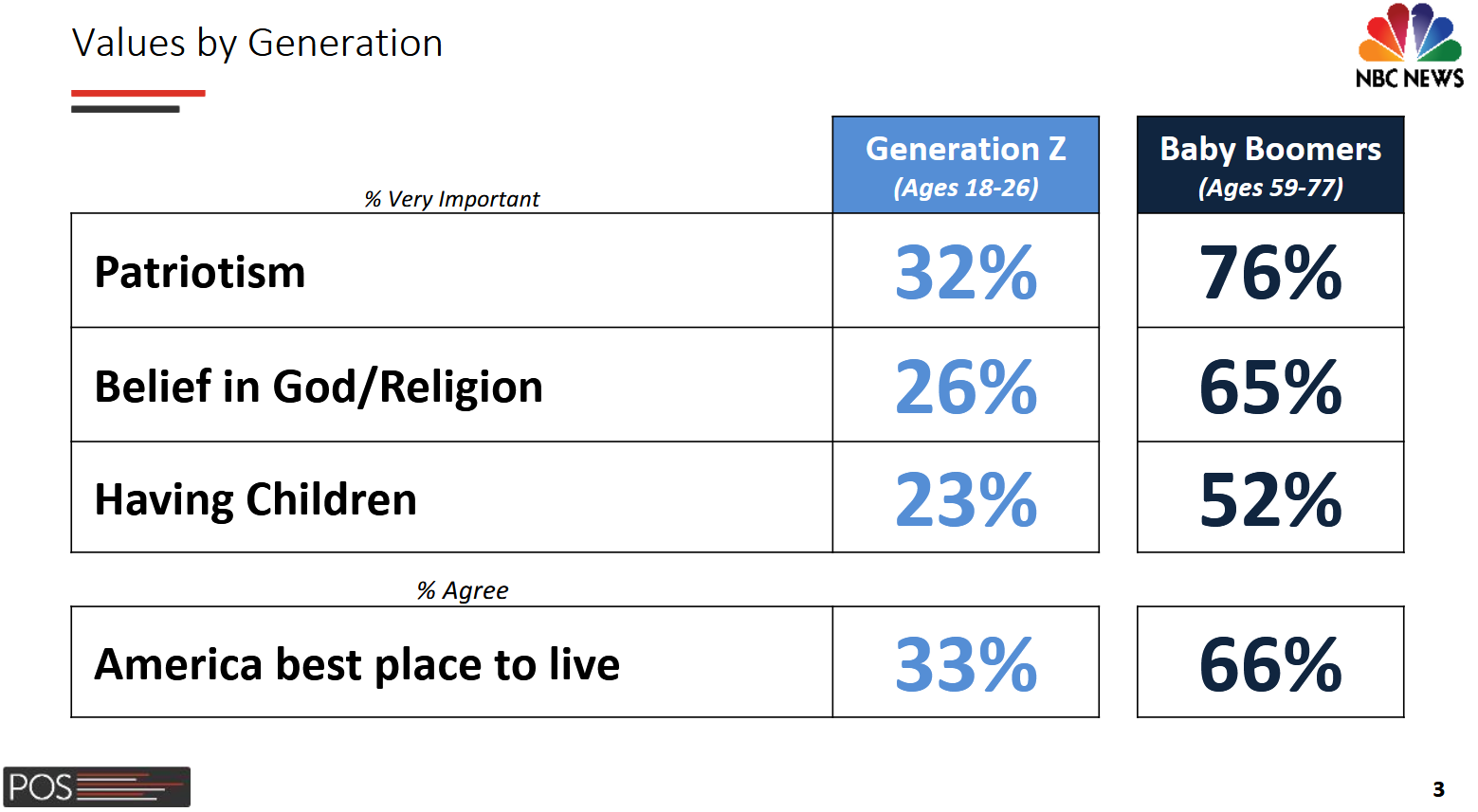
Earlier this year Public Opinion Strategies’ Bill McInturff, who looked at “key data by generation” (38 slides) and found Gen-Z a lot less likely to prioritize more traditional community values.  [The April 2024 slide deck is here.]

Tuesday, July 30, 2024

Evolution and Creation 2024

Megan Brenan at Gallup:

Americans continue to express complex views about human origins, with a majority believing God played at least some role but also a majority believing humans evolved from less advanced forms of life 
  • Though diminished from the early 2000s, the largest segment of Americans, 37%, are creationist purists, saying God created humans in their present form within the past 10,000 years.
  • Twenty-four percent of U.S. adults accept the scientific theory of evolution, that humans evolved from less advanced forms of life over millions of years without God’s involvement.
  • One in three, 34%, straddle both theories, saying humans evolved, but with God’s guidance.


Thursday, November 23, 2023

Lincoln's 1863 Thanksgiving Proclamation

Many posts have discussed the background of Thanksgiving and other holidays.

Transcript for President Abraham Lincoln’s Thanksgiving Proclamation from October 3, 1863

 The year that is drawing toward its close has been filled with the blessings of fruitful fields and healthful skies. To these bounties, which are so constantly enjoyed that we are prone to forget the source from which they come, others have been added, which are of so extraordinary a nature that they cannot fail to penetrate and even soften the heart which is habitually insensible to the ever-watchful providence of Almighty God.

In the midst of a civil war of unequaled magnitude and severity, which has sometimes seemed to foreign states to invite and provoke their aggressions, peace has been preserved with all nations, order has been maintained, the laws have been respected and obeyed, and harmony has prevailed everywhere, except in the theater of military conflict; while that theater has been greatly contracted by the advancing armies and navies of the Union.

Needful diversions of wealth and of strength from the fields of peaceful industry to the national defense have not arrested the plow, the shuttle, or the ship; the ax has enlarged the borders of our settlements, and the mines, as well of iron and coal as of the precious metals, have yielded even more abundantly than heretofore. Population has steadily increased, notwithstanding the waste that has been made in the camp, the siege, and the battlefield, and the country, rejoicing in the consciousness of augmented strength and vigor, is permitted to expect continuance of years with large increase of freedom.

No human counsel hath devised, nor hath any mortal hand worked out these great things. Theyare the gracious gifts of the Most High God, who while dealing with us in anger for our sins, hath nevertheless remembered mercy.

It has seemed to me fit and proper that they should be solemnly, reverently, and gratefully acknowledged as with one heart and one voice by the whole American people. I do, therefore, invite my fellow-citizens in every part of the United States, and also those who are at sea and those who are sojourning in foreign lands, to set apart and observe the last Thursday of November next as a Day of Thanksgiving and Praise to our beneficent Father who dwelleth in the heavens. And I recommend to them that, while offering up the ascriptions justly due to Him for such singular deliverances and blessings, they do also, with humble penitence for our national perverseness and disobedience, commend to His tender care all those who have become widows, orphans, mourners, or sufferers in the lamentable civil strife in which we are unavoidably engaged, and fervently implore the interposition of the Almighty hand to heal the wounds of the nation, and to restore it, as soon as may be consistent with the Divine purposes, to the full enjoyment of peace, harmony, tranquility, and union.

In testimony whereof, I have hereunto set my hand and caused the seal of the United Stated States to be affixed.

Done at the city of Washington, this third day of October, in the year of our Lord one thousand eight hundred and sixty-three, and of the Independence of the United States the eighty-eighth.


Abraham Lincoln

By the President: William H. Seward. Secretary of State

Saturday, June 18, 2022

Declining Belief in God

 Jeffrey M. Jones at Gallup:

The vast majority of U.S. adults believe in God, but the 81% who do so is down six percentage points from 2017 and is the lowest in Gallup's trend. Between 1944 and 2011, more than 90% of Americans believed in God.

Gallup's May 2-22 Values and Beliefs poll finds 17% of Americans saying they do not believe in God.

Gallup first asked this question in 1944, repeating it again in 1947 and twice each in the 1950s and 1960s. In those latter four surveys, a consistent 98% said they believed in God. When Gallup asked the question nearly five decades later, in 2011, 92% of Americans said they believed in God.

A subsequent survey in 2013 found belief in God dipping below 90% to 87%, roughly where it stood in three subsequent updates between 2014 and 2017 before this year's drop to 81%.

Saturday, November 20, 2021

Did God Grant America a Special Place?

From PRRI:
Compared to 2013, significantly fewer Americans today believe that God has granted America a special role in human history. In 2013, nearly two-thirds of Americans (64%) agreed with this statement, compared to only 29% who disagreed. Today, belief in this statement has dropped a massive 20 percentage points, to 44%, with a majority of Americans (53%) now disagreeing that God has granted America a special role in human history.

Republicans (68%) are twice as likely as Democrats (33%) to agree that God has granted America a special role in human history. Independents (40%) are slightly less likely to think this way than all Americans are. Notably, belief in this statement has dropped across all partisan groups since 2013, including 25 percentage points among Democrats (from 58% to 33%), 23 percentage points among independents (from 63% to 40%), and nine percentage points among Republicans (from 77% to 68%).

Among all religious groups, white evangelical Protestants (75%) are the most likely to agree that God has granted America a special role in human history, a significant decline from 84% in 2013. Two-thirds of Black Protestants (67%) and 55% of other Christians also agree with this idea, as do half of Hispanic Catholics (50%). Less than half of white mainline (non-evangelical) Protestants (46%) and white Catholics (46%) agree, substantial decreases from 75% and 60%, respectively, in 2013, while even fewer members of non-Christian religions (29%) and religiously unaffiliated Americans (18%) think this way. Unaffiliated Americans also declined significantly, from 40% in 2013.[3]

Thursday, February 11, 2021

Attitudes on Patriotism and American Exceptionalism

Daniel A. Cox at the Survey Center on American Life:

Despite a lackluster federal response to the COVID-19 outbreak and a violent assault on the US Capitol, Americans remain firm in their belief that American culture and the American way of life are superior to others. More than half (53 percent) of Americans say that the world would be much better off if more countries adopted American values and the American way of life. Approximately four in 10 (42 percent) disagree with this statement.

There is even greater agreement among the public that the US has always been a force for good in the world. Nearly three-quarters (73 percent) of Americans agree, while about one in four (24 percent) reject the idea that the US has been consistently virtuous in its actions abroad.

Fewer Americans believe the US has a special relationship with God. Nearly half (45 percent) the public believe that God has granted the country a special role in human history. Roughly half (49 percent) of Americans disagree.

There are massive generational differences in views about American exceptionalism. Young adults are far more likely to challenge notions that the US serves as a moral beacon. Less than half (46 percent) of young adults (age 18 to 29) believe the world would be better off if more countries adopted American values and lifestyle. In contrast, seven in 10 (70 percent) seniors (age 65 or older) agree with this statement. Young adults are also far less inclined to believe the US continues to be a force for good in the world.

Overall, most Americans feel proud about their national identity. More than six in 10 say they are extremely proud (34 percent) or very proud (28 percent) to be an American. But this sentiment masks considerable cleavages among the public along the lines of race, political affiliation, and generation.

There are sizable generational divisions in feelings of pride about being American. Older Americans express much more pride in their nationality than do younger Americans. In fact, seniors are more than twice as likely to say they are extremely proud to be American than are young adults (55 percent vs. 23 percent).

No religious group expresses greater pride in their national identity than white evangelical Protestants. More than three-quarters of white evangelical Protestants say they are very or extremely proud to be an American; half (50 percent) say they are extremely proud. More than four in 10 white Catholics (46 percent) and white mainline Protestants (43 percent) also report being extremely proud about their national identity. Considerably fewer Hispanic Catholics (29 percent), black Protestants (27 percent), members of non-Christian religious traditions (26 percent), and religiously unaffiliated Americans (20 percent) report they are extremely proud to be American.

Sunday, November 8, 2020

God, Lincoln, and President-Elect Biden

Many posts have discussed the role of religion in American  life.

 In his victory speech, President-elect Biden -- like so many of his predecessors -- mentioned and alluded to classic American documents and religious belief.

To make progress, we must stop treating our opponents as our enemy. We are not enemies. We are Americans.

The Bible tells us that to everything there is a season — a time to build, a time to reap, a time to sow. And a time to heal.

This is the time to heal in America.

...

I’ve long talked about the battle for the soul of America.

We must restore the soul of America.

Our nation is shaped by the constant battle between our better angels and our darkest impulses.

It is time for our better angels to prevail.

...

 In the last days of the campaign, I’ve been thinking about a hymn that means a lot to me and to my family, particularly my deceased son, Beau. It captures the faith that sustains me and which I believe sustains America.

And I hope it can provide some comfort and solace to the more than 230,000 families who have lost a loved one to this terrible virus this year. My heart goes out to each and every one of you. Hopefully this hymn gives you solace as well.

“And He will raise you up on eagle’s wings,

Bear you on the breath of dawn,

Make you to shine like the sun,

And hold you in the palm of His Hand.”

And now, together — on eagle’s wings — we embark on the work that God and history have called upon us to do.

With full hearts and steady hands, with faith in America and in each other, with a love of country — and a thirst for justice — let us be the nation that we know we can be.

A nation united.

A nation strengthened.

A nation healed.

The United States of America.

God bless you.

And may God protect our troops.

The phrases "we are not enemies" and "better angels" are from the ending of Lincoln's First Inaugural, when he was dealing with the secession of Southern states:

I am loath to close. We are not enemies, but friends. We must not be enemies. Though passion may have strained it must not break our bonds of affection. The mystic chords of memory, stretching from every battlefield and patriot grave to every living heart and hearthstone all over this broad land, will yet swell the chorus of the Union, when again touched, as surely they will be, by the better angels of our nature.

Here is the Bible verse ("a time to heal') that he mentioned (Ecclesiastes 3:1-3):

All things have their season, and in their times all things pass under heaven.

A time to be born and a time to die. A time to plant, and a time to pluck up that which is planted. 

A time to kill, and a time to heal. A time to destroy, and a time to build.

At The List, Hope Ngo explains the Catholic hymn that he mentioned.  (Yes, Catholics and Protestants have different hymns.)

The song was composed by Jan Michael Joncas, a Catholic priest who now teaches contemporary Catholic music at the University of St. Thomas. He tells America Magazine he wrote the song after he found out that his friend's father had died of a heart attack. "I knew this was a hard, hard experience in anybody's life, [and I] just wanted to create something that would be both prayerful and then comforting," he said in 2017. The song was written after he had attended the wake of his friend's father, and it rose to prominence after the 1995 bombing of Oklahoma's Federal Building, when the governor's wife asked if the song could be played during a memorial for those whose lives had been taken. 

Catholics often sing it at funeral Masses.  After the speech, I was in touch with Catholics who said that they openly wept when they heard Biden cite it.  

 The phrase "on eagle's wings" comes from the biblical Book of Isaiah (40:31): 

but they who wait for the Lord shall renew their strength;

    they shall mount up with wings like eagles;

they shall run and not be weary;

    they shall walk and not faint.

Bible verses are from the Douay translation preferred by older Catholics. Biden grew up with this version.  

Tuesday, July 21, 2020

The Global God Divide

Christine Tamir et al. at Pew:
What is the connection between belief in God and morality? And how important are God and prayer in people’s lives? Pew Research Center posed these questions to 38,426 people in 34 countries in 2019.
Across the 34 countries, which span six continents, a median of 45% say it is necessary to believe in God to be moral and have good values. But there are large regional variations in answers to this question...Despite variances in religious observance, a median of 62% across the countries surveyed say that religion plays an important role in their lives, while 61% agree that God plays an important role in their lives and 53% say the same about prayer. 
...
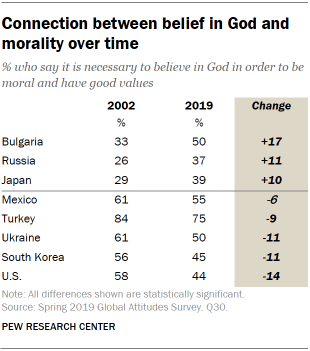
 In addition to Ukraine, four other countries – Mexico, Turkey, South Korea and the United States – have seen significant decreases in the percentage of their publics who say belief in God is necessary to be moral.

 A table showing connection between belief in God and morality over time

A chart showing most in Western Europe say belief in God not needed to be moral
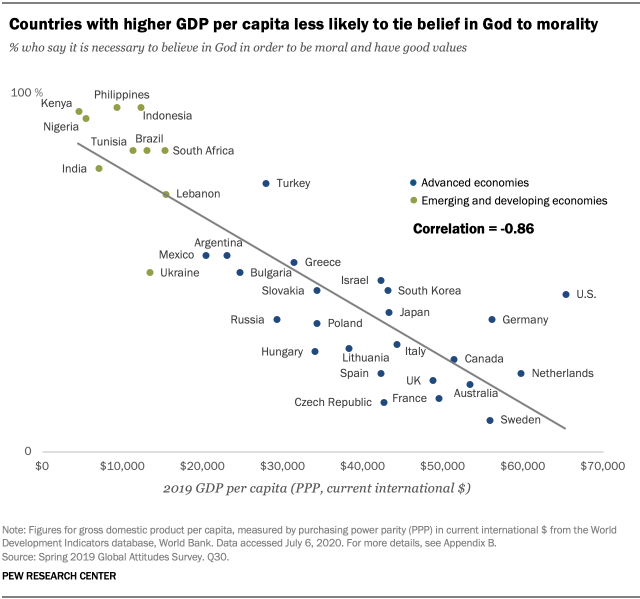
A chart showing countries with higher GDP per capita less likely to tie belief in God to morality

Tuesday, April 2, 2019

Doubt, God, and Polarization

Daniel A. Cox at AEI:
  • Most Americans believe in God, but doubts are more common than is often reported. Nearly half (46 percent) of the public express some amount of uncertainty about the existence of God.
  • Nonbelievers have doubts about God too. More than one-quarter of atheists report that they are not completely certain that God does not exist. Atheists express greater doubts about the existence of God than white evangelical Protestants do. 
  • Religious doubting is particularly common among young adults. About only one-third (34 percent) of young people believe in God and are certain about their beliefs. Nearly 6 in 10 young adults express some degree of uncertainty about God’s existence
...
Americans of differing political perspectives have sharply varying views about God. Political conservatives express much greater certainty about their belief in God than do liberals. In fact, the more conservative one is, the greater certainty their religious beliefs. More than 6 in 10 political conservatives and over three-quarters of Americans who  identify as very conservative believe in God without any doubts. Liberals, by contrast, express considerable doubts about God. Only 21 percent of Americans who are very liberal are completely certain in their belief that God exists. (See Figure 5.) Roughly as many (24 percent) are completely certain that God does not exist, while a majority (55 percent) of Americans entertain some degree of doubt about God’s existence, including 14 percent who are completely uncertain
Reis Thebault at WP:
State Rep. Stephanie Borowicz was on the ninth “Jesus” of her opening prayer in the Pennsylvania statehouse when other lawmakers started to look uncomfortable.
Speaker Mike Turzai, a fellow Republican, glanced up — but Borowicz carried on, delivering a 100-second ceremonial invocation that some of her colleagues decried as an offensive, divisive and Islamophobic display shortly before the legislature swore in its first Muslim woman.
“God forgive us — Jesus — we’ve lost sight of you, we’ve forgotten you, God, in our country, and we’re asking you to forgive us,” Borowicz said, followed by a quote from the Bible’s second book of Chronicles that implores God’s followers to “turn from their wicked ways.”
...
By the time she said “Amen,” Borowicz had invoked Jesus 13 times, deploying the name between prayerful clauses as though it were a comma. She mentioned “Lord” and “God” another six times each and referenced “The Great I Am” and “the one who’s coming back again, the one who came, died and rose again on the third day.”
As the prayer reached a crescendo, at least one member shouted objections. Turzai, standing behind her, looked up again and nudged her elbow, prompting her to quickly conclude the address. Afterward, the protests only grew louder.
“It blatantly represented the Islamophobia that exists among some leaders — leaders that are supposed to represent the people,” Rep. Movita Johnson-Harrell, the newly sworn-in Democrat who is Muslim, told the Pennsylvania Capital-Star on Monday. “I came to the Capitol to help build bipartisanship and collaborations regardless of race or religion to enhance the quality of life for everyone in the Commonwealth.”

Saturday, February 23, 2019

"Truly American"


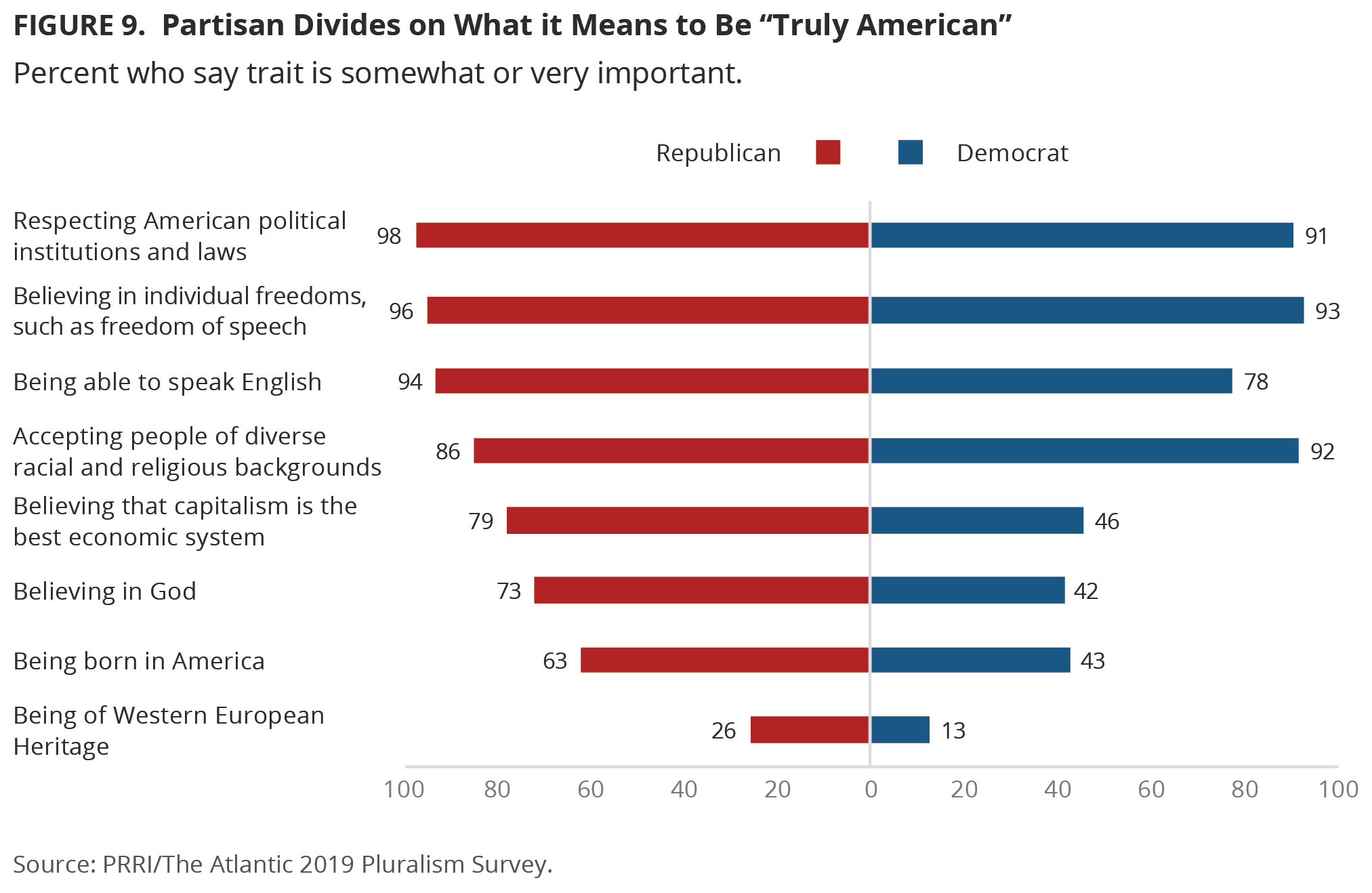
At the Public Religion Research Institute, Maxine Najle and Robert P. Jones report on survey data:
When asked how important certain characteristics or beliefs are to being “truly American,” Americans overwhelmingly agree that a few characteristics are fundamental to being American, but are more divided on others. The vast majority of Americans agree that believing in individual freedoms, such as freedom of speech (91%), respecting American political institutions and laws (90%), accepting people of diverse racial and religious backgrounds (86%), and being able to speak English (83%) are somewhat or very important to being American.
Americans are more divided on other characteristics. A majority (56%) of Americans agree that believing that capitalism is the best economic system is somewhat or very important for being truly American, while 38% say this is not too important or not at all important. A slim majority (52%) of Americans agree that believing in God is somewhat or very important for being American. However, only 39% say that being a Christian is somewhat or very important for being truly American, while a majority (56%) say it is not too important or not at all important.
Half (50%) of Americans say that being born in America is somewhat or very important for being truly American, while 46% say this is not too important or not at all important. However, Americans decisively reject the notion that Western heritage is fundamental to a truly American identity: only 17% say that being of Western heritage is somewhat or very important for being American, while most (78%) agree that this is not very important or not at all important.

Wednesday, September 5, 2018

Americans Are More Religious Than Western Europeans

Many posts have discussed the role of religion in American life, as well as the ways in which religious practices and beliefs set it apart from other countries.

From Jonathan Evans at Pew:
The United States has a religious makeup that’s broadly similar to that of many Western European countries. Most people on both sides of the Atlantic say they are Christian, for example. At the same time, substantial shares in the U.S. and Europe say they are religiously unaffiliated: Roughly a quarter of the American adult population identify as “nones” (23%), similar to the shares in Germany (24%), the United Kingdom (23%) and other Western European countries.
At that point, however, the similarities end: U.S. adults – both Christian and unaffiliated – are considerably more religious than their European counterparts by a variety of other measures, according to an analysis of data from Pew Research Center’s 2014 U.S. Religious Landscape Study in the U.S. and a 2017 survey of Western Europeans. For instance, about two-thirds of U.S. Christians pray daily (68%), compared with a median of just 18% of Christians across 15 surveyed countries in Europe, including 6% in Britain, 9% in Germany, 12% in Denmark and 38% in the Netherlands.

Similarly, 27% of religious “nones” in the U.S. – those who describe themselves as atheist, agnostic or “nothing in particular” – believe in God with absolute certainty. Across the surveyed nations in Western Europe, however, the share of religiously unaffiliated who believe in God with absolute certainty ranges from just 1% in Austria, France, Germany and the UK to 12% in Portugal, with a regional median of 3%.

Monday, June 4, 2018

"In God We Trust" Stays on Currency

Associated Press:
A federal court has ruled that printing "In God We Trust" on U.S. currency doesn't amount to a religious endorsement and therefore doesn't violate the U.S. Constitution. The Chicago Daily Law Bulletin reports the 7th U.S. Circuit Court of Appeals in Chicago made the ruling Thursday in a lawsuit brought by a self-declared Satanist, Kenneth Mayle. He argued that the motto propagates a religious view he opposes.

A lower court tossed the suit citing a Supreme Court decision that a motto on currency isn't something people display prominently and thus that people are not forced to publicly advertise views that clash with their own.
From the ruling:
The inclusion of the motto on currency is similar to other ways in which secular symbols give a nod to the nation’s religious heritage. Examples include the phrase “one nation under God,” which has been in the Pledge of Allegiance since 1954, see Pub. L. No. 83-396, ch. 297, 68 Stat. 249 (1954), as well as the National Day of Prayer, which has existed in various forms since the dawn of the country and is now codified at 36 U.S.C. § 119. Lynch, 465 U.S. at 676–77. Moreover, when the religious aspects of an activity account for “only a fraction,” the possibility that anyone could see it as an endorsement of religion is diluted. Freedom From Religion Found., Inc., 885 F.3d at 1047. In the case of currency, the motto is one of many historical reminders; others include portraits of presidents, state symbols, monuments, notable events such as the Louisiana Purchase, and the national bird. In this context, a reasonable observer would not perceive the motto on currency as a religious endorsement.

Friday, April 27, 2018

Polarized Belefs About God

From Pew:
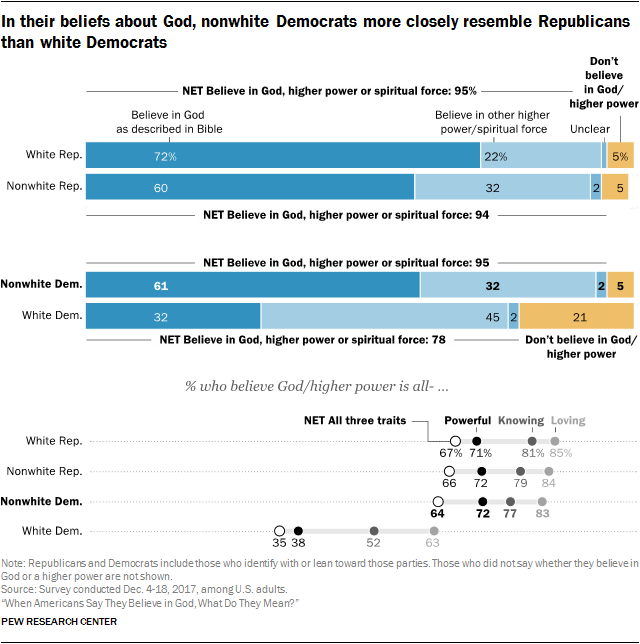
Republicans and Democrats have very different notions about God. Among Republicans and those who lean toward the GOP, seven-in-ten say they believe in God as described in the Bible. Democrats and those who lean Democratic, by contrast, are far less likely to believe in God as described in the Bible (45%), and are more likely than Republicans to believe in another kind of higher power (39% vs. 23%). Democrats also are more likely than Republicans to say they do not believe in any higher power or spiritual force in the universe (14% vs. 5%).
 
Additionally, while 85% of Republicans believe God loves all people, eight-in-ten believe God is all-knowing, and seven-in-ten believe God is all-powerful; Democrats are less likely to express each of these views. Two-thirds of Republicans say they believe God possesses all three of these attributes, compared with roughly half of Democrats (49%). Republicans also are more likely than Democrats to say God has protected, rewarded or punished them (see Chapter 2).
Among Democrats, the survey finds big differences between whites and nonwhites in views about God. Most nonwhite Democrats, who are predominantly black or Hispanic, say they believe in God as described in the Bible, and seven-in-ten or more say they believe God is all-loving, all-knowing or all-powerful, with two-thirds ascribing all of these attributes to God. In these ways, nonwhite Democrats have more in common with Republicans than they do with white Democrats.
In stark contrast with non-white Democrats, just one-third of white Democrats say they believe in God as described in the Bible, while 21% do not believe in a higher power of any kind. And just one-in-three white Democrats say they believe God (or another higher power in the universe) is all-knowing, all-powerful and all-loving.


Sunday, August 20, 2017

God and the State Constitutions

At Pew, Alexandra Sandstrom writes:
The U.S. Constitution never explicitly mentions God or the divine, but the same cannot be said of the nation’s state constitutions. In fact, God or the divine is mentioned at least once in each of the 50 state constitutions and nearly 200 times overall, according to a Pew Research Center analysis.
All but four state constitutions – those in Colorado, Iowa, Hawaii and Washington – use the word “God” at least once. The constitutions in Colorado, Iowa and Washington refer to a “Supreme Being” or “Supreme Ruler of the Universe,” while Hawaii’s constitution makes reference to the divine only in its preamble, which states that the people of Hawaii are “grateful for Divine Guidance.”

Saturday, May 27, 2017

Evolution Picks Up Public Support

Art Swift reports at Gallup:
The percentage of U.S. adults who believe that God created humans in their present form at some time within the last 10,000 years or so -- the strict creationist view -- has reached a new low. Thirty-eight percent of U.S. adults now accept creationism, while 57% believe in some form of evolution -- either God-guided or not -- saying man developed over millions of years from less advanced forms of life.
This is the first time since 1982 -- when Gallup began asking this question using this wording -- that belief in God's direct creation of man has not been the outright most-common response. Overall, roughly three-quarters of Americans believe God was involved in man's creation -- whether that be the creationist view based on the Bible or the view that God guided the evolutionary process, outlined by scientist Charles Darwin and others. Since 1982, agreement with the "secular" viewpoint, meaning humans evolved from lower life forms without any divine intervention, has doubled.

Thursday, April 7, 2016

Is God Dead?

Many posts have discussed the role of religion in American political and civic life.

David Masci and Gregory A. Smith write at Pew:
Fifty years ago this month, Time magazine published one of its most famous and controversial covers. Splashed in bold red print across a black background was a short, simple and yet intensely provocative question: “Is God Dead?”
...
But a half century after the Time article was first published, a recent Pew Research Center survey shows that belief in God is strong in the United States. Indeed, according to our 2014 Religious Landscape Study, nearly nine-in-ten American adults say they believe in God or a universal spirit.

To be sure, the share of people in the United States who say they believe in the Almighty has dropped a bit recently, from 92% in 2007 (when the Center’s first Religious Landscape Study was released) to 89% in 2014. And among the youngest adults surveyed (born between 1990 and 1996), the share of believers is 80%.
In recent years, there also have been small declines in other measures of religious commitment. For instance, between 2007 and 2014, the share of Americans who say they attend church or another house of worship at least once a week has dropped from 39% to 36%. During the same period, the share of Americans who say they pray daily also has dropped 3 percentage points, from 58% to 55%.
Perhaps more strikingly, the number of people who no longer consider themselves to be part of any religious denomination or tradition has risen dramatically in recent decades. Between 2007 and 2014, for example, the share of Americans who are religiously unaffiliated jumped from about 16% to almost 23% of the adult population. However, it’s also important to point out that a majority of these “nones” (61%) still say they believe in God or a universal spirit.