Bessette/Pitney’s AMERICAN GOVERNMENT AND POLITICS: DELIBERATION, DEMOCRACY AND CITIZENSHIP reviews the idea of "deliberative democracy." Building on the book, this blog offers insights, analysis, and facts about recent events.
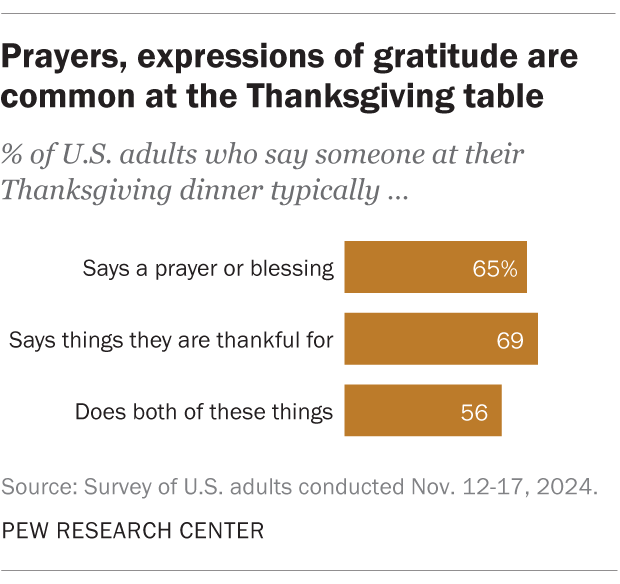
Around two-thirds of U.S. adults say someone at their dinner typically says a prayer or blessing (65%) or says things they are thankful for (69%). And a majority of Americans (56%) say someone at their Thanksgiving dinner typically does both of these things.
Saying grace at Thanksgiving is especially common among certain religious groups. For example, 91% of White evangelical Protestants say someone at their Thanksgiving dinner typically says a prayer or blessing. The same is true for 88% of Black Protestants, 74% of Catholics and 72% of White nonevangelical Protestants. Prayer is much less common among those who say their religion is “nothing in particular” (45%), agnostics (39%), atheists (22%) and Jewish adults (22%).
Majorities across religious groups also say someone at their Thanksgiving dinner typically expresses gratitude. Many religiously unaffiliated Americans say this, too: 59% of those whose religion is “nothing in particular,” along with 61% of agnostics and 48% of atheists, say someone at their dinner typically says things they are thankful for.
Most Americans believe in God, but doubts are more common than is often reported.
Nearly half (46 percent) of the public express some amount of uncertainty about the existence of God.
Nonbelievers have doubts about God too. More than one-quarter of atheists report that
they are not completely certain that God does not exist. Atheists express greater doubts
about the existence of God than white evangelical Protestants do.
Religious doubting is particularly common among young adults. About only one-third
(34 percent) of young people believe in God and are certain about their beliefs. Nearly
6 in 10 young adults express some degree of uncertainty about God’s existence
...
Americans of differing political perspectives have sharply varying views about God. Political conservatives express much greater certainty about their belief in God than do liberals. In fact, the more conservative one is, the greater certainty their religious beliefs. More than 6 in 10 political conservatives and over three-quarters of Americans who identify as very conservative believe in God without any doubts. Liberals, by contrast, express considerable doubts about God. Only 21 percent of Americans who are very liberal are completely certain in their belief that God exists. (See Figure 5.) Roughly as many (24 percent) are completely certain that God does not exist, while a majority (55 percent) of Americans entertain some degree of doubt about God’s existence, including 14 percent who are completely uncertain
State Rep. Stephanie Borowicz was on the ninth “Jesus” of her opening prayer in the Pennsylvania statehouse when other lawmakers started to look uncomfortable.
Speaker Mike Turzai, a fellow Republican, glanced up — but Borowicz carried on, delivering a 100-second ceremonial invocation that some of her colleagues decried as an offensive, divisive and Islamophobic display shortly before the legislature swore in its first Muslim woman.
“God forgive us — Jesus — we’ve lost sight of you, we’ve forgotten you, God, in our country, and we’re asking you to forgive us,” Borowicz said, followed by a quote from the Bible’s second book of Chronicles that implores God’s followers to “turn from their wicked ways.”
...
By the time she said “Amen,” Borowicz had invoked Jesus 13 times, deploying the name between prayerful clauses as though it were a comma. She mentioned “Lord” and “God” another six times each and referenced “The Great I Am” and “the one who’s coming back again, the one who came, died and rose again on the third day.”
As the prayer reached a crescendo, at least one member shouted objections. Turzai, standing behind her, looked up again and nudged her elbow, prompting her to quickly conclude the address. Afterward, the protests only grew louder.
“It blatantly represented the Islamophobia that exists among some leaders — leaders that are supposed to represent the people,” Rep. Movita Johnson-Harrell, the newly sworn-in Democrat who is Muslim, told the Pennsylvania Capital-Star on Monday. “I came to the Capitol to help build bipartisanship and collaborations regardless of race or religion to enhance the quality of life for everyone in the Commonwealth.”
Almost predictably, D’Antonio and Eisner manifest their displeasure with Pence from the outset. They rightly tag him for his tropism toward other people’s money and his discomfort with modernity. All of which is understandable, to a point.
The fact is the first amendment’s free exercise clause was designed to protect those who embrace discomforting creeds. In a narrow 7-2 decision this June, the supreme court sided with a baker who refused to make a wedding cake for a gay couple. In the majority’s view, the Colorado civil rights commission demonstrated “hostility” to the baker’s religious beliefs by ordering him to undergo anti-discrimination training.
Politicians less doctrinaire and more capable of nuance than Pence may yet be able to achieve a modus vivendi. With the Democrats in desperate search of a foothold in red America, the percentage of religious nones growing and evangelicals not backing down anytime soon, that result may even be a matter of civil and political necessity.
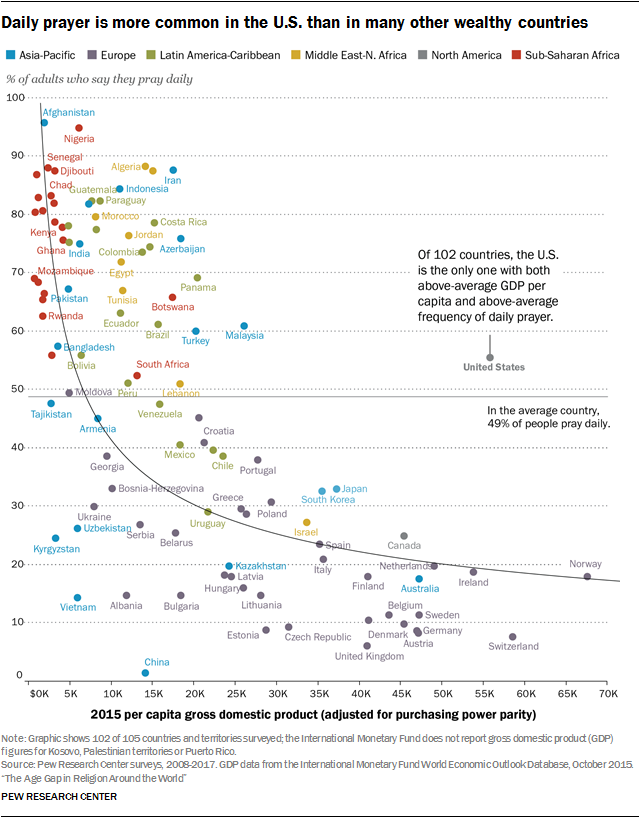
In fact, Americans pray more often, are more likely to attend weekly religious services and ascribe higher importance to faith in their lives than adults in other wealthy, Western democracies, such as Canada, Australia and most European states, according to a recent Pew Research Center study.
For instance, more than half of American adults (55%) say they pray daily, compared with 25% in Canada, 18% in Australia and 6% in Great Britain. (The average European country stands at 22%.) Actually, when it comes to their prayer habits, Americans are more like people in many poorer, developing nations – including South Africa (52%), Bangladesh (57%) and Bolivia (56%) – than people in richer countries.
As it turns out, the U.S. is the only country out of 102 examined in the study that has higher-than-average levels of both prayer and wealth. In every other country surveyed with a gross domestic product of more than $30,000 per person, fewer than 40% of adults say they pray every day.
My fellow Americans: Last night, when I spoke with you about the fall of Rome, I knew at that moment that troops of the United States and our allies were crossing the Channel in another and greater operation. It has come to pass with success thus far.
And so, in this poignant hour, I ask you to join with me in prayer:
Almighty God: Our sons, pride of our Nation, this day have set upon a mighty endeavor, a struggle to preserve our Republic, our religion, and our civilization, and to set free a suffering humanity.
Lead them straight and true; give strength to their arms, stoutness to their hearts, steadfastness in their faith.
They will need Thy blessings. Their road will be long and hard. For the enemy is strong. He may hurl back our forces. Success may not come with rushing speed, but we shall return again and again; and we know that by Thy grace, and by the righteousness of our cause, our sons will triumph.
They will be sore tried, by night and by day, without rest-until the victory is won. The darkness will be rent by noise and flame. Men's souls will be shaken with the violences of war.
For these men are lately drawn from the ways of peace. They fight not for the lust of conquest. They fight to end conquest. They fight to liberate. They fight to let justice arise, and tolerance and good will among all Thy people. They yearn but for the end of battle, for their return to the haven of home.
Some will never return. Embrace these, Father, and receive them, Thy heroic servants, into Thy kingdom.
And for us at home - fathers, mothers, children, wives, sisters, and brothers of brave men overseas - whose thoughts and prayers are ever with them - help us, Almighty God, to rededicate ourselves in renewed faith in Thee in this hour of great sacrifice.
Many people have urged that I call the Nation into a single day of special prayer. But because the road is long and the desire is great, I ask that our people devote themselves in a continuance of prayer. As we rise to each new day, and again when each day is spent, let words of prayer be on our lips, invoking Thy help to our efforts.
Give us strength, too - strength in our daily tasks, to redouble the contributions we make in the physical and the material support of our armed forces.
And let our hearts be stout, to wait out the long travail, to bear sorrows that may come, to impart our courage unto our sons wheresoever they may be.
And, O Lord, give us Faith. Give us Faith in Thee; Faith in our sons; Faith in each other; Faith in our united crusade. Let not the keenness of our spirit ever be dulled. Let not the impacts of temporary events, of temporal matters of but fleeting moment let not these deter us in our unconquerable purpose.
With Thy blessing, we shall prevail over the unholy forces of our enemy. Help us to conquer the apostles of greed and racial arrogancies. Lead us to the saving of our country, and with our sister Nations into a world unity that will spell a sure peace a peace invulnerable to the schemings of unworthy men. And a peace that will let all of men live in freedom, reaping the just rewards of their honest toil.
Since 1999, the monthly town board meetings in Greece, New York, have opened with a roll call, a recitation of the Pledge of Allegiance, and a prayer given by clergy selected from the congregations listed in a local directory. While the prayer program is open to all creeds, nearly all of the local congregations are Christian; thus, nearly all of the participating prayer givers have been too. Respondents, citizens who attend meetings to speak on local issues, filed suit, alleging that the town violated the First Amendment’s Establishment Clause by preferring Christians over other prayer givers and by sponsoring sectarian prayers. They sought to limit the town to “inclusive and ecumenical” prayers that referred only to a “generic God.” The District Court upheld the prayer practice on summary judgment, finding no impermissible preference for Christianity; concluding that the Christian identity of most of the prayer givers reflected the predominantly Christian character of the town’s congregations, not an official policy or practice of discriminating against minority faiths; finding that the First Amendment did not require Greece to invite clergy from congregations beyond its borders to achieve religious diversity; and rejecting the theory that legislative prayer must be nonsectarian. The Second Circuit reversed, holding that some aspects of the prayer program, viewed in their totality by a reasonable observer, conveyed the message that Greece was endorsing Christianity.
Held: The judgment is reversed. 681 F. 3d 20, reversed.
Justice Kennedy delivered the opinion of the Court, except as to Part II–B, concluding that the town’s prayer practice does not violate the Establishment Clause. Pp. 6–18.
(a) Legislative prayer, while religious in nature, has long been understood as compatible with the Establishment Clause. Marsh v. Chambers, 463 U. S. 783. In Marsh, the Court concluded that it was not necessary to define the Establishment Clause’s precise boundary in order to uphold Nebraska’s practice of employing a legislative chaplain because history supported the conclusion that the specific practice was permitted. The First Congress voted to appoint and pay official chaplains shortly after approving language for the First Amendment, and both Houses have maintained the office virtually uninterrupted since then. See id., at 787–789, and n. 10. A majority of the States have also had a consistent practice of legislative prayer. Id., at 788–790, and n. 11. There is historical precedent for the practice of opening local legislative meetings with prayer as well. Marsh teaches that the Establishment Clause must be interpreted “by reference to historical practices and understandings.” County of Allegheny v. American Civil Liberties Union, Greater Pittsburgh Chapter, 492 U. S. 573 (opinion of Kennedy, J.). Thus, any test must acknowledge a practice that was accepted by the Framers and has withstood the critical scrutiny of time and political change. The Court’s inquiry, then, must be to determine whether the prayer practice in the town of Greece fits within the tradition long followed in Congress and the state legislatures. Pp. 6–9.
(b) Respondents’ insistence on nonsectarian prayer is not consistent with this tradition. The prayers in Marsh were consistent with the First Amendment not because they espoused only a generic theism but because the Nation’s history and tradition have shown that prayer in this limited context could “coexis[t] with the principles of disestablishment and religious freedom.” 463 U. S., at 786. Dictum in County of Allegheny suggesting that Marsh permitted only prayer with no overtly Christian references is irreconcilable with the facts, holding, and reasoning of Marsh, which instructed that the “content of the prayer is not of concern to judges,” provided “there is no indication that the prayer opportunity has been exploited to proselytize or advance any one, or to disparage any other, faith or belief.” 463 U. S., at 794–795. To hold that invocations must be nonsectarian would force the legislatures sponsoring prayers and the courts deciding these cases to act as supervisors and censors of religious speech, thus involving government in religious matters to a far greater degree than is the case under the town’s current practice of neither editing nor approving prayers in advance nor criticizing their content after the fact. Respondents’ contrary arguments are unpersuasive. It is doubtful that consensus could be reached as to what qualifies as a generic or nonsectarian prayer. It would also be unwise to conclude that only those religious words acceptable to the majority are permis-sible, for the First Amendment is not a majority rule and government may not seek to define permissible categories of religious speech. In rejecting the suggestion that legislative prayer must be nonsectarian, the Court does not imply that no constraints remain on its content. The relevant constraint derives from the prayer’s place at the opening of legislative sessions, where it is meant to lend gravity to the occasion and reflect values long part of the Nation’s heritage. From the Nation’s earliest days, invocations have been addressed to assemblies comprising many different creeds, striving for the idea that people of many faiths may be united in a community of tolerance and devotion, even if they disagree as to religious doctrine. The prayers delivered in Greece do not fall outside this tradition. They may have invoked, e.g., the name of Jesus, but they also invoked universal themes, e.g., by calling for a “spirit of cooperation.” Absent a pattern of prayers that over time denigrate, proselytize, or betray an impermissible government purpose, a challenge based solely on the content of a particular prayer will not likely establish a constitutional violation. See 463 U. S., at 794–795. Finally, so long as the town maintains a policy of nondiscrimination, the Constitution does not require it to search beyond its borders for non-Christian prayer givers in an effort to achieve religious balancing. Pp. 9–18.
And here we give thanks for His guidance in our own individual faith journeys. In my life, He directed my path to Chicago and my work with churches who were intent on breaking the cycle of poverty in hard-hit communities there. And I’m grateful not only because I was broke and the church fed me, but because it led to everything else. It led me to embrace Jesus Christ as my Lord and Savior. It led me to Michelle -- the love of my life -- and it blessed us with two extraordinary daughters. It led me to public service. And the longer I serve, especially in moments of trial or doubt, the more thankful I am of God’s guiding hand.
Now, here, as Americans, we affirm the freedoms endowed by our Creator, among them freedom of religion. And, yes, this freedom safeguards religion, allowing us to flourish as one of the most religious countries on Earth, but it works the other way, too -- because religion strengthens America. Brave men and women of faith have challenged our conscience and brought us closer to our founding ideals, from the abolition of slavery to civil rights, workers’ rights.
Earlier this month, the valedictorian at Liberty (S.C.) High School ripped up his prepared graduation speech, which had been approved by school officials, and instead recited the Lord’s Prayer at the public school’s graduation ceremony. According to CNN, Roy Costner IV said he was trying to make a statement that “taking prayer out of schools is the worst thing we could do.”
It has been more than 50 years since the Supreme Court ruled in Engel v. Vitale (1962) that school-sponsored prayer in public schools violates the Establishment Clause of the First Amendment, and more than 20 years since the high court decided in Lee v. Weisman(1992) that public schools may not sponsor or promote prayer at graduation ceremonies. But as the incident in South Carolina illustrates, the controversy over prayer in school has not diminished.
A 2012 Pew Research Center poll found that 65% of Americans believe liberals have gone too far trying to keep religion out of schools and government. A smaller, but significant share (48%) think conservative Christians have gone too far to try to impose religious values on the country.
We come together because we're a people of faith. We know that faith is something that must be cultivated. Faith is not a possession. Faith is a process.
I was struck by the passage that was read earlier from the Book of Hebrews: “Without faith it is impossible to please God, because anyone who comes to Him must believe that He exists and He rewards those who diligently seek Him.” He rewards those who diligently seek Him -- not just for one moment, or one day, but for every moment, and every day.
As Christians, we place our faith in the nail-scarred hands of Jesus Christ. But so many other Americans also know the close embrace of faith -- Muslims and Jews, Hindus and Sikhs. And all Americans -- whether religious or secular -- have a deep and abiding faith in this nation.
Recently I had occasion to reflect on the power of faith. A few weeks ago, during the inauguration, I was blessed to place my hand on the Bibles of two great Americans, two men whose faith still echoes today. One was the Bible owned by President Abraham Lincoln, and the other, the Bible owned by Dr. Martin Luther King, Jr. As I prepared to take the sacred oath, I thought about these two men, and I thought of how, in times of joy and pain and uncertainty, they turned to their Bibles to seek the wisdom of God’s word -- and thought of how, for as long as we’ve been a nation, so many of our leaders, our Presidents, and our preachers, our legislators and our jurists have done the same. Each one faced their own challenges; each one finding in Scripture their own lessons from the Lord.
And so my hope is that humility, that that carries over every day, every moment. While God may reveal His plan to us in portions, the expanse of His plan is for God, and God alone, to understand. “For now we see through a glass, darkly; but then face to face; now I know in part, but then shall I know even as also I am known.” Until that moment, until we know, and are fully known, all we can do is live our lives in a Godly way and assume that those we deal with every day, including those in an opposing party, they're groping their way, doing their best, going through the same struggles we're going through.
And in that pursuit, we are blessed with guidance. God has told us how He wishes for us to spend our days. His Commandments are there to be followed. Jesus is there to guide us; the Holy Spirit, to help us. Love the Lord God with all your heart and with all your soul and with all your mind. Love your neighbor as yourself. See in everyone, even in those with whom you disagree most vehemently, the face of God. For we are all His children.
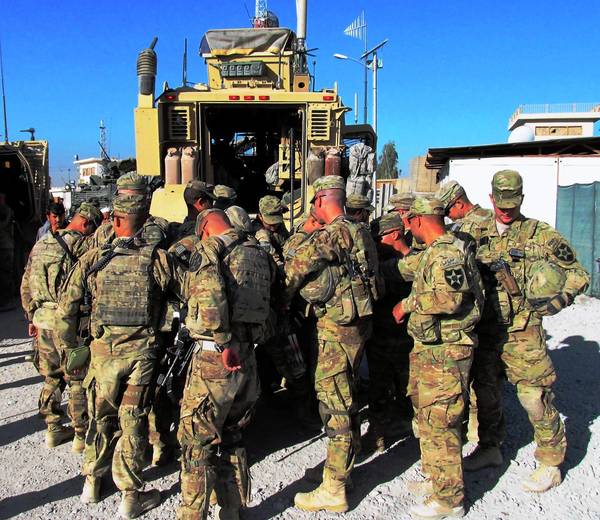
Fifteen U.S. soldiers huddle in a circle. A blue Toyota packed with explosives has been reported somewhere in the city. The troops bow their heads and clasp hands.
"Dear Lord, protect us and protect those entrusted to us as we help the Afghans protect themselves," says Lt. Col. Patrick Michaelis, their gangly 41-year-old commander.
"Amen," say his men.
Every trip outside the wire begins the same way: a quick check of the latest intelligence, then the prayer, which never varies. When Michaelis forgets, someone stops him: Sir, the prayer.
In America's longest war after a dozen years, a yearning for peace comes wrapped in a prayer for survival. Both are unfulfilled, incomplete.
As we note in our chapter on civic culture, religious invocations and benedictions are frequently part of public events.
The Roman Catholic Archbishop of New York, Cardinal Timothy Michael Dolan, gave the closing benediction at the Republican National Convention in Tampa, FL on August 30, 2012. Toward the end of his prayer, he drew on the language of the civic culture:
May we know the truth of your creation, respecting the laws of nature and nature’s God and not seek to replace it with idols of our own making.
Give us the good sense not to cast aside the boundaries of righteous living you first inscribed on our hearts even before inscribing them on tablets of stone.
May you mend our every flaw, confirming our soul in self-control, our liberty in law.
We pray for all those who seek honest labor, as we thank you for the spirit of generosity to those in need with which you so richly blessed this nation.
We beseech your blessing on all who depart from here this evening and on all those in every land who seek to conduct their lives in freedom.
Most of all, Almighty God, we thank you for the great gift of our beloved country. For we are indeed one nation under God, and in God we trust. Dear God, bless America, you who live and reign forever and ever. Amen.
On social issues, the GOP grows ever more conservative. The platform defines marriage as between one man and one woman, assails an “activist judiciary” for decreeing otherwise at the state level and urges a crackdown on Internet pornography. Separate planks support prayer in public schools and the pubic display of the Ten Commandments as “a reflection of our shared Judeo-Christian heritage.” The party would ban all abortions, asserting that “the unborn child has a fundamental individual right to life which cannot be infringed.”
Conservative, yes, but more conservative than before? Hardly. All of the positions in this passage have been in GOP platforms for years, if not decades.
The 1984 platform, and every one since, has declared that the unborn child has a fundamental individual right to life.
Listing "strange obsessions," the article says: "There is an obligatory prohibitions against the use of “foreign law by U.S. courts in interpreting our Constitution and laws,” a reference to the right’s infatuation with Sharia." The 2008 platform called for the appointment of judges who would not "inject foreign law into American jurisprudence." The issue was not Sharia, but the actual practice of some Supreme Court justices of citing foreign law in their opinions. Far from being a "strange obsession," the issue has been the subject of lively legal debate for a number of years.
Yesterday was the 68th anniversary of the D-Day invasion. Warren Kozak writes at The Wall Street Journal:
Franklin Roosevelt is not remembered for his religious dogma. Yet 68 years ago on the night of June 6, as tens of thousands of American and Allied forces were flung into a caldron of fire in Western Europe, the president and commander in chief sought to calm an anxious nation as he spoke to his people. It was a presidential address that stands out as a testament to how much our nation has changed since that evening in the late spring of 1944.
Beginning around midnight the night before, elements of the 101st and 82nd Airborne Divisions had landed behind enemy lines in France. They were followed seven hours later by massive landings on beaches in Normandy code-named Sword, Juneau, Gold, Omaha and Utah.
Americans began hearing special reports in the middle of the night and they continued to follow events closely throughout the day. At lunch counters and in offices and factories, people clustered around their radios. So it was both natural and necessary that the president say something.
Yet instead of giving a news account—something Americans had already heard from network radio news and read in their evening papers—Franklin Roosevelt chose a different course. He led the nation in prayer.
In 1984,
President Reagan observed the 40th anniversary of D-Day:
I wake up each morning and I say a brief prayer, and I spend a little time in scripture and devotion. And from time to time, friends of mine, some of who are here today, friends like Joel Hunter or T.D. Jakes, will come by the Oval Office or they’ll call on the phone or they’ll send me a email, and we’ll pray together, and they’ll pray for me and my family, and for our country.
But I don’t stop there. I’d be remiss if I stopped there; if my values were limited to personal moments of prayer or private conversations with pastors or friends. So instead, I must try -- imperfectly, but I must try -- to make sure those values motivate me as one leader of this great nation.
And so when I talk about our financial institutions playing by the same rules as folks on Main Street, when I talk about making sure insurance companies aren’t discriminating against those who are already sick, or making sure that unscrupulous lenders aren’t taking advantage of the most vulnerable among us, I do so because I genuinely believe it will make the economy stronger for everybody. But I also do it because I know that far too many neighbors in our country have been hurt and treated unfairly over the last few years, and I believe in God’s command to “love thy neighbor as thyself.” I know the version of that Golden Rule is found in every major religion and every set of beliefs -– from Hinduism to Islam to Judaism to the writings of Plato.
And when I talk about shared responsibility, it’s because I genuinely believe that in a time when many folks are struggling, at a time when we have enormous deficits, it’s hard for me to ask seniors on a fixed income, or young people with student loans, or middle-class families who can barely pay the bills to shoulder the burden alone. And I think to myself, if I’m willing to give something up as somebody who’s been extraordinarily blessed, and give up some of the tax breaks that I enjoy, I actually think that’s going to make economic sense.
But for me as a Christian, it also coincides with Jesus’s teaching that “for unto whom much is given, much shall be required.” It mirrors the Islamic belief that those who’ve been blessed have an obligation to use those blessings to help others, or the Jewish doctrine of moderation and consideration for others.
DIANE SAWYER: Someone pulled the Lincoln quote again, thinking of the immeasurable stresses awaited every day. About being on his knees sometimes, because he was in search of wisdom that -- his own wisdom was insufficient for the day.
PRESIDENT OBAMA: I do a lot of praying. Absolutely. Every night, right before I go to bed. You know, and I am praying that -- I'm making the best possible decisions, and that I've got the strength to serve the American people well. And frankly as President of the United States, you know, your responsibilities extend beyond beyond our borders. And these decisions are difficult. Look, I think it's important to understand when -- when people look at a situation like Libya tend to recognize that there are no easy alternatives there. There are no, you know, smooth, painless options.