Search This Blog

Showing posts with label Thanksgiving. Show all posts

Thursday, November 28, 2024

Grace and Thanks

Many posts have discussed the background of Thanksgiving and other holidays.

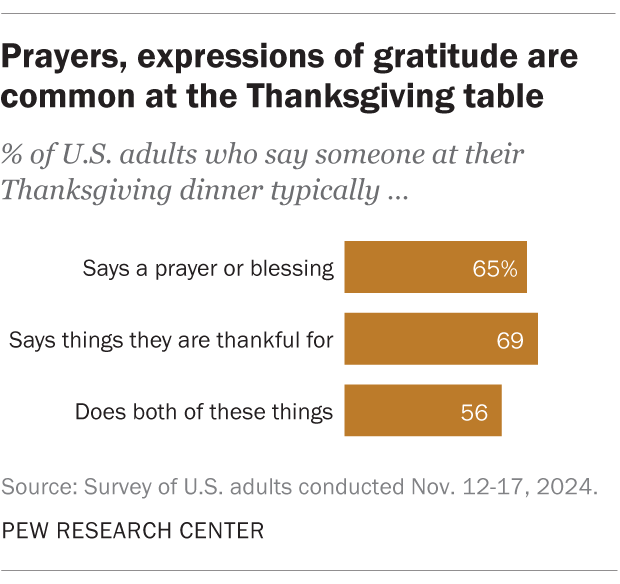
Around two-thirds of U.S. adults say someone at their dinner typically says a prayer or blessing (65%) or says things they are thankful for (69%). And a majority of Americans (56%) say someone at their Thanksgiving dinner typically does both of these things.

Saying grace at Thanksgiving is especially common among certain religious groups. For example, 91% of White evangelical Protestants say someone at their Thanksgiving dinner typically says a prayer or blessing. The same is true for 88% of Black Protestants, 74% of Catholics and 72% of White nonevangelical Protestants. Prayer is much less common among those who say their religion is “nothing in particular” (45%), agnostics (39%), atheists (22%) and Jewish adults (22%).

Majorities across religious groups also say someone at their Thanksgiving dinner typically expresses gratitude. Many religiously unaffiliated Americans say this, too: 59% of those whose religion is “nothing in particular,” along with 61% of agnostics and 48% of atheists, say someone at their dinner typically says things they are thankful for.

Thursday, November 23, 2023

Lincoln's 1863 Thanksgiving Proclamation

Many posts have discussed the background of Thanksgiving and other holidays.

Transcript for President Abraham Lincoln’s Thanksgiving Proclamation from October 3, 1863

 The year that is drawing toward its close has been filled with the blessings of fruitful fields and healthful skies. To these bounties, which are so constantly enjoyed that we are prone to forget the source from which they come, others have been added, which are of so extraordinary a nature that they cannot fail to penetrate and even soften the heart which is habitually insensible to the ever-watchful providence of Almighty God.

In the midst of a civil war of unequaled magnitude and severity, which has sometimes seemed to foreign states to invite and provoke their aggressions, peace has been preserved with all nations, order has been maintained, the laws have been respected and obeyed, and harmony has prevailed everywhere, except in the theater of military conflict; while that theater has been greatly contracted by the advancing armies and navies of the Union.

Needful diversions of wealth and of strength from the fields of peaceful industry to the national defense have not arrested the plow, the shuttle, or the ship; the ax has enlarged the borders of our settlements, and the mines, as well of iron and coal as of the precious metals, have yielded even more abundantly than heretofore. Population has steadily increased, notwithstanding the waste that has been made in the camp, the siege, and the battlefield, and the country, rejoicing in the consciousness of augmented strength and vigor, is permitted to expect continuance of years with large increase of freedom.

No human counsel hath devised, nor hath any mortal hand worked out these great things. Theyare the gracious gifts of the Most High God, who while dealing with us in anger for our sins, hath nevertheless remembered mercy.

It has seemed to me fit and proper that they should be solemnly, reverently, and gratefully acknowledged as with one heart and one voice by the whole American people. I do, therefore, invite my fellow-citizens in every part of the United States, and also those who are at sea and those who are sojourning in foreign lands, to set apart and observe the last Thursday of November next as a Day of Thanksgiving and Praise to our beneficent Father who dwelleth in the heavens. And I recommend to them that, while offering up the ascriptions justly due to Him for such singular deliverances and blessings, they do also, with humble penitence for our national perverseness and disobedience, commend to His tender care all those who have become widows, orphans, mourners, or sufferers in the lamentable civil strife in which we are unavoidably engaged, and fervently implore the interposition of the Almighty hand to heal the wounds of the nation, and to restore it, as soon as may be consistent with the Divine purposes, to the full enjoyment of peace, harmony, tranquility, and union.

In testimony whereof, I have hereunto set my hand and caused the seal of the United Stated States to be affixed.

Done at the city of Washington, this third day of October, in the year of our Lord one thousand eight hundred and sixty-three, and of the Independence of the United States the eighty-eighth.


Abraham Lincoln

By the President: William H. Seward. Secretary of State

Thursday, November 25, 2021

Happy Franksgiving!

Many posts have discussed the background of Thanksgiving and other holidays.

Claire Barrett at History.net:
On November 26, 1789, President George Washington issued a proclamation naming that Thursday a “Day of Publick Thanksgivin.” In 1883 this date was codified by President Abraham Lincoln’s proclamation that Thanksgiving would be commemorated each year on the last Thursday of November.

It would remain so for 56 years until 1939, when the last Thursday fell on the last day of the month. Coupled with the fact that the United States was still in the throes of the Great Depression, business leaders were concerned that Americans wouldn’t want to start shopping for the holidays until after Thanksgiving. (Unless you’re one of those people who start playing Mariah Carey in November. I’m looking at you.) Worried that the shortened shopping season would hurt retail sales, business leaders, including Lew Hahn, the general manager of the Retail Dry Goods Association, lobbied the president to make the holiday one week earlier. President Franklin D. Roosevelt listened, and in August 1939 he issued a Presidential Proclamation that moved Thanksgiving to the second to last Thursday of November.

This seemingly innocuous act sent the nation into a tizzy. Alf Landon, the former governor of Kansas, ranted to Time, “Another illustration of the confusion which his impulsiveness has caused so frequently during his administration. If the change has any merit at all, more time should have been taken in working it out…instead of springing it upon an unprepared country with the omnipotence of a Hitler.”

Thursday, November 26, 2020

Thanksgiving and Constitutional Gratitude

 Yuval Levin and Adam J. White at National Review:

George Washington’s Thanksgiving Proclamation in 1789, like so many other aspects of his presidency, set a precedent. Even if they were spurred by a congressional resolution, Washington’s words went far beyond Congress’s, offering the newly constituted people an example of what to be grateful for, and how to express that gratitude.

Washington went on to further exemplify constitutional gratitude at the end of his presidency, in his 1796 farewell address. There he expressed thanks not just to those who created the Constitution, but also to the Americans now tasked with sustaining it. They had entrusted Washington with the first presidency, and his farewell address is replete with statements of gratitude to Americans, of love for America, and of a profound sense of that with which he had been entrusted.

The man who had devoted his life first to the revolution, and then to the Constitution, left office not suggesting that the people were indebted to him, but the opposite: He offered “deep acknowledgement of that debt of gratitude which I owe to my beloved country,” he wrote, “for the many honors it has conferred upon me; still more for the steadfast confidence with which it has supported me; and for the opportunities I have thence enjoyed of manifesting my inviolable attachment.” The presidency was not a prize that he had earned, but an “important trust” that soon would be committed to his successor.

Washington would not be the last president to speak in such terms, nor should these themes be the exclusive province of presidents. Statesmen in Congress can offer such examples, too. In Federalist No. 57, James Madison writes that members of Congress would be motivated by more than just ambition and self-interest; he also counted duty and gratitude among “the chords by which [those members] will be bound to fidelity and sympathy with the great mass of the people.”

Some more than others, of course, and if the likes of Washington and Lincoln are rare in the White House then they are rarer still on Capitol Hill. But when members of Congress, like presidents, are able to define their office not just in terms of power but also in terms of gratitude both to their fellow countrymen and to their forefathers, they help to perpetuate the Constitution that creates their offices; and they offer an example for the people whose own constitutional gratitude is indispensable for this perpetuation.

This Thanksgiving, when the nation is battered by a pandemic and fractured by political strife, we can hope that statesmen will step forward to exemplify constitutional gratitude. But more important, we can rediscover the sources of our own gratitude, for those who wrote the Constitution and those who perpetuated it — not just for our own sake, but for the sake of posterity.


Thursday, November 28, 2019

Congress and Thanksgiving Day

From the National Archives:
On September 28, 1789, just before leaving for recess, the first Federal Congress passed a resolution asking that the President of the United States recommend to the nation a day of thanksgiving. A few days later, President George Washington issued a proclamation naming Thursday, November 26, 1789 as a "Day of Publick Thanksgivin" - the first time Thanksgiving was celebrated under the new Constitution. Subsequent presidents issued Thanksgiving Proclamations, but the dates and even months of the celebrations varied. It wasn't until President Abraham Lincoln's 1863 Proclamation that Thanksgiving was regularly commemorated each year on the last Thursday of November.
In 1939, however, the last Thursday in November fell on the last day of the month. Concerned that the shortened Christmas shopping season might dampen the economic recovery, President Franklin D. Roosevelt issued a Presidential Proclamation moving Thanksgiving to the second to last Thursday of November. As a result of the proclamation, 32 states issued similar proclamations while 16 states refused to accept the change and proclaimed Thanksgiving to be the last Thursday in November. For two years two days were celebrated as Thanksgiving - the President and part of the nation celebrated it on the second to last Thursday in November, while the rest of the country celebrated it the following week.
To end the confusion, Congress decided to set a fixed-date for the holiday. On October 6, 1941, the House passed a joint resolution declaring the last Thursday in November to be the legal Thanksgiving Day. The Senate, however, amended the resolution establishing the holiday as the fourth Thursday, which would take into account those years when November has five Thursdays. The House agreed to the amendment, and President Roosevelt signed the resolution on December 26, 1941, thus establishing the fourth Thursday in November as the Federal Thanksgiving Day holiday.

Thursday, June 13, 2019

Washington's 1789 Thanksgiving Proclamation

George Washington issued what might be considered the first executive order. To commemorate the end of a bloody Revolutionary War, Washington set aside the last Thursday of November as a day of thanksgiving and prayer. His 1789 Thanksgiving Proclamation was short, a mere 456 words, punctuated by references—“Almighty God,” “the Lord and Ruler of Nations,” “the great and glorious Being,” “the beneficent Author of all the good that was, that is, or that will be”—to a Supreme Being.
...
Historians were not deaf to Washington’s religious references. While the clergy and the scientists saw them as evidence of Washington’s devotion, the historians stressed the president’s precision in crafting a vocabulary that would unite the dizzying array of Protestant denominations in post-revolutionary America without alienating the small but important groups of Catholics, Jews, and freethinkers dotting the American landscape. It was precisely because he understood that Americans did not believe the same thing that Washington was scrupulous in choosing words that would be acceptable to a wide spectrum of religious groups.
In his own time, Washington’s reluctance to show his doctrinal cards dismayed his Christian co-religionists. Members of the first Presbytery of the Eastward (comprised of Presbyterian churches in Massachusetts and New Hampshire) complained to the president that the Constitution failed to mention the cardinal tenets of Christian faith: “We should not have been alone in rejoicing to have seen some explicit acknowledgement of the only true God and Jesus Christ.” Washington dodged the criticism by assuring the Presbyterians that the “path of true piety is so plain as to require but little political direction.”
Similarly, a week before his 1789 proclamation, Washington responded to a letter from Reverend Samuel Langdon, the president of Harvard College from 1774-1780. Langdon had implored Washington to “let all men know that you are not ashamed to be a disciple of the Lord Jesus Christ.” Once again, instead of affirming Christian tenets, Washington wrote back offering thanks to the generic “Author of the Universe.”

Thursday, November 22, 2018

Thanksgiving Proclamations

Richard Samuelson at Law and Liberty:
George Washington set the tone for the office in many ways, none more so than in his Thanksgiving Proclamation, given in October, 1789, seven months after he took the oath of office. Why have such a proclamation at all? Where in Article I, Section 8 (the section that lists the powers the people gave the federal government) is the power to proclaim a federal holiday? In 1791 James Madison would criticize Alexander Hamilton’s assertion that the U.S. government has the authority to create a national bank, for nowhere in the Constitution did the people give the federal government the right to create a bank or to create a corporation (an entity that had traditionally been regarded as a “person” in the eyes of the law). And fourteen years later, the Louisiana Purchase would tie President Jefferson in knots, for nowhere did the people give the U.S. government the right to acquire territory. Yet Madison lost the national bank argument in 1791 and by 1816 he had changed his mind about its constitutionality. Meanwhile, Jefferson didn’t stop the Senate from ratifying the Louisiana Purchase. In other words, he and Madison implicitly accepted that there are some powers that belong to government due to the nature of the thing, and when the people created the U.S. government they, of necessity, allowed it those powers without which no government can function.
The authority to proclaim a Thanksgiving might seem trivial to us—mere words, and an idle declaration. But it is, in fact, fraught with meaning, for the assumption of such authority highlights the degree to which a President is, by nature, much like a monarch—albeit an elected one. Similarly, it points us to the limits of secular nationalism.
Consider President Washington’s Thanksgiving Proclamation. He begins with the universal “duty of all nations to acknowledge the providence of Almighty God, to obey His will, to be grateful for His benefits, and humbly to implore His protection and favor.” But then he stops, as if he knew some might ask why the President is involved. Washington goes on, “Whereas both Houses of Congress have, by their joint committee, requested me ‘to recommend to the people of the United States a day of public thanksgiving and prayer to be observed by acknowledging with grateful hearts the many and signal favors of Almighty God, especially by affording them an opportunity peaceably to establish a a form of government for their safety and happiness.’” Congress asked Washington to proclaim the day. An interesting request. Congress did not pass a law proclaiming a day of Thanksgiving. Such an act may, according to some constructions of the Constitution, have crossed over into an establishment of religion. Instead, they have merely asked the President to “recommend” such an observance to the people. But if it’s not a law, wherefore does the authority come from? It must adhere in the nature of the thing.

Thursday, November 24, 2016

Thursday, November 26, 2015

Thanksgiving 1863

Washington, D.C.
October 3, 1863

By the President of the United States of America.

A Proclamation.

The year that is drawing towards its close, has been filled with the blessings of fruitful fields and healthful skies. To these bounties, which are so constantly enjoyed that we are prone to forget the source from which they come, others have been added, which are of so extraordinary a nature, that they cannot fail to penetrate and soften even the heart which is habitually insensible to the ever watchful providence of Almighty God. In the midst of a civil war of unequalled magnitude and severity, which has sometimes seemed to foreign States to invite and to provoke their aggression, peace has been preserved with all nations, order has been maintained, the laws have been respected and obeyed, and harmony has prevailed everywhere except in the theatre of military conflict; while that theatre has been greatly contracted by the advancing armies and navies of the Union. Needful diversions of wealth and of strength from the fields of peaceful industry to the national defence, have not arrested the plough, the shuttle or the ship; the axe has enlarged the borders of our settlements, and the mines, as well of iron and coal as of the precious metals, have yielded even more abundantly than heretofore. Population has steadily increased, notwithstanding the waste that has been made in the camp, the siege and the battle-field; and the country, rejoicing in the consciousness of augmented strength and vigor, is permitted to expect continuance of years with large increase of freedom. No human counsel hath devised nor hath any mortal hand worked out these great things. They are the gracious gifts of the Most High God, who, while dealing with us in anger for our sins, hath nevertheless remembered mercy. It has seemed to me fit and proper that they should be solemnly, reverently and gratefully acknowledged as with one heart and one voice by the whole American People. I do therefore invite my fellow citizens in every part of the United States, and also those who are at sea and those who are sojourning in foreign lands, to set apart and observe the last Thursday of November next, as a day of Thanksgiving and Praise to our beneficent Father who dwelleth in the Heavens. And I recommend to them that while offering up the ascriptions justly due to Him for such singular deliverances and blessings, they do also, with humble penitence for our national perverseness and disobedience, commend to His tender care all those who have become widows, orphans, mourners or sufferers in the lamentable civil strife in which we are unavoidably engaged, and fervently implore the interposition of the Almighty Hand to heal the wounds of the nation and to restore it as soon as may be consistent with the Divine purposes to the full enjoyment of peace, harmony, tranquillity and Union.

In testimony whereof, I have hereunto set my hand and caused the Seal of the United States to be affixed.

Done at the City of Washington, this Third day of October, in the year of our Lord one thousand eight hundred and sixty-three, and of the Independence of the United States the Eighty-eighth.

By the President: Abraham Lincoln

William H. Seward,
Secretary of State
Thursday, November 28, 2013

Thanksgiving History

At The American Enterprise Institute, Amy Kass and Leon Kass write:
The first Thanksgiving Day celebrated under the new Constitution took place on November 26, 1789, the first year of George Washington’s presidency. At the encouragement of the House of Representatives, President Washington proclaimed a day to be devoted to “public thanksgiving and prayer” and sent money to supply debtors in prison with provisions, thus beginning the Thanksgiving Day tradition of charity. Washington’s proclamation, however, did not result in a new holiday: John Adams, Washington’s successor, recommended a “National Day of Humiliation, Fasting, and Prayer,” rather than a thanksgiving day, while Thomas Jefferson opposed the proclamation of both thanksgiving and fast days as counter to the separation of church and state.
Although many states, particularly in New England, continued to have annual observances of thanksgiving, there wasn’t another national Thanksgiving Day until Abraham Lincoln proclaimed one in 1863 to celebrate the Union victories at Gettysburg and Vicksburg — an act we owe, in part, to the efforts of Sarah Josepha Buell Hale. The editor of the popular magazine Godey’s Lady’s Book and famous author of “Mary Had a Little Lamb,” Hale had devoted an entire chapter to the importance of Thanksgiving traditions in her 1827 novel, Northwood. She campaigned to make the day a national holiday, year after year sending letters to governors, congressmen, senators, and to the White House, addressing notes to at least six different presidents.
By 1855, 14 states recognized the fourth Thursday in November as Thanksgiving Day, with two others celebrating the holiday on the third Thursday. Territories such as California and Oregon even proclaimed the holiday before being recognized as states. In September 1863, Hale published an editorial once again urging President Lincoln to proclaim a national Thanksgiving Day. On October 3 — the same date on which Washington had offered his Thanksgiving Proclamation — Lincoln declared that Thanksgiving Day would be observed on the last Thursday in November. Writing in the midst of the Civil War, Lincoln urged Americans to remember the “gracious gifts of the Most High God, who, while dealing with us in anger for our sins, hath nevertheless remembered mercy” and to “fervently implore the imposition of the Almighty hand to heal the wounds of the nation and to restore it.”

Friday, November 23, 2012

Thanksgiving, Black Friday, and State Law

In Springfield, Massachusetts, WGGB reports:
You’ve probably seen the national commercials saying that you can start your Black Friday shopping at 8 P.M. on Thanksgiving. You’ve also probably also seen signs saying that in Massachusetts, that won’t be the case.
Bay state Blue Laws keep that from happening. They were drafted in the Colonial era by Puritan church members to regulate public activities on Sundays.
Due to the Blue Laws, prior to 1994, retail stores couldn’t open before noon.
Now the legislation is enforced by the Attorney General’s Fair Labor Division prohibiting businesses from opening on certain holidays.
...
Rhode Island is the only other state in the nation to enforce Blue Laws on Thanksgiving.


In Oklahoma City, News9 reports: 
 Retailers may be offering better Black Friday deals to shoppers in other states. It's all because of an old law still on the state books. Those national advertisements for places like Wal-Mart show some huge discounts. But that "Bargain Busting Law" in Oklahoma could mean less savings and disappointed bargain hunters. It's an old law called the Unfair Sales Act, banning retailers from selling products below cost and protecting small businesses from big box stores.

News9.com - Oklahoma City, OK - News, Weather, Video and Sports |

Thursday, November 22, 2012

Thanksgiving Day

The Continental Congress issued the first national Thanksgiving proclamation in 1777, to celebrate the patriots' victory in Saratoga. It is notable for its explicitly Christian language. In 1864, Abraham Lincoln started the national practice of observing Thanksgiving in November. From Proclamation 118:
It has pleased Almighty God to prolong our national life another year, defending us with His guardian care against unfriendly designs from abroad and vouchsafing to us in His mercy many and signal victories over the enemy, who is of our own household. It has also pleased our Heavenly Father to favor as well our citizens in their homes as our soldiers in their camps and our sailors on the rivers and seas with unusual health. He has largely augmented our free population by emancipation and by immigration, while He has opened to us new sources of wealth and has crowned the labor of our workingmen in every department of industry with abundant rewards. Moreover, He has been pleased to animate and inspire our minds and hearts with fortitude, courage, and resolution sufficient for the great trial of civil war into which we have been brought by our adherence as a nation to the cause of freedom and humanity, and to afford to us reasonable hopes of an ultimate and happy deliverance from all our dangers and afflictions:
Now, therefore, I, Abraham Lincoln, President of the United States, do hereby appoint and set apart the last Thursday in November next as a day which I desire to be observed by all my fellow-citizens, wherever they may then be, as a day of thanksgiving and praise to Almighty God, the beneficent Creator and Ruler of the Universe. And I do further recommend to my fellow-citizens aforesaid that on that occasion they do reverently humble themselves in the dust and from thence offer up penitent and fervent prayers and supplications to the Great Disposer of Events for a return of the inestimable blessings of peace, union, and harmony throughout the land which it has pleased Him to assign as a dwelling place for ourselves and for our posterity throughout all generations.
In testimony whereof I have hereunto set my hand and caused the seal of the United States to be affixed.
Done at the city of Washington, this 20th day of October, A.D. 1864, and of the Independence of the United States the eighty-ninth.
Lincoln's successors  followed the practice of proclaiming the last Thursday of November to be Thanksgiving Day.  In 1939 (as in 2012), however, November had five Thursdays.  To lengthen the Christmas shopping season and boost the still-struggling economy, FDR proclaimed Thanksgiving to be the second-to-last Thursday, November 23 instead of November 30.  The move was controversial as many organizations (including calendar manufacturers) had already planned on the later date. The FDR Library picks up the story:
As opposition grew, some states took matters into their own hands and defied the Presidential Proclamation. Some governors declared November 30th as Thanksgiving. And so, depending upon where one lived, Thanksgiving was celebrated on the 23rd and the 30th. This was worse than changing the date in the first place because families that lived in states such as New York did not have the same day off as family members in states such as Connecticut! Family and friends were unable to celebrate the holiday together. 
Franklin Roosevelt observed Thanksgiving on the second to last Thursday of November for two more years, but the amount of public outrage prompted Congress to pass a law on December 26, 1941, ensuring that all Americans would celebrate a unified Thanksgiving on the fourth Thursday of November every year.
Here is President Obama's 2012 Thanksgiving message:


Thursday, November 24, 2011

Thanksgiving 2011

Dave Cook writes at The Chrstian Science Monitor of the connection between Thanksgiving and "Mary had a little lamb."
Magazine editor Sarah Josepha Hale, who wrote the famous nursery rhyme, had lobbied for decades for a Thanksgiving holiday to be celebrated nationwide on a specific day. She persuaded President Abraham Lincoln that such a celebration could help unify a nation fractured by the Civil War. Lincoln’s proclamation, dated Oct. 3, 1863, established the last Thursday in November as “a day of Thanksgiving and Praise to our beneficent Father who dwelleth in the heavens.”

The task of drafting the proclamation falls to the president’s speechwriting staff – and it can be a challenging assignment. James Humes, a speechwriter for several Republican presidents, once complained, “You try sometime writing the presidential Thanksgiving Day message and not sounding trite!”

What the proclamation omits also can be troublesome. In 2009, conservatives criticized Mr. Obama because the proclamation mentioned God only when it quoted George Washington.

Last year, Obama’s message said: “We lift up our hearts in gratitude to God for our many blessings....” This year, it says, "... we give thanks to each other and to God for the many kindnesses and comforts that grace our lives."

Monday, October 3, 2011

October 3 and Thanksgiving

Our chapter on civic culture discusses thanksgiving proclamations as a sign of religious influence on American life. On this date in 1789, President Washington issued a thanksgiving proclamation:

Whereas it is the duty of all nations to acknowledge the providence of Almighty God, to obey His will, to be grateful for His benefits, and humbly to implore His protection and favor; and

Whereas both Houses of Congress have, by their joint committee, requested me "to recommend to the people of the United States a day of public thanksgiving and prayer, to be observed by acknowledging with grateful hearts the many and signal favors of Almighty God, especially by affording them an opportunity peaceably to establish a form of government for their safety and happiness:"

Now, therefore, I do recommend and assign Thursday, the 26th day of November next, to be devoted by the people of these States to the service of that great and glorious Being who is the beneficent author of all the good that was, that is, or that will be; that we may then all unite in rendering unto Him our sincere and humble thanks for His kind care and protection of the people of this country previous to their becoming a nation; for the signal and manifold mercies and the favorable interpositions of His providence in the course and conclusion of the late war; for the great degree of tranquillity, union, and plenty which we have since enjoyed; for the peaceable and rational manner in which we have been enabled to establish constitutions of government for our safety and happiness, and particularly the national one now lately instituted; for the civil and religious liberty with which we are blessed, and the means we have of acquiring and diffusing useful knowledge; and, in general, for all the great and various favors which He has been pleased to confer upon us.
Also on this date, in 1863, President Lincoln issued another thanksgiving proclamation:
No human counsel hath devised nor hath any mortal hand worked out these great things. They are the gracious gifts of the Most High God, who, while dealing with us in anger for our sins, hath nevertheless remembered mercy.

It has seemed to me fit and proper that they should be solemnly, reverently, and gratefully acknowledged, as with one heart and one voice, by the whole American people. I do therefore invite my fellow-citizens in every part of the United States, and also those who are at sea and those who are sojourning in foreign lands, to set apart and observe the last Thursday of November next as a day of thanksgiving and praise to our beneficent Father who dwelleth in the heavens. And I recommend to them that while offering up the ascriptions justly due to Him for such singular deliverances and blessings they do also, with humble penitence for our national perverseness and disobedience, commend to His tender care all those who have become widows, orphans. mourners, or sufferers in the lamentable civil strife in which we are unavoidably engaged, and fervently implore the interposition of the Almighty hand to heal the wounds of the nation and to restore it, as soon as may be consistent with the divine purposes, to the full enjoyment of peace, harmony, tranquillity, and union.

Thursday, November 25, 2010

Thanksgiving and Faith

Dan Gilgoff writes at the CNN Belief Blog:

This year's Thanksgiving Day proclamation from the White House has a distinctly religious ring to it, referring to the "gifts of a gracious God" to the nation.

"A beloved American tradition, Thanksgiving Day offers us the opportunity to focus our thoughts on the grace that has been extended to our people and our country," President Barack Obama's Thanksgiving proclamation begins."...We also pause our normal pursuits on this day and join in a spirit of fellowship and gratitude for the year's bounties and blessings."

At a time when Obama has been criticized by some conservatives who say he has not been firm enough in espousing American exceptionalism, the statement includes repeated mentions of a relationship between God and America.

"Thanksgiving Day is a time each year, dating back to our founding, when we lay aside the troubles and disagreements of the day and bow our heads in humble recognition of the providence bestowed upon our Nation," the proclamation, issued Tuesday, says.

The president's weekly video address is less religious, instead emphasizing another aspect of American civic culture, community service:


Thursday, November 26, 2009

Thanksgiving

In chapter 5, we discuss America's civic culture. Among the wealthy countries, the United States is unusual in its religiosity, which has helped shape national symbols and observances.

Thanksgiving is an example. Official Thanksgiving proclamations have often had a deeply religious tone. In 1777, the Continental Congress issued the following in response to the patriot victory in the Battle of Saratoga:
FORASMUCH as it is the indispensable Duty of all Men to adore the superintending Providence of Almighty God; to acknowledge with Gratitude their Obligation to him for Benefits received, and to implore such farther Blessings as they stand in Need of: And it having pleased him in his abundant Mercy, not only to continue to us the innumerable Bounties of his common Providence; but also to smile upon us in the Prosecution of a just and necessary War, for the Defense and Establishment of our unalienable Rights and Liberties; particularly in that he hath been pleased, in so great a Measure, to prosper the Means used for the Support of our Troops, and to crown our Arms with most signal success:
It is therefore recommended to the legislative or executive Powers of these UNITED STATES to set apart THURSDAY, the eighteenth Day of December next, for SOLEMN THANKSGIVING and PRAISE: That at one Time and with one Voice, the good People may express the grateful Feelings of their Hearts, and consecrate themselves to the Service of their Divine Benefactor; and that, together with their sincere Acknowledgments and Offerings, they may join the penitent Confession of their manifold Sins, whereby they had forfeited every Favor; and their humble and earnest Supplication that it may please GOD through the Merits of JESUS CHRIST, mercifully to forgive and blot them out of Remembrance; That it may please him graciously to afford his Blessing on the Governments of these States respectively, and prosper the public Council of the whole: To inspire our Commanders, both by Land and Sea, and all under them, with that Wisdom and Fortitude which may render them fit Instruments, under the Providence of Almighty GOD, to secure for these United States, the greatest of all human Blessings, INDEPENDENCE and PEACE: That it may please him, to prosper the Trade and Manufactures of the People, and the Labor of the Husbandman, that our Land may yield its Increase: To take Schools and Seminaries of Education, so necessary for cultivating the Principles of true Liberty, Virtue and Piety, under his nurturing Hand; and to prosper the Means of Religion, for the promotion and enlargement of that Kingdom, which consisteth "in Righteousness, Peace and Joy in the Holy Ghost."
And it is further recommended, That servile Labor, and such Recreation, as, though at other Times innocent, may be unbecoming the Purpose of this Appointment, be omitted on so solemn an Occasion.

Another element of our civic culture is service. President Obama's 2009 proclamation gives a good example:
As we gather once again among loved ones, let us also reach out to our neighbors and fellow citizens in need of a helping hand. This is a time for us to renew our bonds with one another, and we can fulfill that commitment by serving our communities and our Nation throughout the year. In doing so, we pay tribute to our country's men and women in uniform who set an example of service that inspires us all. Let us be guided by the legacy of those who have fought for the freedoms for which we give thanks, and be worthy heirs to the noble tradition of goodwill shown on this day.