Search This Blog

Showing posts with label Bible. Show all posts

Thursday, July 9, 2026

Prayer and the Continental Congress

Many posts have discussed the role of religion in American life.

From Tikvah:

In September of 1774, the First Continental Congress gathered at Carpenters' Hall in Philadelphia. The delegates were divided by geography, culture, and religion—uncertain whether so fractious a body could act as one. When a proposal to open with prayer met with resistance, Samuel Adams rose and declared he would pray with any man who was a friend of his country—and they opened the session with Psalm 35. Rabbi Soloveichik reflects on what that moment reveals about the Hebrew Bible in American civic life, illustrating how faith serves not as a source of division, but as the unifying foundation of our national covenant.

Thursday, April 16, 2026

Hegseth Fake Bible Verse


Charlie Nash at Mediaite:
Secretary of Defense Pete Hegseth read a fake Bible quote from Quentin Tarantino’s 1994 movie Pulp Fiction during a prayer service at the Pentagon on Wednesday.

Discussing the Sandy 1 rescue mission of a downed pilot in Iran this month, Hegseth (as first flagged by A Public Witness, a religion-themed Substack) urged his audience to join him in a prayer, which he claims was delivered at the beginning of the mission.

“This prayer was recited by Sandy 1, which is one of the Sandies, to all Sandies, all those A-10 crews, prior to all CSAR missions, but especially this CSAR mission, which happened in real time,” Hegseth said. “They call it CSAR 25:17, which I think is meant to reflect Ezekiel 25:17.”

He continued:
So the prayer is CSAR 25:17 and it reads, and pray with me please, “The path of the downed aviator is beset on all sides by the inequities of the selfish and the tyranny of evil men. Blessed is he who in the name of camaraderie and duty shepherds the lost through the valley of darkness, for he is truly his brother’s keeper and the finder of lost children. And I will strike down upon thee with great vengeance and furious anger those who attempt to capture and destroy my brother, and you will know my call sign is Sandy 1 when I lay my vengeance upon thee. Amen.”
While the prayer didn’t sound very much like Ezekiel 25:17, which — in the King James Bible — simply reads, “And I will execute great vengeance upon them with furious rebukes; and they shall know that I am the Lord, when I shall lay my vengeance upon them,” it did bear a strong resemblance to a fake version of Ezekiel 25:17 quoted by the actor Samuel L. Jackson in Tarantino’s 1994 crime movie Pulp Fiction, just before his character shoots a man to death.


Sunday, February 1, 2026

Judicial Order Cites the Declaration, the Constitution, and the Bible

  The Trump administration is snatching people without due processKilling them, too.

Judge Fred Biery:

Before the Court is the petition of asylum seeker Adrian Conejo Arias and his five-year-old son for protection of the Great Writ of habeas 1 corpus. They seek nothing more than some modicum of due process and the rule of law. The government has responded.

The case has its genesis in the ill-conceived and incompetently-implemented government pursuit of daily deportation quotas, apparently even if it requires traumatizing children. This Court and others regularly send undocumented people to prison and orders them deported but do so by proper legal procedures.

Apparent also is the government's ignorance of an American historical document called the Declaration of Independence.  Thirty-three-year-old Thomas Jefferson enumerated grievances against a would-be authoritarian king over our nascent nation.  Among others were:  

1."He has sent hither Swarms of Officers to harass our People."  

2."He has excited domestic Insurrection among us.” 

3."For quartering large Bodies of Armed Troops among us." 

4."He has kept among us, in Times of Peace, Standing Armies without the consent of our Legislatures."

"We the people" are hearing echoes of that history. And then there is that pesky inconvenience called the Fourth Amendment

The right of the people to be secure in their persons, houses, papers, and effects, against unreasonable searches and seizures, shall not be violated, and no Warrants shall issue, but upon probable cause, supported by Oath or affirmation, and particularly describing the place to be searched, and persons or things to be seized. U.S. CONST. amend. IV.

Civics lesson to the government:  Administrative warrants issued by the executive branch to itself do not pass probable cause muster.  That is called the fox guarding the henhouse.  The Constitution requires an independent judicial officer. 

Accordingly, the Court finds that the Constitution of these United States trumps this administration's detention of petitioner Adrian Conejo Arias and his minor son, L.C.R.  The Great Writ and release from detention are GRANTED pursuant to the attached Judgment. 

Observing human behavior confirms that for some among us, the perfidious lust for unbridled power and the imposition of cruelty in its quest know no bounds and are bereft of human decency.  And the rule of law be damned.

Ultimately, Petitioners may, because of the arcane United States immigration system, return to their home country, involuntarily or by self-deportation.  But that result should occur through a more orderly and humane policy than currently in place.  


Matthew 19:14 Jesus said, “Let the little children come to me, and do not hinder them, for the kingdom of heaven belongs to such as these.”

John 11:35 Jesus wept.


Thursday, January 30, 2025

Religious Nationalism in the US


Many posts have discussed patriotism and the role of religion in American life.

Laura Silver et al.  at Pew:

U.S. adults are more likely than people in any other high-income country surveyed to say the Bible currently has either a great deal or some influence over the laws of their country (in other countries, people were asked about other texts).

And the U.S. public is also more inclined than people in other high-income countries to say that the Bible should have that kind of influence (again, relative to the sacred texts asked about in other places).

Americans are also among the most likely of any high-income public to:

Describe a religious identity (in this case, being a Christian) as very important to truly sharing in the national identity (being American)

Say it’s very important for their country’s political leader to have strong religious beliefs,


Friday, June 21, 2024

Ten Commandments and Denominational Differences


Many posts have discussed the role of religion in American life.    

Steven Lubet at The Hill:
Posting the Ten Commandments is an essentially religious act — not only because it favors religion over non-religion, but also because it invariably favors one faith tradition over others.

The Louisiana statute requires a distinctly Protestant text, with Elizabethan language based on the King James Bible, which differs significantly from the versions used by Catholics, Jews and others. Some differences are inconsequential, but others have deep theological implications.

The Ten Commandments first appear in Exodus, and again in Deuteronomy. Although it is clear that God gave Moses a covenant of Ten Commandments, the relevant Exodus chapter comprises 17 verses, with no instructions for numbering or organizing them into 10 laws.

It is an act of interpretation to reduce the 17 verses to 10 poster-sized commandments, omitting some while abbreviating or combining others. Thus, any specific text always denotes a choice for one tradition or another.

The first commandment for Jews is “I am the Lord your God, who brought you out of the land of Egypt, out of the house of bondage.” This commandment is missing from Christian texts, as it is from the Louisiana statute, likely because it is not considered an imperative (the Hebrew speaks of 10 d’varim, or words, rather than commandments.)

The Jewish second commandment — “You shall have no other gods before me”– is where Christians begin, as does the Louisiana legislature (using King James’s “thou” and “shalt”), with numerical adjustments down the line.

Theological disputes then arise, as the leading Christian texts diverge. For Protestants, the second commandment is a variation on “Thou shalt not make for yourself a graven image,” which is also used in the Louisiana statute.

This commandment, however, is found nowhere in standard Catholic iterations, which instead divide the erstwhile 10th Commandment — against coveting — in two.

Monday, June 10, 2024

The Bible v. The Will of the People

Many posts have discussed the role of religion in American life.    

Thursday, October 27, 2022

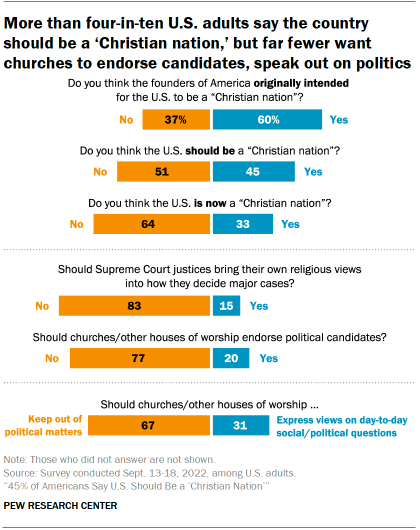
Christian Nation? A Survey


From Pew:
Growing numbers of religious and political leaders are embracing the “Christian nationalist” label, and some dispute the idea that the country’s founders wanted a separation of church and state. On the other side of the debate, however, many Americans – including the leaders of many Christian churches – have pushed back against Christian nationalism, calling it a “danger” to the country.

Most U.S. adults believe America’s founders intended the country to be a Christian nation, and many say they think it should be a Christian nation today, according to a new Pew Research Center survey designed to explore Americans’ views on the topic. But the survey also finds widely differing opinions about what it means to be a “Christian nation” and to support “Christian nationalism.”

For instance, many supporters of Christian nationhood define the concept in broad terms, as the idea that the country is guided by Christian values. Those who say the United States should not be a Christian nation, on the other hand, are much more inclined to define a Christian nation as one where the laws explicitly enshrine religious teachings.
...

Among those who say the U.S. should be a Christian nation, roughly three-in-ten (28%) said in March 2021 that “the federal government should declare the U.S. a Christian nation,” while half (52%) said the federal government “should never declare any particular religion as the official religion of the United States.”

Similarly, among those who say in the new survey that the U.S. should be a Christian nation, only about a quarter (24%) said in the prior survey that the federal government should advocate Christian religious values. About twice as many (52%) said the government should “advocate for moral values that are shared by people of many faiths.”

And three-in-ten U.S. adults who want the U.S. to be a Christian nation (31%) said in the March 2021 survey that the federal government should stop enforcing the separation of church and state. More took the opposite position, saying the federal government should enforce that separation (39%).
...

Furthermore, the new survey finds that nearly eight-in-ten people who say the U.S. should be a Christian nation also say the Bible should have at least some influence on U.S. laws, including slightly more than half (54%) who say that when the Bible conflicts with the will of the people, the Bible should prevail.


Wednesday, July 6, 2022

Intepreting the Bible

Many posts have discussed the role of religion in American life.

 Frank Newport at Gallup:

A record-low 20% of Americans now say the Bible is the literal word of God, down from 24% the last time the question was asked in 2017, and half of what it was at its high points in 1980 and 1984. Meanwhile, a new high of 29% say the Bible is a collection of "fables, legends, history and moral precepts recorded by man." This marks the first time significantly more Americans have viewed the Bible as not divinely inspired than as the literal word of God. The largest percentage, 49%, choose the middle alternative, roughly in line with where it has been in previous years.


Monday, January 18, 2021

References and Allusions in MLK's "I Have a Dream"

 The "I Have a Dream" speech contains many references and allusions to key ideas, sites, and documents of American civic culture.  The text below contains relevant links in red.

A major theme of our textbook is the relevance of religion in American public life.  Many passages in the speech refer or allude to Bible verses, spiritual songs, sermons, and other aspects of religion. These links are in blue.

------------------------------------------------

I am happy to join with you today in what will go down in history as the greatest demonstration for freedom in the history of our nation.

Five score years ago, a great American, in whose symbolic shadow we stand today, signed the Emancipation ProclamationThis momentous decree came as a great beacon light of hope to millions of Negro slaves who had been seared in the flames of withering injustice. It came as a joyous daybreak to end the long night of their captivity.

But one hundred years later, the Negro still is not free. One hundred years later, the life of the Negro is still sadly crippled by the manacles of segregation and the chains of discrimination. One hundred years later, the Negro lives on a lonely island of poverty in the midst of a vast ocean of material prosperity. One hundred years later, the Negro is still languished in the corners of American society and finds himself an exile in his own land. And so we've come here today to dramatize a shameful condition.

In a sense we've come to our nation's capital to cash a check. When the architects of our republic wrote the magnificent words of the Constitution and the Declaration of Independence, they were signing a promissory note to which every American was to fall heir. This note was a promise that all men, yes, black men as well as white men, would be guaranteed the "unalienable Rights" of "Life, Liberty and the pursuit of Happiness." It is obvious today that America has defaulted on this promissory note, insofar as her citizens of color are concerned. Instead of honoring this sacred obligation, America has given the Negro people a bad check, a check which has come back marked "insufficient funds."

But we refuse to believe that the bank of justice is bankrupt. We refuse to believe that there are insufficient funds in the great vaults of opportunity of this nation. And so, we've come to cash this check, a check that will give us upon demand the riches of freedom and the security of justice.

We have also come to this hallowed spot to remind America of the fierce urgency of Now. This is no time to engage in the luxury of cooling off or to take the tranquilizing drug of gradualism. Now is the time to make real the promises of democracy. Now is the time to rise from the dark and desolate valley of segregation to the sunlit path of racial justice. Now is the time to lift our nation from the quicksands of racial injustice to the solid rock of brotherhood. Now is the time to make justice a reality for all of God's children.

It would be fatal for the nation to overlook the urgency of the moment. This sweltering summer of the Negro's legitimate discontent will not pass until there is an invigorating autumn of freedom and equality. Nineteen sixty-three is not an end, but a beginning. And those who hope that the Negro needed to blow off steam and will now be content will have a rude awakening if the nation returns to business as usual. And there will be neither rest nor tranquility in America until the Negro is granted his citizenship rights. The whirlwinds of revolt will continue to shake the foundations of our nation until the bright day of justice emerges.

But there is something that I must say to my people, who stand on the warm threshold which leads into the palace of justice: In the process of gaining our rightful place, we must not be guilty of wrongful deeds. Let us not seek to satisfy our thirst for freedom by drinking from the cup of bitterness and hatred. We must forever conduct our struggle on the high plane of dignity and discipline. We must not allow our creative protest to degenerate into physical violence. Again and again, we must rise to the majestic heights of meeting physical force with soul force.

The marvelous new militancy which has engulfed the Negro community must not lead us to a distrust of all white people, for many of our white brothers, as evidenced by their presence here today, have come to realize that their destiny is tied up with our destiny. And they have come to realize that their freedom is inextricably bound to our freedom.

We cannot walk alone.

And as we walk, we must make the pledge that we shall always march ahead.

We cannot turn back.

There are those who are asking the devotees of civil rights, "When will you be satisfied?" We can never be satisfied as long as the Negro is the victim of the unspeakable horrors of police brutality. We can never be satisfied as long as our bodies, heavy with the fatigue of travel, cannot gain lodging in the motels of the highways and the hotels of the cities.

We cannot be satisfied as long as the Negro’s basic mobility is from a smaller ghetto to a larger one. We can never be satisfied as long as our children are stripped of their selfhood and robbed of their dignity by signs stating for whites only. 

We cannot be satisfied as long as a Negro in Mississippi cannot vote and a Negro in New York believes he has nothing for which to vote. No, no, we are not satisfied, and we will not be satisfied until "justice rolls down like waters, and righteousness like a mighty stream."

I am not unmindful that some of you have come here out of great trials and tribulations. Some of you have come fresh from narrow jail cells. And some of you have come from areas where your quest for freedom left you battered by the storms of persecution and staggered by the winds of police brutality. You have been the veterans of creative suffering. Continue to work with the faith that unearned suffering is redemptive. Go back to Mississippi, go back to Alabama, go back to South Carolina, go back to Georgia, go back to Louisiana, go back to the slums and ghettos of our northern cities, knowing that somehow this situation can and will be changed.

Let us not wallow in the valley of despair, I say to you today, my friends.

And so even though we face the difficulties of today and tomorrow, I still have a dreamIt is a dream deeply rooted in the American dream.

I have a dream that one day this nation will rise up and live out the true meaning of its creed: "We hold these truths to be self-evidentthat all men are created equal."

I have a dream that one day on the red hills of Georgia, the sons of former slaves and the sons of former slave owners will be able to sit down together at the table of brotherhood.

I have a dream that one day even the state of Mississippi, a state sweltering with the heat of injustice, sweltering with the heat of oppression, will be transformed into an oasis of freedom and justice.

I have a dream that my four little children will one day live in a nation where they will not be judged by the color of their skin but by the content of their character.

I have a dream today!

I have a dream that one day, down in Alabama, with its vicious racists, with its governor having his lips dripping with the words of "interposition" and "nullification" -- one day right there in Alabama little black boys and black girls will be able to join hands with little white boys and white girls as sisters and brothers.

I have a dream today!

I have a dream that one day every valley shall be exalted, and every hill and mountain shall be made low, the rough places will be made plain, and the crooked places will be made straight; "and the glory of the Lord shall be revealed and all flesh shall see it together."

This is our hope, and this is the faith that I go back to the South with.

With this faith, we will be able to hew out of the mountain of despair a stone of hope. With this faith, we will be able to transform the jangling discords of our nation into a beautiful symphony of brotherhood. With this faith, we will be able to work together, to pray together, to struggle together, to go to jail together, to stand up for freedom togetherknowing that we will be free one day.

And this will be the day -- this will be the day when all of God's children will be able to sing with new meaning:

My country 'tis of thee, sweet land of liberty, of thee I sing.
Land where my fathers died, land of the Pilgrim's pride,
From every mountainside, let freedom ring!

And if America is to be a great nation, this must become true.

And so let freedom ring from the prodigious hilltops of New Hampshire.

Let freedom ring from the mighty mountains of New York.

Let freedom ring from the heightening Alleghenies of Pennsylvania.

Let freedom ring from the snow-capped Rockies of Colorado.

Let freedom ring from the curvaceous slopes of California.

But not only that:

Let freedom ring from Stone Mountain of Georgia.

Let freedom ring from Lookout Mountain of Tennessee.

Let freedom ring from every hill and molehill of Mississippi.

From every mountainside, let freedom ring.

And when this happens, and when we allow freedom ring, when we let it ring from every village and every hamlet, from every state and every city, we will be able to speed up that day when all of God's children, black men and white men, Jews and Gentiles, Protestants and Catholics, will be able to join hands and sing in the words of the old Negro spiritual:

Free at last! Free at last!

Thank God Almighty, we are free at last!

Wednesday, April 15, 2020

The Bible and the Will of the People

Michael Lipka at Pew:
The U.S. Constitution does not mention the Bible, God, Jesus or Christianity, and the First Amendment clarifies that “Congress shall make no law respecting an establishment of religion.” Still, some scholars have argued that the Bible heavily influenced America’s founders.
Today, about half of Americans (49%) say the Bible should have at least “some” influence on U.S. laws, including nearly a quarter (23%) who say it should have “a great deal” of influence, according to a recent Pew Research Center survey. Among U.S. Christians, two-thirds (68%) want the Bible to influence U.S. laws at least some, and among white evangelical Protestants, this figure rises to about nine-in-ten (89%).
At the other end of the spectrum, there’s broad opposition to biblical influence on U.S. laws among religiously unaffiliated Americans, also known as religious “nones,” who identify as atheist, agnostic or “nothing in particular.” Roughly three-quarters in this group (78%) say the Bible should hold little to no sway, including 86% of self-described atheists who say the Bible should not influence U.S. legislation at all. Two-thirds of U.S. Jews, as well, think the Bible should have not much or should have no influence on laws.

There also are differences on this question by age and political party. Older Americans are much more likely than younger adults to want biblical influence on U.S. laws, while Republicans – by a two-to-one margin – are more likely than Democrats to do so.
All survey respondents who said the Bible should have at least “some” influence on U.S. laws were asked a follow-up question: When the Bible and the will of the people conflict, which should have more influence on U.S. laws?
The more common answer to this question is that the Bible should take priority over the will of the people. This view is expressed by more than a quarter of all Americans (28%). About one-in-five (19%) say the Bible should have at least some influence but that the will of the people should prevail.
Two religious groups stand out for being especially supportive of biblical influence in legislation, even if that means going against the will of the American people: Two-thirds of white evangelical Protestants (68%) say the Bible should take precedence over the people, and half of black Protestants say the same. Among Catholics (25%) and white Protestants who do not identify as born-again or evangelical (27%), only about a quarter share this perspective.

Saturday, August 10, 2019

Knowledge of Religion

Most Americans are familiar with some of the basics of Christianity and the Bible, and even a few facts about Islam. But far fewer U.S. adults are able to correctly answer factual questions about Judaism, Buddhism and Hinduism, and most do not know what the U.S. Constitution says about religion as it relates to elected officials. In addition, large majorities of Americans are unsure (or incorrect) about the share of the U.S. public that is Muslim or Jewish, according to a new Pew Research Center survey that quizzed nearly 11,000 U.S. adults on a variety of religious topics.
...
Many Americans also struggle to answer some questions about the size of religious minorities in the U.S. and about religion’s role in American government. For instance, most U.S. adults overestimate the shares of Jews and Muslims in the U.S. or are unaware that Jews and Muslims each account for less than 5% of the population.3 And when asked what the U.S. Constitution says about religion as it relates to federal officeholders, just one-quarter (27%) correctly answer that it says “no religious test” shall be a qualification for holding office; 15% incorrectly believe the Constitution requires federal officeholders to affirm that all men are endowed by their Creator with certain unalienable rights, 12% think the Constitution requires elected officials to be sworn in using the Bible, 13% think the Constitution is silent on this issue, and 31% say they are not sure.

Sunday, May 27, 2018

Refugees and Evangelicals

In February 2017, as debate raged nationally over President Trump’s decision to curtail immigration to the United States, the conservative Christian Broadcasting Network dipped into the Bible to share what that sacred text said about refugees.

“Treat refugees the way you want to be treated,” it said, quoting Leviticus. “Invite the stranger in” (Matthew) and “Open your door to the traveler” (Job).

The first comment in reply to the article captures the tone of the rest of the feedback the site received: “Shame on CBN for this very poorly written article full of political rhetoric. This is not a Biblical issue.”

At the time, polling from Pew Research Center showed that about 56 percent of Americans believed that the United States had a responsibility to welcome refugees into the country. In the year since, that figure has dropped and is now at a bare majority, 51 percent.

But Pew’s new research includes a fascinating detail: No group agrees less with the idea that the United States has a responsibility to accept refugees than white evangelical Protestants.

Pew reports on attitudes toward refugees:


David Greene & Frank Newport at Gallup:
Americans rarely agree as overwhelmingly as they did in November 1938. Just two weeks after Nazi Germany coordinated a brutal nationwide attack against Jews within its own borders -- an event known as "Kristallnacht" -- Gallup asked Americans: "Do you approve or disapprove of the Nazi treatment of Jews in Germany?" Nearly everyone who responded -- 94% -- indicated that they disapproved.
Yet, even though nearly all Americans condemned the Nazi regime's terror against Jews in November 1938, that very same week, 72% of Americans said "No" when Gallup asked: "Should we allow a larger number of Jewish exiles from Germany to come to the United States to live?" Just 21% said "Yes."
Why this yawning gap between disapproval of the Nazi regime's persecutions and a willingness to aid refugees? Gallup polling on these topics during the Nazi era helps answer this question, providing important context for understanding Americans' responses to the threat of Nazism.
Americans' widespread disapproval of the Nazi regime's treatment of Jews could not necessarily be assumed in 1938, given evidence that the U.S. was not immune from its own xenophobia and discrimination.
Prejudice against Jews in the U.S. was evident in a number of ways in the 1930s. According to historian Leonard Dinnerstein, more than 100 new anti-Semitic organizations were founded in the U.S. between 1933 and 1941. One of the most influential, Father Charles Coughlin's National Union for Social Justice, spread Nazi propaganda and accused all Jews of being communists. Coughlin broadcast anti-Jewish ideas to millions of radio listeners, asking them to "pledge" with him to "restore America to the Americans."

Saturday, May 26, 2018

A Bible Verse with Political Relevance

Do not put your trust in princes,
in human beings, who cannot save.
When their spirit departs, they return to the ground;
on that very day their plans come to nothing.
Blessed are those whose help is the God of Jacob,
whose hope is in the Lord their God.

He is the Maker of heaven and earth,
the sea, and everything in them—
he remains faithful forever.
He upholds the cause of the oppressed
and gives food to the hungry.
he Lord sets prisoners free,
-- Psalm 146: 3-7, NIV

Sunday, May 13, 2018

African Americans the the Bible

Many posts have discussed the role of religion in American society and politicsJeff Diamant at Pew:
For African Americans, the Bible’s Exodus narrative is a cultural touchstone. Since before the Civil War, the story of the Israelites’ slavery and deliverance has spurred comparisons to black people’s experiences in the United States. Scripture’s importance to the black population in the U.S. is reflected in Pew Research Center survey data showing that black people are more likely than most other Americans to read scripture regularly and to view it as the word of God.
Indeed, more than half of black people in the U.S. (54%) – both Christian and non-Christian – say they read the Bible or other holy scripture at least once a week outside of religious services, compared with 32% of whites and 38% of Hispanics, according to data from the 2014 Religious Landscape Study. Indeed, relatively few black people (24%) say they seldom or never read the Bible, compared with 50% of whites and 40% of Hispanics.

Wednesday, December 13, 2017

Oaths and the Bible

Nothing in the Constitution or laws of the United States requires office-holders to swear on a Bible, or any other book.

When Lyndon Johnson took the oath, his left hand was not on a Bible, but on a Roman Catholic missal that happened to be aboard Air Force One at the time. Judge Sarah Hughes, who administered the oath, apparently assumed that the leather-bound prayer book was a Bible. It did not matter. When John Quincy Adams took the oath in 1825, he used a law book instead of a Bible.  In 1901, when Theodore Roosevelt assumed office after the assassination of William McKinley, no Bible was nearby, so he took the oath without it.

In Congress, some use Bibles, and some do not.  From CRS:
The first order of business in a new Senate is the swearing-in of Senators elected or reelected in the most recent general election and of newly appointed Senators. On occasion in recent years, the majority leader or the majority and minority leaders might first be recognized for brief remarks. If there is a contested or undecided Senate election, the leadership might provide a status report and plan for its resolution, before or after Senators are sworn in.
After the Vice President lays the certificates of election and appointment before the Senate and states that their reading will be waived if there is no objection, he calls those Senators to the front of the chamber, generally in alphabetical order in groups of four, to take the oath and to also “subscribe to the oath” in the official oath book. Each Senator may be accompanied by the other Senator from his or her state, the Senator he or she is replacing, or a former Senator.
The oath, which is the same for Representatives and executive and judicial appointees, is as follows:
I do solemnly swear (or affirm) that I will support and defend the Constitution of the United States against all enemies, foreign and domestic; that I will bear true faith and allegiance to the same; that I take this  bligation freely, without any mental reservation or purpose of evasion; and that I will well and faithfully discharge the duties of the office on which I am about to enter. So help me God.
An oath is mandated by Article VI of the Constitution; its text is set by statute (5 U.S.C. 3331).
When Senators take the oath, they raise their right hand to swear or affirm, repeating after the Vice President. Many Senators hold a family Bible or another item, and some hold nothing. There is no requirement that a Bible or anything else be used when the oath is taken.
When the Vice President (or another individual of a Senator’s choosing) and individual Senators subsequently reenact the swearing-ins in the Old Senate Chamber with the Senator’s family, each Senator might hold a Bible, another item, or nothing in his or her left hand. Although photography is not permitted on the Senate floor, photographers are present for the ceremonial swearing-in. Individuals might also record a ceremonial swearing-in. 
CRS describes the House procedure:
After taking the oath, the Speaker administers the oath to all Members of the House, en masse, including the nonvoting Delegates and Resident Commissioner. The Speaker directs the Representatives-elect to rise and raise their right hands...As the Members-elect raise their right hands, they are not required to hold anything in their left hands. Many have held a family Bible or another sacred text in their left hands, but there is no requirement that anything be held when the oath is taken. 
The same is true for Representatives who re-enact the event with their families and the Speaker in the Speaker’s office after the formal ceremony. Many Members choose to hold something meaningful in their left hands. These objects have often been, but are not limited to, a family heirloom or something else of special significance. Nothing, however, is required. 

Wednesday, June 14, 2017

Reacting to a Shooting

On January 12, 2011, President Obama spoke at a memorial for the victims of the Tucson shooting:
You see, when a tragedy like this strikes, it is part of our nature to demand explanations, to try to impose some order on the chaos and make sense out of that which seems senseless. Already we've seen a national conversation commence, not only about the motivations behind these killings, but about everything from the merits of gun safety laws to the adequacy of our mental health system. And much of this process of debating what might be done to prevent such tragedies in the future is an essential ingredient in our exercise of self-government.
But at a time when our discourse has become so sharply polarized, at a time when we are far too eager to lay the blame for all that ails the world at the feet of those who happen to think differently than we do, it's important for us to pause for a moment and make sure that we're talking with each other in a way that heals, not in a way that wounds.
Scripture tells us that there is evil in the world and that terrible things happen for reasons that defy human understanding. In the words of Job, "When I looked for light, then came darkness." Bad things happen, and we have to guard against simple explanations in the aftermath.
For the truth is, none of us can know exactly what triggered this vicious attack. None of us can know with any certainty what might have stopped these shots from being fired or what thoughts lurked in the inner recesses of a violent man's mind. Yes, we have to examine all the facts behind this tragedy. We cannot and will not be passive in the face of such violence. We should be willing to challenge old assumptions in order to lessen the prospects of such violence in the future. But what we cannot do is use this tragedy as one more occasion to turn on each other. That we cannot do. [Applause] That we cannot do.
As we discuss these issues, let each of us do so with a good dose of humility. Rather than pointing fingers or assigning blame, let's use this occasion to expand our moral imaginations, to listen to each other more carefully, to sharpen our instincts for empathy and remind ourselves of all the ways that our hopes and dreams are bound together.

Saturday, March 14, 2015

Religion, Name-Calling, and Immigration

American politicians routinely use religion and the Bible for justification for their policies and a cudgel against their opponents.

Michael Doyle reports at McClatchy:
Gov. Jerry Brown on Friday took to the White House driveway for a round of Republican-bashing over immigration.
One day after California joined a dozen other states in a legal brief supporting the Obama administration’s policies, Brown used a quickly arranged meeting with reporters to deploy some less judicious language.
“I just think some of these Republican governors should be ashamed of themselves,” Brown said, adding that “the Republicans delight in undermining the president, and the presidency, and in dividing the country even more than it is.”
Brown further accused the Republicans of “declaring war on millions of people, not just those who are undocumented, but those who sympathize with them.”
Driving the point home, Brown said the Republican position opposed to immigration reform “at best is troglodyte, and at worst un-Christian.”
In July, David Siders reported at The Sacramento Bee:
Gov. Jerry Brown suggested Monday that Texas Gov. Rick Perry’s ordering of National Guard troops to the U.S.-Mexico border to address the surge in border crossings is misguided, urging politicians instead to heed the “religious call … to welcome the stranger” in addressing the crisis.
“This is a human problem, and it has been the religious call of all religions to welcome the stranger, and it’s in that spirit that I believe the clergy can call the United States, Mexico and all the players to perhaps a higher response than might otherwise happen,” Brown said on the first full day of his trade mission to Mexico.
Read more here: http://www.sacbee.com/news/politics-government/capitol-alert/article2605087.html#storylink=cpy

At the Center for Immigration Studies, James Edwards explains:
Even the passages of Scripture most often cited by religious advocates of mass immigration and amnesty plainly do not argue for open borders. Rather, these writings generally reflect “equal justice under law” principles.
Consider Leviticus 19:33-34: “When a stranger sojourns with you in your land, you shall not do him wrong. You shall treat the stranger who sojourns with you as the native among you, and you shall love him as yourself, for you were strangers in the land of Egypt: I am the Lord your God.” Similarly reads Exodus 22:21: “You shall not wrong a sojourner or oppress him, for you were sojourners in the land of Egypt.”

Dr. Stephen Steinlight has noted that the Hebrew term for “sojourn” means temporary stay.5 A related term used in some scriptural translations is “stranger.” One Bible dictionary says, “This word generally denotes a person from a foreign land residing in Palestine. Such persons enjoyed many privileges in common with the Jews, but still were separate from them. The relation of the Jews to strangers was regulated by special laws (Deut. 23:3; 24:14-21; 25:5; 26:10-13).”6 This Bible dictionary defines “two classes of aliens: 1) those who were temporary visitors, who owned no landed property; and 2) those who held permanent residence without becoming citizens (Lev. 22:10; Ps. 19:12). Both of these classes were to enjoy, under certain conditions, the same rights as other citizens (Lev. 19:33, 34; Deut. 10:19).”7 Again, those rights amounted to equal standing under the law, or having the benefit of the rule of law. Therefore, it is biblically inaccurate to incorporate, automatically and dogmatically, permanent immigration into every such term.

Wednesday, June 4, 2014

The Bible

The Bible is important in American political culture.  Writers and orators frequently quote from it, and many see it as a source of moral guidance. Gallup reports:
Twenty-eight percent of Americans believe the Bible is the actual word of God and that it should be taken literally. This is somewhat below the 38% to 40% seen in the late 1970s, and near the all-time low of 27% reached in 2001 and 2009. But about half of Americans continue to say the Bible is the inspiredword of God, not to be taken literally -- meaning a combined 75% believe the Bible is in some way connected to God. About one in five Americans view the Bible in purely secular terms -- as ancient fables, legends, history, and precepts written by man -- which is up from 13% in 1976.

The latest results are from Gallup's 2014 update of its annual Values and Beliefs poll, conducted May 8-11.

Fittingly, overall acceptance of the Bible as being divinely written or inspired closely approximates the proportion of Americans identifying themselves as Christian: 76% in Gallup's 2013 religion aggregate. Meanwhile, the 21% viewing the Bible in secular terms nearly matches the combined 22% who identify with another religion or no religion.
...
Ultimately, the finding that nine in 10 Christians believe the Bible emanates from God indicates that U.S. Christians are Christian in more than name only.

Sunday, August 25, 2013

References and Allusions in the "I Have a Dream Speech"

The "I Have a Dream" speech contains many references and allusions to key ideas, sites, and documents of American civic culture.  The text below contains relevant links in red.

A major theme of our textbook is the relevance of religion in American public life.  Many passages in the speech refer or allude to Bible verses, spiritual songs, sermons, and other aspects of religion. These links are in blue.

------------------------------------------------

I am happy to join with you today in what will go down in history as the greatest demonstration for freedom in the history of our nation.

Five score years ago, a great American, in whose symbolic shadow we stand today, signed the Emancipation Proclamation. This momentous decree came as a great beacon light of hope to millions of Negro slaves who had been seared in the flames of withering injustice. It came as a joyous daybreak to end the long night of their captivity.

But one hundred years later, the Negro still is not free. One hundred years later, the life of the Negro is still sadly crippled by the manacles of segregation and the chains of discrimination. One hundred years later, the Negro lives on a lonely island of poverty in the midst of a vast ocean of material prosperity. One hundred years later, the Negro is still languished in the corners of American society and finds himself an exile in his own land. And so we've come here today to dramatize a shameful condition.

In a sense we've come to our nation's capital to cash a check. When the architects of our republic wrote the magnificent words of the Constitution and the Declaration of Independence, they were signing a promissory note to which every American was to fall heir. This note was a promise that all men, yes, black men as well as white men, would be guaranteed the "unalienable Rights" of "Life, Liberty and the pursuit of Happiness." It is obvious today that America has defaulted on this promissory note, insofar as her citizens of color are concerned. Instead of honoring this sacred obligation, America has given the Negro people a bad check, a check which has come back marked "insufficient funds."

But we refuse to believe that the bank of justice is bankrupt. We refuse to believe that there are insufficient funds in the great vaults of opportunity of this nation. And so, we've come to cash this check, a check that will give us upon demand the riches of freedom and the security of justice.

We have also come to this hallowed spot to remind America of the fierce urgency of Now. This is no time to engage in the luxury of cooling off or to take the tranquilizing drug of gradualism. Now is the time to make real the promises of democracy. Now is the time to rise from the dark and desolate valley of segregation to the sunlit path of racial justice. Now is the time to lift our nation from the quicksands of racial injustice to the solid rock of brotherhood. Now is the time to make justice a reality for all of God's children.

It would be fatal for the nation to overlook the urgency of the moment. This sweltering summer of the Negro's legitimate discontent will not pass until there is an invigorating autumn of freedom and equality. Nineteen sixty-three is not an end, but a beginning. And those who hope that the Negro needed to blow off steam and will now be content will have a rude awakening if the nation returns to business as usual. And there will be neither rest nor tranquility in America until the Negro is granted his citizenship rights. The whirlwinds of revolt will continue to shake the foundations of our nation until the bright day of justice emerges.

But there is something that I must say to my people, who stand on the warm threshold which leads into the palace of justice: In the process of gaining our rightful place, we must not be guilty of wrongful deeds. Let us not seek to satisfy our thirst for freedom by drinking from the cup of bitterness and hatred. We must forever conduct our struggle on the high plane of dignity and discipline. We must not allow our creative protest to degenerate into physical violence. Again and again, we must rise to the majestic heights of meeting physical force with soul force.

The marvelous new militancy which has engulfed the Negro community must not lead us to a distrust of all white people, for many of our white brothers, as evidenced by their presence here today, have come to realize that their destiny is tied up with our destiny. And they have come to realize that their freedom is inextricably bound to our freedom.

We cannot walk alone.

And as we walk, we must make the pledge that we shall always march ahead.

We cannot turn back.

There are those who are asking the devotees of civil rights, "When will you be satisfied?" We can never be satisfied as long as the Negro is the victim of the unspeakable horrors of police brutality. We can never be satisfied as long as our bodies, heavy with the fatigue of travel, cannot gain lodging in the motels of the highways and the hotels of the cities.

We cannot be satisfied as long as the Negro’s basic mobility is from a smaller ghetto to a larger one. We can never be satisfied as long as our children are stripped of their selfhood and robbed of their dignity by signs stating for whites only. 

We cannot be satisfied as long as a Negro in Mississippi cannot vote and a Negro in New York believes he has nothing for which to vote. No, no, we are not satisfied, and we will not be satisfied until "justice rolls down like waters, and righteousness like a mighty stream."

I am not unmindful that some of you have come here out of great trials and tribulations. Some of you have come fresh from narrow jail cells. And some of you have come from areas where your quest for freedom left you battered by the storms of persecution and staggered by the winds of police brutality. You have been the veterans of creative suffering. Continue to work with the faith that unearned suffering is redemptive. Go back to Mississippi, go back to Alabama, go back to South Carolina, go back to Georgia, go back to Louisiana, go back to the slums and ghettos of our northern cities, knowing that somehow this situation can and will be changed.

Let us not wallow in the valley of despair, I say to you today, my friends.

And so even though we face the difficulties of today and tomorrow, I still have a dream. It is a dream deeply rooted in the American dream.

I have a dream that one day this nation will rise up and live out the true meaning of its creed: "We hold these truths to be self-evident, that all men are created equal."

I have a dream that one day on the red hills of Georgia, the sons of former slaves and the sons of former slave owners will be able to sit down together at the table of brotherhood.

I have a dream that one day even the state of Mississippi, a state sweltering with the heat of injustice, sweltering with the heat of oppression, will be transformed into an oasis of freedom and justice.

I have a dream that my four little children will one day live in a nation where they will not be judged by the color of their skin but by the content of their character.

I have a dream today!

I have a dream that one day, down in Alabama, with its vicious racists, with its governor having his lips dripping with the words of "interposition" and "nullification" -- one day right there in Alabama little black boys and black girls will be able to join hands with little white boys and white girls as sisters and brothers.

I have a dream today!

I have a dream that one day every valley shall be exalted, and every hill and mountain shall be made low, the rough places will be made plain, and the crooked places will be made straight; "and the glory of the Lord shall be revealed and all flesh shall see it together."

This is our hope, and this is the faith that I go back to the South with.

With this faith, we will be able to hew out of the mountain of despair a stone of hope. With this faith, we will be able to transform the jangling discords of our nation into a beautiful symphony of brotherhood. With this faith, we will be able to work together, to pray together, to struggle together, to go to jail together, to stand up for freedom together, knowing that we will be free one day.

And this will be the day -- this will be the day when all of God's children will be able to sing with new meaning:

My country 'tis of thee, sweet land of liberty, of thee I sing.
Land where my fathers died, land of the Pilgrim's pride,
From every mountainside, let freedom ring!

And if America is to be a great nation, this must become true.

And so let freedom ring from the prodigious hilltops of New Hampshire.

Let freedom ring from the mighty mountains of New York.

Let freedom ring from the heightening Alleghenies of Pennsylvania.

Let freedom ring from the snow-capped Rockies of Colorado.

Let freedom ring from the curvaceous slopes of California.

But not only that:

Let freedom ring from Stone Mountain of Georgia.

Let freedom ring from Lookout Mountain of Tennessee.

Let freedom ring from every hill and molehill of Mississippi.

From every mountainside, let freedom ring.

And when this happens, and when we allow freedom ring, when we let it ring from every village and every hamlet, from every state and every city, we will be able to speed up that day when all of God's children, black men and white men, Jews and Gentiles, Protestants and Catholics, will be able to join hands and sing in the words of the old Negro spiritual:

Free at last! Free at last!

Thank God Almighty, we are free at last!


Read more here: http://www.miamiherald.com/2013/08/24/v-print/3580335/full-text-of-martin-luther-king.html#storylink=cpy