Search This Blog

Showing posts with label citizenship. Show all posts

Tuesday, July 21, 2026

Opinion on Immigration Proposals

Many posts have discussed immigration

Megan Brenan at Gallup:

Beyond general views on immigration, the telephone poll measured Americans’ support for five specific policy proposals. The highest levels of support are seen for two proposals related to citizenship, with slightly more in favor of allowing immigrants who were brought to the U.S. illegally as children the chance to become U.S. citizens if they meet certain requirements (81%) than doing the same for immigrants living in the U.S. illegally (75%). In each case, more Americans “strongly favor” the proposal than just “favor” it.


Friday, July 17, 2026

Noncitizens on the Voter Rolls?

Many posts have discussed immigration. Illegal voting by noncitizens is rare.

 Last night, Trump claimed there were 278,000 noncitizens who had registered to vote.  At PolitiFact, Louis Jacobson provides reasons for skepticism.

Experts cited several reasons to be cautious about the headline number and how Trump and Mullin framed it.

For starters, Homeland Security’s letters to state officials used more cautious language — glossed over in public remarks by Trump and Mullin — that called it a "preliminary review" and said that there "may be as many as" the number of noncitizens they found on the voter rolls.

At his press conference, Mullin did not identify the individuals as potential noncitizens; he simply called them "noncitizens."

Another reason for caution is history.

In the past, when government officials have announced initial numbers of noncitizens on voter rolls, those figures have dropped dramatically after months of vetting by state and local officials and the media.

In 2012, then-Florida Gov. Rick Scott ordered state officials to clear the rolls of noncitizen voters ahead of the election.

Florida initially assembled a list of about 180,000 potential noncitizens. With more scrutiny, however, officials whittled the count to about 2,600 names, then 198, then 85. The initial list was rife with errors, even flagging a Brooklyn-born World War II veteran.

Saturday, June 27, 2026

Passports, Visas, and Trump

Many posts have discussed myths and misinformation


Saturday, June 13, 2026

Renouncing US Citizenship


Terry Ward at CNN:
Official government figures related to Americans renouncing citizenship are difficult to pin down.

A State Department spokesperson said in an email to CNN that it does not publish statistics on the number of US citizens who choose to renounce their citizenship, adding that the Treasury Department publishes a quarterly IRS report on expatriations. The IRS told CNN that it does not have compilations of the number of annual expatriations.

But according to Americans Overseas, a resource for US citizens living abroad that tallies the number of names reported within the quarterly IRS reports, 4,889 people are listed on the agency’s list for 2025, the highest number since 2020 when the figure spiked to 6,705. The organization said it is receiving significantly more inquiries about renunciation this year and is predicting a 15% increase in expatriations over last year, with numbers expected to remain elevated over the coming years.

Americans Overseas is currently advising roughly 40,000 US citizens, most with dual citizenship, in Europe and throughout the rest of the world who are either in the process of renouncing or inquiring about pursuing it, according to Daan Durlacher, co-founder of Americans Overseas.

Durlacher said he isn’t seeing all the names of clients he knows have renounced their US citizenship in the IRS reports, and he suggests that the figures are underreported. The IRS did not immediately respond to follow-up questions about the reports.

“These numbers are not complete, and I don’t know why,” said Durlacher, a dual Dutch and US citizen who was born in the Netherlands to an American mother.


To renounce something means to give it up, usually by formal declaration. Indeed, renouncing US citizenship is both a formal and legal process that requires potentially arduous paperwork as well as appearing for an in-person oath in front of a consular officer at a US embassy or consulate office outside of the US, along with other requirements.

Saturday, December 6, 2025

Holidays, National Parks, and a Renamed Institute of Peace

Free entry to National Parks will now be granted on President Trump's birthday but not on Martin Luther King Jr. Day or Juneteenth.

Why it matters: The Trump administration has almost entirely overhauled the list of free National Park days, favoring days that celebrate U.S. patriotism instead of traditional federal holidays.

The Department of the Interior, National Park Service and White House did not immediately respond to Axios' request for comment.

State of play: The June 14 free day falls on both Trump's birthday and Flag Day.Veterans Day is the only free day that was carried into the list for 2026.

Context: Calendar changes were announced on Nov. 25 along with international tourist price hikes, which the Interior Secretary Doug Burgum called "America-first pricing."Beginning next year, free entrance on these days is only for U.S. citizens and residents. Nonresidents will pay the regular entrance fee and applicable nonresident fees.


And yes, the NPS notice specifically mentions Trump's birthday:

 Come experience the national parks! All National Park Service sites that charge an entrance fee will offer free admission to everyone (other fees, including timed entry or reservation fees, may apply). Mark your calendar for these entrance fee-free dates:

Beginning in 2026, free entrance on these days will be for US citizens and residents only. Nonresidents will pay the regular entrance fee and any applicable nonresident fees.

Michelle L. Price and Gary Fields at AP:
The Trump administration has renamed the U.S. Institute of Peace after President Donald Trump and has planted the president’s name on its headquarters despite an ongoing fight over control of the institute.

It’s the latest twist in a seesaw court battle over who controls the U.S. Institute of Peace, a nonprofit think tank that focuses on peace initiatives. It was an early target of the Department of Government Efficiency this year.

On Wednesday, the State Department said it renamed the organization to the Donald J. Trump Institute of Peace to “reflect the greatest dealmaker in our nation’s history.” The new name could be seen on its building, which is near the State Department.


Friday, November 28, 2025

Protection Against Denaturalization

Several  posts have discussed naturalization and denaturalization.  

 Denaturalization is in the news.

Faiza Patel, Margy O’Herron, and Kendall Verhovek at the Brennan Center:

Under the law today, the government may seek denaturalization proceedings either when naturalization is obtained illegally or disqualifying facts on citizenship applications are concealed. But throughout much of the 20th century, it was much easier to achieve.

More than 22,000 Americans lost their citizenship between 1907 and 1967 based on political affiliations, race, and gender, according to denaturalization scholar Patrick Weil. President Woodrow Wilson’s administration began denaturalizing German- and Asian-born citizens during World War I, along with anarchists and people who spoke out against the war. During World War II, a push for denaturalization of naturalized citizens from Germany, Italy, and Japan intensified. A primary target included members of the pro-Nazi German-American Bund for disloyalty and insufficient attachment to the principles of the Constitution.

After the war, the Second Red Scare took hold of a country fearful of domestic communism amid its emergence abroad. Sen. Joseph McCarthy of Wisconsin led witch hunts, with denaturalization often used as a tool against accused communists or sympathizers. Among those targets was Harry Bridges, an Australian-born, nationally known labor leader accused of being a communist, who faced an ultimately unsuccessful campaign to revoke his citizenship. The Supreme Court ruled in his favor, not once, but twice.

Throughout the 20th century, the Court’s jurisprudence evolved to protect naturalized citizens — even those with unpopular views during wartime — against efforts to strip them of citizenship. The Court established constraints on the government’s ability to revoke citizenship in a case challenging an attempt to denaturalize Russian-born William Schneiderman over ties to the Communist Party. The Court wrote, “We believe the facts and the law should be construed as far as is reasonably possible in favor of the citizen.” It also emphasized that citizenship should not be rescinded lightly: “[The United States] must sustain the heavy burden which then rests upon it to prove lack of attachment by ‘clear, unequivocal, and convincing’ evidence.”

A few years later, the Supreme Court warned against using denaturalization proceedings as a political weapon. “Ill-tempered expressions, extreme views, even the promotion of ideas which run counter to our American ideals, are not to be given disloyal connotations in absence of solid, convincing evidence that that is their significance,” the Court’s majority wrote. “Any other course would run counter to our traditions, and make denaturalization proceedings the ready instrument for political persecutions.”

In 1967, the Court found that under the 14th Amendment, the government cannot forcibly deprive a naturalized American of citizenship without the citizen’s consent, except when citizenship is “unlawfully procured.”

In the succeeding decades, denaturalizations declined significantly. Between 1990 and 2017, the Justice Department filed an average of just 11 cases per year. Only during the Obama administration did they climb, when new technology allowed the government to search decades of data for indicators of possible fraud. In 2016, the yearly average rose to 15. During the first Trump administration, the program expanded, increasing the average to 25 per year.

Yet the Supreme Court remained resistant to easing limits on denaturalization. In 2017, the Court unanimously ruled that citizenship was “unlawfully procured” only if the unlawful act, such as making a false statement, had a causal connection to the acquisition of citizenship. The Court wrote that a prosecutor should not be able to “scour her paperwork” and bring a charge because doing so would “give prosecutors nearly limitless leverage — and afford newly naturalized citizens precious little security.”

Tuesday, November 18, 2025

Expatriation 2025

Many posts have discussed citizenship and expatriation.

Benedict Vigers and Julie Ray at Gallup:

For the second straight year, about one in five Americans say they would like to leave the U.S. and move permanently to another country if they could. This heightened desire to migrate is driven primarily by younger women.

In 2025, 40% of women aged 15 to 44 say they would move abroad permanently if they had the opportunity. The current figure is four times higher than the 10% who shared this desire in 2014, when it was generally in line with other age and gender groups.

The percentage of younger women wanting to move to another country first rose decisively in 2016, the final year of President Barack Obama's second term. That year, Gallup surveyed the U.S. in June and July, after both parties’ presumptive nominees were set for the November election, which Donald Trump went on to win. Desire to migrate continued to climb afterward, hitting 44% in President Joe Biden’s last year in office and remaining near that level in 2025. This suggests a broader shift in opinion among younger women, rather than a solely partisan one.

Monday, August 4, 2025

What's Important to Being American?


Friday, July 25, 2025

Ninth Circuit and Birthright Ciltizenship


Mattathias Schwartz at NYT:
A federal appeals court ruled on Wednesday that President Trump’s executive order restricting birthright citizenship violated the Constitution, affirming a district court judge’s nationwide injunction and bringing the issue one step closer to a full constitutional review by the Supreme Court.

In a 48-page opinion, two of the three judges on the panel for the U.S. Court of Appeals for the Ninth Circuit found that Mr. Trump’s executive order “contradicts the plain language of the 14th Amendment’s grant of citizenship to ‘all persons born in the United States and subject to the jurisdiction thereof.’
From the opinion:
We conclude that the text of the Fourteenth Amendment supports the Plaintiffs’ interpretation. In interpreting the text of the Constitution, courts are “guided by the principle that ‘[t]he Constitution was written to be understood by the voters; its words and phrases were used in their normal and ordinary as distinguished from technical meaning.’” District of Columbia v. Heller, 544 U.S. 570, 576 (2008) (quoting United States v. Sprague, 282 U.S. 716, 731 (1931)). When the Fourteenth Amendment was adopted, as it is today, “jurisdiction” was commonly used in reference to the power of the courts, defined as “[t]he legal power or authority of hearing and determining causes.” Noah Webster, An American Dictionary of the English Language 732 (1865). But in reference to nations, “jurisdiction” was also defined as the “[p]ower of governing or legislating; the right of making or enforcing laws; the power or right of exercising authority;” and the “limit within which power may be exercised,” or “extent of power or authority.” Id; see also Benjamin Vaughan Abbott, Dictionary of Terms and Phrases Used in American or English Jurisprudence 671 (1879) (defining jurisdiction as “[t]he authority of government; the sway of a sovereign power.”). This ordinary meaning of jurisdiction is consistent with Plaintiffs’ interpretation of “subject to the jurisdiction thereof” as subject to the laws and authority of the United States.

 Defendants point to no contrary dictionary definitions that define jurisdiction in terms of allegiance and protection. Indeed, they make no arguments about the ordinary meaning of the Citizenship Clause at all. Defendants’ only argument based on the text of the Citizenship Clause is that “subject to the jurisdiction” cannot simply refer to “regulatory jurisdiction,” because that definition would render the Citizenship Clause’s requirement of jurisdiction surplusage. They claim that the United States has “exclusive and absolute” regulatory jurisdiction within its territory, so that all children born in the United States are subject to its jurisdiction. Id. They further contend that that definition does not explain why certain groups, such as Native Americans and children of diplomats, were excluded from citizenship.

Supreme Court precedent makes clear that reading “subject to the jurisdiction thereof” to mean “subject to United States authority and laws” is not redundant. In Wong Kim Ark, the Supreme Court directly addressed the meaning of the phrasobject of” the dual requirements of birth in U.S. territory and being subject to United States jurisdiction was, “to exclude, by the fewest and fittest words, (besides children of members of the Indian tribes, standing in a peculiar relation to the National Government, unknown to the common law), the two classes of cases, – children born of alien enemies in hostile occupation, and children of diplomatic representatives of a foreign State, both of which . . . had been recognized exceptions to the fundamental rule of citizenship by birth within the country.” Id. at 682.e “subject to the jurisdiction thereof.” 169 U.S. 649. The Court stated that “[t]he real object of” the dual requirements of birth in U.S. territory and being subject to United States jurisdiction was, “to exclude, by the fewest and fittest words, (besides children of members of the Indian tribes, standing in a peculiar relation to the National Government, unknown to the common law), the two classes of cases, – children born of alien enemies in hostile occupation, and children of diplomatic representatives of a foreign State, both of which . . . had been recognized exceptions to the fundamental rule of citizenship by birth within the country.” Id. at 682.


Tuesday, July 1, 2025

Denaturalization 2025

Several  posts have discussed naturalization and denaturalization.  

 Jason Lalljee at Axios:

The U.S. Department of Justice has begun to prioritize stripping naturalized Americans of their citizenship when charged with crimes, according to a recent memo.

Why it matters: It ramps up the Trump administration's immigration crackdown, which it has expanded to target, deport and detain legal permanent residents and citizens.

Driving the news: The DOJ directed attorneys to prioritize denaturalization in cases where naturalized citizens commit crimes, per the memo.

...

From 1990-2017, the DOJ filed 305 denaturalization cases, about 11 per year. The number has surged since President Trump's first term.

What they're saying: "Denaturalization is no longer so rare," noted Cassandra Burke Robertson, a professor at Case Western Reserve University's law school, in 2019, saying that the rise began under the Obama administration, "which used improved digital tools to identify potential cases of naturalization fraud from years before.""But the Trump administration, with its overall immigration crackdown, is taking denaturalization to new levels." Robertson also noted that denaturalization was a common political tool of the McCarthy era.

Monday, June 30, 2025

Stateless

 Many posts have discussed citizenship and immigration.

Maggie Quinlan at The Austin Chronicle:

Ten years ago, Jermaine Thomas was at the center of a case brought before the U.S. Supreme Court: Should a baby born to a U.S. citizen father deployed to a U.S. Army base in Germany have U.S. citizenship?

Last week, Thomas was escorted onto a plane with his wrists and ankles shackled, he says. He arrived in Jamaica, a country he’d never been to, a stateless man.

“I’m looking out the window on the plane,” Thomas told the Chronicle, “and I’m hoping the plane crashes and I die.”

Thomas has no citizenship, according to court documents. He is not a citizen of Germany (where he was born in 1986) or of the United States (where his father served in the military for nearly two decades) or of his father’s birth country of Jamaica (a place he’d never been).

Thomas doesn’t remember Germany. He says he thinks his first memory is in Washington state, but he moved around so much in his military family that it was hard to keep track.

Mandy Taheri at Newsweek:

Margaret Stock, a lawyer who specializes in immigration and military law, told Newsweek in a phone interview Saturday that citizenship status for babies born on overseas military bases can be "really complicated" and depend on a range of factors including marriage status, parental citizenship status and length of residency, paperwork, and more.

Children born on U.S. military bases overseas do not get automatic citizenship, but they typically acquire citizenship through their parents if eligibility requirements are met and proper paperwork is filed. Stock said typically they have to go to the State Department and file certain applications to obtain a "Consular Report of Birth Abroad."

"Thomas was admitted to the United States as a lawful permanent resident in July 1989. His visa form listed his nationality as Jamaican," the 2015 court filing noted. Thomas moved around the U.S. a bit from bases and ended up settling in Texas when he was older.

Friday, March 28, 2025

The Rights of Noncitizens


María Luisa Paúl at WP:
Legal scholars broadly agree that the U.S. Constitution protects all people within the country’s borders, not just citizens. That includes rights to free speech, freedom of religion and peaceful assembly under the First Amendment, as well as the right to due process.

In a 1953 decision, the Supreme Court maintained that “once an alien lawfully enters and resides in this country he becomes invested with the rights guaranteed by the Constitution to all people within our borders.” Over the following decades, the court extended those constitutional protections to any noncitizen within the country — including those who entered illegally.

But while noncitizens are generally protected from criminal or civil penalties for expressing political views, those same protections don’t always apply in the immigration context, where the government has broad discretion to detain or deport. The Supreme Court has sent mixed messages in its decisions.

“To be frank, it’s really a murky area,” said Tyler Coward, lead counsel for government affairs at the Foundation for Individual Rights and Expression (FIRE). “The Supreme Court has upheld, back during the Red Scare era, deportations of noncitizens for their involvement with Communist Party politics. But there are other Supreme Court cases where they do uphold noncitizens’ free speech rights.”
...

Noncitizens do not have the same legal protections in immigration court as citizens do in criminal court, Asad L. Asad, a sociology professor at Stanford University, wrote in 2019. For instance, they can be detained without a warrant and have no guaranteed right to a government-appointed attorney. The immigration judges overseeing their cases, Asad added, are “administrative judges under the executive — not judicial — branch of government and subject to replacement should they make decisions unaligned with the goals of the U.S. Attorney General.”

Still, noncitizens have the right to contact a lawyer, to remain silent, to refuse to consent to a search, to request bond and to appeal deportation orders, according to Espíritu. Just like American citizens, they also have a right to due process. Legal defense organizations are mobilizing to assist students and residents caught in the current sweep.

Tuesday, February 25, 2025

Birthright Citizenship, Period.

A number of posts have discussed birthright citizenship.

John Yoo at AEI:

We are all familiar with the first sentence of the 14th Amendment: “All persons born or naturalized in the United States, and subject to the jurisdiction thereof, are citizens of the United States and of the State wherein they reside.” Unfortunately, my friends have misconstrued the phrase “subject to the jurisdiction thereof” in the amendment’s text. To describe their argument fairly, Claremont scholars read the phrase as referring to someone whose parents are already part of the American political community, such as a citizen or permanent resident alien.

I think their reading takes a text with a defined legal meaning at the time of the 14th Amendment’s ratification and reads into it a deeper political theory that it does not bear. I don’t blame Claremont scholars for this—they are trained political theorists, after all. Sometimes, however, Claremont scholars seem to be engaged in a competition to find deeper political theories lurking in places where no one thought they resided. But sometimes a cigar is just a cigar. And in this case, the cigar is just the use of standard common law legal concepts in the interpretation of the constitutional text.

Under the common law and international law of the 18th and 19th centuries, there were discrete categories of individuals who could be present on U.S. territory but would not be considered subject to our jurisdiction. This included diplomats, occupying armies, and Indians. Diplomats had this status because of the immunity we reciprocally provide for similar benefits for our diplomats abroad. Occupying armies (which would not have been such an unusual occurrence during the Civil War) were not under U.S. jurisdiction, because they sat on territory over which the U.S. had a legal claim, but not actual control. Indians fell into this category too because our Constitution, according to Chief Justice John Marshall, recognized tribes “as domestic dependent nations” that enforced their own laws in the territory they occupied. Hence the 14th Amendment’s language excluding from automatic citizenship the children of the parents within these three categories.

Sunday, December 8, 2024

BIrthright Citizenship

Allan Smith at NBC:
On birthright citizenship, Trump said he would seek to repeal it via executive action — which would be certain to spark immediate legal challenges.

“We have to end it,” Trump said, calling it “ridiculous.”

Trump suggested that birthright citizenship is uniquely American, saying, “We’re the only country that has it, you know.” But according to a review by the Library of Congress, more than 30 nations provide birthright citizenship, including Canada and Brazil.
The Citizenship Clause of the Fourteenth Amendment says: "All persons born or naturalized in the United States, and subject to the jurisdiction thereof, are citizens of the United States and of the State wherein they reside."


Trump and his supporters (including some writers for National Review) may draw support from the phrase “and subject to the jurisdiction thereof.” Some have argued that this language must exclude the children of aliens from citizenship, because aliens owe allegiance to another nation and hence are not under “the jurisdiction” of the United States. But the constitutional text requires only that the children born in the United States fall subject to American jurisdiction, which means that they are governed by American law. Almost all aliens in the United States, even citizens of other nations, still fall within our jurisdiction while they are in our territory: Otherwise they could commit crimes of all sorts without fear of punishment. Other uses of “jurisdiction” in the Constitution, such as in the 13th and 14th Amendments, also refer to the power to govern by law, not national allegiance.
Instead, “subject to the jurisdiction thereof” refers to certain discrete categories of people excluded from citizenship, even though they might be born on U.S. territory. These include the children of diplomats and enemy soldiers at war who are occupying territory. These individuals could be on U.S. territory, but are not subject to U.S. law. A third and obvious category was American Indians. At the time of the 14th Amendment, American Indians were still considered semi-sovereigns who governed themselves with their own laws and made treaties with the United States. But “subject to the jurisdiction thereof” did not grant Congress the power to pick and choose among different ethnic and national groups for citizenship. Instead, the phrase recognized a few narrow exceptions to the general principle of birthright citizenship that has prevailed throughout American history.


Friday, November 1, 2024

The Alien Enemies Act, Explained

Don Wolfensberger at The Hill:
Two things should be understood about the Alien Enemies Act. First, it can only be operable when there is a “declared war between the United States and any foreign nation or government.” The act was not triggered when enacted because the U.S. maintained its neutrality throughout the war between Britain and France.

Second, the legislation authorized the president to “make public proclamation” of his intent to apprehend, restrain, secure and remove foreign male nationals aged 14 and over (since amended in 1918 to include women) as enemy aliens, whether or not they were present in the U.S. legally.

The act has been invoked only three times over the last two- and a quarter centuries: in the War of 1812 against Britain, in World War I and in World War II — the latter being the last war declared by Congress.

The Alien Enemies Act was used to during World War II to arrest and detain in internment camps or military facilities more than 30,000 suspected enemy aliens in the U.S. from Italy and Nazi Germany. The more outrageous occurrence was the internment of over 100,000 ethnic Japanese. But approximately two-thirds of these were U.S. citizens, who therefore had to be detained under different legal authorities than the Alien Enemies Act.

Even if Trump’s threat to utilize the 1798 law to round-up and either detain or deport immigrants, the task would be a hugely costly, litigious and prolonged. Moreover, he would be challenged in the courts that the U.S. is not now engaged in a declared war and the president has no authority under the Constitution to unilaterally declare war on other nations.
 
Several experts have pointed out that the president already has authority to expel undocumented aliens, war or no war, and need not invoke the Alien Enemies Act. So why would he want to jump through all the extra hoops? And even then, it still comes down to the bottom-line question: “Where’s the money?”


Sunday, June 2, 2024

100th Anniversary of the Indian Citizenship Act

Laura Gillespie at History Now:

On 2 June 1924 President Calvin Coolidge signed into law the Indian Citizenship Act, also known as the Snyder Act, granting citizenship to all Indigenous peoples in the United States. The Act stated:

That all non-citizen Indians born within the territorial limits of the United States be ... citizens of the United States: Provided, That the granting of such citizenship shall not in any manner impair or otherwise affect the right of any Indian to tribal or other property.

This law made citizens of approximately 125,000 of the 300,000 Indigenous people in the country, with the remainder having secured US citizenship before this through other means, such as the Dawes Act or service in the First World War.

There was, however, much confusion over what US citizenship meant for members of Indigenous tribes. By granting citizenship but stating that it would not affect tribal rights, the Act essentially conferred a form of dual citizenship upon those who were members of a particular tribe or nation. Indigenous people occupied an ambiguous place in American society, neither wholly inside nor wholly outside its political, legal and cultural boundaries. Conferral of citizenship did not suddenly entitle Indigenous people to full civic rights as there were still restrictions on their lands, and it did not guarantee the right to vote: that decision was left up to each individual state, some of which, such as Arkansas and New Mexico, did not enact voting legislation until 1948. Peggy Flanagan, Minnesota’s 50th lieutenant governor and an enrolled member of the Ojibwe tribe, stated in 2023:

For far too long, Native people had no say in the government that dictated nearly every aspect of our lives, and gaining citizenship required giving up tribal citizenship and assimilating into American culture.

This confusing, quasi-citizenship did little to improve the condition of Native Americans in the early 20th century. While the granting of citizenship to marginalised groups would usually be seen as a progressive development, this was not the case for many Indigenous people. Some tribal members, such as archaeologist and historian Arthur Caswell Parker and physician and social reformer Charles Eastman, believed that the Act was an essential component in allowing Native Americans to integrate fully into US society. Many, however, viewed the Act as an attempted enforcement of collective naturalisation that sought to extinguish Indigenous sovereignty. Benjamin Caswell, President of the Chippewa Indians at the time, saw the conferral of US citizenship as a significant step on the path towards the eventual dissolution of Indigenous communities as meaningful political entities in the US.


Thursday, April 4, 2024

Misinformation about Arizona Voter Registration

 Many posts have discussed myths and misinformation, including falsehoods about elections

On X, Maricopa County Recorder Stephen Richer responds to Elon Musk:

Hi Elon!

The post you're quote-tweeting seems to suggest that, based on Social Security Administration data, 220,731 illegal immigrants have registered to vote in Arizona since January 1, 2024.

A few things if I may be so bold (since I have easy access to Maricopa County's data -- which makes up 62% of Arizona):

1) Only 39,653 new voters have registered in Maricopa County in 2024 in total.  For Arizona, that number is about 60,000.

2) Arizona's voter rolls have actually been going down.  In Maricopa County, we've gone from about 2.6 million active registered voters in 2020 to about 2.4 million active registered voters in 2024.

3) SSA is not used to check citizenship.  It's used to check proof of identity.

4) Motor Vehicle Divisions are typically used for proof of citizenship.  In Arizona, since October 1, 1996, drivers have had to provide proof of citizenship for driver's licenses (except Type F).  We use this data to confirm citizenship for the vast majority of registration applicants.  We also have some other tools at our disposal, or we communicate directly with the voter to get documentation.

5) If the voter cannot provide documented proof of citizenship, but still attests under penalty of law that he is a citizen, he goes on what is called the "Federal Only" list in Arizona.

6) In Maricopa County, there are 20,768 registered voters on the Federal Only list.  There are about 30,000 for all of Arizona.

7) Again, these people attest that they are U.S. Citizens, but they have not provided documented proof.

8) Most studies show that these people are disproportionately college-aged students (perhaps who don't have ready access to a birth certificate).

But there is 0 validity to the suggestion in the original post that 220,731 illegal immigrants have registered in Arizona in 2024.

Hope this helps.

We loved the recent rocket launch that we could see in the Arizona sky.  Thanks for all the cool sciencey stuff you continue to do.

Stephen

(owner of many, many Musk-related products, and former user of TBC "flamethrower")


Monday, May 29, 2023

A MEMORIAL DAY REMINDER THAT PUERTO RICO IS PART OF THE UNITED STATES


Thursday, November 10, 2022

Being a Good Member of Society

Many posts have discussed topics such as civic duty and partisan polarization.

Laura Silver at Pew:

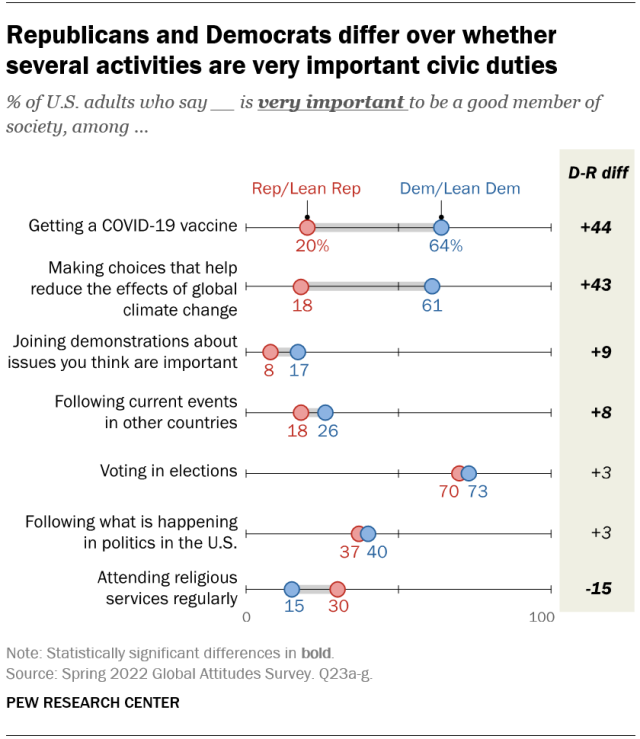
Around seven-in-ten U.S. adults (69%) say it’s very important to vote in elections to be a good member of society – more than say the same about any of the other activities included in a Pew Research Center survey conducted earlier this year. 


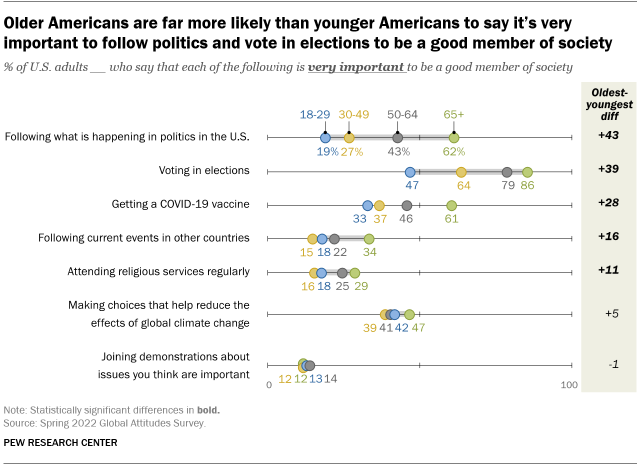
Young and old differ on some points.


Wednesday, October 19, 2022

Noncitizen Voting in DC?

The Washington Post opposes a proposal to allow noncitizens to vote in DC elections:

This newspaper has opposed efforts over the past decade to rewrite D.C.’s election code so green-card holders could vote. What’s now before the council is more radical. The proposal has been expanded to give voting rights in local elections to all noncitizen adults, regardless of whether they are in the country legally, so long as they’ve resided in the District for 30 days.

Anyone who has ever been to a naturalization ceremony can attest to how special it feels to welcome new members into the American family. New citizens must swear an oath renouncing all allegiances to foreign powers and promising to support and defend the Constitution against all enemies. There’s nothing in this measure to prevent employees at embassies of governments that are openly hostile to the United States from casting ballots. Or foreign students who are studying abroad in Washington for a semester.