Search This Blog

Showing posts with label police. Show all posts

Thursday, January 8, 2026

An Incident in Minneapolis

 Zolan Kanno-Youngs at NYT:

Just hours after an Immigration and Customs Enforcement agent shot a 37-year-old woman in Minneapolis on Wednesday, Mr. Trump told a group of New York Times reporters that the woman was at fault because she had tried to “run over” the officer.

We were in the Oval Office for an interview with the president, and the unfolding situation in Minneapolis was high on our list of questions. As soon as we started asking him about the incident, he said: “I want to see nobody get shot. I want to see nobody screaming and trying to run over policemen either.”

When we pressed Mr. Trump on his conclusion that the victim, Renee Nicole Good, tried to run over the agent, he asked an aide to pull up the video on a laptop in an effort to prove his point.

“That was a vicious situation that took place,” Mr. Trump said, apparently referring to what federal officials have said was an effort by Ms. Good to run down an ICE agent.
...

Before the video began, Mr. Trump acknowledged the tragic nature of the shooting. “With all of it being said, no, I don’t like that happening,” he said, before pivoting to his common refrain of criticizing illegal immigration.

As a slow-motion surveillance video of the shooting played on the laptop, we told him that this angle did not appear to show an ICE officer had been run over.

“Well,” Mr. Trump said. “I — the way I look at it … ”

“It’s a terrible scene,” Mr. Trump said at the end of the video. “I think it’s horrible to watch. No, I hate to see it.”

But did this fatal shooting mean his ICE operation had gone too far? Mr. Trump sidestepped the question, instead blaming his predecessor's immigration policies.

But did this fatal shooting mean his ICE operation had gone too far? Mr. Trump sidestepped the question, instead blaming his predecessor's immigration policies.


Tennessee v. Garner, 471 U.S. 1 (1985) Argued: October 30, 1984 Decided: March 27, 1985 Annotation Primary Holding Under the Fourth Amendment of the U.S. Constitution, a police officer may use deadly force to prevent the escape of a fleeing suspect only if the officer has a good-faith belief that the suspect poses a significant threat of death or serious physical injury to the officer or others.

Saturday, October 18, 2025

Know Your Rights

ACLU: 

You have the right to remain silent. For example, you do not have to answer any questions about where you are going, where you are traveling from, what you are doing, or where you live. If you wish to exercise your right to remain silent, say so out loud. (In some states, you may be required to provide your name if asked to identify yourself, and an officer may arrest you for refusing to do so.)

You do not have to consent to a search of yourself or your belongings, but police may pat down your clothing if they suspect a weapon. Note that refusing consent may not stop the officer from carrying out the search against your will, but making a timely objection before or during the search can help preserve your rights in any later legal proceeding.

If you are arrested by police, you have the right to a government-appointed lawyer if you cannot afford one.

You do not have to answer questions about where you were born, whether you are a U.S. citizen, or how you entered the country. (Separate rules apply at international borders and airports as well as for individuals on certain nonimmigrant visas, including tourists and business travelers. For more specific guidance about how to deal with immigration-related questions, see our immigrants’ rights section.)

ACLU of Southern California:

If Immigration Agents come to your door:

Do not open the door.

You are not legally required to let them in unless they have a warrant.
Ask why they are there.

If you don’t speak English, you have the right to an interpreter.
If they want to enter, ask to see a warrant.

There are two kinds of warrants: search and arrest.A search warrant allows police to enter the address listed on the warrant, but officers can only search the areas and for the items listed.
An arrest warrant allows police to enter the home of the person listed on the warrant if they believe the person listed is inside. A warrant of removal/deportation (ICE warrant) does not allow officers to enter a home without consent.
Ask the officer to slip the warrant under the door or hold it up to the window, so you can inspect it.

  • They might show administrative forms (I-200 and I-205). But if they don’t have a warrant signed by a judge, you may refuse entry.
  • Check for signature by judge.If it's a search warrant, make sure it is for your address; if not, you don’t have to open.
  • If it's an arrest warrant, make sure it is for someone who lives at your address; if not, you don’t have to open.
  • Even if officers have a warrant and you have to let them in, you have the right to remain silent.

Say: “I plead the Fifth Amendment and choose to remain silent.” If they force their way inside, don’t resist.

Remain calm, but don’t share any information. If you’re arrested, remain silent.

You’re entitled to speak to a lawyer before cooperating and most importantly, keep calm because YOU HAVE RIGHTS, EXERCISE THEM.
If ICE is at your workplace:
Do NOT consent.

State that you do not consent to a search. ICE can enter areas open to the general public (dining area, parking lot, waiting room) of a business without permission. But that does not give ICE the authority to detain, question, or arrest anyone.
Ask if they have a warrant.

If agents don't have a warrant, calmly ask them to leave. Advise workers that they have the right to remain silent and do not have to answer questions, but do not direct anyone not to answer questions.
If ICE has a SEARCH warrant signed by a judge:

Make sure the warrant has the correct address for your workplace. Review the warrant to see what areas and items ICE is authorized to search. ICE is not authorized to search areas or inspect items that are not described in the warrant.
Stay calm.

Do not run, ICE can use that as a reason to arrest you. Do not encourage anyone to escape or hide.
Know the law.

Under California law, employers cannot turn over employee records or voluntarily allow immigration agents to enter non-public areas of the workplace without a judicial warrant.
Ask to see identification.

Write down the name, contact information, and badge number of officers or agents. If the agent refuses to provide documentation, you should note that as well. Document any violence or abuse. Document the details of the search, and persons or property taken. Call the rapid response hotline in your area.

Monday, August 19, 2024

Attitudes Toward the Justice System

Friday, May 24, 2024

Sheriffs and Their Power

Law enforcement in the United States is decentralized and fragmented.  Sometimes the system works well.  Sometimes it does not.  Sheriffs wield vast and often  unchecked power.   News deserts do not help.

E.D. Cauchi, Scott Pham at CBS:
CBS News gathered and analyzed federal law enforcement data that showed while more people died overall in encounters with city police, deaths in encounters with county sheriffs occurred at a significantly higher rate. For every 100,000 people arrested, more than 27 people died in the custody of sheriffs, while that number was fewer than 10 for police officers in 2022, the most recent year of available data.
...
According to CBS News' investigation, problems were more prevalent in smaller, more remote communities where deputies typically had less training, fewer resources and limited oversight. These factors allowed sheriff misconduct to continue for longer, becoming more severe and brazen before it was discovered. Even then, they rarely faced consequences.
...

In McCurtain County, Oklahoma, Sheriff Kevin Clardy was caught on audiotape in March of 2023 talking with other county leaders about how they might kill and discreetly bury the bodies of two local journalists who had written stories about alleged corruption inside his office, among others.

...

"Nothing has happened to them," said McCurtain Gazette reporter Chris Willingham. He and his father Bruce were the journalists whose murders the sheriff and others were heard contemplating. "They have to feel untouchable, they're above the law."

...

An estimated 72% of the U.S. is rural, where more than 3,000 sheriffs act as the primary law enforcement. Only Alaska and Connecticut don't have any sheriffs; the latter abolished the position two decades ago due to high-profile corruption scandals.

What it takes to qualify for the job of sheriff varies from state to state: some require law enforcement experience, while others allow any U.S. citizen over age 18 to wear the star. The vast majority of sheriffs are elected, making voters the ultimate check on their authority. But candidates frequently run unopposed and it's not uncommon for a sheriff to remain in power for decades.


Sunday, April 28, 2024

Rightward Snapback

Our most recent book is titled Divided We Stand: The 2020 Elections and American Politics. The 2024 race has begun.   Democrats thought they saw a leftward shift in 2020.  They were mistaken.  As we explain, "defund the police" hurt the Democrats in key congressional races.  California voters rejected affirmative action.  Immigration remained problematic.

Neal Rothschild at Axios:
The big picture: Across politics, business, education and the economy, a number of the sudden, radical shifts we experienced in 2020 have proven short-lived.
1. DEI: America's racial justice reckoning after the police murder of George Floyd in 2020 led many organizations to hire diversity officers and invest heavily in efforts to address racial inequality.Over the past two years, conservatives have waged a remarkably successful war against those initiatives — prompting many companies to cut DEI funding and drop racial justice as a talking point.

2. Policing: Amid the 2020 protests and calls to defund the police, a number of cities cut their law enforcement budgets.The next year, many of those cities — including New York, Los Angeles, Denver and Dallas — restored and even increased police funding in response to surging violent crime.
Police reforms are now being rolled back in cities and states across the country, with "defund the police" shifting from a progressive slogan to a Republican weapon that very few Democrats align with.

3. Immigration: During his 2020 campaign, President Biden cast former President Trump's harsh border policies as part of a "battle for the soul of the country" that inspired his decision to run.Amid a record wave of migrants illegally crossing the border over the last several years, Biden is now considering a dramatic executive order that would impose Trump-like restrictions on asylum-seekers.
Half of Americans — including 42% of Democrats — say they'd support mass deportations of undocumented immigrants, according to an Axios Vibes survey by The Harris Poll released Thursday.

Saturday, April 27, 2024

Literally Getting Away With Murder


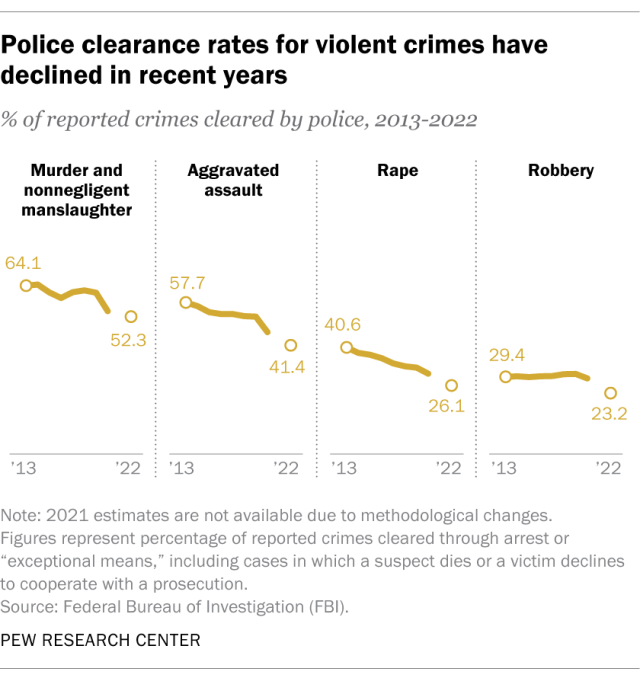
Deep down in a Pew report by John Gramlich are some startling stats:
Nationwide clearance rates for both violent and property crime are at their lowest levels since at least 1993, the FBI data shows.

Police cleared a little over a third (36.7%) of the violent crimes that came to their attention in 2022, down from nearly half (48.1%) as recently as 2013. During the same period, there were decreases for each of the four types of violent crime the FBI tracks:
  • Police cleared 52.3% of reported murders and nonnegligent homicides in 2022, down from 64.1% in 2013.
  • They cleared 41.4% of aggravated assaults, down from 57.7%.
  • They cleared 26.1% of rapes, down from 40.6%.
  • They cleared 23.2% of robberies, down from 29.4%.
The pattern is less pronounced for property crime. Overall, law enforcement agencies cleared 12.1% of reported property crimes in 2022, down from 19.7% in 2013. The clearance rate for burglary didn’t change much, but it fell for larceny/theft (to 12.4% in 2022 from 22.4% in 2013) and motor vehicle theft (to 9.3% from 14.2%).

Monday, January 22, 2024

Polarized Views of Professions

 Megan Brenan and Jeffrey M. Jones at Gallup:

Republicans and Democrats have different views of professions, with Democrats tending to be more complimentary of workers’ honesty and ethical standards than Republicans are. In fact, police officers are the only profession with higher honesty and ethics ratings among Republicans and Republican-leaning independents (55%) than among Democrats and Democratic-leaning independents (37%).

The largest party differences are seen in evaluations of college teachers, with a 40-point gap (62% among Democrats/Democratic leaners and 22% among Republicans/Republican leaners). Partisans’ honesty and ethics ratings of psychiatrists, journalists and labor union leaders differ by 20 points or more, while there is a 19-point difference for medical doctors.


Friday, January 19, 2024

Deadly Failure in Uvalde

Law enforcement in the United States is decentralized and fragmented.  Sometimes the system works well. During the Uvalde Massacre, it did not.

 Justice Department, Critical Incident Review: Active Shooter at Robb Elementary School

The most significant failure was that responding officers should have immediately recognized the incident as an active shooter situation, using the resources and equipment that were sufficient to push forward immediately and continuously toward the threat until entry was made into classrooms 111/112 and the threat was eliminated. Since the tragic shooting at Columbine High School in 1999, a fundamental precept in active shooter response and the generally accepted practice is that the first priority must be to immediately neutralize the subject; everything else, including officer safety, is subordinate to that objective. Accordingly, when a subject has already shot numerous victims and is in a room with additional victims, efforts first must be dedicated to making entry into the room, stopping the subject, and rendering aid to victims. These efforts must be undertaken regardless of the equipment and personnel available to those first on the scene. Critical Incident Review: Active Shooter at Robb Elementary School | Executive Summary xvi 

 This did not occur during the Robb Elementary shooting response, where there was a 77-minute gap between when officers first arrived on the scene and when they finally confronted and killed the subject. Several of the first officers on scene initially acted consistent with generally accepted practices to try to engage the subject, and they moved quickly toward classrooms 111/112 within minutes of arriving. But once they retreated after being met with gunfire, the law enforcement responders, including UCISD PD Chief Pete Arredondo—who we conclude was the de facto on-scene incident commander—began treating the incident as a barricaded subject scenario and not as an active shooter situation. 

As more law enforcement resources arrived, first responders on the scene, including those with specific leadership responsibilities, did not coordinate immediate entry into the classrooms, running counter to generally accepted practices for active shooter response to immediately engage the subject to further save lives. Instead, law enforcement focused on calls for additional SWAT equipment (which should not delay the response to an active shooter), requests for delivery of classroom keys and breaching tools (which may not have been necessary to gain entry), and orders to evacuate surrounding classrooms prior to making entry into classrooms 111/112.

In addition to the overall failure to appreciate the active shooter nature of the situation, responders also failed to act promptly even after hearing gunshots around 12:21 p.m., which should have spurred greater urgency to confront the subject but instead set off a renewed search for keys. 

There were also failures in leadership, command, and coordination. None of the law enforcementleaders at the scene established an incident command structure to provide timely direction, control, andcoordination to the overwhelming number of responders who arrived on the scene. This lack of structure contributed to confusion among responders about who was in charge of the response and how they could assist. Communications difficulties exacerbated these problems. Per UCISD policies, Chief Arredondo was the on-scene incident commander, but he lacked a radio, having discarded his radios during his arrival thinking they were unnecessary. And although he attempted to communicate with officers in other parts of the hallway via phone, unfortunately, on multiple occasions, he directed officers intending to gain entry into the classrooms to stop, because he appeared to determine that other victims should first be removed from nearby classrooms to prevent further injury. 

These failures may have been influenced by policy and training deficiencies. For example, recent training that UCISD PD provided seemed to suggest, inappropriately, that an active shooter situation can transition into a hostage or barricaded subject situation. And while many of the FOS had sufficient active shooter and incident command training, other key FOS responders lacked any active shooter training or incident command training. The vast majority of the officers from different law enforcement agencies had never trained together, contributing to difficulties in coordination and communication on the day of the incident. The lack of pre-planning hampered even well-prepared agencies from functioning at their best

Sunday, January 29, 2023

Police Unions and Civilian Oversight

Organized labor in general has fallen on hard times.  But in many places, public-employee unions retain enormous power.

Jamiles Lartey at the Marhsall Project:
If you heard about a group called “Voters for Oversight and Police Accountability,” who would you guess is funding and coordinating its efforts? Progressive activists? Civic-minded community members?

How about a police union?

That’s the situation in Austin, Texas, where this fall, canvassers for “VOPA” appear to have amassed the 25,000 signatures needed to get a referendum on the so-called “Austin Police Oversight Act” into the city’s May 6 election.

The thing is, there was already an “Austin Police Oversight Act” on the ballot. The duplicate effort, funded by the Austin Police Association, is similar — but seriously watered down, when compared with the original promoted by the progressive political action committee Equity Action. That original proposal seeks to open up public access to police records, and give the city’s office of police oversight the ability to participate in investigations of officer conduct.

By contrast, the police union-funded ballot initiative would keep certain misconduct records hidden from the public and leave the board with a more passive role in investigations.

Reporting late last year found that the police union was running VOPA’s website, and this week, a reporter with the Austin Chronicle uncovered that the union had contributed virtually every penny of the nearly $300,000 raised for the campaign. The union did not respond to a request for comment from The Marshall Project, and has not responded to a request from the local Fox affiliate.

The effort appears to be a brazen version of something police unions have attempted in numerous cities recently: to derail and disempower civilian oversight groups tasked with monitoring and reviewing police conduct.

Friday, January 20, 2023

Lowest Unionization Rate on Record

 From BLS:

The union membership rate--the percent of wage and salary workers who were members of unions--was 10.1 percent in 2022, down from 10.3 percent in 2021, the U.S. Bureau of Labor Statistics reported today. The number of wage and salary workers belonging to unions, at 14.3 million in 2022, increased by 273,000, or 1.9 percent, from 2021. However, the total number of wage and salary workers grew by 5.3 million (mostly among nonunion workers), or 3.9 percent. This disproportionately large increase in the number of total wage and salary employment compared with the increase in the number of union members led to a decrease in the union membership rate. The 2022 unionization rate (10.1 percent) is the lowest on record. In 1983, the first year where comparable union data are available, the union membership rate was 20.1 percent and there were 17.7 million union workers.

... 

In 2022, 7.1 million employees in the public sector belonged to unions, about the same as in the private sector (7.2 million). (See table 3.)
Union membership was little changed over the year (+80,000) in the public sector, after a decline the prior year (-191,000). The public-sector union membership rate continued to decline in 2022; the rate went down by 0.8 percentage point to 33.1 percent. In 2022, the union membership rate continued to be highest in local government (38.8 percent), which employs many workers in heavily unionized occupations, such as police officers, firefighters, and teachers.
The number of union workers employed in the private sector increased by 193,000 to 7.2 million over the year. The private-sector unionization rate edged down by 0.1 percentage point in 2022 to 6.0 percent. Industries with high unionization rates included utilities (19.6 percent), motion pictures and sound recording industries (17.3 percent), and transportation and warehousing (14.5 percent). Low unionization rates occurred in insurance (1.2 percent), finance (1.3 percent), professional and technical services (1.3 percent), and food services and drinking places (1.4 percent).


Monday, July 18, 2022

Three Hundred Seventy-Six Officers Failed to Stop the Uvalde Massacre

Law enforcement in the United States is decentralized and fragmented.  Sometimes the system works well. During the Uvalde Massacre, it did not.

INVESTIGATIVE COMMITTEE ON THE ROBB ELEMENTARY SHOOTING TEXAS HOUSE OF REPRESENTATIVES, INTERIM REPORT 2022 

In total, 376 law enforcement officers responded to the tragedy at Robb Elementary School. The breakdown of responders, by agency, is as follows.

  • 149 United States Border Patrol
  • 91 Texas Department of Public Safety
  • 25 Uvalde Police Department
  • 16 San Antonio Police Department (SWAT)
  • 16 Uvalde County Sheriff ’s Office
  • 14 Department of Homeland Security – HIS
  • 13 United States Marshals
  • 8 Drug Enforcement Agency
  • 7 Frio County Sheriff ’s Office
  • 5 Kinney County Sheriff ’s Office
  • 5 Uvalde Consolidated Independent School District
  • 4 Dilley Police Department
  • 4 Zavala County Sheriff ’s Office
  • 3 Medina County Sheriff ’s Office
  • 3 Sabinal Police Department
  • 2 City of Uvalde Fire Marshals
  • 2 Pearsall Police Department
  • 2 Texas Parks and Wildlife
  • 2 Uvalde County Constables
  • 2 Val Verde County Sheriff ’s Office
  • 1 Frio County Constables
  • 1 Southwest Texas Junior College
  • 1 Zavala County Constables 

Tuesday, May 17, 2022

Domestic Terrorism

 From CSIS:

To better understand the trends in U.S. domestic terrorism, CSIS compiled a data set of 1,040 terrorist attacks and plots in the United States between January 1, 1994, and December 31, 2021. The 2021 data are new, and they yield several main findings.

First, there was a significant increase in the number and percentage of domestic terrorist incidents at demonstrations in cities in 2020 and 2021. In 2019, only 2 percent of all U.S. terrorist attacks and plots occurred at demonstrations, but this portion rose to 47 percent in 2020 and 53 percent in 2021. The result is that some metropolitan areas of the United States—such as Portland, Seattle, New York, Los Angeles, and Washington, D.C.—are becoming focal points of domestic terrorism, where extremists from opposing sides square off against each other and against law enforcement agencies. This development has created a “security dilemma” in metropolitan areas, where attempts by one side to improve its own security threatens the security of others, leading to further escalation.

Second, U.S. law enforcement agencies have increasingly become a target of domestic terrorists from all sides of the political spectrum. The government, military, and especially law enforcement were the primary targets of domestic terrorist attacks and plots in 2021, composing 43 percent of all attacks. They were most likely to be targeted regardless of perpetrator ideology: they were selected in 48 percent of violent far-left events, 37 percent of violent far-right events, and all Salafi-jihadist events in 2021. This development indicates that U.S. security agencies—particularly law enforcement—are increasingly at risk from domestic terrorism.

Third, there was an increase in the percentage of attacks and plots by anarchists, anti-fascists, and other likeminded extremists in 2021. While white supremacists, anti-government militias, and likeminded extremists conducted the most attacks and plots in 2021 (49 percent), the percentage of attacks and plots by anarchists, anti-fascists, and likeminded extremists grew from 23 percent in 2020 to 40 percent in 2021. This rise has occurred alongside an increase in violence at demonstrations. However, although there was a historically high level of both far-right and far-left terrorist attacks in 2021, violent far-right incidents were significantly more likely to be lethal, both in terms of weapon choice and number of resulting fatalities.


Sunday, January 23, 2022

Deliberating about Civil Asset Forfeiture

 From C-SPAN:

Britannica defines civil asset forfeiture as a “legal process that enables a government to seize property and other assets belonging to persons suspected of committing a crime.” This law enforcement tool has been used throughout United States history, dating back to the earliest days of the country and the nation’s foundation on English law. The Legal Information Institute at Cornell University describes the tool as having gained popularity during the Prohibition era, as the government sought to seize illegal alcohol and prevent further illicit production.

The tool once again grew in popularity through the 1980s’ War on Drugs. Legally, the tool was federally codified in the Comprehensive Crime Act of 1984, which allowed the government to “seize first, and defend the forfeiture in court later.” Since that decade, the use of the tool has been subject to robust debate regarding its appropriate use and potential safeguards. For example, the Department of Justice under the Obama Administration issued a 2015 order that eliminated most types of federal adoptions of state and local seizures. This order was then reversed by the Department of Justice in 2017 under the leadership of the Trump Administration.

Supporters of civil asset forfeiture describe its effectiveness in reducing potential crime and limiting the impact of organized crime groups. Opponents of the tool argue that law enforcement agencies have a clear bias and incentive to seize property, as law enforcement agencies are able to use the funds or proceeds from sales for regular operations. Regardless of perspective, the use of the tool has exponentially escalated since 2000.

This deliberation guides students through a review of both the historical and contemporary arguments for and against the use of the tool. After a careful review of multiple perspectives, students will determine whether federal, state, and local law enforcement officials should continue the practice of civil asset forfeiture.

Objectives and Outcomes
  • Students will be able to describe key vocabulary terms and concepts associated with the debate surrounding the continued use of civil asset forfeiture.
  • Students will be able to identify and explain aspects of the civil asset forfeiture debate including those of civil liberties, due process, criminal justice, and law enforcement.
  • Students will be able to evaluate arguments relating to the continued use of civil asset forfeiture and formulate an opinion on this question.

Saturday, January 1, 2022

Militarization of Police

Connor Sheets and Robert J. Lopez at LAT:
Policing in Los Angeles changed forever on the morning of Feb. 28, 1997, when Americans watched on live TV as a 44-minute firefight unfolded between two heavily armed bank robbers and outgunned LAPD officers at a Bank of America in a bustling North Hollywood shopping district.

In the end, nearly 2,000 bullets were fired, the two robbers were killed, and multiple officers and civilians were injured in the now-infamous showdown, which helped usher in the modern era of militarized police.

Last week, another shocking incident just three blocks away offered a tragic postscript to the high-powered approach that police adopted after the bank shootout.

A Los Angeles police officer carrying an assault-style rifle rushed with several other officers into a Burlington department store after receiving reports that a man was attacking people inside. The officer charged ahead to confront a man who had attacked shoppers with a bike lock, firing three rounds and killing the man seconds after first laying eyes on him.

But those shots also killed 14-year-old Valentina Orellana-Peralta, who was hiding in a nearby changing room with her mother and was struck by one of the rounds after police say it ricocheted off the floor and pierced a wall.

Those two violent events — 24 years apart — demonstrate the pendulum swing in American law enforcement that has become a part of the outrage that followed Valentina’s killing.

After the shootout, the LAPD and law enforcement agencies across the country boosted their firepower, equipping officers with high-powered rifles and other weaponry. The LAPD also authorized its officers to carry high-caliber handguns, and Los Angeles passed a series of gun control measures.

The officer who killed Valentina fired a military-grade rifle.

Thursday, December 2, 2021

Police Reform

At Divided We Fall, Michael Javen Fortner writes:
“This concerted nationwide attack on police is nothing less than the gravest assault on the rule of law in modern times,” U.S. Senator Tom Cotton blared a few months ago. In a partisan broadside, he added, “The simple fact is that today’s Democrat Party is pro-riot, anti-cop, and anti-prosecutor. Democrats today have more sympathy for violent criminals than for innocent victims.” When former Democratic President Barack Obama dubbed “defund the police” a counterproductive “snappy” slogan, U.S. Congresswoman Cori Bush responded, “With all due respect, Mr. President – let’s talk about losing people. We lost Michael Brown Jr. We lost Breonna Taylor. We’re losing our loved ones to police violence.” She pressed, “It’s not a slogan. It’s a mandate for keeping our people alive. Defund the police.” There we have it: a debate where one end of the ideological spectrum considers police reform an existential threat to the rule of law and where the other end sees law enforcement as an existential threat to Black life. Like with so many issues today, these extremes do not represent the bipartisan, cross-racial consensus that exists among the American people.
...

In California, 75% of Democrats and 58% of Republicans say “more jobs and economic opportunity” would prevent violent crime. Overwhelming numbers of Whites, Blacks, Hispanics, and Asians felt similarly. Nearly 80% of Democrats and 58% of Republicans believe “more mental health and treatment services would reduce violent crime,” a view also shared across racial groups. These positions are not unique to liberal California. In the national Washington Post-ABC news poll, the majority of Whites, Blacks, and Hispanics believe that having social workers “help police defuse situations with people having emotional problems” would reduce violence somewhat or by a lot. However, his issue was divisive among party lines: 83% of Democrats say it would reduce violence somewhat or by a lot while 54% of Republicans said it would not reduce crime. There was more consensus on structural approaches: 90% of Democrats and 61% of Republicans reported that increasing economic opportunities in poor communities would reduce violence somewhat or by a lot. This view was shared across all racial groups as well. Most Americans – Republicans, Democrats, Whites, Blacks, Hispanics, and Asians – insist that community investment and economic opportunity should be part of a reimagined public safety strategy.

Tuesday, November 2, 2021

The Deadly Culture of Traffic Stops

 Mike McIntire and Michael H. Keller at NYT:

A hidden scaffolding of financial incentives underpins the policing of motorists in the United States, encouraging some communities to essentially repurpose armed officers as revenue agents searching for infractions largely unrelated to public safety. As a result, driving is one of the most common daily routines during which people have been shot, Tased, beaten or arrested after minor offenses.

Some of those encounters — like those with Sandra Bland, Walter Scott and Philando Castile — are now notorious and contributed to a national upheaval over race and policing. The New York Times has identified more than 400 others from the past five years in which officers killed unarmed civilians who had not been under pursuit for violent crimes.

Fueling the culture of traffic stops is the federal government, which issues over $600 million a year in highway safety grants that subsidize ticket writing. Although federal officials say they do not impose quotas, at least 20 states have evaluated police performance on the number of traffic stops per hour, which critics say contributes to overpolicing and erosion of public trust, particularly among members of certain racial groups.
Many municipalities across the country rely heavily on ticket revenue and court fees to pay for government services, and some maintain outsize police departments to help generate that money, according to a review of hundreds of municipal audit reports, town budgets, court files and state highway records.


Thursday, July 15, 2021

Polarization and Confidence in Institutions

 Megan Brenan at Gallup:

Majorities of Republicans and Republican-leaning independents, as well as Democrats and Democratic-leaning independents, express confidence in the military and small business. Both party groups express similarly low confidence in the Supreme Court, big business, banks and the criminal justice system.

However, partisans' confidence in the remaining 10 institutions diverges. Republicans have far more confidence than Democrats in the police and the church. Meanwhile, Democrats' confidence in the other eight institutions outpaces Republicans' by double digits.

 The largest partisan gap in confidence for any institution is for the presidency, with 49 points separating Democrats' and Republicans' ratings. Confidence in the presidency has become increasingly linked to the party affiliation of the president, with supporters of the president's party much more confident than supporters of the opposition party, consistent with the greater party polarization in presidential job approval ratings. Between 1993 and 2004, the average party gap in confidence in the presidency was 34 points. Since then, it has averaged 50 points.

Saturday, May 22, 2021

Opinion on Equal Justice

At Axios, David Nather reports on a new Ipsos poll:

By the numbers: Nearly six out of 10 respondents — 59% — disagreed with the statement "police treat all Americans equally," while 58% said the same about criminal justice courts and lawyers.
  • Black Americans gave the system an especially strong vote of no confidence, with 84% disagreeing that police treat people equally and 76% saying the same about the courts.
  • But 53% of white Americans, 62% of Hispanic Americans and 67% of Asian Americans also disagreed that police treat everyone equally, while 55% of white Americans and Asian Americans and 56% of Hispanic Americans voiced a lack of confidence in the courts.
  • That lack of faith extended across virtually all other groups, including by gender, age, region, urban/suburban/rural residency, and education and income levels.
  • The only hint of confidence in the police came from Republicans, with 51% saying police treat everyone equally (only 7% of Democrats and 18% of independents agreed). Just 42% of Republicans said the courts treat everyone equally.
Between the lines: Most Americans still have a positive view of the police, regardless of how they feel about equal justice. But that's not true of Black Americans — nearly six out of 10 (57%) said they have unfavorable views of the police and law enforcement.

...

When Americans face the courts, the poll found a large gap in their experiences, with Black and Hispanic Americans more likely to depend on court-ordered attorneys than other groups.
  • 43% of white Americans and 52% of Asian Americans said they've had their own attorneys when they or a family member has had to appear in court.
  • By contrast, just 29% of Black Americans and 39% of Hispanic Americans had their own lawyers, while 49% of Black Americans and 43% of Hispanic Americans had court-ordered attorneys.
  • That's important because public defenders are widely considered to be overworked and underfunded, and because researchers have become concerned in recent years that some public defenders might have their own forms of implicit bias.


Monday, May 10, 2021

US Policing: Decentralized and Mostly Small-Scale

At WP, Mark Berman reports that police reform is tough because policing is decentralized and most departments are small.
According to a federal survey in 2016, there are more than 12,200 local police departments nationwide, along with another 3,000 sheriff’s offices. And most of those don’t look like the New York Police Department, which employs more officers than Brooklyn Center, in suburban Minneapolis, has residents.

Nearly half of all local police departments have fewer than 10 officers. Three in 4 of the departments have no more than two dozen officers. And 9 in 10 employ fewer than 50 sworn officers. Brooklyn Center, which has 43 officers, and Windsor, which reported a seven-member force, fit comfortably in that majority.

Experts say that while smaller departments have their benefits, including being able to adapt to their communities and hire officers with local ties, these agencies also are typically able to avoid the accountability being sought as part of the national movement to restructure and improve policing. These departments’ often limited resources and the decentralized structure of American law enforcement complicate efforts to mandate widespread training and policy changes, experts say.

“You want to change American policing, figure out how to get to … the departments of 50 officers or less,” said Chuck Wexler, executive director of the Police Executive Research Forum, a Washington-based group that works with police departments. “How do you reach them? How do you get to them? … That’s what the American people keep wondering.”

Monday, April 12, 2021

Domestic Terrorism Data

 From the Center for Strategic & International Studies

U.S. active-duty military personnel and reservists have participated in a growing number of domestic terrorist plots and attacks, according to new data from CSIS. The percentage of all domestic terrorist incidents linked to active-duty and reserve personnel rose in 2020 to 6.4 percent, up from 1.5 percent in 2019 and none in 2018. Similarly, a growing number of current and former law enforcement officers have been involved in domestic terrorism in recent years. But domestic terrorism is a double-edged sword. In 2020, extremists from all sides of the ideological spectrum increasingly targeted the military, law enforcement, and other government actors—putting U.S. security agencies in the crosshairs of domestic terrorists.

... 

There is growing concern about the extent to which U.S. military and law enforcement personnel have perpetrated—and been victims of—domestic terrorism.1 In March 2021, the U.S. Department of Defense (DoD) sent a report to the House and Senate Armed Services Committees which concluded: “DoD is facing a threat from domestic extremists (DE), particularly those who espouse white supremacy or white nationalist ideologies.” It continued that some domestic extremist networks “(a) actively attempt to recruit military personnel into their group or cause, (b) encourage their members to join the military, or (c) join, themselves, for the purpose of acquiring combat and tactical experience.”2 In 2020, the FBI alerted the DoD that it had opened 143 criminal investigations involving current or former service members—of which nearly half (68) were related to domestic extremism. Most investigations apparently involved veterans, some of whom had unfavorable discharge records.3 The January 6, 2021, events at the U.S. Capitol raised additional concerns, since one reservist, one National Guard member, and at least 31 veterans were charged with conspiracy or other crimes.4 In addition, at least four police officers and three former officers faced federal charges for their involvement in storming the Capitol.5

Robert O'Harrow Jr., Andrew Ba Tran and Derek Hawkins at WP:

Domestic terrorism incidents have soared to new highs in the United States, driven chiefly by white-supremacist, anti-Muslim and anti-government extremists on the far right, according to a Washington Post analysis of data compiled by the Center for Strategic and International Studies.

The surge reflects a growing threat from homegrown terrorism not seen in a quarter-century, with right-wing extremist attacks and plots greatly eclipsing those from the far left and causing more deaths, the analysis shows.

The number of all domestic terrorism incidents in the data peaked in 2020.

Since 2015, right-wing extremists have been involved in 267 plots or attacks and 91 fatalities, the data shows. At the same time, attacks and plots ascribed to far-left views accounted for 66 incidents leading to 19 deaths.