Search This Blog

Showing posts with label individualism. Show all posts

Friday, October 12, 2018

American Politics for International Students 2018

Ways in which America is different 


I. RELIGION

There are other rich countries.  There are other religious countries. The US is rich and religious.
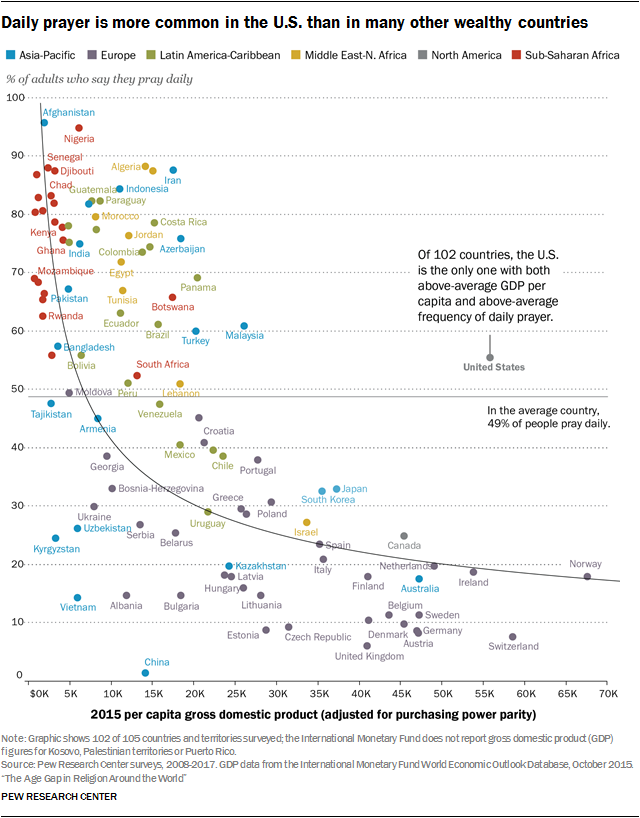


"Of all the dispositions and habits which lead to political prosperity, religion and morality are indispensable supports." -- George Washington, 1796  Farewell Address

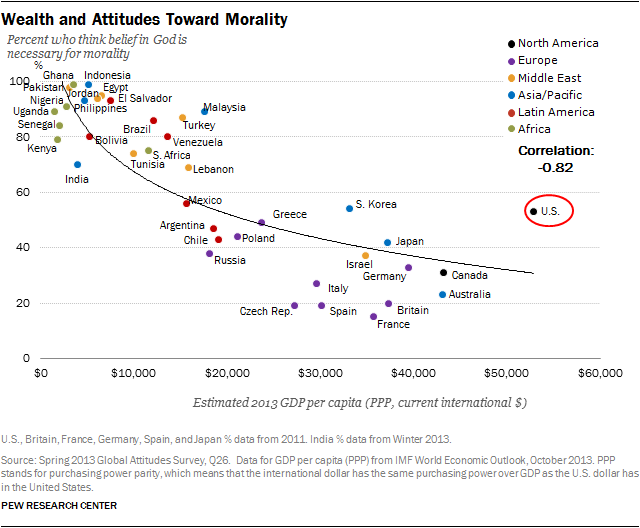
Similarly, see percentage who think that belief in God is necessary for morality:


Being "truly American:
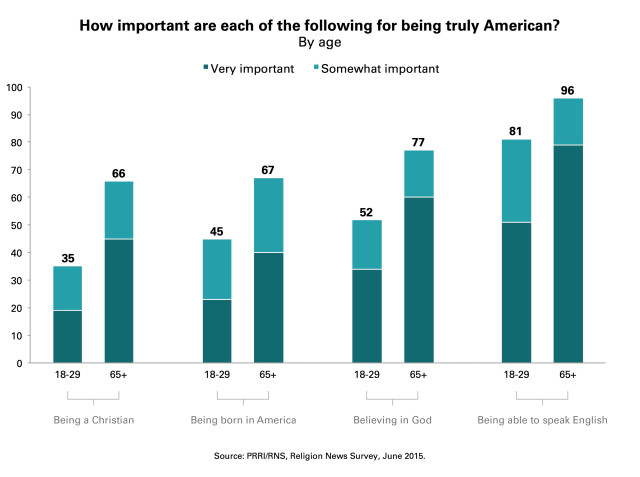
Chart-3-Important-Factors-Being-American-by-Generation
II. PATRIOTISM

"Nothing is more annoying ... than this irritable patriotism of the Americans. A foreigner will gladly agree to praise much in their country, but he would like to be allowed to criticize something, and that he is absolutely refused."  -- Tocqueville, Democracy in America


More than six in ten (62%) Americans believe that God has granted America a special role in human history, while roughly one-third (33%) disagree. Views have not shifted significantly in recent years. In 2012, an identical number of Americans (62%) agreed that the U.S. was granted a special role in human history. There are sharp differences on this question by political ideology and religious affiliation.
Conservatives are nearly twice as likely as liberals to agree that God has granted the U.S. a special role in human history—80% of conservatives and only 45% of liberals agree with this statement. Half (50%) of liberals reject the notion that the country has a divinely sanctioned role in human history.
White evangelical Protestants are unique among religious Americans in their affirmation of American exceptionalism. More than eight in ten (83%) white evangelical Protestants agree that God has granted the country a special role in human history. Seven in ten non-white Protestants (73%) and Catholics (70%) and a majority (56%) of white mainline Protestants also believe in a divinely chosen role for the U.S. In contrast, a majority (53%) of religiously unaffiliated Americans disagree that God granted the U.S. a special role, compared to fewer than four in ten (39%) who agree.
...
More than eight in ten (83%) Americans say that it is important to publicly show support for the U.S. by doing things such as displaying the American flag; only 14% of the public disagree. Across political and religious spectrums, Americans embrace the importance of public demonstrations of patriotism.
THE 45TH PRESIDENT IS QUITE ODD, SINCE HE BELIEVES IN NEITHER AMERICAN EXCEPTIONALISM NOR THE CENTRAL PRINCIPLE OF THE DECLARATION.


III. INDIVIDUALISM AND THE WELFARE STATE


The self-made man:  Alexander Hamilton as immigrant and American hero.


IV.  INSTITUTIONS AND ELECTIONS

Ranking Presidents

The Separation of Powers

Congress and Bicameralism:


Federalism:  about 89,000 governments and about 513,000 elected officials

Federalism and ballot complexity

Voter turnout

Partisan Polarization

Parties and Campaigns:


"Those who profess to favor freedom and yet deprecate agitation, are men who want crops without plowing up the ground, they want rain without thunder and lightning. They want the ocean without the awful roar of its many waters." --Frederick Douglass

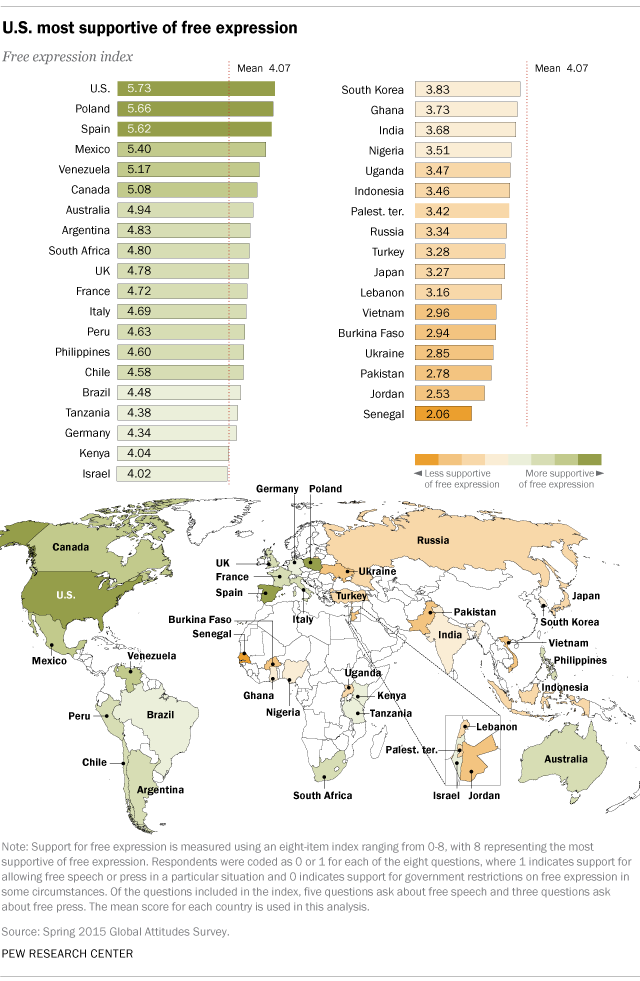
Free Speech:  the Unusual First Amendment

Support for Free Expression


Friday, October 6, 2017

American Politics for International Students, 2017

Ways in which America is different 

Donald Trump's Foreign Policy Blunders SUPERCUT from Alexandra Rosenmann on Vimeo.


I. RELIGION

US stands out as rich nation highly religious

"Of all the dispositions and habits which lead to political prosperity, religion and morality are indispensable supports." -- George Washington, 1796  Farewell Address

Similarly, see percentage who think that belief in God is necessary for morality:

Wealth and Attitudes Toward Morality

Being "truly American:

Chart-3-Important-Factors-Being-American-by-Generation
II. PATRIOTISM

"Nothing is more annoying ... than this irritable patriotism of the Americans. A foreigner will gladly agree to praise much in their country, but he would like to be allowed to criticize something, and that he is absolutely refused."  -- Tocqueville, Democracy in America


More than six in ten (62%) Americans believe that God has granted America a special role in human history, while roughly one-third (33%) disagree. Views have not shifted significantly in recent years. In 2012, an identical number of Americans (62%) agreed that the U.S. was granted a special role in human history. There are sharp differences on this question by political ideology and religious affiliation.
Conservatives are nearly twice as likely as liberals to agree that God has granted the U.S. a special role in human history—80% of conservatives and only 45% of liberals agree with this statement. Half (50%) of liberals reject the notion that the country has a divinely sanctioned role in human history.
White evangelical Protestants are unique among religious Americans in their affirmation of American exceptionalism. More than eight in ten (83%) white evangelical Protestants agree that God has granted the country a special role in human history. Seven in ten non-white Protestants (73%) and Catholics (70%) and a majority (56%) of white mainline Protestants also believe in a divinely chosen role for the U.S. In contrast, a majority (53%) of religiously unaffiliated Americans disagree that God granted the U.S. a special role, compared to fewer than four in ten (39%) who agree.
...
More than eight in ten (83%) Americans say that it is important to publicly show support for the U.S. by doing things such as displaying the American flag; only 14% of the public disagree. Across political and religious spectrums, Americans embrace the importance of public demonstrations of patriotism.
TRUMP IS QUITE ODD, SINCE HE BELIEVES IN NEITHER AMERICAN EXCEPTIONALISM NOR THE CENTRAL PRINCIPLE OF THE DECLARATION.


III. INDIVIDUALISM AND THE WELFARE STATE


Americans Stand Out on Individualism
One might think that socialists should beware:

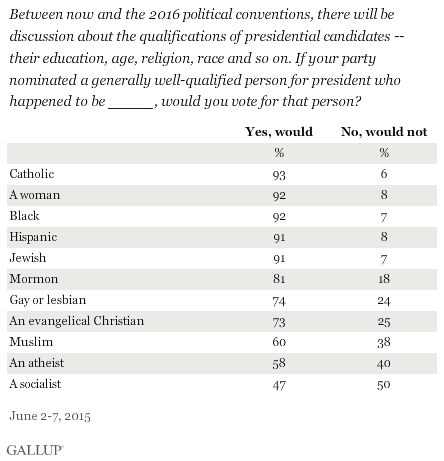
Between now and the 2016 political conventions, there will be discussion about the qualifications of presidential candidates -- their education, age, religion, race and so on. If your party nominated a generally well-qualified person for president who happened to be _____, would you vote for that person? June 2015 results

The self-made man:  Alexander Hamilton as immigrant and American hero.


IV.  INSTITUTIONS AND ELECTIONS

Ranking Presidents

The Separation of Powers

Congress and Bicameralism:


Federalism:  about 89,000 governments and about 513,000 elected officials

Federalism and ballot complexity

Voter turnout

Partisan Polarization

Parties and Campaigns:


"Those who profess to favor freedom and yet deprecate agitation, are men who want crops without plowing up the ground, they want rain without thunder and lightning. They want the ocean without the awful roar of its many waters." --Frederick Douglass

Free Speech:  the Unusual First Amendment

Support for Free Expression


Tuesday, March 17, 2015

American Exceptionalism: The Data

George Gao writes at Pew:
The differences between America and other nations have long been a subject of fascination and study for social scientists, dating back to Alexis de Tocqueville, the early 19th century French political thinker who described the United States as “exceptional.”
Nearly 200 years later, Americans’ emphasis on individualism and work ethic stands out in surveys of people around the world. When Pew Research Center surveyed people in 44 countries last spring, 57% of Americans disagreed with the statement “Success in life is pretty much determined by forces outside our control,” a higher percentage than most other nations and far above the global median of 38%.
True to the stereotype, surveys showed that Americans are more likely to believe that hard work pays off. When asked, on a scale of 0 to 10, about how important working hard is to getting ahead in life, 73% of Americans said it is was a “10” or “very important,” compared with a global median of 50% among the 44 nations.
...
In general, people in richer nations are less likely than those in poorer nations to say religion plays a very important role in their lives. But Americans are more likely than their counterparts in economically advanced nations to deem religion very important. More than half (54%) of Americans said religion was very important in their lives, much higher than the share of people in Canada (24%), Australia (21%) and Germany (21%), the next three wealthiest economies we surveyed from 2011 through 2013.
...
Americans are also more upbeat than people in other wealthy nations when asked how their day is going. While we ask this question to help respondents get more comfortable with the interviewer, it provides a glimpse into people’s moods and reveals a slightly negative correlation between those saying the day is a good one and per capita gross domestic product. About four-in-ten Americans (41%) described their day as a “particularly good day,” a much higher share than those in Germany (21%), the UK (27%) and Japan (8%).

Thursday, October 9, 2014

Individualism and Global Attitudes: the USA as an Outlier

Pew reports on a new global survey:
The survey also highlights how Americans are different from many others around the world on questions related to individualism, a value often associated with American exceptionalism. Fifty-seven percent of Americans disagree with the statement “Success in life is pretty much determined by forces outside our control,” a considerably higher percentage than the global median of 38%. Similarly, Americans place an especially strong emphasis on the value of hard work – 73% think it is very important to work hard in order to get ahead in life, compared with a global median of 50%.
Americans Stand Out on Individualism

Thursday, January 31, 2013

Majority Sees Government as a Threat

As we discuss in our chapter on citizenship and civic culture, Americans tend to distrust centralized power (see pp. 115-116 of the second edition.) In this light, the Pew Research Center reports:
As Barack Obama begins his second term in office, trust in the federal government remains mired near a historic low, while frustration with government remains high. And for the first time, a majority of the public says that the federal government threatens their personal rights and freedoms.
The latest national survey by the Pew Research Center for the People & the Press, conducted Jan. 9-13 among 1,502 adults, finds that 53% think that the federal government threatens their own personal rights and freedoms while 43% disagree.
In March 2010, opinions were divided over whether the government represented a threat to personal freedom; 47% said it did while 50% disagreed. In surveys between 1995 and 2003, majorities rejected the idea that the government threatened people’s rights and freedoms.
The growing view that the federal government threatens personal rights and freedoms has been led by conservative Republicans. Currently 76% of conservative Republicans say that the federal government threatens their personal rights and freedoms and 54% describe the government as a “major” threat. Three years ago, 62% of conservative Republicans said the government was a threat to their freedom; 47% said it was a major threat.
By comparison, there has been little change in opinions among Democrats; 38% say the government poses a threat to personal rights and freedoms and just 16% view it as a major threat.

Friday, January 18, 2013

Opinion on Limiting Power

As we discussed in our chapter on citizenship and civic culture, Americans have long been suspicious of concentrations of power.  Gallup reports that those suspicions are alive and well:
Americans continue to be worried about the effects of big companies and big government, with 35% saying they are very or somewhat satisfied with the size and influence of major corporations, and 36% saying they are very or somewhat satisfied with the size and power of the federal government. Both of these levels of satisfaction are up slightly from the last two years, but significantly below satisfaction levels recorded in the early years of the last decade, when satisfaction with government was generally higher than satisfaction with major corporations.
Americans are also suspicious of the entrenched incumbents that they reelect.  Gallup reports:
Even after the 2012 election in which Americans re-elected most of the sitting members of the U.S. House and Senate -- as is typical in national elections -- three-quarters of Americans say that, given the opportunity, they would vote "for" term limits for members of both houses of Congress.

Republicans and independents are slightly more likely than Democrats to favor term limits; nevertheless, the vast majority of all party groups agree on the issue. Further, Gallup finds no generational differences in support for the proposal.

These findings, from Gallup Daily tracking conducted Jan. 8-9, are similar to those from 1994 to 1996 Gallup polls, in which between two-thirds and three-quarters of Americans said they would vote for a constitutional amendment to limit the number of terms that members of Congress and the U.S. Senate can serve.
As in the past, they would also scrap the electoral college:
Americans are nearly as open to major electoral reform when it comes to doing away with the Electoral College. Sixty-three percent would abolish this unique, but sometimes controversial, mechanism for electing presidents that was devised by the framers of the Constitution. While constitutional and statutory revisions have been made to the Electoral College since the nation's founding, numerous efforts to abolish it over the last 200+ years have met with little success

Tuesday, December 4, 2012

The Translatlanic Values Gap

At the Pew Research Center, Richard Wike writes:
[W]hile the pervasive anti-Americanism of the Bush years has receded, the “values gap” between Americans and Europeans is alive and well. Polls consistently find a transatlantic divide when it comes to fundamental beliefs on a variety of political and cultural issues. Americans and Europeans view each other with less hostility today, but they still don’t see the world in the same way.
Take the issue of military force. Americans remain more inclined than Europeans to say it’s necessary to use military force to maintain order in the world. Meanwhile, they are significantly less likely than Europeans to believe that getting UN approval is necessary before using military force to deal with international threats. America’s willingness to “go it alone” in world affairs has become an ingrained piece of the country’s international image – and it hasn’t changed much in the Obama years. Majorities across Europe continue to see the U.S. as acting unilaterally, not taking into account the interests of other nations when making foreign policy.
...

Religion is another topic where Americans and Europeans hold very different views. In largely secular Western European nations such as Spain, Germany, Britain, and France, less than a quarter consider religion very important to their lives. Even in Poland, where Catholicism still plays an important role in public life, only 27% say religion is very important. By contrast, fully half of Americans hold this view. Similarly, solid majorities in the six EU nations surveyed by Pew in 2011 said you do not have to believe in God to be a moral person, but only 46% of Americans felt this way.
...
Individualism also continues to differentiate Americans and Europeans. Most Americans believe individuals largely control their own fate – just 36% agree with the statement “Success in life is pretty much determined by forces outside our control.” However, half or more in Germany, France, and Spain agree with this statement.
Europeans also believe in a very different relationship between the individual and the state. When asked which is more important, that everyone be free to pursue life’s goals without interference from the state, or that the state play an active role in society to guarantee that no one is in need, 58% of Americans choose the former. Majorities across Western and Eastern Europe, on the other hand, say making sure no one is in need should be a bigger priority.

Monday, September 24, 2012

Opinion on Government and the Economy

Previous posts have examined public opinion on economic policy and the role of government. The Pew Research Center finds that more voters still favor a smaller government with fewer services than a bigger government with more services. 
Currently, 56% say they would rather have a smaller government providing fewer services; 35% prefer a bigger government. These opinions have changed little over the course of Obama’s presidency. In October 2008, however, opinion was more evenly divided (46% smaller government vs. 40% bigger government).
Gallup finds something similar:
Americans say there is too much (47%) rather than too little (26%) government regulation of business and industry, with 24% saying the amount of regulation is about right. Americans have been most likely to say there is too much regulation of business over the last several years, but prior to 2006, Americans' views on the issue of government regulation of business were more mixed.

The collapse of Lehman Bros., the failure of the secondary mortgage market, and other business problems in 2008 and 2009 might have been expected to increase Americans' desire for more government control of business and industry. But that was not the case. Americans' views that there is too much government regulation in fact began to rise in 2009, perhaps in response to the new Obama administration and new business regulation policies such as Dodd-Frank, reaching an all-time high of 50% in 2011 before settling down slightly this year to 47%.
There has been little change since 2003 in the percentage of Americans saying there is too little regulation of business. The changes that have occurred in recent years have involved shifts between the percentages choosing the "too much" and "about right" alternatives.
The Reason-Rupe poll finds:
As the presidential candidates debate the role of government, the Reason-Rupe poll finds 55 percent of Americans believe the federal government has too much influence over their lives, 36 percent say the amount of influence is about right and just 7 percent say the government does not have enough influence.
Over two-thirds, 67 percent, of likely voters say it is not the government’s responsibility to reduce income differences between Americans, while 29 percent say it is the government’s responsibility. Similarly, 61 percent of likely voters tell Reason-Rupe that today’s levels of income inequality are an acceptable part of America’s economic system, 35 percent say income inequalities need to be fixed.

Today, 59 percent of voters believe all Americans have equal opportunities to succeed, whereas 39 percent do not believe everyone has equal opportunities.
When asked if they are better off than they were four years ago, 44 percent of likely voters feel they are better off, 41 percent say worse off.

A majority of Americans, 57 percent, support raising income tax rates on incomes over $250,000. However, the very same number—57 percent—says the top 5 percent of earners shouldn’t have to contribute more than 40 percent of the total federal income taxes paid to government. In 2009, the top 5 percent of earners contributed 59 percent of total federal income taxes paid.

Friday, May 11, 2012

Attitudes Toward the Rich

Our chapters on civic culture and economic policy discuss attitudes toward wealth. Previous posts noted that American want their government to stress economic growth over economic equality. In a similar vein, Gallup reports:
Despite the recent political emphasis on wealth inequality and the call for higher taxes on the rich, more than six in 10 Americans think the United States benefits from having a class of rich people, unchanged from 22 years ago.

The findings, based on a Gallup poll conducted May 3-6, 2012, reflect the first update of a question Gallup initially asked in May 1990. The remarkable similarity in Americans' views over this 22-year span shows that despite the recent economic recession and the renewed focus from the Obama administration on the unequal distribution of wealth in contemporary society, Americans' belief in the value of having the "rich among us" has not changed.
There are political differences in these views, as would be expected. A slim majority of Democrats say the U.S. benefits from having a class of rich people, while eight in 10 Republicans and almost six in 10 independents say the same.

Thursday, January 19, 2012

Anti-Bigness

As we point out in our chapter on civic culture, Americans have long had misgivings about concentrations of power, whether in big government or big business. Gallup provides new data to confirm the point:
Americans' satisfaction with the size and power of the federal government is at a record-low 29% and their satisfaction with the size and influence of major corporations remains near the all-time low at 30% -- making both highly susceptible targets for politicians and presidential candidates in this election year.

...
Republicans in particular are displeased with the size and power of the federal government, with 16% satisfied and 84% dissatisfied. Democrats are more positive about the federal government, but hardly overwhelmingly so, with 49% satisfied and 47% dissatisfied. The politically crucial group of independents is slightly more negative than the national average.
Democrats, as would be expected, are disproportionately displeased with the size and influence of major corporations, with 71% dissatisfied and 23% satisfied. Republicans break even in their views of major corporations, with 48% satisfied and the same percentage dissatisfied. Independents -- as was the case in their views of the federal government -- are slightly more negative than the national average.

Monday, December 12, 2011

Concern About Big Government

An earlier post noted a poll showing a majority of Americans believing that the federal government poses an immediate threat to the rights of Americans. Now, Gallup reports:
Americans' concerns about the threat of big government continue to dwarf those about big business and big labor, and by an even larger margin now than in March 2009. The 64% of Americans who say big government will be the biggest threat to the country is just one percentage point shy of the record high, while the 26% who say big business is down from the 32% recorded during the recession. Relatively few name big labor as the greatest threat.

Historically, Americans have always been more concerned about big government than big business or big labor in response to this trend question dating back to 1965. Concerns about big business surged to a high of 38% in 2002, after the large-scale accounting scandals at Enron and WorldCom. An all-time-high 65% of Americans named big government as the greatest threat in 1999 and 2000. Worries about big labor have declined significantly over the years, from a high of 29% in 1965 to the 8% to 11% range over the past decade and a half.
...

Americans' concerns about the threat of big government are near record-high levels. The Occupy Wall Street movement, focused on "fighting back against the corrosive power of major banks and multinational corporations," has drawn much attention and a large following. Still, the majority of Americans do not view big business as the greatest threat to the country when asked to choose among big business, big government, and big labor. In fact, Americans' concerns about big business have declined significantly since 2009.

Additionally, while Occupy Wall Street isn't necessarily affiliated with a particular party, its anti-big business message may not be resonating with majorities in any party. Republicans, independents, and now close to half of Democrats are more concerned about the threat of big government than that coming from big business.

Thursday, January 13, 2011

Violence and Freedom

In our chapter on political culture, we discuss the relationship between crime and American individualism (p. 136). David Paul Kuhn writes at RealClearPolitics:

Harvard's David Hemenway and UCLA doctorial student Erin Richardson studied 23 wealthy nations. The United States had one-third the total population but accounted for eight in 10 firearm deaths.

..

There is an unspoken willingness to tolerate our share of murders. American hyper-capitalism makes a similar tradeoff. We subscribe to social Darwinism to a degree unseen in Western Europe. It's one reason our economy is the fittest. But it also explains why the wealthiest nation in the world has a weaker social safety net than other developed countries. The conservative equation of freedom: lower taxes and fewer regulations on guns, equals more freedom. Liberals adhere to their own zealous formulation of American freedom. The left has won more civil rights for the mentally ill, but those rights will sometimes risk the public's welfare. It's this most-American value that Jonathan Franzen explores, within the ordinariness of middle class daily life, in his recent novel "Freedom."

The National Rifle Association has long understood that guns are best defended as tools of that value. It ran a multi-million dollar ad campaign to defeat Al Gore in the 2000 election. NRA billboards read: "Vote Freedom!"

As Franzen wrote in his novel, "The personality susceptible to the dream of limitless freedom is a personality also prone, should the dream ever sour, to misanthropy and rage." The Arizona tragedy is not an inevitable consequence of freedom. But the nation has accepted its American berserks as one of the prices of that freedom.

Friday, February 26, 2010

Concentration of Power

A new poll reinforces a point that we discuss in our chapter on civic culture. CNN reports:

A majority of Americans think the federal government poses a threat to rights of Americans, according to a new national poll.

Fifty-six percent of people questioned in a CNN/Opinion Research Corporation survey released Friday say they think the federal government's become so large and powerful that it poses an immediate threat to the rights and freedoms of ordinary citizens. Forty-four percent of those polled disagree.

Thursday, November 12, 2009

Opposition to Government Growth

In chapter 5 of our book, we discuss America's civic culture, including its tradition of individualism. In The New Republic, John Judis develops a similar theme:
Americans have supported, or have come to support, specific governmental remedies, such as Social Security, the minimum wage, and environmental and consumer protections. But, when a new program that expands government is proposed, they have displayed a general ideological predisposition against the power of government. As Obama tries to get his reform agenda through Congress, this predisposition is already proving to be a formidable obstacle.

Americans’ skepticism about government dates at least from the Revolution. In The Liberal Tradition in America, published in 1955, political scientist Louis Hartz described the Americans of 1776 as “Lockean liberals.” He was using the term “liberal” in its classic connotation--more like today’s free-market conservative or libertarian. Americans, he perceived, envisaged the state as strictly limited to protecting property relations among equal producers. They saw strong government--which they identified with the British crown--as a threat to economic and political freedom. Government, in Thomas Paine’s words, was a “necessary evil.”