Search This Blog

Showing posts with label congressional elections. Show all posts

Monday, August 3, 2026

The Paradox of Competition in House Elections

Many posts have discussed the state of Congress.

 Bruce Mehlman:

While overall House control is highly competitive, most individual House seats are not. Three straight Houses have seen single digit majorities, the first such run since the 1790s — even as the number of genuinely balanced districts has collapsed. (David Wasserman, Cook Political)


Monday, June 29, 2026

The Districts Are Too Damn Big

Many posts have discussed reapportionment and redistricting.  There have long been proposals to enlarge the House, thereby creating less populous districts.


Bruce Mehlman:

At the Constitutional Convention, George Washington spoke only once — to urge that representation remain close to the people, with a ratio of one representative for every 30,000. For more than a century, Congress followed that blueprint, with the House growing steadily from 65 members in 1789 to 435 by 1913. And then it stopped. Today, the actual ratio is roughly one representative for every 760,000 Americans. Is there any population at which a House district becomes too big to represent?


Tuesday, June 23, 2026

Polling Averages

Many posts have discussed the problems of surveying public opinion in the 21st century.

At Strength in Numbers, G. Elliott Morris discusses polling averages:

In our 50+1 generic ballot average, the published Democratic margin across polls read about D+7 a couple of weeks ago and reads D+5 today — a paper loss of two points that reader Tyler was asking about. But take the raw numbers for the parties (Democrats at 48.9% and Republicans at 43.4; a change from 49.1 and 42.4 two weeks ago), and the drop is only from D+6.7 to D+5.49 — a drop of about one point, not two.

Unfortunately, this incident of exaggeration is inherent to a tradeoff we made when deciding how to present the data. The general practice in polling analysis is not to show decimals on differences between percentages, because a number like “D+5.4” implies a precision the polls just don’t offer (see: 2024, 2020, 2016, etc). Or, if you’re going to publish decimals, you should include a margin of error either visually it in the text.

The tradeoff is that a small move in the margin between the parties sometimes looks bigger than it is, which is exactly what caught Tyler’s eye here. A 1-point change became 2.

...

But much of that 1-point decline is likely mechanical — a product of what data is available for the average. Over the last 2 weeks, new polls have tended to come from firms that lean to the right and produce numbers that are typically on the lower end for Democrats — Quantus Insights, McLaughlin & Associates (Trump’s pollster), and Morning Consult are a few examples. The average I publish for 50+1 tries to account for some of this availability bias (see my methodology) but there is only so much you can do if your trend is being bogged down by biased data. The high-quality New York Times/Siena poll that had Democrats up 10 points is now over a month old.

This is a dynamic of poll-aggregation that people often miss or ignore. A smart polling average can remove a lot of noise from polling data, but the tool inherently still wiggles around from sampling error and house effects even when the “truth” of public opinion is stable. A poll of 1,000 people has a margin of error of roughly three points — and you’re blending at best half a dozen of those from the last week, and usually less.

This doesn’t mean polls are useless — they are still the best tool we have for predicting elections, and the only one we have for directly measuring how people feel about public life. But it does mean that averages tend to move around somewhat predictably. So how much movement is worth paying attention to? Let’s boot up the historical polling averages and take a look.


Sunday, December 21, 2025

How Other Countries Draw Districts

Many posts have discussed reapportionment and redistricting -- much in the news now because of dueling gerrymanders in Texas and California.

Drew DeSilver at Pew:

So far this year, at least four states have redrawn their congressional districts with the stated goal of advantaging one party or the other in the 2026 midterms. Several others are exploring similar moves.

With this unprecedented wave of voluntary midcycle redistricting in the United States, we wondered how redistricting works in other democracies – and whether the process is as inherently political as it is in the U.S.

We analyzed how 107 democracies elect their national legislatures (mostly unicameral, or the “lower house” in bicameral systems). We found that only one other country uses the same redistricting approach as the U.S. – that is, single-member districts drawn mainly by state legislatures. That country is the Federated States of Micronesia, with a population of around 100,000, which was formerly administered by the U.S. under a United Nations trusteeship.
...

 In more than two-thirds of the democracies that heavily rely on single-member districts (29 of 42), special commissions or national election agencies have primary responsibility for drawing the lines. Lawmakers’ role, if any, is limited.


Sunday, August 31, 2025

Midcycle Redistricting

Many posts have discussed reapportionment and redistricting -- much in the news now because of looming gerrymanders in Texas and California.

DrewSeSilver at Pew:

Texas Republicans, at the urging of President Donald Trump, have redrawn their state’s congressional districts to give the GOP an advantage in next year’s midterm elections. The effort has led to a countermove by California to redraw its districts to give Democrats an edge. Several other states reportedly are considering similar moves.

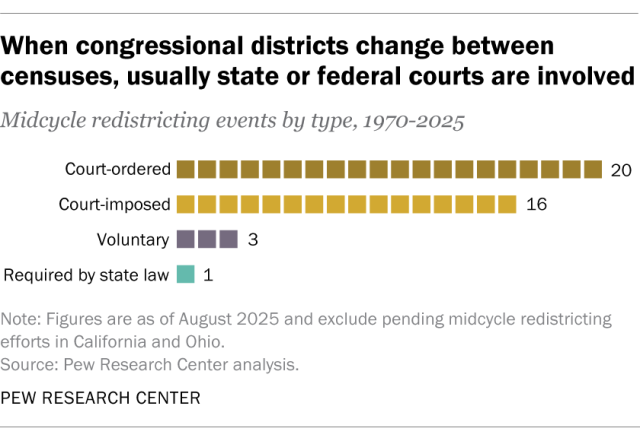
Midcycle redistricting efforts like the ones in Texas and California have, up to now, been extremely uncommon. Since 1970, only two states – Texas in 2003 and this year, and Georgia in 2005 – have voluntarily redrawn their congressional maps between censuses for partisan advantage, according to a new Pew Research Center analysis.


When midcycle redistricting occurs, it’s usually because courts have thrown out the previous maps for violating state or federal law. In fact, 36 of the 40 midcycle redistricting changes since 1970 have either been made in response to a court order (20) or imposed by a court itself (16). In addition to Texas and Georgia, California is also an exception: After the 1982 elections, lawmakers passed a revised version of the congressional map that voters had rejected in a referendum earlier that year.

A chart showing that when congressional districts change between censuses, usually state or federal courts are involved.

Friday, August 22, 2025

World War G

Many posts have discussed reapportionment and redistricting.

Laurel Rosenhall at NYT:
California leaders on Thursday approved a sweeping plan to elect more Democrats by redrawing congressional districts, delivering an immediate counterpunch to the gerrymandered map that Republicans in Texas are passing at the request of President Trump.

Gov. Gavin Newsom signed two redistricting bills that the Democratic-controlled Legislature sent to him earlier Thursday. He also declared a special election on Nov. 4 that will ask voters to grant final approval to the newly drawn congressional districts.

The moves will immediately thrust California into a feverish campaign with national implications as Democrats and Republicans vie for control of the House of Representatives through an extraordinary effort to redraw political maps in the middle of a decade. They will also put Mr. Newsom, a potential presidential candidate, at the forefront of a partisan fight against President Trump heading into the midterm election cycle.

Thursday, August 14, 2025

Measuring Gerrymandering

Many posts have discussed reapportionment and redistricting -- much in the news now because of looming gerrymanders in Texas and California.

Harvard economist Roland Fryer at NYT:
After months huddled around a whiteboard with a sharp graduate student, Richard Holden, fueled by too much bad Harvard Square coffee, we created a measure we call the “Relative Proximity Index.

Picture every voter as a dot on the state map. First, we pin down the geometric minimum — the most compact way to bundle those dots inside the state’s jagged borders into its exact number of congressional districts, each with equal population, whether that means wrapping around Florida’s panhandle or hugging Georgia’s slanted shoulder. Then we compare the map the legislature actually draws to that floor. The ratio is the Relative Proximity Index. An R.P.I. of 1 means you’ve hit the geometric ideal; an R.P.I. of 3 means voters within a district would live — on average — three times as far apart than necessary.
Sign up for the Opinion Today newsletter Get expert analysis of the news and a guide to the big ideas shaping the world every weekday morning. Get it sent to your inbox.

Since compactness isn’t the only legitimate redistricting criterion, we shouldn’t expect maps to hit 1.0. Lawmakers need room to respect county and city lines, comply with the Voting Rights Act and keep real neighborhoods intact. But compactness should be the starting point because it is neutral, measurable and easy to audit.

It subsumes contiguity (tight districts are, by construction, connected), discourages gratuitous splits of counties and cities, and helps protect genuine communities by forcing mapmakers to justify every detour. Start with the tightest lawful plan; if you deviate, say why, in public. As a rule: the bigger the R.P.I., the heavier the mapmaker’s thumb on the scale.

Our 50-state census of the 106th Congress — from 1999 through 2001 — turned up five of the least-compact maps: Tennessee (R.P.I. = 2.91), New Jersey (2.27), Texas (1.90), Massachusetts (1.87), and New York (1.83). To see what a strict maximal compactness rule would change, we looked at seat-vote curves — a standard political science tool showing how a party’s share of the statewide vote translates into seats — comparing current maps with compact redraws in California, New York, Pennsylvania and Texas.

Wednesday, August 6, 2025

World War Gerrymander

Many posts have discussed reapportionment and redistricting.

Joan Biskupic on the Rucho case:

The brazen partisan redistricting underway in Texas, with Republicans attempting to entrench themselves in office and Democrats weighing a counter-offensive in blue states, was greenlit by the US Supreme Court six years ago.

Chief Justice John Roberts, in an opinion for a 5-4 court, declared that federal judges could not review extreme partisan gerrymanders to determine if they violated constitutional rights.

Roberts’ opinion reversed cases that would have allowed such districts – drawn to advantage one political party over another irrespective of voters’ interests – to be challenged as violations of the First Amendment’s guarantee of free speech and association and the Fourteenth Amendment’s guarantee of equal protection.

The justices split among the familiar ideological lines, with the five conservatives ruling against challenges to partisan gerrymanders and the four liberals dissenting.

“Of all times to abandon the Court’s duty to declare the law, this was not the one,” dissenting justices warned in 2019, “The practices challenged in these cases imperil our system of government. Part of the Court’s role in that system is to defend its foundations. None is more important than free and fair elections.”

That decision in Rucho v. Common Cause has generated a new era of partisan rivalry with vast repercussions for American democracy. The decision resonates as profoundly as the Roberts Court’s decision last year in Trump v. United States, which granted presidents substantial immunity from criminal prosecution (also delivered among partisan lines).

And speaking of Common Cause...

Cameron Joseph at CSM:

The nation’s most prominent anti-gerrymandering organization is in the midst of a tense internal debate over whether to modify its position opposing all partisan redistricting, a remarkable development in response to a gerrymandering war that has broken out across the nation.

It’s a sign that after two decades of hard-won progress against partisan line-drawing, the movement is facing an existential crisis.

Common Cause has fought to bar gerrymandering through laws, referenda, and constitutional amendments for decades, battling both Democrats and Republicans in red and blue states to adopt measures to restrain lawmakers from drawing district lines that advantage their own party.

But on Monday night, after a meeting by the organization’s national governing board, the group’s president and CEO Virginia Kase SolomĂłn emailed organization leaders asking them not to make any new statements on gerrymandering until the board issued further guidance, which she said would come later this week. The request to stand down comes as Democrats in California are pushing to temporarily suspend the state’s independent redistricting commission to allow them to draw five or more new Democratic-leaning House districts. The move – which would undo anti-gerrymandering reforms that Common Cause helped make law in 2010 – is a response to Republicans’ aggressive mid-decade push to redraw state maps in Texas and elsewhere in their favor ahead of the 2026 midterm elections.

“While IRCs [independent redistricting commissions] remain our gold standard and will continue to be our position, the board is currently considering options as to how we will respond under these highly unusual circumstances,” Ms. SolomĂłn wrote in an email to the group’s leaders that was read to the Monitor by two separate sources who had received it.

“It’s certainly an inflection point for our organization,” one Common Cause staffer told the Monitor.


Wednesday, July 23, 2025

Change Elections

Many posts have discussed the state of Congress.

Bruce Mehlman:
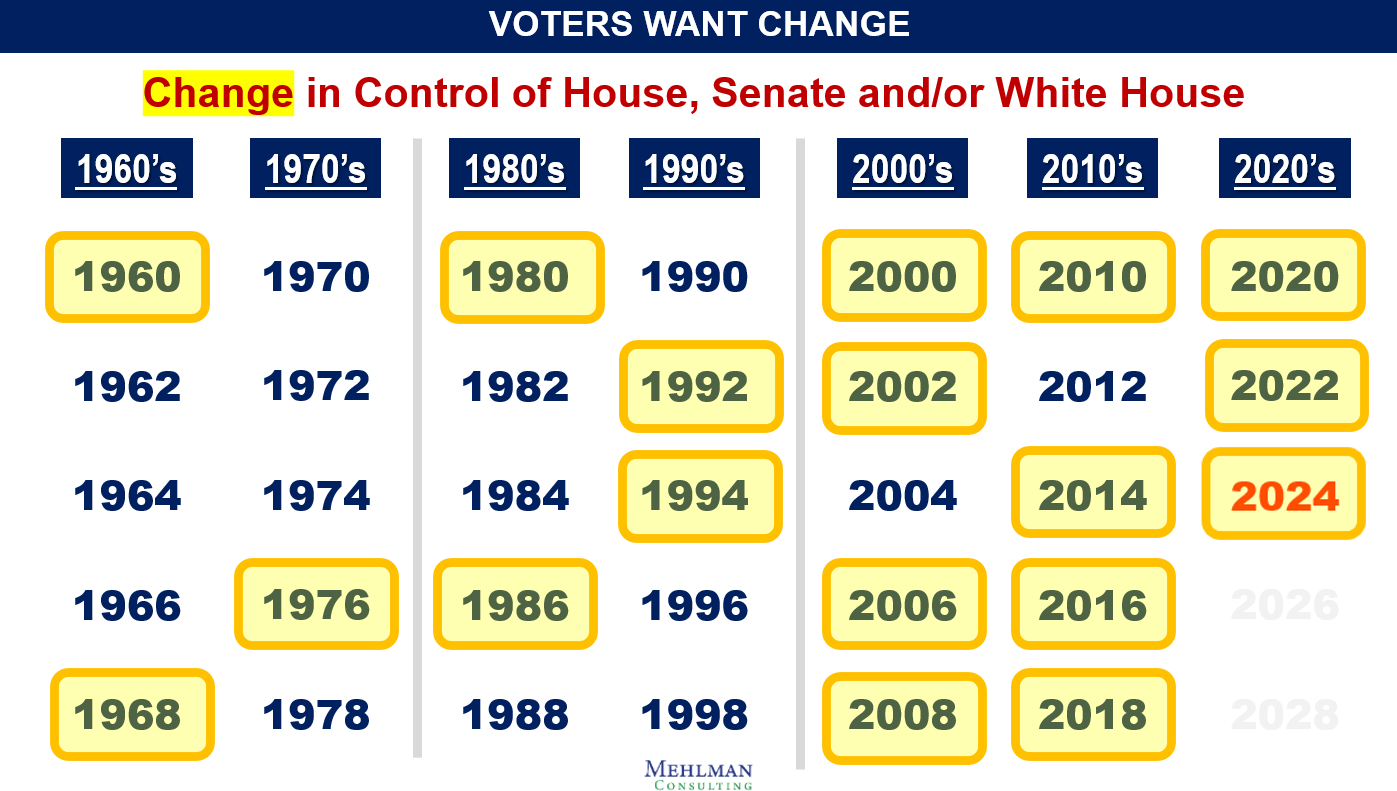
Voters in the U.S. and around the world are unhappy with the direction of their countries and keep voting to “throw the bums out”. In the U.S. there were just 3 change elections (where the party controlling the House, Senate and/or White House changed) out of the 10 held in the 1960’s & 70s. In the 80’s & 90’s it happened 4 times in 10 elections. This century? 11 out of 13 elections.

Sunday, December 22, 2024

Frequent Power Shifts, Narrow Majorities

Many posts have discussed the state of Congress.

Bruce Mehlman:


 Katherine Schaeffer at Pew:

Narrow partisan divides in the House and Senate have become the norm in recent decades, according to a Pew Research Center analysis of historical data going back to the 88th Congress (1963-65), the first Congress with 435 representatives and 100 senators. This analysis reflects the initial election results for each Congress and does not factor in any shifts during the session.
  • The largest majorities in the House and Senate during this stretch occurred in the 1960s. Both belonged to Democrats.Democrats held 68% of House seats in the 89th Congress (1965-67).
  • Democrats held 66% of Senate seats in the 88th Congress (1963-65).
Since then, the size of the majorities in both chambers has generally trended downward. By the late 1990s and early 2000s, the partisan split in both chambers hovered around 50-50. 


Sunday, February 4, 2024

People Dislike Congress, Like Their Own Member of Congress

 The old saying is that voters hate Congress and love their congressman.  Still true.  Jeffrey M. Jones at Gallup:

Fewer than four in 10 U.S. registered voters say President Joe Biden deserves to be reelected, while less than a quarter say the same about most members of the U.S. House. As is almost always the case, voters are more inclined to believe the U.S. representative from their own district should be returned to Congress, with 55% holding that view.


Bar chart. Registered voters' belief that federal officeholders deserve reelection. Fifty-five percent of voters say their representative in Congress deserves reelection, 38% say President Biden does, and 24% say most members of Congress do.
A table showing registered voters' beliefs that federal officeholders deserve reelection, by political party. Majorities of Democrats say their representative in Congress and President Biden deserve reelection. Majorities of Republicans say their member of Congress deserves reelection.

Saturday, April 15, 2023

Class Inversion and House Districts

  Stef Kight at Axios:

Nine of the top 10 wealthiest congressional districts are represented by Democrats, while Republicans now represent most of the poorer half of the country, according to median income data provided by Rep. Marcy Kaptur's (D-Ohio) office.

Why it matters: The last several decades have ushered in a dramatic political realignment, as the GOP has broadened its appeal to a more diverse working class and Democrats have become the party of wealthier, more-educated voters.
  • "Republicans were the party of the country club, and they're increasingly the party of country," lobbyist and political analyst Bruce Mehlman told Axios.
  • "We have seen an inversion of Democrat and Republican shares of the highest- and lowest-income districts — and the highest and lowest college degree-holding districts," Cook Political Report's Dave Wasserman told Axios.
By the numbers: 64% of congressional districts with median incomes below the national median are now represented by Republicans — a shift in historical party demographics, the data shows.

Wednesday, December 7, 2022

51-49

The victory of Senator Raphael Warnock (D-GA) gives Democrats a 51-49 majority in the Senate.  

Louis Jacobson and Yacob Reyes at PolitiFact:

During the last Congress, when the Senate had a 50-50 tie broken by Harris, the chamber's committees were evenly split, sometimes forcing Democrats to use special maneuvers to bring nominations to the floor when such actions stalled in committee.

Now, Democrats can assume greater control of Senate committees, allowing them a freer hand in advancing Biden's picks, avoiding impasses on legislation and issuing subpoenas.

Senate Majority Leader Chuck Schumer, D-N.Y., told NBC in November that a larger majority would allow the Biden administration to build on its "historic pace of judicial confirmations and ensure the federal bench better reflects the diversity of America."

The ratio on committees is not fixed under Senate rules. Rather, it results from negotiations between the majority and minority leaders. However, in recent 51-49 chambers, such as those from 2003 to 2005 and 2007 to 2009, the majority party typically held a one-seat advantage on committees, according to the Congressional Research Service, a public policy institute.

Democrats could use their majority on committees to continue the current House investigation into the Jan. 6, 2021, attack on the U.S. Capitol or launch new ones, Axios reported. The House’s Jan. 6 committee is scheduled to end in January after releasing its final report.

Sunday, November 13, 2022

A Most Unusual Midterm

The 2022 midterm is most unusual. The vote count will continue for many days to come, but it is clear that the Democrats have at least broken even in the Senate and will at most lose a few seats in the House. There is even a chance that they could retain control.  These outcomes represent a departure from historical patterns.