Bessette Pitney Text

Bessette/Pitney’s AMERICAN GOVERNMENT AND POLITICS: DELIBERATION, DEMOCRACY AND CITIZENSHIP reviews the idea of "deliberative democracy." Building on the book, this blog offers insights, analysis, and facts about recent events.

Search This Blog

Showing posts with label disaster. Show all posts

Wednesday, July 22, 2026

"Victim" Group Is a Front for Utility Companies

A number of posts have discussed Astroturf, i.e., artificial grassroots lobbying.  Interest groups create front groups to disguise their true aims.

Melody Petersen at LAT:
A group claiming to represent California fire survivors began sending mailers and paying for social media ads this spring, calling on lawmakers to take action to reduce the rising cost of wildfires.

“Contact your legislator and tell them we need to fix our wildfire problem to make California more affordable,” said a mailer sent this month by the group called Wildfire Victims First.

“Stand with wildfire victims,” the group’s website states, urging people to join its cause.

The group was created with money from California’s three biggest for-profit electric utilities — Southern California Edison, Pacific Gas & Electric and San Diego Gas & Electric — which government investigators found ignited at least six of the state’s 20 most destructive wildfires.

The corporate campaign has angered wildfire survivors, including some of the thousands of families in Altadena who lost their homes in last year’s Eaton fire. The blaze, which killed 19 people, remains under investigation. Edison has said its century-old transmission line is the likely cause.

The utility-funded group is lobbying in Sacramento for proposals in a study that Gov. Gavin Newsom ordered to guide lawmakers in writing wildfire-related bills. The study largely ignored utilities’ responsibility for igniting fires.

Among its dozens of proposals is limiting amounts victims can get for pain and suffering, capping fees for attorneys representing survivors and requiring property insurers to bear more of the cost of utility-sparked fires.

”Each proposal would shift more of the cost of catastrophic fires away from the corporations responsible and onto survivors, policyholders, taxpayers, and the public,” wrote Joy Chen of Every Fire Survivor’s Network in a letter to Newsom this week.

Chen wrote that the industry-funded Wildfire Victims First campaign “created the appearance that wildfire survivors supported” the findings of the study. “We do not.”
Posted by Pitney at 5:21 AM
Labels: California, disaster, government, interest groups, political science, politics

Thursday, December 18, 2025

Failed State: Wildfire Recovery

Many posts have discussed disasters.

 David Zahniser at LAT:

It was supposed to be a speech with a clear message of hope for survivors of the Palisades fire.

In her State of the City address in April, Los Angeles Mayor Karen Bass called for a law exempting fire victims from construction permit fees — potentially saving them tens of thousands of dollars as they rebuild their homes.

Eight months later, the City Council is still debating how much permit relief the city can afford. Palisades residents have been left hanging, with some blaming Bass for failing to finalize a deal.
Advertisement


“This should have been pushed, and it wasn’t pushed,” said electrician Tom Doran, who has submitted plans to rebuild his three-bedroom home. “There was no motor on that boat. It was allowed to drift downstream.”

Since the Jan. 7 fire destroyed thousands of homes, Bass has been announcing recovery strategies with great fanfare, only for them to get bogged down in the details or abandoned altogether.


After two of the most destructive fires in the state’s history, The Times takes a critical look at the past year and the steps taken — or not taken — to prevent this from happening again in all future fires.
Read the stories

At one point, she called for the removal of traffic checkpoints around Pacific Palisades, only to reverse course after an outcry over public safety. She pushed tax relief for wildfire victims in Sacramento, only to abruptly pull the plug on her bill. Her relationship with Steve Soboroff, her first and only chief recovery officer, quickly unraveled over pay and other issues. He left after a 90-day stint.

Critics in and outside the Palisades say the mayor’s missteps have undermined public confidence in the rebuilding process. They have also made her more politically vulnerable as she ramps up her campaign for a second term.


Posted by Pitney at 5:28 AM
Labels: bureaucracy, California, disaster, government, Los Angeles, political science, politics

Thursday, July 10, 2025

FEMA Red Tape Hampers Disaster Response

Previous posts have discussed budget cuts.

Gabe Cohen and Michael Williams, CNN:
As monstrous floodwaters surged across central Texas late last week, officials at the Federal Emergency Management Agency leapt into action, preparing to deploy critical search and rescue teams and life-saving resources, like they have in countless past disasters.

But almost instantly, FEMA ran into bureaucratic obstacles, four officials inside the agency told CNN.

As CNN has previously reported, Homeland Security Secretary Kristi Noem — whose department oversees FEMA — recently enacted a sweeping rule aimed at cutting spending: Every contract and grant over $100,000 now requires her personal sign-off before any funds can be released.

For FEMA, where disaster response costs routinely soar into the billions as the agency contracts with on-the-ground crews, officials say that threshold is essentially “pennies,” requiring sign-off for relatively small expenditures.

In essence, they say the order has stripped the agency of much of its autonomy at the very moment its help is needed most.

“We were operating under a clear set of guidance: lean forward, be prepared, anticipate what the state needs, and be ready to deliver it,” a longtime FEMA official told CNN. “That is not as clear of an intent for us at the moment.”

For example, as central Texas towns were submerged in rising waters, FEMA officials realized they couldn’t pre-position Urban Search and Rescue crews from a network of teams stationed regionally across the country.

In the past, FEMA would have swiftly staged these teams, which are specifically trained for situations including catastrophic floods, closer to a disaster zone in anticipation of urgent requests, multiple agency sources told CNN.

But even as Texas rescue crews raced to save lives, FEMA officials realized they needed Noem’s approval before sending those additional assets. Noem didn’t authorize FEMA’s deployment of Urban Search and Rescue teams until Monday, more than 72 hours after the flooding began, multiple sources told CNN.
Posted by Pitney at 5:57 AM
Labels: bureaucracy, disaster, FEMA, government, political science, politics, Texas

Sunday, July 6, 2025

Cutting the National Weather Service

Previous posts have discussed budget cuts.

Christopher Flavelle at NYT:
Crucial positions at the local offices of the National Weather Service were unfilled as severe rainfall inundated parts of Central Texas on Friday morning, prompting some experts to question whether staffing shortages made it harder for the forecasting agency to coordinate with local emergency managers as floodwaters rose.

Texas officials appeared to blame the Weather Service for issuing forecasts on Wednesday that underestimated how much rain was coming. But former Weather Service officials said the forecasts were as good as could be expected, given the enormous levels of rainfall and the storm’s unusually abrupt escalation.

The staffing shortages suggested a separate problem, those former officials said — the loss of experienced people who would typically have helped communicate with local authorities in the hours after flash flood warnings were issued overnight.
Posted by Pitney at 6:36 AM
Labels: budget, bureaucracy, disaster, government, political science, politics

Sunday, January 12, 2025

Los Angeles on Fire

States with a smaller population than Los Angeles County ! @GavinNewsom @fema @R5_Fire_News pic.twitter.com/Ebxv6KygpA

— Russel L. Honore' (@ltgrusselhonore) January 12, 2025


Maanvi Singh and Dani Anguiano at The Guardian:

The horrors that unfolded around US’s second largest city this week were shocking – but they were also, to some extent, expected. The blazes are part of the wildfire crisis that’s been unfolding in the American west for the last decade, from the 2017 fire siege in California’s Bay area to the 2018 blaze that destroyed Paradise and killed 85 people.

The fires that ravaged Los Angeles unfolded on a stunning landscape that is prone to burn, yet dotted with thousands of homes built over the years. Hurricane-force winds barreled through an area that hadn’t seen substantial rain in months, leading to massive conflagrations, fanned by hurricane-force gusts. It created a firestorm that spread at a rate that far exceeded firefighters’ ability to respond.

Firefighting forces across the state are deeply understaffed and have been struggling for years to battle the barrage of extreme wildfires. The 9,000 firefighters in Los Angeles county – including crews with the county’s fire department and 29 other fire agencies – were overwhelmed by the size and ferocity of the wildfires across the region, calling for aid from neighboring counties and states.

Infrastructure failed, too. “This is like a third world country,” said Rick Caruso, the billionaire real estate developer who lost the mayoral race to Bass, calling into a local radio station. Caruso was referring to reports that water hydrants in the Pacific Palisades, where his daughter lost her home, ran dry. A Los Angeles Times report that a massive reservoir in the Pacific Palisades was closed for repairs and empty at the time of the fire has raised further questions.

The city did, in fact, have enough water, but the system was not built for fighting multiple infernos. The LA department of water and power (LADWP) said that fire crews drew so much water, so fast in the initial hours of the fight, that the tanks that maintain water pressure to help supplies travel uphill to hydrants were strained.

“We pushed the system to the extreme,” the LADWP CEO Janisse Quiñones said in a news conference. “Four times the normal demand was seen for 15 hours straight, which lowered our water pressure.” Crews instead had to rely on water trucks.
Posted by Pitney at 4:55 PM
Labels: California, disaster, Fire, firefighters, local government, Los Angeles, political science, politics

Wednesday, October 9, 2024

Hurricanes, Climate Change, and Public Policy

  A number of posts have discussed climate change and hurricanes.

Florida is suffering the effects of Hurricanes Helene and Milton: Carolyn Gramling at Science News:
The rapid intensifications of both storms were fueled by the Gulf’s extremely warm water. Developing tropical storms can suck up heat from warm seawater, dragging the humid air upward where it condenses, releasing that heat into the storm’s core. As the storm moves forward, it pumps more and more water and heat into the air, and the spiraling winds will move faster and faster. Milton’s particularly explosive rate of growth may also be linked to its relatively compact size, compared with Helene (SN: 9/27/24).

Two separate reports published this week find that those warm Gulf waters were made hundreds of times more likely by human-caused climate change.

An analysis by the international World Weather Attribution, or WWA, initiative, released October 9, analyzed the role of climate change in contributing to Hurricane Helene’s intensification and its torrential rainfall, including as it moved inland across the Southern Appalachian Mountains.

Gulf of Mexico sea surface temperatures in the path of the storm were, on average, about 1.26 degrees Celsius (2.3 degrees Fahrenheit) warmer than they would have been in a world without climate change, the WWA researchers found. Or, to put it another way, the anomalously high temperatures along Helene’s path from development to landfall were made 200 to 500 times more likely due to climate change.
...
Climate Central, based in Princeton, N.J., contributed to the WWA’s sea surface temperature analysis for Helene. And, in a separate alert released October 7, Climate Central reported that elevated sea surface temperatures in the southwestern Gulf of Mexico were also behind the “explosive” increase in intensity of Hurricane Milton. The analysis found that the sea surface temperatures in the Gulf were made 400 to 800 times more likely over the past two weeks due to human-caused climate change
Arian Campo-Flores, Deborah Acosta,and  Eric Niiler at WSJ:
The Tampa and St. Petersburg metro area is the most vulnerable to flooding damage in the U.S., according to a 2015 study by risk modeler Karen Clark & Co. Among the reasons the report cited: a shallow continental shelf off the coast and a funnel effect in Tampa Bay that together create the potential for a huge buildup of water that can inundate neighborhoods.

In addition, the metro area has experienced a building boom in recent decades that has sent the population soaring to about 3.2 million. Much of the development is on low-lying ground, with poorly developed drainage systems. A third of the area’s residents live within storm-surge zones.

“It’s the recipe for a huge storm-surge disaster,” said Jeff Masters, a former hurricane scientist at the National Oceanic and Atmospheric Administration and now a contributor at Yale Climate Connections, a news service.
In 2010, the Tampa Bay Regional Planning Council drew up the Tampa Bay Catastrophic Plan, in which a hypothetical Category 5 storm dubbed “Hurricane Phoenix” hit downtown Tampa with 160 mph winds and a 26-foot storm surge. The study projected that the city would have about 2,000 deaths and nearly $250 billion in damage.

In Tampa Bay, nearly 17,000 commercial properties and apartment buildings spanning 182 million square feet are in areas at high risk of flooding, according to real-estate data company CoStar Group. Billions of dollars of private and public funds have been invested in the redevelopment of downtown Tampa’s waterfront in recent decades. Many of these buildings are in vulnerable low-lying areas, according to data from CoStar.

Newer construction that was built to Florida’s current stringent building codes should stand up well to hurricane-force winds, storm specialists say. Other, more-established neighborhoods with older structures, however, are more susceptible.
Posted by Pitney at 4:26 AM
Labels: climate change, disaster, Florida, local government, state government

Wednesday, September 6, 2023

Insurance, Disaster, and Climate Change

 Jacob Bogage at WP:

In the aftermath of extreme weather events, major insurers are increasingly no longer offering coverage that homeowners in areas vulnerable to those disasters need most.

At least five large U.S. property insurers — including Allstate, American Family, Nationwide, Erie Insurance Group and Berkshire Hathaway — have told regulators that extreme weather patterns caused by climate change have led them to stop writing coverages in some regions, exclude protections from various weather events and raise monthly premiums and deductibles.

Major insurers say they will cut out damage caused by hurricanes, wind and hail from policies underwriting property along coastlines and in wildfire country, according to a voluntary survey conducted by the National Association of Insurance Commissioners, a group of state officials who regulate rates and policy forms


 Robert Gebelhoff at WP:

More than 30 insurers have left the state or limited their coverage options in the past three years, and more are expected to leave soon. That’s partly due to an insurance scam in the state that has tied up insurers in frivolous, expensive litigation, which the state government enacted legislation to address. But the much larger problem — that powerful hurricanes are becoming more frequent — looms large.

With fewer coverage options, Florida homeowners are scrambling to find affordable policies. The state-backed Citizens Property Insurance, ostensibly a last-resort option, is now Florida’s largest home insurer, stressing the company’s solvency. Some Floridians have taken the much riskier route of going without insurance, setting up the local economy for serious pain the next time a powerful storm hits.

And it’s not just Florida. In California, worsening wildfires have also driven insurers from the state or forced them to scale back policies. Residents of Washington, Montana and Colorado are watching their coverage options shrink, too.


Posted by Pitney at 5:55 AM
Labels: climate change, disaster, Florida, government, insurance, political science, politics

Thursday, August 12, 2021

Masks in 1918

Many posts have discussed COVID, vaccines, and masks.

We have been here before.

 J. Alexander Navarro at The Conversation:

In mid-October of 1918, amidst a raging epidemic in the Northeast and rapidly growing outbreaks nationwide, the United States Public Health Service circulated leaflets recommending that all citizens wear a mask. The Red Cross took out newspaper ads encouraging their use and offered instructions on how to construct masks at home using gauze and cotton string. Some state health departments launched their own initiatives, most notably California, Utah and Washington.

Nationwide, posters presented mask-wearing as a civic duty – social responsibility had been embedded into the social fabric by a massive wartime federal propaganda campaign launched in early 1917 when the U.S. entered the Great War. San Francisco Mayor James Rolph announced that “conscience, patriotism and self-protection demand immediate and rigid compliance” with mask wearing. In nearby Oakland, Mayor John Davie stated that “it is sensible and patriotic, no matter what our personal beliefs may be, to safeguard our fellow citizens by joining in this practice” of wearing a mask.

Health officials understood that radically changing public behavior was a difficult undertaking, especially since many found masks uncomfortable to wear. Appeals to patriotism could go only so far. As one Sacramento official noted, people “must be forced to do the things that are for their best interests.” The Red Cross bluntly stated that “the man or woman or child who will not wear a mask now is a dangerous slacker.” Numerous communities, particularly across the West, imposed mandatory ordinances. Some sentenced scofflaws to short jail terms, and fines ranged from US$5 to $200.
Posted by Pitney at 6:23 AM
Labels: civic duty, coronavirus, disaster, government, health, pandemic, patriotism, political science, politics

Saturday, March 28, 2020

Congress and the 1918-19 Pandemic

From the House historian:
October 07, 1918 On this date, the House public galleries were closed due to the severity of the Spanish influenza pandemic. According to some modern estimates, more than 50 million persons perished worldwide in the 1918–1919 outbreak; most sources attribute approximately 675,000 deaths in the U.S. alone to the Spanish flu. Washington, D.C., swollen by an influx of government workers during the First World War, was particularly hard hit. Medical facilities were stretched beyond capacity. Four hundred deaths were reported in the District of Columbia during the second week of October; 730 were reported the following week. During an abbreviated session on October 7, with many Members absent because of sickness, Henry T. Rainey of Illinois addressed the House on the necessity of closing the galleries, where large crowds often were closely confined, to prevent the spread of the disease. “Mr. Speaker, it is matter of common knowledge that an epidemic of alarming proportions is prevailing throughout the country,” Rainey said. “Out of an abundant precaution the Senate has ordered the galleries closed, which action, I understand, meets with the approval of the medical authorities, and so I ask unanimous consent that the Speaker be instructed to close the galleries of this House until further action shall be taken by the House.” The motion was approved without objection. The House did not stop operating at the peak of the flu outbreak during October, but its schedule was affected. Until the middle of the month, it usually stood in recess punctuated by brief pro forma sessions that often lacked quorums necessary to conduct business. The closure of the public galleries while the House met was exceedingly unusual—as was the length of the closure. The House and Senate galleries did not reopen until November 4, after the flu had largely run its course in the capital.
Posted by Pitney at 8:15 AM
Labels: Congress, disaster, government, health, political science, politics

Sunday, March 15, 2020

Six Principles of Crisis and Emergency Communication

The Centers for Disease Control’s (CDC) Crisis andEmergency Risk Communication (CERC) manual:
  1. Be First: Crises are time-sensitive. Communicating information quickly is crucial. For members of the public, the first source of information often becomes the preferred source. 
  2. Be Right: Accuracy establishes credibility. Information can include what is known, what is not known, and what is being done to fill in the gaps. 
  3. Be Credible: Honesty and truthfulness should not be compromised during crises. 
  4. Express Empathy: Crises create harm, and the suffering should be acknowledged in words. Addressing what people are feeling, and the challenges they face, builds trust and rapport.
  5. Promote Action: Giving people meaningful things to do calms anxiety, helps restore order, and promotes some sense of control. 
  6. Show Respect: Respectful communication is particularly important when people feel vulnerable. Respectful communication promotes cooperation and rapport. 
Posted by Pitney at 6:05 AM
Labels: coronavirus, disaster, emergency, government, mass media, news media, political science, politics

Friday, November 1, 2019

Disaster Declarations

Philip Bump at WP:
As the East Coast was keeping an eye on the fate of the Nationals and the fate of the nation, California was on fire.

Not all of California, but a lot of it, and not for the first time in recent years. Fires burned in wine country in the north, and fires burned near museums in the south. Tens of thousands of people went without power in the hope that shutting down electrical lines would prevent fires from breaking out with fire-favorable weather looming; to the extent that it worked that strategy didn’t prevent the Golden State from burning.

Since 1960, counties have been the focus of disaster declarations by the federal government more than 50,000 times. No individual county has had more such declarations than Los Angeles County, which has seen 72 such declarations over that period — more than one a year.
...
 The publicly available data from FEMA (which predate FEMA’s own creation) shows how the number of declarations began to surge in about 1990, mostly as a function of the number of severe storms that prompt disaster declarations. This isn’t necessarily a function of more storms and may reflect a shift in the number of declarations issued. It is the case, though, that the number of heavy precipitation storms has increased across the United States in recent years, a trend tied to the warming climate.
Posted by Pitney at 6:05 AM
Labels: California, climate change, disaster, FEMA, government, political science, politics

Saturday, September 28, 2019

Moving from Puerto Rico

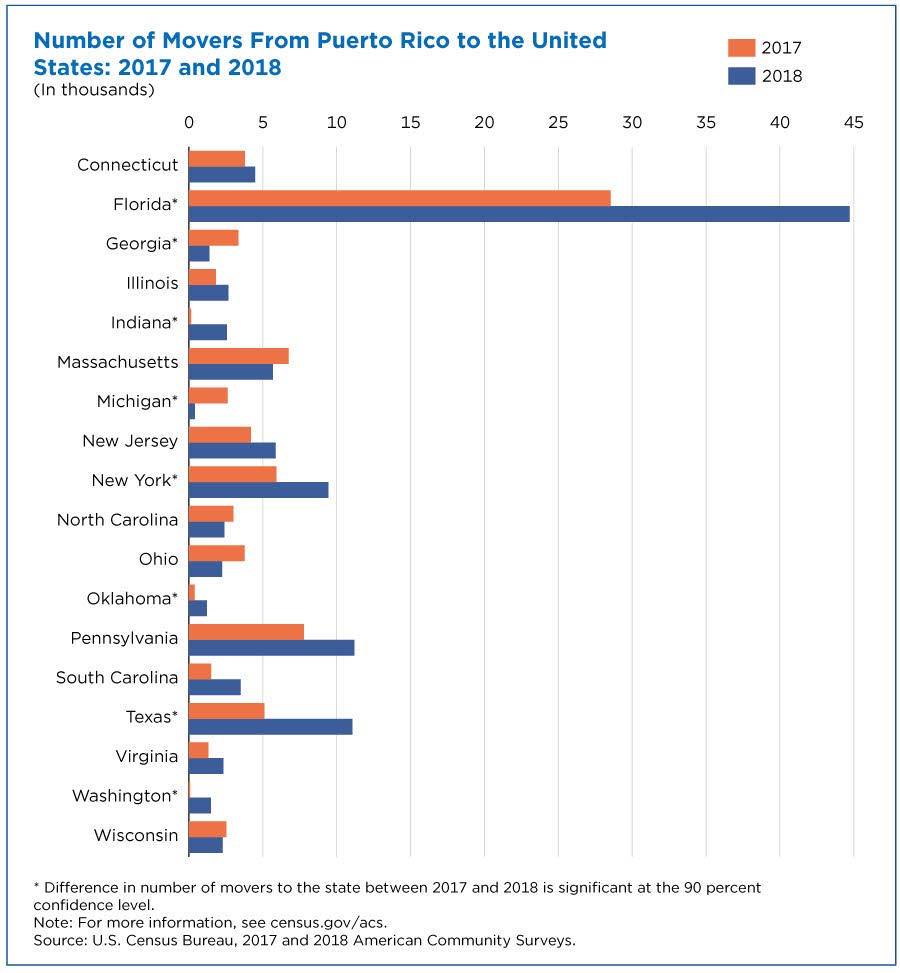
Hurricane Maria and the botched federal response have caused many Puerto Ricans to move to the US mainland. Brian Glassman at the Census Bureau:
The number of people living in Puerto Rico decreased by 142,000 (4.4%) from 3,337,000 in 2017 to 3,195,000 in 2018.
The number of movers from the territory to the mainland United States increased by more than a third in 2018. About 133,500 people moved, up 36.9% from 97,500 movers the year before.

More than half moved to the South and more than a quarter moved to the Northeast. Their destinations across the United States shifted from 2017 with higher growth rates in the West and South than in the Northeast or Midwest.
Puerto Ricans are overwhelmingly Democratic, so the movement could shift electoral politics in several states, especially Florida.

 
Posted by Pitney at 1:18 PM
Labels: 2020 election, demographics, disaster, government, political science, politics, Puerto Rico

Wednesday, September 12, 2018

The Disasters of 2017

BREAKING: What may be millions of water bottles. meant for victims of Hurricane Maria, have been sitting on a runway in Ceiba, Puerto Rico, since last year, according to @FEMA, which confirmed the news to me, late tonight, after pictures, posted today on social media, went viral. pic.twitter.com/jidGJAvCyJ
— David Begnaud (@DavidBegnaud) September 12, 2018

From the Government Accountability Office:
The federal government provided significant support to Puerto Rico and the U.S. Virgin Islands in response to Hurricanes Irma and Maria, but faced numerous challenges that complicated response efforts. FEMA efforts in Puerto Rico alone were the largest and longest single response in the agency's history. As of April 2018, FEMA had obligated over $12 billion for response and recovery for Hurricane Maria (see figure below) reflecting the scale and complexity of efforts given the widespread damage. FEMA tasked federal agencies with over 1,000 response mission assignments for Hurricanes Maria and Irma in the territories at a cost of over $5 billion, compared to about 400 such assignments for Hurricanes Harvey and Irma and the California wildfires combined. For example, FEMA assigned the U.S. Army Corps of Engineers the mission to install over 1,700 emergency electricity generators in Puerto Rico, compared to the 310 for the response to Hurricane Katrina.

Nevertheless, GAO found that FEMA faced a number of challenges that slowed and complicated its response efforts to Hurricane Maria, particularly in Puerto Rico. Many of these challenges were also highlighted in FEMA's own 2017 hurricane after action report, including:
  • the sequential and overlapping timing of the three hurricanes—with Maria being the last of the three—caused staffing shortages and required FEMA to shift staff to the territories that were already deployed to other disasters;
  • logistical challenges complicated efforts to deploy federal resources and personnel quickly given the remote distance of both territories; and
  • limited preparedness by the U.S. Virgin Islands and Puerto Rico for a Category 5 hurricane and incapacitation of local response functions due to widespread devastation and loss of power and communications led FEMA to assume response functions that territories would usually perform themselves.
The 2017 hurricanes and wildfires highlighted some longstanding issues and revealed other emerging response and recovery challenges. For example, the concurrent timing and scale of the disaster damages nationwide caused shortages in available debris removal contractors and delays in removing disaster debris—a key first step in recovery. In addition, FEMA's available workforce was overwhelmed by the response needs. For example, at the height of FEMA workforce deployments in October 2017, 54 percent of staff were serving in a capacity in which they did not hold the title of “Qualified”—according to FEMA's qualification system standards—a past challenge GAO has identified. FEMA officials noted that staff shortages, and lack of trained personnel with program expertise led to complications in its response efforts, particularly after Hurricane Maria.
Posted by Pitney at 5:39 AM
Labels: California, disaster, government, politics. political science, Puerto Rico, scandal, Texas

Thursday, August 30, 2018

Hurricane Deaths in Puerto Rico

From the GW Milken Institute SPH:
In an independent report published today, researchers at the George Washington University Milken Institute School of Public Health (GW Milken Institute SPH) estimated there were 2,975 excess deaths in Puerto Rico due to Hurricane Maria from September 2017 through the end of February 2018. The researchers also identified gaps in the death certification and public communication processes and went on to make recommendations that will help prepare Puerto Rico for future hurricanes and other natural disasters.
Hurricane Maria hit Puerto Rico in September 2017 and, soon after, the government of Puerto Rico determined that 64 people had died. Later, unofficial investigations and independent scientific studies suggested that the death toll was likely much higher. To get a more accurate and rigorous assessment, the Governor of Puerto Rico commissioned an independent study from GW Milken Institute SPH.
Today, GW Milken Institute SPH, in collaboration with researchers from the University of Puerto Rico Graduate School of Public Health, delivered on that request.
“The results of our epidemiological study suggest that, tragically, Hurricane Maria led to a large number of excess deaths throughout the island. Certain groups – those in lower income areas and the elderly – faced the highest risk,” said Carlos Santos-Burgoa, MD, MPH, PhD, the principal investigator of the project and a professor of global health at GW Milken Institute SPH. “We hope this report and its recommendations will help build the island’s resilience and pave the way toward a plan that will protect all sectors of society in times of natural disasters.”
The epidemiological study found:
  • An estimated 2,975 excess deaths related to Hurricane Maria from September 2017 to February 2018, a number that is 22 percent higher than the number of deaths that would have been expected during that period in a year without the storm.
  • All municipalities in Puerto Rico were hit hard by the hurricane and the aftermath, however, certain groups faced the biggest risk. In fact, this study showed that the risk of dying over this period was the highest (60 percent higher than expected) for people living in the poorest municipalities – and that the elevated risk persisted beyond February 2018.
  • Over this same period, older male Puerto Ricans had a risk of death that was 35 percent higher than expected and that elevated risk continued past the study observation period.
Posted by Pitney at 5:32 AM
Labels: death, disaster, government, political science, politics, Puerto Rico, statistics

Wednesday, May 30, 2018

Hurricane Deaths in Puerto Rico: 70x the Official Estimate

Nishant Kishore and colleagues have an article at The New England Journal of Medicine titled "Mortality in Puerto Rico after Hurricane Maria."  The abstract:
BACKGROUND
Quantifying the effect of natural disasters on society is critical for recovery of public health services and infrastructure. The death toll can be difficult to assess in the aftermath of a major disaster. In September 2017, Hurricane Maria caused massive infrastructural damage to Puerto Rico, but its effect on mortality remains contentious. The official death count is 64.
METHODS
Using a representative, stratified sample, we surveyed 3299 randomly chosen households across Puerto Rico to produce an independent estimate of all-cause mortality after the hurricane. Respondents were asked about displacement, infrastructure loss, and causes of death. We calculated excess deaths by comparing our estimated post-hurricane mortality rate with official rates for the same period in 2016.
RESULTS
From the survey data, we estimated a mortality rate of 14.3 deaths (95% confidence interval [CI], 9.8 to 18.9) per 1000 persons from September 20 through December 31, 2017. This rate yielded a total of 4645 excess deaths during this period (95% CI, 793 to 8498), equivalent to a 62% increase in the mortality rate as compared with the same period in 2016. However, this number is likely to be an underestimate because of survivor bias. The mortality rate remained high through the end of December 2017, and one third of the deaths were attributed to delayed or interrupted health care. Hurricane-related migration was substantial.
CONCLUSIONS
This household-based survey suggests that the number of excess deaths related to Hurricane Maria in Puerto Rico is more than 70 times the official estimate. (Funded by the Harvard T.H. Chan School of Public Health and others.)  
Posted by Pitney at 5:23 AM
Labels: death, disaster, government, health care, political science, politics, Puerto Rico

Thursday, October 12, 2017

Puerto Rico's Troubles

"Puerto Rico survived the Hurricanes, now a financial crisis looms largely of their own making." says Sharyl Attkisson. A total lack of.....
— Donald J. Trump (@realDonaldTrump) October 12, 2017

...accountability say the Governor. Electric and all infrastructure was disaster before hurricanes. Congress to decide how much to spend....
— Donald J. Trump (@realDonaldTrump) October 12, 2017

...We cannot keep FEMA, the Military & the First Responders, who have been amazing (under the most difficult circumstances) in P.R. forever!
— Donald J. Trump (@realDonaldTrump) October 12, 2017
Vox:
At Vox, we decided to compare what the government has been saying with other reports of deaths from the ground. We searched Google News for reports of deaths in English and Spanish media from Puerto Rico since Hurricane Maria. We found reports of a total of 81 deaths linked directly or indirectly to the hurricane. Of those, 45 were the deaths certified by the government. The remaining 36 deaths were confirmed by local public officials or funeral directors, according to the reports. We also found another 450 reported deaths, most of causes still unknown, and reports of at least 69 people still missing.
 CNN:
As of Wednesday 89% of the island was without electricity and almost 47% had no phone service, according to a website set up by the Puerto Rican government. Some 43% of the island's 313 bank branches remained closed, it said.
EPA:
There are reports of residents obtaining, or trying to obtain, drinking water from wells at hazardous waste “Superfund” sites in Puerto Rico. EPA advises against tampering with sealed and locked wells or drinking from these wells, as it may be dangerous to people’s health. 
KFF:
Since the hurricane, there has been some discussion of whether the U.S. public is aware that Puerto Rico is part of the United States. The public largely knows that most residents of Puerto Rico are U.S. citizens (76 percent), including at least seven in ten across parties. This is higher than a recent online poll conducted immediately after the hurricane, which found just over half of the public was aware that people born in Puerto Rico are U.S. citizens.1 This difference may be due, at least in part, to the differences in question wording, poll methodology, and/or timing of the poll.
... 
In the wake of the hurricane and the devastation it caused, some have questioned whether the federal government is doing enough to respond. About half (52 percent) of the public says the federal government is notdoing enough to restore electricity and access to food and water in Puerto Rico, while four in ten say the federal government is doing enough. This varies greatly by party. Three-quarters of Democrats (74 percent) say the federal government is not doing enough while the same share of Republicans feel it is (74 percent). A majority of independents say the government is not doing enough (54 percent), compared to 38 percent who say it is. People who feel that most people in Puerto Rico are getting the help they need are much more likely to say that the federal government is doing enough (78 percent), whereas those who feel like most Puerto Ricans are not yet getting what they need are most likely to say the federal government is not doing enough (75 percent).
Posted by Pitney at 1:02 PM
Labels: citizenship, death, disaster, Donald Trump, environment, government, political science, politics, public opinion, Puerto Rico, statistics

Tuesday, September 26, 2017

Knowledge of Puerto Rico: Update

Kyle Dropp and Brendan Nyhan at NYT:
A new poll of 2,200 adults by Morning Consult found that only 54 percent of Americans know that people born in Puerto Rico, a commonwealth of the United States, are U.S. citizens. (Because Puerto Rico is not a state, they do not vote in presidential elections, but they send one nonvoting representative to Congress.)
This finding varied significantly by age and education. Only 37 percent of people ages 18 to 29 know people born in Puerto Rico are citizens, compared with 64 percent of those 65 or older. Similarly, 47 percent of Americans without a college degree know Puerto Ricans are Americans, compared with 72 percent of those with a bachelor’s degree and 66 percent of those with a postgraduate education.
Inaccurate beliefs on this question matter, because Americans often supportcuts to foreign aid when asked to evaluate spending priorities. In our poll, support for additional aid was strongly associated with knowledge of the citizenship status of Puerto Ricans. More than 8 in 10 Americans who know Puerto Ricans are citizens support aid, compared with only 4 in 10 of those who do not.

Being informed about the citizenship status of Puerto Ricans also modestly increases support for aid. Over all, 64 percent of Americans in the poll who were given no additional information said that Puerto Rico should receive additional government aid to help rebuild the territory, while 14 percent said it was not necessary and 20 percent said they did not know or had no opinion.
But when a random sample of participants was informed that Puerto Ricans were U.S. citizens before answering this question, support for aid increased four percentage points, to 68 percent. These effects were especially large for Republicans (+9 percentage points), Trump voters (+10 percentage points) and Hispanic respondents (+12 percentage points). For example, 67 percent of Trump voters who saw a prompt informing them that Puerto Ricans were U.S. citizens supported additional aid, compared with 57 percent who did not see the prompt.
Posted by Pitney at 8:46 AM
Labels: citizenship, disaster, government, knowledge, political science, politics, public opinion, Puerto Rico

Tuesday, October 28, 2014

James Madison, Ebola, and States' Rights

At yesterday's White House press briefing, a reporter asked about Ebola:
Q Doesn’t that kind of create a patchwork of policies that can confuse the public, might even encourage people to game the system, lie about what they encountered when they’ve been in West Africa when you don’t have an overarching federal policy that rules?

MR. EARNEST: Well, I mean, we were talking about this a little bit earlier, Jim -- anticipating your question. I mean, some of this is -- in some ways, you can sort of take this up with James Madison, right? We have a federal system in this country in which states are given significant authority for governing their constituents. That is certainly true when it comes to public safety and public health.
At the same time, I think that you have seen a strong working relationship between states across the country and the federal government. What we believe is important -- and I think is a view that is shared by governors and local officials across the country -- is that these kinds of policies should be driven by science and the best scientific advice that is available. We have experts at the Centers for Disease Control and at HHS that have been dealing with Ebola outbreaks for decades now. And there is a body of medical science and research that should guide the implementation of these policies, and we’re going to work closely with states and localities to do exactly that.
Indeed, James Madison wrote in Federalist 45:
The powers delegated by the proposed Constitution to the federal government, are few and defined. Those which are to remain in the State governments are numerous and indefinite. The former will be exercised principally on external objects, as war, peace, negotiation, and foreign commerce; with which last the power of taxation will, for the most part, be connected. The powers reserved to the several States will extend to all the objects which, in the ordinary course of affairs, concern the lives, liberties, and properties of the people, and the internal order, improvement, and prosperity of the State.
Earnest seemed to suggest that federalism was an obstacle or a complication.  At other times, though, progressives have found great virtue in federalism.

President Obama has even used the controversial term "states' rights."
  • From a statement of administration policy opposing an appropriations bill: "Section 810 of the bill prevents the District of Columbia from using its own funds for abortions, which undermines the principle of states' rights and of D.C. home rule."
  • From remarks on signing a memorandum on non-discrimination: "Among the steps we have not yet taken is to repeal the Defense of Marriage Act. I believe it's discriminatory, I think it interferes with states' rights, and we will work with Congress to overturn it."
Posted by Pitney at 1:08 PM
Labels: disaster, ebola, federalism, government, health, Madison, political science, politics

Tuesday, May 21, 2013

Coburn and Coolidge

The Washington Post reports:
Sen. Tom Coburn (R-Okla.) will insist that any federal aid to deal with the tornado in his home state must be offset by budget cuts.
“He will ask his colleagues to sacrifice lower priority areas of the budget to help Oklahoma,” spokesman John Hart said. Should other Republicans join Coburn, it could set up a fight similar to the January tug-of-war over Hurricane Sandy funding. That aid package was delayed by GOP opposition and ultimately passed with mostly Democratic support.
In a statement, Coburn said that “as the ranking member of Senate committee that oversees FEMA, I can assure Oklahomans that any and all available aid will be delivered without delay.”
Coburn was against the Sandy relief package, as well as 2011 legislation to replenish the Federal Emergency Management Agency’s disaster fund. His office has noted that the 1995 aid for victims of the Oklahoma City bombing was balanced by cuts to unspent appropriations. However, he did ask for expedited FEMA aid in 2007, when an ice storm hit his state.
His position recalls that of President Coolidge.  Amity Shlaes writes:
The Hurricane Katrina of the Coolidge years, the great Mississippi River flood of 1927, wiped out many areas of the South. Yet Coolidge pointedly chose not to visit the devastated areas—sending Commerce Secretary Herbert Hoover in his place—out of concern that a presidential visit might encourage the idea of federal spending on disaster relief, for which there were already advocates in Congress. This triggered resentment, which Senator Thaddeus Caraway of Arkansas expressed in personal terms: “I venture to say that if a similar disaster had affected New England the President would have had no hesitation in calling an extra session. Unfortunately he was unable to visualize the situation.” But soon thereafter floods tore across Vermont, the state where Coolidge had spent his childhood, and calls for him to visit grew loud—to no avail. “He can’t do for his own, you see, more than he did for the others,” as one Vermonter explained. Vermont, like Arkansas, would have to recover without federal intervention.
Posted by Pitney at 9:06 AM
Labels: Coolidge, disaster, economic policy, federalism, government, political science, politics

Tuesday, April 16, 2013

Social Media and the Boston Bombing

Social media reacted quickly -- and often inaccurately -- to Hurricane Sandy and the Newtown massacre. At PCWorld, Zack Miners writes that the bombing at the Boston Marathon shows both the strengths and weaknesses of social media:
Twitter spread news of the blasts quickly and was a useful communications tool for public authorities such as the Boston police and the marathon organizers. But information on social media sites can also be questionable or just plain inaccurate, noted Greg Sterling, senior analyst with Opus Research.
“It cuts both ways,” Sterling said. “It allows you to get the information out more quickly, but it can also fan hysteria.”
Two bombs exploded within 100 yards of each other near the marathon finish line on Monday afternoon. Police say two people were killed and dozens more injured. They have no suspects yet, and President Barack Obama has said it’s not known yet if terrorists were involved.
The Boston Police Department’s Twitter log showed a positive side of social media. It was updated minute by minute in the aftermath of the bombings, often with instructions about which areas to avoid, or information about where the most police officers might be stationed.
There was also misinformation, however. A report was circulated quickly on Twitter that police had shut down cellphone service in Boston to prevent detonation of further blasts, though it ultimately turned out to be inaccurate, according to network operators.
Others had nefarious intentions. At one point, a Twitter account with the handle @_BostonMarathon was promising to donate $1 to victims of the blast for every one of its tweets that was retweeted. Users soon called it out as a fake, noting the real Twitter account for the Boston Marathon was @BostonMarathon.
That type of self-correction could be one of social media’s strongest assets, said Karsten Weide, an analyst with IDC. There can be a lot of false or misleading content, but the nature of the service means that anyone, regardless of their credentials, can do some fact-checking.
Posted by Pitney at 9:06 AM
Labels: crime, disaster, government, mass media, myths and misinformation, political science, politics, social media, terrorism, Twitter
Older Posts Home
View mobile version
Subscribe to: Posts (Atom)

Links

  • Our Textbook -- American Government: Deliberation, Democracy, and Citizenship
  • After Hope and Change -- the Blog
  • Autism Policy and Politics
  • John J. Pitney, Jr.

Digg

('DiggThis’)

BlogCatalog

Political History Blogs - BlogCatalog Blog Directory
Simple theme. Theme images by sandoclr. Powered by Blogger.