Search This Blog

Showing posts with label Twitter. Show all posts

Sunday, November 23, 2025

Foreign Trolls

 Many posts have analyzed how foreign governments try to influence American politics and policy. Russia and China are prominent influencers.

Jack Revell at The Daily Beast:
Elon Musk’s social media site X has rolled out a new feature in an effort to increase transparency—and unwittingly revealed that many of the site’s top MAGA influencers are actually foreign actors.

The new “About This Account” feature, which became available to X users on Friday, allows others to see where an account is based, when they joined the platform, how often they have changed their username, and how they downloaded the X app.

Upon rollout, rival factions began to inspect just where their online adversaries were really based on the combative social platform—with dozens of major MAGA and right-wing influencer accounts revealed to be based overseas.

“This is easily one of the greatest days on this platform,” wrote Democratic influencer Harry Sisson.

“Seeing all of these MAGA accounts get exposed as foreign actors trying to destroy the United States is a complete vindication of Democrats, like myself and many on here, who have been warning about this”.

Dozens of major accounts masquerading as “America First” or “MAGA” proponents have been identified as originating in places such as Russia, India, and Nigeria.

In one example, the account MAGANationX—with nearly 400,000 followers and a bio reading “Patriot Voice for We The People”—is actually based in Eastern Europe.
...

The use of fake accounts to bolster the MAGA movement is something The Centre for Information Resilience, an independent, nonprofit research organization, flagged during the 2024 election.

With many of the MAGA influencer accounts revealed to originate in Eastern Europe or Russia, users are questioning the ongoing interference in American politics by foreign adversaries.


Thursday, November 20, 2025

Social Media Use 2025

Many posts have discussed social media

Jeffrey Gottfried and Eugenie Park at Pew:

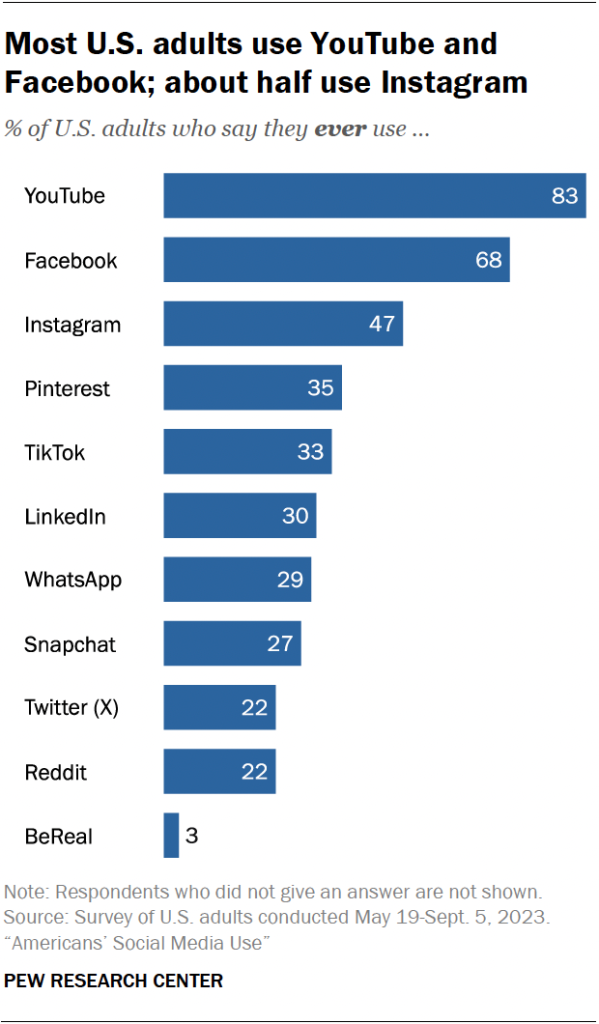
YouTube and Facebook remain the most widely used online platforms. The vast majority of U.S. adults (84%) say they ever use YouTube. Most Americans (71%) also report using Facebook. These findings are according to a Pew Research Center survey of 5,022 U.S. adults conducted Feb. 5-June 18, 2025.

Half of adults say they use Instagram, making it the only other platform in our survey used by at least 50% of Americans.

Smaller shares use the other sites and apps we asked about, such as TikTok (37%) and WhatsApp (32%). Somewhat fewer say the same of Reddit, Snapchat and X (formerly Twitter).

This year we also asked about three platforms that are used by about one-in-ten or fewer U.S. adults: Threads, Bluesky, and Truth Social.

Center studies also find that YouTube is the most widely used online platform among U.S. teens, like it is among U.S. adults.

Thursday, September 25, 2025

News from Social Media


From Pew:
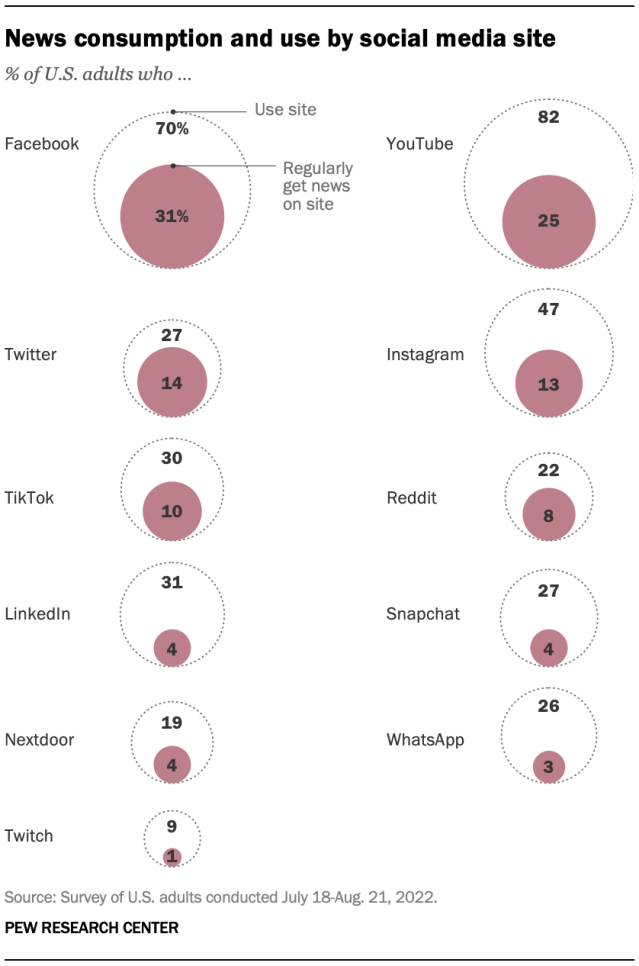
Digital sources have become an important part of Americans’ news diets – with social media playing a crucial role, particularly for younger adults. Overall, about half of U.S. adults (53%) say they at least sometimes get news from social media, roughly stable over the last few years.


Saturday, September 20, 2025

Beware of Posting Photos You Have Not Checked


Saturday, May 31, 2025

Bluesky and Influencers

Many posts have discussed social media

Galen Stocking, Regina Widjaya, Luxuan Wang, and Naomi Forman-Katz at Pew:

Bluesky is an emerging social media site with similar features to X (the platform formerly known as Twitter). It has become a destination for many news influencers, especially those who lean to the political left, according to a new Pew Research Center analysis.

The share of news influencers in our sample with a Bluesky account roughly doubled in the four months after Election Day 2024, from 21% beforehand to 43% by March 2025. Most of these influencers – including left-leaning ones – are also on X and post there frequently.


Related: America’s News Influencers

What is a news influencer?

In this study, we use the term “news influencers” to refer to individuals who regularly post about current events and civic issues on social media and have at least 100,000 followers on any of Facebook, Instagram, TikTok, X (formerly Twitter) or YouTube. News influencers can be journalists who are or were affiliated with a news organization or independent content creators, but they must be people and not organizations.

... 

About one-in-five U.S. adults (21%) say they regularly get news from news influencers on social media, according to a survey of 10,658 Americans conducted in summer 2024. This is especially common among younger adults: 37% of those ages 18 to 29 say they regularly get news from influencers. But there are minimal differences between Republicans and Democrats on this question.


Tuesday, January 7, 2025

Misinformation at Scale

Many posts have discussed myths and misinformation.

 Mike Allen and Jim Vande Hei at Axios:

Never has it been easier to spread misinformation at scale — with less concern about media meaningfully policing it, Jim VandeHei and Mike Allen write in a "Behind the Curtain" column.

Why it matters: Elon Musk and Mark Zuckerberg are of one mind. The most powerful global information platforms should be governed by free speech — and the people — not by the platforms themselves.

Both concluded it's too hard, too inherently biased, and too restrictive to put limits on speech. It's also cheaper to stop trying — and convenient to switch as Washington goes all-in on MAGA.A decade ago, the mainstream media played the role of spotting and exposing misinformation spread under the guise of legitimate free speech. But faith in the traditional media is in the dumpster.

What's new: Meta made a far-reaching announcement Tuesday, with a post headlined, "More Speech and Fewer Mistakes." Facebook, Instagram and Threads will end their third-party fact-checking program — and move to a Community Notes model, where users add corrections and context.Joel Kaplan — who last week was named Meta's chief global affairs officer, succeeding Nick Clegg — announced the changes Tuesday on the famous curvy couch at "Fox & Friends," a favorite show of President-elect Trump. "This is a great opportunity for us to reset the balance in favor of free expression," Kaplan said.

Mark Zuckerberg — Meta founder, chairman and CEO — says in a video: "We're going to get back to our roots and focus on reducing mistakes, simplifying our policies and restoring free expression on our platforms."

Between the lines: The truth is, it is an almost impossible task for companies to police speech without bias or unfairness. That leaves two other options — the government or individuals. Both X and Meta are choosing people, with an imperfect "community notes" mechanism to correct misinformation in real time.

X's Community Notes system "regularly allows blatant misinformation to be loudly amplified for hours or days before being noted," Axios' Dan Primack notes (on X!).


Tuesday, June 11, 2024

The X Factor of Misinformation

Many posts have discussed myths and misinformation.

Marc Burrows at The Independent:

Back when I worked at Twitter, in the days before Elon Musk’s takeover and self-consciously edgy and embarrassing “X” rebrand, we took the threat of misinformation incredibly seriously. I worked on Twitter’s curation team during multiple elections, including in the UK and the US, and through the first two years of the pandemic. I saw how false information spreads quickly and is believed easily, and how difficult it is to stop it travelling once it starts.

We worked with Reuters and the Associated Press to debunk rapidly growing and unreliable stories. We coined the term “pre-bunk” for identifying likely misinformation before it spread. Misleading posts were labelled once they reached a certain influence threshold.

We all knew this was mission critical, because Twitter punches above its weight in terms of influence on the news agenda and public conversation – that’s why Musk became so invested. We all wanted to make it safer. Better. A force for good.

The curation team – my team – was among the first to be cut in Musk’s new regime. In his first weeks, and, in my view, with a lack of subtlety, grace or much sense, he undid years of work; wiping out or reducing those areas of the company that dealt with misinformation and community moderation, disbanding the Trust and Safety team, and unbanning accounts previously sanctioned for spreading harmful lies.

Since then, the EU has found that X is the social media platform with the highest disinformation rate. As Miah Hammond-Errey, the director of the Emerging Technology Program at the United States Studies Centre at the University of Sydney said last year: “Few recent actions have done more to make a social media platform safe for disinformation, extremism, and authoritarian regime propaganda than the changes to Twitter since its purchase by Elon Musk.

Monday, May 20, 2024

Digital Decay

Athena Chapekis et al. at Pew:Athena Chapekis et al. at Pew:
The internet is an unimaginably vast repository of modern life, with hundreds of billions of indexed webpages. But even as users across the world rely on the web to access books, images, news articles and other resources, this content sometimes disappears from view.
A new Pew Research Center analysis shows just how fleeting online content actually is:
  • A quarter of all webpages that existed at one point between 2013 and 2023 are no longer accessible, as of October 2023. In most cases, this is because an individual page was deleted or removed on an otherwise functional website.
  • For older content, this trend is even starker. Some 38% of webpages that existed in 2013 are not available today, compared with 8% of pages that existed in 2023.
This “digital decay” occurs in many different online spaces. We examined the links that appear on government and news websites, as well as in the “References” section of Wikipedia pages as of spring 2023. This analysis found that:
  • 23% of news webpages contain at least one broken link, as do 21% of webpages from government sites. News sites with a high level of site traffic and those with less are about equally likely to contain broken links. Local-level government webpages (those belonging to city governments) are especially likely to have broken links.
  • 54% of Wikipedia pages contain at least one link in their “References” section that points to a page that no longer exists.
To see how digital decay plays out on social media, we also collected a real-time sample of tweets during spring 2023 on the social media platform X (then known as Twitter) and followed them for three months. We found that:
  • Nearly one-in-five tweets are no longer publicly visible on the site just months after being posted. In 60% of these cases, the account that originally posted the tweet was made private, suspended or deleted entirely. In the other 40%, the account holder deleted the individual tweet, but the account itself still existed.
  • Certain types of tweets tend to go away more often than others. More than 40% of tweets written in Turkish or Arabic are no longer visible on the site within three months of being posted. And tweets from accounts with the default profile settings are especially likely to disappear from public view.

Friday, April 12, 2024

Online Antisemitism


Steven Lee Myers and Tiffany Hsu at NYT:

Jackson Hinkle has cultivated an online persona so incendiary that he has been kicked off YouTube, Twitch and Instagram.

He rages on undaunted, even energized. He produces a regular podcast on Rumble, a website popular with many prominent conservatives. He writes dozens of posts a day on X, where his following has surged to 2.5 million from 417,000 in the six months since Oct. 7 — the day Hamas fighters mounted their assault on Israel.

Along the way, he has employed false or misleading content, promoted manipulated images and made comments that watchdog organizations have denounced as antisemitic. He calls himself an American patriot even as he praises American adversaries, including Vladimir V. Putin, Xi Jinping and Ayatollah Ali Khamenei.

...

Two Israeli research companies that specialize in online threats, and that have focused on what they consider disinformation related to the war in Gaza, said they had identified coordinated and possibly state-sponsored networks of bots or inauthentic accounts that were amplifying Mr. Hinkle’s provocative brew of political views. China, Russia and other foreign actors are known to use such tactics to achieve their geopolitical goals — including efforts to influence this fall’s presidential election.
Mr. Hinkle has also benefited from changes by X’s owner, Elon Musk, including the cancellation of policies that once limited toxic content. With the addition of a premium subscription feature, he now charges certain followers $3 a month for what he calls “extra cool stuff,” including behind-the-scenes videos and “random thoughts.” X allows him to pocket up to 97 percent of the revenue — money that Mr. Hinkle has told subscribers helps him “continue exposing the Deep State.”

Imran Ahmed, the head of the Center for Countering Digital Hate, a research organization, said Mr. Hinkle was part of “a sort of new cadre of people who exploit the algorithms’ insatiable desire for highly contentious content to benefit themselves economically.”
In a new report, the center documented a staggering rise in followers for 10 prominent accounts on X that spread antisemitic content since the start of the war between Israel and Hamas.

Wednesday, January 31, 2024

Wednesday, August 9, 2023

Organizing Online Harassment of Harassment Victims

Many posts have discussed the political uses and abuses of social media.

 Nicholas Fandos at NYT:

The menacing posts began cropping up on Twitter last September just hours after a former aide to Gov. Andrew M. Cuomo of New York sued him over sexual harassment claims.

The tweets attacked the aide, Charlotte Bennett, in starkly personal terms. “Your life will be dissected like a frog in a HS science class,” read one of the most threatening, which also featured a photo of Ms. Bennett dancing at a bar in lingerie.

The post was part of a thread written by Anna Vavare, a leader of a small but devoted group of mostly older women who banded together online to defend Mr. Cuomo from a cascade of sexual misconduct claims that led to his resignation in August 2021. But it turns out, her tweets had secretly been ordered up by someone even closer to the former governor’s cause: Madeline Cuomo, his sister.

In the hours before the posts went live that morning, Ms. Cuomo exchanged dozens of text messages with Ms. Vavare and another leader of the pro-Cuomo group We Decide New York, Inc., pushing the activists to target Ms. Bennett, one of the first women to accuse Mr. Cuomo of sexual harassment. She appeared to invoke her brother’s wishes.

Sunday, June 25, 2023

Coup Misinformation

The potential coup attempt in Russia by a paramilitary organization may already be over(opens in a new tab), but the misinformation sure did flow during the breaking global event.

... 

Since Elon Musk acquired the platform, Twitter has gone through changes that don't exactly bode well for it as an invaluable breaking news resource like it once was.

For example, prior to Musk, the blue checkmark meant that a user was verified by Twitter as the journalist or expert that the individual claimed they were. Remember, the purpose of the checkmark was to make sure these users couldn't be impersonated. Now, however, anyone who pays $8 per month for Twitter's premium subscription service, Twitter Blue, gets a blue checkmark.
Furthermore, those paid blue checkmark users now get priority placement in Twitter's For You feed algorithm, and in the replies to other users' tweets. And, echoing the issue on Telegram, many Twitter Blue subscribers are not far, ideologically speaking, from the Putin regime.


From WNYC "On the Media":


Sunday, March 19, 2023

Pro-Russian Twitter Accounts


David Klepper at AP:
Soon after a train derailed and spilled toxic chemicals in Ohio last month, anonymous pro-Russian accounts started spreading misleading claims and anti-American propaganda about it on Twitter, using Elon Musk’s new verification system to expand their reach while creating the illusion of credibility.

The accounts, which parroted Kremlin talking points on myriad topics, claimed without evidence that authorities in Ohio were lying about the true impact of the chemical spill. The accounts spread fearmongering posts that preyed on legitimate concerns about pollution and health effects and compared the response to the derailment with America’s support for Ukraine following its invasion by Russia.

...

Another pro-Russian account recently tried to pick an online argument with Ukraine’s defense department, posting photos of documents that it claimed came from the Wagner Group, a private military company owned by a Yevgeny Prigozhin, a key Putin ally. Prigozhin operates troll farms that have targeted U.S. social media users in the past. Last fall he boasted of his efforts to meddle with American democracy.

A separate Twitter account claiming to represent Wagner actively uses the site to recruit fighters.

Gentlemen, we have interfered, are interfering and will interfere,” Prigozhin said last fall on the eve of the 2022 midterm elections in the U.S. “Carefully, precisely, surgically and in our own way, as we know how to do,” Prigozhin said at the time.

Sunday, December 11, 2022

Impact of Social Media: International Opinion

Richard Wike and colleagues at Pew:
As people across the globe have increasingly turned to Facebook, Twitter, WhatsApp and other platforms to get their news and express their opinions, the sphere of social media has become a new public space for discussing – and often arguing bitterly – about political and social issues. And in the mind of many analysts, social media is one of the major reasons for the declining health of democracy in nations around the world.

However, as a new Pew Research Center survey of 19 advanced economies shows, ordinary citizens see social media as both a constructive and destructive component of political life, and overall most believe it has actually had a positive impact on democracy. Across the countries polled, a median of 57% say social media has been more of a good thing for their democracy, with 35% saying it is has been a bad thing.

There are substantial cross-national differences on this question, however, and the United States is a clear outlier: Just 34% of U.S. adults think social media has been good for democracy, while 64% say it has had a bad impact. In fact, the U.S. is an outlier on a number of measures, with larger shares of Americans seeing social media as divisive.

Even in countries where assessments of social media’s impact are largely positive, most believe it has had some pernicious effects – in particular, it has led to manipulation and division within societies. A median of 84% across the 19 countries surveyed believe access to the internet and social media have made people easier to manipulate with false information and rumors. A recent analysis of the same survey shows that a median of 70% across the 19 nations consider the spread of false information online to be a major threat, second only to climate change on a list of global threats.

Thursday, December 8, 2022

Not the Day After D-Day

Saturday, November 5, 2022

Social Media, Mass Media, and Misinformation

 Blake Hounshell at NYT:

And by the way, Musk is in the middle of firing thousands of Twitter employees, including members of the trust and safety teams that manage content moderation.

“It’s an egregiously irresponsible thing to do just days before midterms that are likely to be mired by voter intimidation, false claims of election rigging and potential political violence,” said Jesse Lehrich, a co-founder of the nonprofit watchdog group Accountable Tech.
...

Part of what’s going on here is declining levels of trust in the pillars of American civic life — a decades-long trend captured vividly in “Bowling Alone,” Robert Putnam’s famous book from 2000.

The numbers are even worse now. Jeffrey Jones, an analyst at Gallup, noted in July that Americans had reached “record-low confidence across all institutions.”

News organizations polled near the bottom of Gallup’s list. Just 16 percent of the public said they had “a great deal” or “quite a lot” of confidence in newspapers, and only 11 percent said the same for TV news.

The differences by party were stark. Just 5 percent of Republicans and 12 percent of independents said they had high confidence in newspapers, and only 35 percent of Democrats said the same. All of these numbers had declined from a year earlier.

Coming in the middle of a midterm election in which journalists are trying to inform millions of voters about what’s happening and to help them assess the ideas and personal characteristics of the candidates, Gallup’s finding was alarming.

And that’s just one data point. A recent poll by Bright Line Watch, a project run by a group of political scientists, found that 91 percent of Democrats were confident that their vote would be counted, versus just 68 percent of Republicans. That lack of trust is the starter fuel of election denialism.

...

Surveys show that younger people increasingly trust what they see on social media about as much as they trust traditional news sources. Data also shows that readers often can’t tell the difference between news reporting and opinion, even when they are labeled explicitly. Social media timelines jumble them all up together.

And, as the Pew Research Center has noted, people don’t even agree on what a “fact” is: “Members of each political party were more likely to label both factual and opinion statements as factual when they appealed more to their political side,” Pew wrote in 2018.

Tuesday, June 28, 2022

Social Media Use: Journalists and Normals

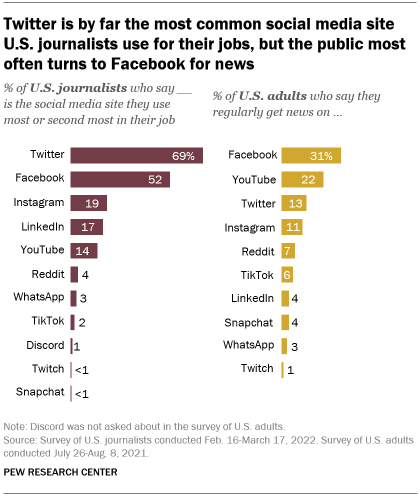
More than nine-in-ten journalists in the United States (94%) use social media for their jobs, according to a recent Pew Research Center survey of reporters, editors and others working in the news industry. But the sites that journalists use most frequently differ from those that the public turns to for news

Among journalists, Twitter clearly ranks at the top of the list for work-related tasks. Around seven-in-ten U.S. journalists (69%) say it is the social media site they use most or second most for their job. Twitter is followed by Facebook at 52% and, far lower on the list, by Instagram (19%), LinkedIn (17%) and YouTube (14%). None of the other sites asked about in the survey – Reddit, WhatsApp, TikTok, Discord, Twitch and Snapchat – were named by more than 4% of the journalists surveyed.

A different lineup emerges for the public. Among Americans overall, Facebook is the most widely used social media site for news, with 31% of U.S. adults saying they go there regularly for news. YouTube is the second-most frequently used site, with 22% of the public regularly getting news there. Fewer adults (13%) say they regularly get news on Twitter, despite the platform’s widespread use among journalists. Overall, a little under half of U.S. adults (48%) say they often or sometimes get news from social media sites.

Friday, April 29, 2022

Twitter Incivility

 Melanie Mason at LAT:

It’s not your imagination. Political discourse on Twitter really has grown meaner in recent years, according to a new study.

The research, published Thursday in the journal Social Psychological and Personality Science, found that the level of incivility in tweets by members of Congress increased by 23% between 2009 and 2019 — a change the study’s authors attribute in part to how Twitter’s “like” and “retweet” buttons reinforce the spread of toxic content.

Its findings mark “the first robust evidence that incivility is rising among American politicians on Twitter,” wrote the study’s authors, hailing from several U.S. and Canadian universities.

Researchers examined 1.3 million tweets from official congressional accounts between 2009 and 2019. To quantify the levels of incivility, they used artificial intelligence to analyze the messages and assign a toxicity score from 0 to 100, reflecting the likelihood that someone would consider the text to be rude or disrespectful.

The analysis classified a 2009 tweet by then-Sen. Arlen Specter (D-Pa.) with a high incivility score of 45.1 for accusing a rival of “going AWOL” from his congressional post. And a 2019 tweet by Rep. Kevin Hern (R-Okla.) — which said another politician was “endorsing infanticide & proudly doing it!” — scored at 47.6.


Tuesday, March 8, 2022

Normals

 Axios Finish Line:

Three stats we find reassuring:
  1. 75% of people in the U.S. never tweet.
  2. On an average weeknight in January, just 1% of U.S. adults watched primetime Fox News (2.2 million). 0.5% tuned into MSNBC (1.15 million).
  3. Nearly three times more Americans (56%) donated to charities during the pandemic than typically give money to politicians and parties (21%).
The bottom line: Every current trend suggests politics will get more toxic before it normalizes. But the silent majority gives us hope beyond the nuttiness.