Search This Blog

Showing posts with label Facebook. Show all posts

Thursday, November 20, 2025

Social Media Use 2025

Many posts have discussed social media

Jeffrey Gottfried and Eugenie Park at Pew:

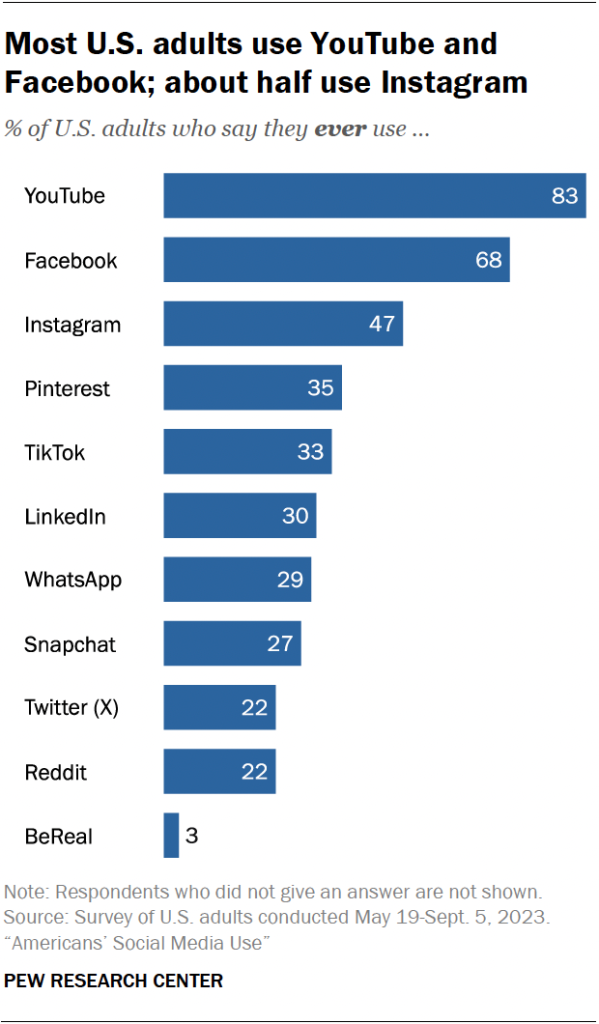
YouTube and Facebook remain the most widely used online platforms. The vast majority of U.S. adults (84%) say they ever use YouTube. Most Americans (71%) also report using Facebook. These findings are according to a Pew Research Center survey of 5,022 U.S. adults conducted Feb. 5-June 18, 2025.

Half of adults say they use Instagram, making it the only other platform in our survey used by at least 50% of Americans.

Smaller shares use the other sites and apps we asked about, such as TikTok (37%) and WhatsApp (32%). Somewhat fewer say the same of Reddit, Snapchat and X (formerly Twitter).

This year we also asked about three platforms that are used by about one-in-ten or fewer U.S. adults: Threads, Bluesky, and Truth Social.

Center studies also find that YouTube is the most widely used online platform among U.S. teens, like it is among U.S. adults.

Thursday, September 25, 2025

News from Social Media


From Pew:
Digital sources have become an important part of Americans’ news diets – with social media playing a crucial role, particularly for younger adults. Overall, about half of U.S. adults (53%) say they at least sometimes get news from social media, roughly stable over the last few years.


Tuesday, January 7, 2025

Misinformation at Scale

Many posts have discussed myths and misinformation.

 Mike Allen and Jim Vande Hei at Axios:

Never has it been easier to spread misinformation at scale — with less concern about media meaningfully policing it, Jim VandeHei and Mike Allen write in a "Behind the Curtain" column.

Why it matters: Elon Musk and Mark Zuckerberg are of one mind. The most powerful global information platforms should be governed by free speech — and the people — not by the platforms themselves.

Both concluded it's too hard, too inherently biased, and too restrictive to put limits on speech. It's also cheaper to stop trying — and convenient to switch as Washington goes all-in on MAGA.A decade ago, the mainstream media played the role of spotting and exposing misinformation spread under the guise of legitimate free speech. But faith in the traditional media is in the dumpster.

What's new: Meta made a far-reaching announcement Tuesday, with a post headlined, "More Speech and Fewer Mistakes." Facebook, Instagram and Threads will end their third-party fact-checking program — and move to a Community Notes model, where users add corrections and context.Joel Kaplan — who last week was named Meta's chief global affairs officer, succeeding Nick Clegg — announced the changes Tuesday on the famous curvy couch at "Fox & Friends," a favorite show of President-elect Trump. "This is a great opportunity for us to reset the balance in favor of free expression," Kaplan said.

Mark Zuckerberg — Meta founder, chairman and CEO — says in a video: "We're going to get back to our roots and focus on reducing mistakes, simplifying our policies and restoring free expression on our platforms."

Between the lines: The truth is, it is an almost impossible task for companies to police speech without bias or unfairness. That leaves two other options — the government or individuals. Both X and Meta are choosing people, with an imperfect "community notes" mechanism to correct misinformation in real time.

X's Community Notes system "regularly allows blatant misinformation to be loudly amplified for hours or days before being noted," Axios' Dan Primack notes (on X!).


Saturday, September 14, 2024

Cats, Dogs, Immigrants, and Myths

 Many posts have discussed myths and misinformation.

Alicia Victoria Lozano at NBC:

The woman behind an early Facebook post spreading a harmful and baseless claim about Haitian immigrants eating local pets that helped thrust a small Ohio city into the national spotlight says she had no firsthand knowledge of any such incident and is now filled with regret and fear as a result of the ensuing fallout.

“It just exploded into something I didn’t mean to happen,” Erika Lee, a Springfield resident, told NBC News on Friday.

Lee recently posted on Facebook about a neighbor’s cat that went missing, adding that the neighbor told Lee she thought the cat was the victim of an attack by her Haitian neighbors.

Newsguard, a media watchdog that monitors for misinformation online, found that Lee had been among the first people to publish a post to social media about the rumor, screenshots of which circulated online. The neighbor, Kimberly Newton, said she heard about the attack from a third party, NewsGuard reported.

Newton told Newsguard that Lee’s Facebook post misstated her story, and that the owner of the missing cat was “an acquaintance of a friend” rather than her daughter’s friend. Newton could not be reached for comment.

Lee said she had no idea the post would become part of a rumor mill that would spiral into the national consciousness. She has since deleted the Facebook post.

Other posts have also contributed to the false allegations, including a photo of a man holding a dead goose that was taken in Columbus, Ohio, but was spread by some online as evidence of the claims about Springfield. Graphic video of a woman who allegedly killed and tried to eat a cat was also found not to have originated in Springfield but in Canton, Ohio, and does not have any connection to the Haitian community.

Local police and city officials have repeatedly said there is no evidence of such crimes in Springfield, but that hasn’t stopped the lies from spreading across the country and igniting a national frenzy that landed on the presidential debate stage this week. Former President Donald Trump and his running mate Ohio Sen. JD Vance, who was born less than an hour away from Springfield, have repeated the baseless allegations.

Wednesday, January 31, 2024

Saturday, December 16, 2023

AI and Deliberative Democracy

 From Helene Landemore at the International Monetary Fund:

We now have the chance to scale and improve such deliberative processes exponentially so that citizens’ voices, in all their richness and diversity, can make a difference. Taiwan Province of China exemplifies this transition.

Following the 2014 Sunflower Revolution there, which brought tech-savvy politicians to power, an online open-source platform called pol.is was introduced. This platform allows people to express elaborate opinions about any topic, from Uber regulation to COVID policies, and vote on the opinions submitted by others. It also uses these votes to map the opinion landscape, helping contributors understand which proposals would garner consensus while clearly identifying minority and dissenting opinions and even groups of lobbyists with an obvious party line. This helps people understand each other better and reduces polarization. Politicians then use the resulting information to shape public policy responses that take into account all viewpoints.

Over the past few months pol.is has evolved to integrate machine learning with some of its functions to render the experience of the platform more deliberative. Contributors to the platform can now engage with a large language model, or LLM (a type of AI), that speaks on behalf of different opinion clusters and helps individuals figure out the position of their allies, opponents, and everyone in between. This makes the experience on the platform more truly deliberative and further helps depolarization. Today, this tool is frequently used to consult with residents, engaging 12 million people, or nearly half the population.

Corporations, which face their own governance challenges, also see the potential of large-scale AI-augmented consultations. After launching its more classically technocratic Oversight Board, staffed with lawyers and experts to make decisions on content, Meta (formerly Facebook) began experimenting in 2022 with Meta Community Forums—where randomly selected groups of users from several countries could deliberate on climate content regulation. An even more ambitious effort, in December 2022, involved 6,000 users from 32 countries in 19 languages to discuss cyberbullying in the metaverse over several days. Deliberations in the Meta experiment were facilitated on a proprietary Stanford University platform by (still basic) AI, which assigned speaking times, helped the group decide on topics, and advised on when to put them aside.

For now there is no evidence that AI facilitators do a better job than humans, but that may soon change. And when it does, the AI facilitators will have the distinct advantage of being much cheaper, which matters if we are ever to scale deep deliberative processes among humans (rather than between humans and LLM impersonators, as in the Taiwanese experience) from 6,000 to millions of people.

Friday, December 8, 2023

Meta Influence at KSG

Many posts have discussed the political uses of philanthropy

 Joseph Menn at WP:

A prominent disinformation scholar has accused Harvard University of dismissing her to curry favor with Facebook and its current and former executives in violation of her right to free speech.

Joan Donovan claimed in a filing with the Education Department and the Massachusetts attorney general that her superiors soured on her as Harvard was getting a record $500 million pledge from Meta founder Mark Zuckerberg’s charitable arm.

... 

As the main attraction at a Zoom meeting for top Kennedy School donors on Oct. 29 that year, Donovan said the papers showed that Meta knew the harms it was causing. Former top Facebook communications executive Elliot Schrage asked repeated questions during the meeting and said she badly misunderstood the papers, Donovan wrote in a sworn declaration included in the filing.

Ten days after the donors meeting, Kennedy School dean Doug Elmendorf, a former director of the Congressional Budget Office, emailed Donovan with pointed questions about her research goals and methods, launching an increase in oversight that restricted her activities and led to her dismissal before the end of her contract, according to the declaration. Donovan wrote that the Chan Zuckerberg Initiative’s $500 million gift for a new artificial intelligence institute at the university, announced Dec. 7 that year, had been in the works before the donor meeting.
...

The Donovan case comes at a time when researchers who focus on social media platforms find themselves under increasing attack. Trump adviser Stephen Miller’s legal foundation has sued academic and independent researchers, claiming that they conspired with government agencies to suppress speech, and Republican-led congressional committees have subpoenaed their records, adding to the pressure.

In addition, Big Tech companies themselves have sponsored research, made grants to some colleges and universities, and doled out data to professors who agree to specific avenues of inquiry.

Tuesday, December 27, 2022

Tech Beats Antitrust Push

 Emily Birnbaum at Bloomberg:

A passionate and bipartisan legislative effort to rein in the country’s largest technology companies collapsed this week, the victim of an epic lobbying campaign by Amazon, Apple, Google and Meta.

The internet titans spent hundreds of millions of dollars, sent their chief executives to Washington and deployed trade groups and sympathetic scholars to quash two antitrust bills co-sponsored by Senator Amy Klobuchar, a Minnesota Democrat, and Senator Chuck Grassley, an Iowa Republican. The companies treated the bills like an existential threat.The years-long US legislative effort, which harnessed outrage over tech companies’ power and dominance, would have cracked down on the practices of Alphabet Inc.’s Google, Amazon.com Inc, Meta Platforms Inc. and Apple Inc. for the first time in the nearly three decades since the internet was unveiled to the public.

The closely-watched bills advanced farther than any other antitrust overhaul in decades and emerged from an 18-month House investigation led by Rhode Island Democrat David Cicilline. The American Innovation and Choice Online Act would have prevented the tech giants from using their platforms to disadvantage competitors, while the Open App Markets Act would have pared back Apple and Google’s control over app stores.Despite an aggressive eleventh-hour push, the bills were not included in the end-of-year spending package released Monday, the final shot this year. The Senate included a narrower trio of antitrust bills in the end-of-year spending package. That legislation will give more money and resources to the country’s top antitrust regulators, marking the first time Congress has voted to expand antitrust enforcement measures in decades. But those provisions will not make the sweeping changes to the law that some advocates hoped for.


Sunday, December 11, 2022

Impact of Social Media: International Opinion

Richard Wike and colleagues at Pew:
As people across the globe have increasingly turned to Facebook, Twitter, WhatsApp and other platforms to get their news and express their opinions, the sphere of social media has become a new public space for discussing – and often arguing bitterly – about political and social issues. And in the mind of many analysts, social media is one of the major reasons for the declining health of democracy in nations around the world.

However, as a new Pew Research Center survey of 19 advanced economies shows, ordinary citizens see social media as both a constructive and destructive component of political life, and overall most believe it has actually had a positive impact on democracy. Across the countries polled, a median of 57% say social media has been more of a good thing for their democracy, with 35% saying it is has been a bad thing.

There are substantial cross-national differences on this question, however, and the United States is a clear outlier: Just 34% of U.S. adults think social media has been good for democracy, while 64% say it has had a bad impact. In fact, the U.S. is an outlier on a number of measures, with larger shares of Americans seeing social media as divisive.

Even in countries where assessments of social media’s impact are largely positive, most believe it has had some pernicious effects – in particular, it has led to manipulation and division within societies. A median of 84% across the 19 countries surveyed believe access to the internet and social media have made people easier to manipulate with false information and rumors. A recent analysis of the same survey shows that a median of 70% across the 19 nations consider the spread of false information online to be a major threat, second only to climate change on a list of global threats.

Tuesday, June 28, 2022

Social Media Use: Journalists and Normals

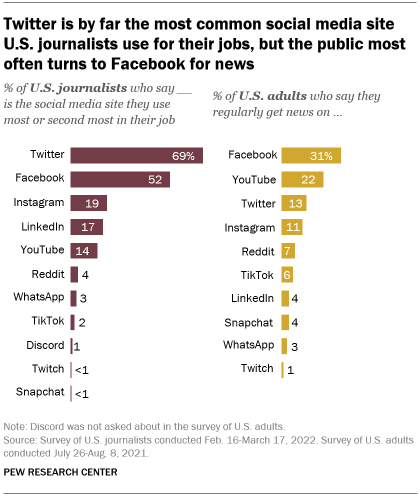
More than nine-in-ten journalists in the United States (94%) use social media for their jobs, according to a recent Pew Research Center survey of reporters, editors and others working in the news industry. But the sites that journalists use most frequently differ from those that the public turns to for news

Among journalists, Twitter clearly ranks at the top of the list for work-related tasks. Around seven-in-ten U.S. journalists (69%) say it is the social media site they use most or second most for their job. Twitter is followed by Facebook at 52% and, far lower on the list, by Instagram (19%), LinkedIn (17%) and YouTube (14%). None of the other sites asked about in the survey – Reddit, WhatsApp, TikTok, Discord, Twitch and Snapchat – were named by more than 4% of the journalists surveyed.

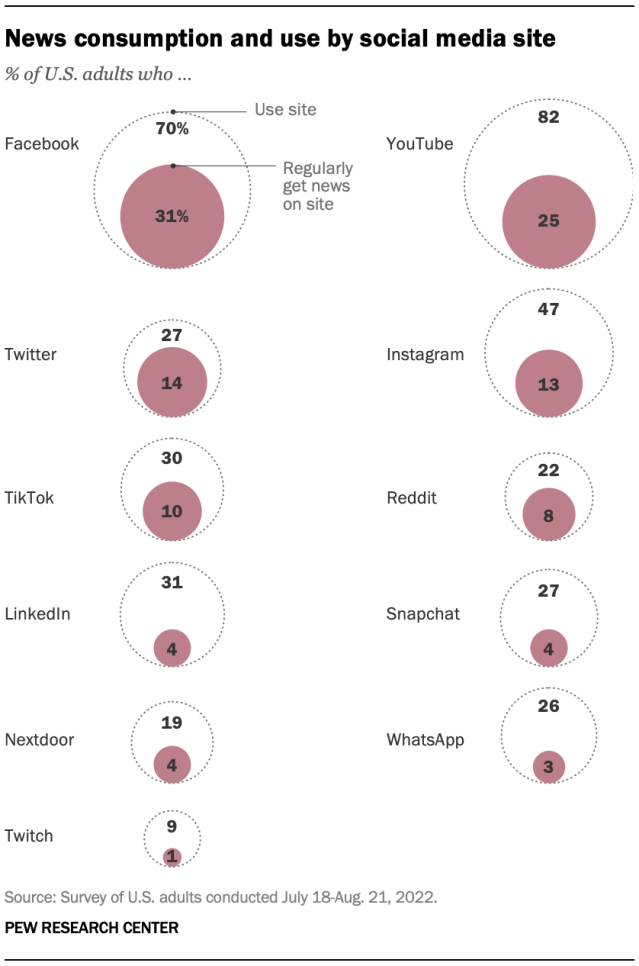
A different lineup emerges for the public. Among Americans overall, Facebook is the most widely used social media site for news, with 31% of U.S. adults saying they go there regularly for news. YouTube is the second-most frequently used site, with 22% of the public regularly getting news there. Fewer adults (13%) say they regularly get news on Twitter, despite the platform’s widespread use among journalists. Overall, a little under half of U.S. adults (48%) say they often or sometimes get news from social media sites.

Tuesday, July 6, 2021

Insurrection, Six Months Later

 Alanna Durkin Richer and Michael Kunzelman at Associated Press:

The first waves of arrests in the deadly siege at the U.S. Capitol focused on the easy targets. Dozens in the pro-Trump mob openly bragged about their actions on Jan. 6 on social media and were captured in shocking footage broadcast live by national news outlets.

But six months after the insurrection, the Justice Department is still hunting for scores of rioters, even as the first of more than 500 people already arrested have pleaded guilty. The struggle reflects the massive scale of the investigation and the grueling work still ahead for authorities in the face of an increasing effort by some Republican lawmakers to rewrite what happened that day.

Among those who still haven’t been caught: the person who planted two pipe bombs outside the offices of the Republican and Democratic national committees the night before the melee, as well as many people accused of attacks on law enforcement officers or violence and threats against journalists. The FBI website seeking information about those involved in the Capitol violence includes more than 900 pictures of roughly 300 people labeled “unidentified.”

Ryan J.  Reilly at Huffington Post:

They call themselves sedition hunters, and they have receipts. They’re members of a loosely affiliated network of motivated individuals and pop-up volunteer organizations with names like Deep State Dogs and Capitol Terrorists Exposers that developed after the Jan. 6 attack to identify the Trump supporters who organized the Capitol riot and brutalized the law enforcement officers protecting the building.

The sedition hunters scour the web for any and all photographs, videos and posts from people at the Capitol during the Jan. 6 attack across well-known websites like Facebook, YouTube and Twitter along with lesser-used sites and apps like Rumble, Gab and Telegram. They’ve got spreadsheets, Google Docs, links, bookmarks, unlisted YouTube backups, group chats and screenshots, as Joan puts it, “coming out the rear end.” They can uncover new evidence of conduct that’ll elevate a misdemeanor trespassing case into something much more serious; find the highest-quality image of a suspect that could generate new leads through facial recognition; and compile multimedia databases that turn the Jan. 6 attack into an interactive, high-stakes and soul-crushing edition of Where’s Waldo.


Wednesday, May 12, 2021

Antivax and QAnon

Alex Kaplan at Media Matters:

Multiple online influencers known for spreading misinformation about the coronavirus and vaccines have been appearing on shows supporting the QAnon conspiracy theory, where they have continued to spread this misinformation.

Supporters of QAnon -- some of whom have been tied to violent incidents and participated in the January 6 insurrection at the United States Capitol -- have also played a significant role in spreading misinformation about the coronavirus pandemic since it began. In recent months, as coronavirus vaccines -- which are safe and effective -- have been released, QAnon supporters have turned their attacks on the vaccines, spreading numerous false claims about them.

In recent months, anti-vax influencers have appeared on multiple different QAnon shows, apparently noticing in QAnon supporters an audience primed to be receptive to their message. At least two are part of the so-called “Disinformation Dozen,” influencers identified in a report by the Center for Countering Digital Hate as the originators of an estimated 65% of vaccine misinformation spread on Facebook and Twitter.


Friday, April 9, 2021

Social Media Use


Brooke Auxier and Monica Anderson at Pew:
Despite a string of controversies and the public’s relatively negative sentiments about aspects of social media, roughly seven-in-ten Americans say they ever use any kind of social media site – a share that has remained relatively stable over the past five years, according to a new Pew Research Center survey of U.S. adults.

Beyond the general question of overall social media use, the survey also covers use of individual sites and apps. YouTube and Facebook continue to dominate the online landscape, with 81% and 69%, respectively, reporting ever using these sites. And YouTube and Reddit were the only two platforms measured that saw statistically significant growth since 2019, when the Center last polled on this topic via a phone survey

...

In a pattern consistent with past Center studies on social media use, there are some stark age differences. Some 84% of adults ages 18 to 29 say they ever use any social media sites, which is similar to the share of those ages 30 to 49 who say this (81%). By comparison, a somewhat smaller share of those ages 50 to 64 (73%) say they use social media sites, while fewer than half of those 65 and older (45%) report doing this.

These age differences generally extend to use of specific platforms, with younger Americans being more likely than their older counterparts to use these sites – though the gaps between younger and older Americans vary across platforms.

Majorities of 18- to 29-year-olds say they use Instagram or Snapchat and about half say they use TikTok, with those on the younger end of this cohort – ages 18 to 24 – being especially likely to report using Instagram (76%), Snapchat (75%) or TikTok (55%).1 These shares stand in stark contrast to those in older age groups. For instance, while 65% of adults ages 18 to 29 say they use Snapchat, just 2% of those 65 and older report using the app – a difference of 63 percentage points.

Additionally, a vast majority of adults under the age of 65 say they use YouTube. Fully 95% of those 18 to 29 say they use the platform, along with 91% of those 30 to 49 and 83% of adults 50 to 64. However, this share drops substantially – to 49% – among those 65 and older.

By comparison, age gaps between the youngest and oldest Americans are narrower for Facebook. Fully 70% of those ages 18 to 29 say they use the platform, and those shares are statistically the same for those ages 30 to 49 (77%) or ages 50 to 64 (73%). Half of those 65 and older say they use the site – making Facebook and YouTube the two most used platforms among this older population.
...

YouTube is used daily by 54% if its users, with 36% saying they visit the site several times a day. By comparison, Twitter is used less frequently, with fewer than half of its users (46%) saying they visit the site daily.

Saturday, October 24, 2020

Right-Wing Media

The Epoch Times is a right-wing newspaper affiliated with the secretive Chinese spiritual movement Falun Gong, Kevin Roose at NYT:

The publication and its affiliates employed a novel strategy that involved creating dozens of Facebook pages, filling them with feel-good videos and viral clickbait, and using them to sell subscriptions and drive traffic back to its partisan news coverage.

In an April 2017 email to the staff obtained by The New York Times, the paper’s leadership envisioned that the Facebook strategy could help turn The Epoch Times into “the world’s largest and most authoritative media.” It could also introduce millions of people to the teachings of Falun Gong, fulfilling the group’s mission of “saving sentient beings.”

Today, The Epoch Times and its affiliates are a force in right-wing media, with tens of millions of social media followers spread across dozens of pages and an online audience that rivals those of The Daily Caller and Breitbart News, and with a similar willingness to feed the online fever swamps of the far right.

...

 It is a remarkable success story for Falun Gong, which has long struggled to establish its bona fides against Beijing’s efforts to demonize it as an “evil cult,” partly because its strident accounts of persecution in China can sometimes be difficult to substantiate or veer into exaggeration. In 2006, an Epoch Times reporter disrupted a White House visit by the Chinese president by shouting, “Evil people will die early.”

Stephen K. Bannon... former chairman of Breitbart, said in an interview in July that The Epoch Times’s fast growth had impressed him.

“They’ll be the top conservative news site in two years,” said Mr. Bannon, who was arrested on fraud charges in August. “They punch way above their weight, they have the readers, and they’re going to be a force to be reckoned with.”

Justin Baragona at The Daily Beast:

It seems Newsmax TV—the decade-old, also-ran, right-wing cable channel hoping to compete with Fox News—may have finally found a way to boost its dismal ratings.

In recent months, Newsmax chief Chris Ruddy has gone on a hiring spree, snapping up a bevy of former Fox News personalities ... and right-wing media hangers-on to reshape and fill out the channel’s lineup. Furthermore, the network has made it a point to embrace disgraced TV hosts or heretofore unemployable pundits mired in scandal.
...

Benny Johnson, a serial plagiarist who abandoned his notorious career as a clickbait writer to become a “meme lord” for right-wing student group TPUSA, now hosts a Saturday program titled The Benny Report. Johnson’s most recent prior media gig was as a writer for The Daily Caller, where he landed after being fired by BuzzFeed over at least 40 instances of plagiarism and then ousted from conservative news site Independent Journal Review following a series of incidents including publishing baseless conspiracies and, naturally, more plagiarism.

...

And then there’s Michelle Malkin. Once a right-wing media superstar and a fixture on Fox News for more than a decade before she leaned hard into supporting the “groyper” movement and white nationalists last year, she now hosts a Saturday evening show for Newsmax. The program’s title, Sovereign Nation, underscores how Malkin, always an anti-immigration hardliner, has repositioned herself as a leading voice of the xenophobic fever swamp. (She was fired from the Young America’s Foundation in Nov. 2019 over her support for Holocaust denier and anti-Semitic internet personality Nick Fuentes.)

Monday, August 31, 2020

Russian Efforts to Divide Americans

Craig Timberg and  Isaac Stanley-Becker at WP:
Four years after Russian operatives used social media in a bid to exacerbate racial divisions in the United States and suppress Black voter turnout, such tactics have spread across a wide range of deceptive online campaigns operated from numerous nations — including from within the United States itself.

The potency and persistence of the racial playbook was highlighted this week when Twitter deleted an account featuring a profile photo of a young Black man claiming to be a former Black Lives Matter protester who switched his allegiance to the Republican Party.

The account, @WentDemtoRep, offered an online testimonial Sunday — the eve of a Republican convention featuring prominent African Americans challenging allegations of racism against President Trump — and was retweeted 22,000 times. Disinformation researcher Marc Owen Jones, of Hamad Bin Khalifa University in Qatar, found the tweet had 39,000 likes just 19 hours after it was posted.
On June 18, Jeff Seldin reported at VOA:
Russia appears to be intensifying its focus on police enforcement issues in the United States, using popular reactions to protests that have gripped the nation as part of a larger propaganda campaign to divide Americans ahead of the U.S. presidential election in November.
The death of African American George Floyd in police custody and the ensuing U.S. protests have for weeks dominated media coverage from Russian state-sponsored outlets like RT and Sputnik.
Only now, it seems that Russia, through the English-language RT in particular, is reaching out to U.S. police officers and union officials, in what some U.S. officials and lawmakers say is an effort to further inflame tensions.
...
Law enforcement officers and organizations who spoke with VOA about their interactions with RT described being caught off guard.
“We had no idea about the ties they have,” a representative for lawofficer.com, a website catering to law enforcement officers, told VOA about being approached by the Russian television news channel. “They actually told us they were out of Britain.”
RT contacted lawofficer.com seeking permission to republish an essay by Tulsa, Oklahoma Police Major Travis Yates about the frustration he and many of his police colleagues have been feeling as a result of the protests of police practices, titled, “America, We Are Leaving.
RT also booked Yates for an on-air interview through its London bureau.
“If I had any idea whatsoever, I obviously never would have done it,” Yates told VOA when asked if he knew about RT’s Russian connection.
Since Yates’ essay was first published, it has been shared thousands of times on social media and even helped get him an appearance on Fox News’
"Tucker Carlson Tonight."

Friday, August 14, 2020

QAnon

Kevin Roose at NYT:
QAnon first surfaced in 2017 with a series of anonymous posts on the internet forum 4chan claiming to reveal high-level government intelligence about crimes by top Democrats. It has since spawned one of the most disturbing and consequential conspiracy theory communities in modern history. Its followers have committed serious crimes, and its online vigilantes have made a sport of harassing and doxxing their perceived enemies. The F.B.I. has cited QAnon as a potential domestic terror threat, and social networks have begun trying to pull QAnon groups off their platforms. Dozens of QAnon-affiliated candidates are running for office this year.
...

Like any movement, QAnon needs to win over new members. And its most recent growth strategy involves piggybacking on the anti-human-trafficking movement.
The idea, in a nutshell, is to create a groundswell of concern by flooding social media with posts about human trafficking, joining parenting Facebook groups and glomming on to hashtag campaigns like #SaveTheChildren, which began as a legitimate fund-raising campaign for the Save the Children charity. Then followers can shift the conversation to baseless theories about who they believe is doing the trafficking: a cabal of nefarious elites that includes Tom Hanks, Oprah Winfrey and Pope Francis.
Antivaxxers have also used this tactic, called "entryism."

Ari Sen and Brandy Zadrozny at NBC:
An internal investigation by Facebook has uncovered thousands of groups and pages, with millions of members and followers, that support the QAnon conspiracy theory, according to internal company documents reviewed by NBC News.
The investigation’s preliminary results, which were provided to NBC News by a Facebook employee, shed new light on the scope of activity and content from the QAnon community on Facebook, a scale previously undisclosed by Facebook and unreported by the news media, because most of the groups are private.

The top 10 groups identified in the investigation collectively contain more than 1 million members, with totals from more top groups and pages pushing the number of members and followers past 3 million. It is not clear how much overlap there is among the groups.
The investigation will likely inform what, if any, action Facebook decides to take against its QAnon community, according to the documents and two current Facebook employees who spoke on the condition of anonymity because they were not authorized to speak publicly on the matter. The company is considering an option similar to its handling of anti-vaccination content, which is to reject advertising and exclude QAnon groups and pages from search results and recommendations, an action that would reduce the community’s visibility.
An announcement about Facebook’s ultimate decision is also expected to target members of “militias and other violent social movements,” according to the documents and Facebook employees.
Facebook has been key to QAnon's growth, in large part due to the platform's Groups feature, which has also seen a significant uptick in use since the social network began emphasizing it in 2017.

Friday, July 17, 2020

Congress on Social Media

From Pew:
As social media platforms like Facebook and Twitter have become ingrained in political and popular culture, a new Pew Research Center analysis of every tweet and Facebook post from members of Congress since 2015 finds that the congressional social media landscape has undergone vast changes in recent years.
These shifts have been especially pronounced on Twitter. Compared with a similar time period in 2016, the typical member of Congress now tweets nearly twice as often (81% more), has nearly three times as many followers and receives more than six times as many retweets on their average post. On Facebook, the typical member of Congress produces 48% more posts and has increased their total number of followers and average shares by half.1

Social media use by members of Congress – and the online audience’s response to those communications – fluctuates in real time and varies based on the issues and events of the day. But underlying this constant churn, there have been notable changes in how lawmakers of each party use social media and interact with the Twitter and Facebook audiences more broadly.
Today, Democratic members tend to post more often and have more followers on Twitter. Relative to the typical (median) Republican member of Congress, the typical Democratic member has over 17,000 more followers on Twitter and posts nearly twice as many tweets in a typical month (130 vs. 73), differences that have grown substantially in the last four years. On Facebook, the typical member of each party has a similar number of followers and much smaller differences in posting volume.
These differences may to some degree reflect differences in the demographic compositions of the two platforms. A 2019 survey by the Center found that 62% of U.S. adults who use Twitter identify as Democrats or political independents who lean toward the Democratic Party, compared with 50% of U.S. adults who use Facebook.
But although the median Democratic lawmaker is more active on both platforms, through the first five months of 2020 the typical Republican received greater levels of audience engagement (as measured by reactions, shares, favorites and retweets) on both Facebook and Twitter.

Sunday, April 19, 2020

The Newspaper Crisis

Newspapers were on the decline even before COVID-19 Now things are much worse as advertising has dried up. Meg James at The Los Angeles Times:
The print industry’s demise has larger implications, Doctor and others say. Without reporters keeping tabs on city halls, state agencies and community organizations, there would be little accountability. Researchers have found that newspapers remain the nation’s most comprehensive, fact-based source of information.
The industry’s collapse has been driven by the exodus of longtime advertisers, who have shifted their money to internet giants Facebook and Google, leading to a precipitous revenue decline. Ad revenue to U.S. newspapers peaked in 2005 at $49.4 billion; it’s now less than a third of that amount, according to Pew Research Center.
Responding to the crisis, Facebook in late March announced $25 million in emergency funding for local news through its Facebook Journalism Project. “The news industry is working under extraordinary conditions to keep people informed during the COVID-19 pandemic. At a time when journalism is needed more than ever, ad revenues are declining,” Facebook said, adding that it would also spend $75 million to buy newspaper ads.
On Wednesday, Google Inc. announced its own $100-million journalism fund “to deliver urgent aid to thousands of small, medium and local news publishers globally.”
The need is great. Small dailies and alternative weeklies are among the most threatened. They rely on local businesses for advertising, rather than big-dollar national advertisers.
In Southern California, the alternative OC Weekly shut down in December and the LA Weekly has absorbed deep cuts and management turmoil. The Orange County Register’s parent, Southern California News Group, furloughed newsroom employees. And the Feather River Bulletin in Quincy, Calif., stopped printing this month — after 153 years.
The Los Angeles Times, which was thrown a lifeline in 2018 when biomedical billionaire Dr. Patrick Soon-Shiong purchased the paper along with the San Diego Union-Tribune, also is feeling financial pain. The paper has spent 18 months rebuilding its newsroom and expanding its online offering only to be walloped by the virus.
...
On Thursday, the company folded three of its community newspapers — the Burbank Leader, the Glendale News-Press and the La Cañada Valley Sun — because they were losing money. The Glendale paper was a pioneer, publishing since 1905. The Valley Sun popped up in 1946 as the postwar building and population boom began to reshape California.

Thursday, November 21, 2019

Losing the News

A report from PEN America:
As local news outlets are gutted and shuttered, reporters laid off, publication schedules cut, and resources tightened across the country, Losing the News: The Decimation of Local News and the Search for Solutions sounds the alarm about the existential threat facing local watchdog journalism and proposes big-picture solutions for its revitalization.
Key conclusions:

  •  As local journalism declines, government officials conduct themselves with less integrity, efficiency, and effectiveness and corporate malfeasance goes unchecked. With the loss of local news, citizens are: less likely to vote, less politically informed, and less likely to run for office.
  • With the shift to digital, the business model for for-profit local journalism has collapsed, as circulation patterns have been upended and tech giants, notably the digital duopoly of Google and Facebook, have siphoned the majority of advertising revenue for content paid for and produced by news outlets.
  • Local newspapers, TV stations, and radio stations are being bought and consolidated by hedge funds and media conglomerates and often subjected to relentless cost cutting—leading to coverage that is more national, less diverse, and, in some cases, more politically polarized.
  • Newspapers have been hit the hardest, losing over $35 billion in ad revenue and 47 percent of newsroom staff over the past 15 years. Over 1,800 newspapers have closed, leaving more than three million people with no newspaper at all, and more than at least a thousand have become “ghost newspapers,” with little original reporting.
  • Because newspapers still provide the majority of original local reporting in communities, their evisceration robs the American public of trusted sources of critical information about health, education, elections, and other pressing local issues.
  • Many of the communities traditionally underserved by legacy local media—communities of color, low-income communities, and communities in rural areas—are those most affected by its decline. Finding meaningful, scalable solutions to the local news crisis presents an opportunity to revamp the industry to better represent, reflect, and serve all Americans.
  • Across the country, existing and emerging outlets are building out new revenue streams, experimenting with digital-first and nonprofit models, and collaborating rather than competing to better serve communities’ pressing information needs. But in the face of market failure, adaptation and innovation alone cannot address the crisis at the needed scale.
  • Philanthropic funding must expand dramatically to make a dent at the local level. Only a small fraction of philanthropic funding for journalism supports local news, and that funding is concentrated on the coasts and a handful of other states and often bypasses smaller and midsize outlets, as well as ethnic- or minority-led ones.
  • Legislators and regulators must ensure that technology companies fairly compensate local outlets for the journalism they produce, which including levying an ad revenue tax on platforms like Facebook and Google to fund local watchdog reporting.
  • The Federal Communications Commission must roll back recent decisions that enable media consolidation and cost-cutting and clarify and enforce the requirement that media broadcasters produce programming that serves the public interest.
  • Given the scope and scale of the problem, a solution is unlikely without dramatically expanding public funding for local journalism, through either reform and expansion of the Corporation for Public Broadcasting or the creation of a new national endowment for journalism. PEN America is calling for a new congressional commission—a Commission on Public Support for Local News—to assess the viability of these options and recommend a path forward.