Sen. Bernie Moreno (R-OH) said on Wednesday night that anyone who does not believe that Jesus died for their salvation is unfit to serve in the Senate and “should be nowhere near Washington.”
Moreno spoke at a rally in Chillicothe, Ohio, where he was joined by President Donald Trump and Sen. Jon Husted, who is in a close race against former Democratic Sen. Sherrod Brown.
During his remarks, Moreno turned his attention to Michigan, where Democrat Abdul El-Sayed is in a similarly tight contest with former Rep. Mike Rogers. If El-Sayed wins, he would be the first Muslim to serve in the U.S. Senate.
“On Monday, I went up and campaigned with Mike Rogers because he’s in a race with somebody that just is an affront to me as an American,” Moreno said. “By the way, an affront to me as a naturalized citizen to this country.”
Moreno was born in Colombia. El-Sayed was born in suburban Detroit.
“This character, Abdul El-Sayed, can be nowhere near Washington, D.C.,” he continued before saying non-Christians have no business in the Senate. “Do you think he understands that concept? That our rights come from God Almighty? That Jesus came here for our salvation. He should be nowhere near Washington, D.C. And Mike Rogers is gonna kick his ass on Tuesday.”
Moreno’s litmus test – that only people who believe that “Jesus came here for our salvation” should serve in the Senate – would exclude not only Muslims, but Jews, Hindus, Sikhs, Buddhists, atheists, and everyone else who does not subscribe to his religion.
It is worth noting that Ohio Republican gubernatorial candidate Vivek Ramaswamy, a Hindu, also spoke at the rally.
Article VI of the Constitution famously bans religious requirements as a precondition for public office, stating that “no religious Test shall ever be required as a Qualification to any Office or public Trust under the United States.
Showing posts with label Ohio. Show all posts
Showing posts with label Ohio. Show all posts
Thursday, October 29, 2026
Bernie Moreno's Religious Test


Monday, April 6, 2026
Little Evidence that Undocumented People Get Medicaid
Many posts have discussed federal deficits and the federal debt. Americans vastly overestimate the amount of waste in the budget
Last August, as part of the federal government’s crackdown on people in the country illegally, the Trump administration sent states the names of hundreds of thousands of Medicaid enrollees with orders to determine whether they were ineligible based on immigration status.
But seven months later, findings from five states shared with KFF Health News show that the reviews have uncovered little evidence of a widespread problem.
Only U.S. citizens and some lawfully present immigrants are eligible for Medicaid, which covers health care costs for people with low incomes and disabilities, and the closely related Children’s Health Insurance Program. Both programs are administered by states.
Spokespeople from Pennsylvania’s and Colorado’s Medicaid agencies said, as of March, the states had found no one who needed to be terminated from Medicaid. That was after checking a combined 79,000 names.
Texas has reviewed records of more than 28,000 Medicaid enrollees at the Trump administration’s request and terminated coverage for 77 of them, according to Jennifer Ruffcorn, a spokesperson for the Texas Department of Human Services.
Ohio has checked 65,000 Medicaid enrollees, of which 260 people were disenrolled from the program, said Stephanie O’Grady, a spokesperson for the Ohio Department of Medicaid.
In Utah, 42 of the 8,000 enrollees identified by the Trump administration had their Medicaid coverage terminated, said Becky Wickstrom, a spokesperson for the state’s Department of Workforce Services.
Saturday, September 14, 2024
Cats, Dogs, Immigrants, and Myths
Many posts have discussed myths and misinformation.
Alicia Victoria Lozano at NBC:
The woman behind an early Facebook post spreading a harmful and baseless claim about Haitian immigrants eating local pets that helped thrust a small Ohio city into the national spotlight says she had no firsthand knowledge of any such incident and is now filled with regret and fear as a result of the ensuing fallout.
“It just exploded into something I didn’t mean to happen,” Erika Lee, a Springfield resident, told NBC News on Friday.
Lee recently posted on Facebook about a neighbor’s cat that went missing, adding that the neighbor told Lee she thought the cat was the victim of an attack by her Haitian neighbors.
Newsguard, a media watchdog that monitors for misinformation online, found that Lee had been among the first people to publish a post to social media about the rumor, screenshots of which circulated online. The neighbor, Kimberly Newton, said she heard about the attack from a third party, NewsGuard reported.
Newton told Newsguard that Lee’s Facebook post misstated her story, and that the owner of the missing cat was “an acquaintance of a friend” rather than her daughter’s friend. Newton could not be reached for comment.
Lee said she had no idea the post would become part of a rumor mill that would spiral into the national consciousness. She has since deleted the Facebook post.
Other posts have also contributed to the false allegations, including a photo of a man holding a dead goose that was taken in Columbus, Ohio, but was spread by some online as evidence of the claims about Springfield. Graphic video of a woman who allegedly killed and tried to eat a cat was also found not to have originated in Springfield but in Canton, Ohio, and does not have any connection to the Haitian community.
Local police and city officials have repeatedly said there is no evidence of such crimes in Springfield, but that hasn’t stopped the lies from spreading across the country and igniting a national frenzy that landed on the presidential debate stage this week. Former President Donald Trump and his running mate Ohio Sen. JD Vance, who was born less than an hour away from Springfield, have repeated the baseless allegations.
Monday, July 8, 2019
Paperless
Many posts have described the economic woes of the media industry.
Margaret Sullivan at WP:
Margaret Sullivan at WP:
Mere moments after the start of the hastily called community forum, the tears started to flow.
“Gobsmacked,” was how one Youngtown reader described her horrified reaction to the surprise announcement, just days before, that the city’s 150-year-old daily newspaper, the Vindicator, would publish its last edition on Aug. 31.
...
The paper’s demise is another blow for a region hit hard earlier this year by the shutdown of the sprawling General Motors plant in Lordstown, a 20-minute drive from downtown, which once employed 14,000. ...
With the Vindicator’s closing, Youngstown will become an unfortunate first: a good-size city with no daily newspaper of its own. (The metro area has more than 500,000 residents; the city about 65,000.) Many other newspapers have folded in recent years, but they were mostly weeklies; the dailies were in cities with a competing newspaper — that was not the case in Youngstown.
...
What this means, said Joel Kaplan, associate dean of Syracuse University’s Newhouse School, “is that no one in that community will be covering, on a regular basis, school board meetings, city council meetings, the cops and the courts. Democracy, as we know it, is about to die in Youngstown.”
The city and its surrounding Mahoning Valley have an ugly history of corruption. “Crimetown, USA — the city that fell in love with the mob” was how the New Republic magazine described Youngstown in a 2000 retrospective piece.
Thursday, December 28, 2017
Overdoses and Life Expectancy
The Centers for Disase Control reports that life expectancy dipped slightly in 2016
- Life expectancy for the U.S. population in 2016 was 78.6 years, a decrease of 0.1 year from 2015.
- The age-adjusted death rate decreased by 0.6% from 733.1 deaths per 100,000 standard population in 2015 to 728.8 in 2016. Age-specific death rates between 2015 and 2016 increased for younger age groups and decreased for older age groups.
- The 10 leading causes of death in 2016 remained the same as in 2015, although unintentional injuries became the third leading cause, while chronic lower respiratory diseases became the fourth.
- In 2016, there were more than 63,600 drug overdose deaths in the United States.
The age-adjusted rate of drug overdose deaths in 2016 (19.8 per 100,000) was 21% higher than the rate in 2015 (16.3). - Among persons aged 15 and over, adults aged 25–34, 35–44, and 45–54 had the highest rates of drug overdose deaths in 2016 at around 35 per 100,000.
- West Virginia (52.0 per 100,000), Ohio (39.1), New Hampshire (39.0), the District of Columbia (38.8), and Pennsylvania (37.9) had the highest observed age-adjusted drug overdose death rates in 2016.
- The age-adjusted rate of drug overdose deaths involving synthetic opioids other than methadone (drugs such as fentanyl, fentanyl analogs, and tramadol) doubled between 2015 and 2016, from 3.1 to 6.2 per 100,000.
Monday, December 17, 2012
What an Actual Vote for President Looks Like
Meeting in state capitols, the Electoral College is today formally voting to give President Obama a second term. Click here for video of the Ohio electors. Click here for video of North Carolina electors.
Here is the ballot of Pennyslvania elector Josh Shapiro:
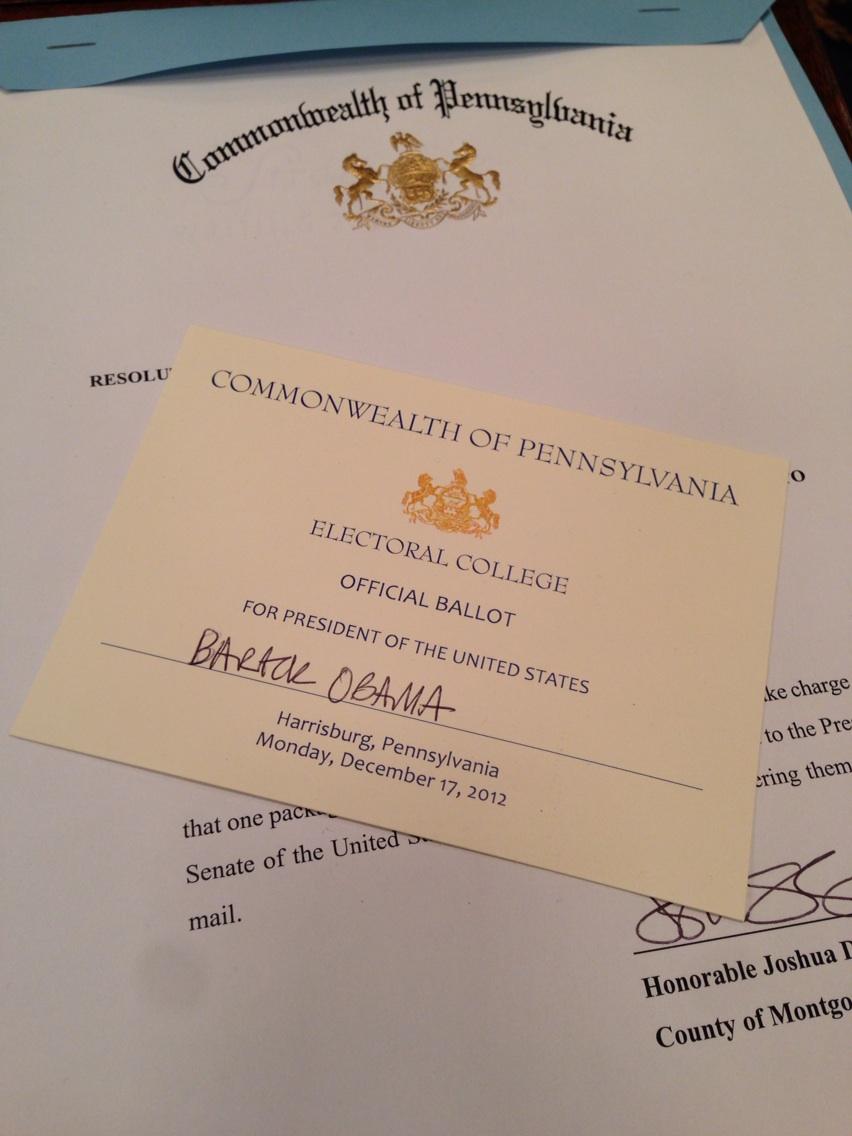
Here is the ballot of Pennyslvania elector Josh Shapiro:
Sunday, October 28, 2012
A Romney Path Without Ohio or Virginia
It is just possible for Romney to win without Ohio or Virginia. An independent poll finds that Obama and Romney are in a statistical tie in Minnesota. If he can carry that state, along with Iowa and Wisconsin, then Romney could get the minimum 270.
Here is a map from the RCP do-it-yourself page:

Here is a map from the RCP do-it-yourself page:

Friday, October 14, 2011
Social Media's New Role
At TechPresident, Nick Judd writes of the new role of social media in the presidential campaign:
More than in any other race to date, Americans may experience the 2012 presidential election through precisely targeted phone calls, visits, tweets and Facebook posts — messages not from the candidates themselves, but from their own politically active friends.
If those messages come, they won't be random. As campaigns become more savvy about their data on supporters and voters, they are also becoming more and more sophisticated in the way they plan voter contact. This is already leading to new tools, like one built by NGP VAN and used in an ongoing labor campaign, that don't just encourage users to spread the message of a campaign — they help each supporter make a data-driven decision about who to contact.
The union-backed We Are Ohio campaign, organizing against changed collective bargaining laws in Ohio, uses a tool built by NGP VAN that serves as a prime example of this kind of strategy. Users who visit the tool, accessible via a web interface, can build a list from among their Facebook friends by logging in with their account. (They can also type names in one at a time.) As they identify people they'd be willing to reach out to, the tool checks an NGP VAN voter database for an existing record of that person's name, phone number and voting status. When the user has a list of the right kinds of people to call, the tool then presents the user with each voter's phone number and a script.
"We know that messages coming from your friends or your family are more powerful," Melissa Fazekas, a spokeswoman for We Are Ohio, told me Monday. At We Are Ohio, this tool is called the "friends and family program" — and it taps into the personal connections of thousands of supporters, she said.
Subscribe to:
Posts (Atom)