Bessette Pitney Text

Bessette/Pitney’s AMERICAN GOVERNMENT AND POLITICS: DELIBERATION, DEMOCRACY AND CITIZENSHIP reviews the idea of "deliberative democracy." Building on the book, this blog offers insights, analysis, and facts about recent events.

Search This Blog

Showing posts with label insurance. Show all posts

Sunday, May 11, 2025

Disability Insurance and Private Investigators

Esmé Weijun Wang at WP:
A little-known (or at least, I believe it’s little-known) fact about private investigators is that they are not so much like the heroes of mystery novels. They usually aren’t solving crimes that the cops can’t manage or even searching out if someone is conducting an extramarital love affair. Most of the time, they’re hired by insurance companies like the one that I dealt with for at least two years, who are trying to prove that their claimants are not disabled. According to Marc Whitehead & Associates, a national disability benefits law firm, “Insurance companies do use private investigators to prove the claimant is not as injured as alleged. It is a way for them to deny claims and save money. The aim is to deny as many claims as possible. That is the business model.”

More details from the NY  law firm Riemer Hess. 

The insurance company will latch onto any social media activity that seemingly contradicts your long term disability claim.  This is extremely problematic because your social media profile may not accurately depict your everyday life.  People tend to put their best face forward on social media – choosing to share information about happy events and milestones, rather than their everyday struggles. 

For example, your social media profile is likely to have more pictures of you smiling than of you struggling with mundane daily activities (e.g., cleaning, cooking, grooming, etc.) or work-related activities (e.g., typing, multitasking, thinking critically, sitting or walking for long periods, etc.).  But, when the insurance company looks at your profile, it may assume you simply don’t have any difficulties.


Posted by Pitney at 5:18 AM
Labels: disability, government, insurance, political science, politics, privacy

Tuesday, May 28, 2024

Home Insurance

Patrick Cooley at WP:
One 2023 estimate, released by the industry group Insurance Information Institute, concluded that 12 percent of homeowners had no insurance in 2022, up from just 5 percent in 2019.

Another more recent study, released by the Consumer Federation of America this past March, reported a lower share of uninsured — 7.4 percent — but that estimate is based on 2021 data from the American Housing Survey, which the Census Bureau conducts every two years. The organization is certain to revise that share upward once 2023 numbers come out, said the CFA’s director of housing, Sharon Cornelissen.

Most uninsured homeowners are those who have paid off their mortgage and are no longer required to have insurance. Among those who own their home outright, the CFA estimates roughly 14 percent are uninsured, with low-income and minority homeowners especially at risk. Among mortgage holders, only 2 percent opt to go without coverage.

Experts say this trend is driven by the escalating threat of climate change — which has forced insurers  to make larger and larger payouts — and skyrocketing housing prices. Both trends are pushing the cost of policies up. On average, home insurance policies rose 11.3 percent in 2023, according to S&P Global.

Compounding the problem, some insurance providers, driven by rising payouts, are pulling out of disaster-prone areas — leaving former policyholders with fewer and more expensive alternatives.
Posted by Pitney at 5:54 AM
Labels: climate change, government, housing, insurance, political science, politics, state government

Wednesday, September 6, 2023

Insurance, Disaster, and Climate Change

 Jacob Bogage at WP:

In the aftermath of extreme weather events, major insurers are increasingly no longer offering coverage that homeowners in areas vulnerable to those disasters need most.

At least five large U.S. property insurers — including Allstate, American Family, Nationwide, Erie Insurance Group and Berkshire Hathaway — have told regulators that extreme weather patterns caused by climate change have led them to stop writing coverages in some regions, exclude protections from various weather events and raise monthly premiums and deductibles.

Major insurers say they will cut out damage caused by hurricanes, wind and hail from policies underwriting property along coastlines and in wildfire country, according to a voluntary survey conducted by the National Association of Insurance Commissioners, a group of state officials who regulate rates and policy forms


 Robert Gebelhoff at WP:

More than 30 insurers have left the state or limited their coverage options in the past three years, and more are expected to leave soon. That’s partly due to an insurance scam in the state that has tied up insurers in frivolous, expensive litigation, which the state government enacted legislation to address. But the much larger problem — that powerful hurricanes are becoming more frequent — looms large.

With fewer coverage options, Florida homeowners are scrambling to find affordable policies. The state-backed Citizens Property Insurance, ostensibly a last-resort option, is now Florida’s largest home insurer, stressing the company’s solvency. Some Floridians have taken the much riskier route of going without insurance, setting up the local economy for serious pain the next time a powerful storm hits.

And it’s not just Florida. In California, worsening wildfires have also driven insurers from the state or forced them to scale back policies. Residents of Washington, Montana and Colorado are watching their coverage options shrink, too.


Posted by Pitney at 5:55 AM
Labels: climate change, disaster, Florida, government, insurance, political science, politics

Tuesday, December 10, 2019

Health Care Opinion 2019

At Gallup, Jeffrey M. Jones reports on polarized views of health care costs:
Republicans' and Democrats' levels of satisfaction with what they pay for their own healthcare have diverged in the past year. The 73% of Republicans who are satisfied with the total cost they pay for healthcare is up from 60% a year ago, and is the highest level of satisfaction for the group to date. Meanwhile, 52% of Democrats, down from 61%, are satisfied -- the lowest satisfaction for Democrats in Gallup's 19-year trend.
Jones also reports:
Americans continue to prefer a healthcare system based on private insurance (54%) over a government-run healthcare system (42%). Support for a government-run system averaged 36% from 2010 to 2014 but has been 40% or higher each of the past five years.
 Lydia Saad reports a disturbing number:
 A record 25% of Americans say they or a family member put off treatment for a serious medical condition in the past year because of the cost, up from 19% a year ago and the highest in Gallup's trend. Another 8% said they or a family member put off treatment for a less serious condition, bringing the total percentage of households delaying care due to costs to 33%, tying the high from 2014.
Posted by Pitney at 6:31 AM
Labels: government, health, health care, insurance, polarization, political science, politics, public opinion

Wednesday, September 18, 2019

AARP v. PhRMA

Nicholas Florko at STAT:
AARP’s white-haired “strike force,” as the organization calls them, is on the offensive like never before — bashing big business with a righteous indignation that could surprise activists decades younger and positioning AARP as the drug industry’s primary opponent.
“I can’t really think of another time when there’s been this strong a message in opposition to an entire industry,” said John Rother, the group’s former head of policy and the current CEO of the National Coalition on Health Care.
As Max Richtman, head of the National Committee to Preserve Social Security and Medicare, put it, “PhRMA is an 800-pound gorilla. And I think they’re meeting another 800-pound gorilla in AARP.”

Positioning itself as pharma’s main antagonist, however, has opened up the group to a new line of attack from PhRMA, the drug industry’s lobbying arm, which has launched something of a counter-offensive campaign. Its ads zoom in on the roughly $600 million AARP rakes in each year from selling private Medicare Advantage and Medicare supplement insurance plans to its members. That hefty sum, PhRMA says, raises serious questions about the motivation behind AARP’s push.
“In many respects, AARP is an insurance company that is masquerading as a seniors advocacy organization,” said Robert Zirkelbach, executive vice president of public affairs at PhRMA. “AARP has significantly increased their involvement in the drug pricing debate, and we think it’s important to point out what might be motivating their perspective.”
Posted by Pitney at 1:45 PM
Labels: AARP, business, drugs, government, health care, insurance, interest groups, political science, politics

Tuesday, July 23, 2019

Americans Like Their Private Insurance

Daniel Dale at CNN:
If you ask people for their views on the cost of their health care, people on Medicare are much more likely to be satisfied than people on private insurance. In a Gallup poll in 2018, 51% of people on private insurance said they were satisfied with the total cost they paid. That was much lower than the 70% of satisfied people on Medicare or Medicaid.
If you ask people for their views on health insurance corporations, they tend to be negative. In a 2015 poll by the Kaiser Family Foundation, 44% said they had a favorable view of these companies, while 51% said they had an unfavorable view.
Sanders can point to figures like these to bolster his case.
But the story changes when you ask people for their views on their own private insurance plans rather than about insurance companies or costs. In poll after poll, for years, Americans using such plans have expressed positive opinions.
...
More than 155 million Americans received private coverage through employers in 2017, or about 58% of people under age 65.
Last year, the Kaiser Family Foundation asked people who have employer plans to give their coverage a grade. Twenty-five percent gave it an "A," or excellent; 43% said "B," or good. These results -- about two-thirds rating their employer coverage positively -- have been quite consistent dating back to 1997, according to data provided to CNN by Kaiser.
In a Gallup poll last year, 85% of people who used private insurance said the quality of their health care was "excellent" or "good," versus 79% of people on Medicare or Medicaid. (Gallup combined the Medicare and Medicaid groups in its report on the poll.) When people were asked about their coverage itself rather than the quality of care, 79% of people on Medicare or Medicaid said it was excellent or good, versus 70% of people on private insurance.
Posted by Pitney at 6:06 AM
Labels: Bernie Sanders, government, health care, insurance, Medicaid, medicare, political science, politics, public opinion

Friday, March 23, 2018

Public Opinion on Interest Group Power

From the Kaiser Family Foundation:
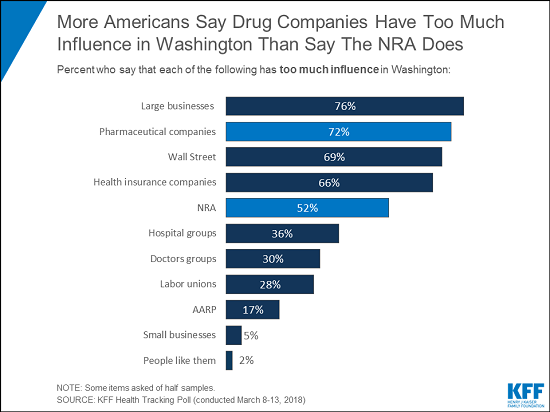
As policymakers weigh strategies to address the high cost of prescription drugs, the latest Kaiser Health Tracking Poll finds that a large majority of the public (72%) view pharmaceutical companies as having too much influence in Washington – more than say the same about the National Rifle Association (NRA).
Drug makers rank among the top tier of groups that Americans say have too much influence in Washington, along with large businesses (76%), Wall Street (69%), and health insurance companies (66%). All of these organizations rank higher than the NRA (52%), which has been at the center of the debate about school safety and gun laws following recent school shootings and subsequent protests.

 Charts_for_Alert_FINAL_marchpolltwo.png
Posted by Pitney at 1:14 PM
Labels: business, drugs, government, gun control, health care, insurance, interest groups, political science, politics, public opinion

Tuesday, January 16, 2018

Adults without Health Insurance

Gallup reports:
The percentage of U.S. adults without health insurance was essentially unchanged in the fourth quarter of 2017, at 12.2%, but it is up 1.3 percentage points from the record low of 10.9% found in the last quarter of 2016. The 1.3-point increase in the uninsured rate during 2017 is the largest single-year increase Gallup and Sharecare have measured since beginning to track the rate in 2008, including the period before the Affordable Care Act (ACA) went into effect. That 1.3 point increase represents an estimated 3.2 million Americans who entered the ranks of the uninsured in 2017.
Posted by Pitney at 5:35 AM
Labels: government, health, health care, insurance, political science, politics

Sunday, September 24, 2017

Pretty Much Everybody Hates Graham-Cassidy

There is a remarkable consensus against the Graham-Cassidy health bill.  Groups and interests that usually disagree are united in opposition. From America's Health Insurance Plans:
The following statement was jointly released on September 23, 2017 by the American Medical Association, American Academy of Family Physicians, American Hospital Association, Federation of American Hospitals, America’s Health Insurance Plans, and the BlueCross BlueShield Association regarding the Graham-Cassidy-Heller-Johnson legislation.
We represent the nation’s doctors, hospitals, and health plans. Collectively, our organizations include hundreds of thousands individual physicians, thousands of hospitals, and hundreds of health plans that serve tens of millions of American patients, consumers, and employers every day across the United States.
While we sometimes disagree on important issues in health care, we are in total agreement that Americans deserve a stable healthcare market that provides access to high-quality care and affordable coverage for all. The Graham-Cassidy-Heller-Johnson bill does not move us closer to that goal. The Senate should reject it.
We agree that the bill will cause patients and consumers to lose important protections, as
well as undermine safeguards for those with pre-existing conditions. Without these
guaranteed protections, people with significant medical conditions can be charged much
higher premiums and some may not be able to buy coverage at all.
We agree that the bill will result in dramatic cuts to Medicaid and a funding cliff in the
future, fundamentally changing the way that states provide coverage for some of our most vulnerable citizens. This means that millions of patients will lose their coverage and go without much-needed care.
We agree that the individual insurance market will be drastically weakened, making
coverage more expensive and jeopardizing Americans’ choice of health plans. By not
providing all states with sufficient funds to support working families who need help buying coverage, millions will go without it.
We agree that the bill’s current implementation timelines are not workable. State and
industry leaders will need to completely transform their individual insurance markets and
Medicaid programs in little more than a year – an impossible task.
Health care is too important to get wrong. Let’s take the time to get it right. Let’s agree to
find real, bipartisan solutions that make health care work for every American.
At The Washington Post, Christopher Ingraham provides a partial list of groups against the bill:
  • Adult Congenital Heart Association
  • ALS Association
  • Alzheimer's Association
  • Alzheimer's Impact Movement
  • American Cancer Society
  • American College of Emergency Physicians
  • American College of Physicians
  • American College of Preventive Medicine
  • American Diabetes Association
  • American Academy of Family Physicians
  • American Academy of Pediatrics
  • American Cancer Society
  • American College of Emergency Physicians
  • American College of Physicians
  • American College of Preventive Medicine
  • American Congress of Obstetricians and Gynecologists
  • American Diabetes Association
  • America's Essential Hospitals
  • American Foundation for the Blind
  • American Health Care Association
  • America's Health Insurance Plans
  • American Heart Association
  • American Hospital Association
  • American Liver Foundation
  • American Lung Association
  • American Medical Association
  • American Nurses Association
  • American Osteopathic Association
  • American Occupational Therapy Association
  • American Psychiatric Association
  • American Psychological Association
  • American Public Health Association
  • American Society for Addiction Medicine
  • American Speech-Language-Hearing Association
  • Amputee Coalition
  • The Arc
  • Arthritis Foundation
  • Association for Community Affiliated Plans

  • Association of American Medical Colleges
  • Association of University Centers on Disabilities
  • Asthma and Allergy Foundation of America
  • Autism Society
  • Autism Speaks
  • Autistic Self Advocacy Network
  • Big Cities Health Coalition
  • Blue Cross Blue Shield Association
  • Catholic Health Association
  • Children's Hospital Association
  • Center for Medicare Advocacy
  • Coalition to Stop Opioid Overdose
  • Consortium for Citizens with Disabilities
  • COPD Foundation
  • Cystic Fibrosis Foundation
  • Family Voices
  • Federation of American Hospitals
  • HIV Medicine Association
  • Infectious Diseases Society of America
  • JDRF
  • Lutheran Services in America
  • Kaiser Permanente
  • March of Dimes
  • Medicare Rights Center
  • National Association of Medicaid Directors
  • National Association of Pediatric Nurse Practitioners
  • National Association of School Nurses
  • National Coalition for Cancer Survivorship
  • National Down Syndrome Congress
  • National Health Council
  • National Institute for Reproductive Health
  • National Kidney Foundation
  • National Multiple Sclerosis Society
  • National Organization for Rare Diseases
  • Planned Parenthood
  • Public Health Institute
  • Robert Wood Johnson Foundation
  • Trust for America's Health
  • WomenHeart


Posted by Pitney at 8:10 AM
Labels: autism, government, health care, insurance, interest groups, Medicaid, political science, politics

Thursday, July 20, 2017

What Trump Does Not Know

At New York, Jonathan Chait:
In his bizarre New York Times interview, Donald Trump expresses his characteristic assortment of fever-dream assertions. The president believes Hillary Clinton “was totally opposed to any sanctions for Russia,” that a properly amortized health-insurance plan would cost “$12 a year,” that Napoleon’s “one problem is he didn’t go to Russia that night because he had extracurricular activities,” and that Trump has somehow either carried out or reversed sweeping land reforms (“I’ve given the farmers back their farms. I’ve given the builders back their land to build houses and to build other things”). Yet a consistent idea manages to poke through the delirious rambling. Trump repeatedly affirmed his conviction that the entire federal government ought to be operated for his personal benefit.
Sarah Kliff at Vox:
Of course, anyone who has purchased health coverage, let alone studied the health insurance market, knows that a $12 monthly premium is unheard of. The numbers Trump cites seem to come from the universe of life insurance rather than that of health insurance. Life insurance premiums are significantly lower and a completely different benefit program than health coverage.
This isn’t the first time Trump has so dramatically underestimated the costs of health insurance. In a May interview with the Economist, he estimated that health coverage ought to cost $15 per month.
“Insurance is, you’re 20 years old, you just graduated from college, and you start paying $15 a month for the rest of your life and you really need it, you’re still paying the same amount and that’s really insurance,” Trump told the magazine.
Posted by Pitney at 7:48 AM
Labels: Donald Trump, government, health care, insurance, knowledge, myths and misinformation, political science, politics, presidency, separation of powers

Tuesday, October 4, 2016

Insurance Industry and Insurance Regulation

Many posts have discussed interest group influence at the state level. Michael J. Mishak reports at The Center for Public Integrity:
An investigation by the Center for Public Integrity found that half of the 109 insurance commissioners who have left their posts in the last decade have gone on to work for the industry they used to regulate — many leaving before their terms expire. Just two moved into consumer advocacy.
...
The cozy relationships between regulators and industry were revealed in the Center for Public Integrity’s review of lobbyist reports, regulator financial disclosures, campaign finance records and more than 3,700 pages of emails obtained through open records laws in 13 states.
At least four commissioners had direct financial ties to the industry, with New Jersey’s top regulator selling his insurance stocks — prohibited investments under state ethics laws — only after an inquiry from the Center for Public Integrity.
Many more have accepted thousands of dollars in trips to lavish conferences sponsored by insurance companies and their trade groups in locales like The Sanctuary Hotel on Kiawah Island, South Carolina, and the Four Seasons in Jackson Hole, Wyoming.

Multiple commissioners rely on industry campaign contributions. Over the past decade, insurance companies and their employees were among the top political donors to commissioner candidates in at least six of the 11 states that elect regulators, according to data collected by the National Institute on Money in State Politics. Four of those 11 states ban contributions from the insurance industry
Posted by Pitney at 5:28 AM
Labels: business, government, insurance, interest groups, lobbying, political science, politics, regulation, state government

Wednesday, October 8, 2014

Obamacare: Still a Negative with the Public

Gallup reports:
Although more provisions of the Affordable Care Act have taken effect over the past year, more Americans still say the law has hurt rather than helped them. Compared with early 2014, fewer Americans say it has had no effect, although this group is still in the majority, at 54%.
Americans overall are both more positive and more negative about the law's effect on themselves and their families. Since the start of this year, the percentage saying the law has helped them has increased from 10% to 16%, while the percentage saying it has hurt them has also gone up, and by a similar amount, from 19% to 27%.
At the same time, overall attitudes about the law have stayed constant over the past year. Currently, 41% of Americans approve of the Affordable Care Act, commonly referred to as "Obamacare," while 53% disapprove.
Attitudes toward the Affordable Care Act remain sharply divided along party lines. Democrats are much more likely than Republicans and independents to say the law has helped them, and Republicans are much more likely to say it has hurt them. Similar percentages of Americans from all three partisan groups say the law has had no effect.
Posted by Pitney at 4:16 PM
Labels: government, health care, insurance, political science, politics, public opinion

Monday, September 29, 2014

Affordable Care Act: Limited Access to Doctors

The New York Times reports:
Enrollment in Medicaid is surging as a result of the Affordable Care Act, but the Obama administration and state officials have done little to ensure that new beneficiaries have access to doctors after they get their Medicaid cards, federal investigators say in a new report.
The report, to be issued this week by the inspector general at the Department of Health and Human Services, says state standards for access to care vary widely and are rarely enforced. As a result, it says, Medicaid patients often find that they must wait for months or travel long distances to see a doctor.
The inspector general, Daniel R. Levinson, said federal and state officials must do more to protect beneficiaries’ access to care, in view of the program’s rapid growth. Just since October, the administration says, eight million people with low incomes have enrolled. By 2016, the Congressional Budget Office estimates, one in four Americans will be on Medicaid at some time during the year.
Twenty-seven states have expanded Medicaid eligibility since the passage of the health care law in 2010, and President Obama is urging other states to do so.
The Los Angeles Times reports:
Finding a doctor who takes Obamacare coverage could be just as frustrating for Californians in 2015 as the health-law expansion enters its second year.
The state's largest health insurers are sticking with their often-criticized narrow networks of doctors, and in some cases they are cutting the number of physicians even more, according to a Times analysis of company data. And the state's insurance exchange, Covered California, still has no comprehensive directory to help consumers match doctors with health plans.
This comes as insurers prepare to enroll hundreds of thousands of new patients this fall and get 1.2 million Californians to renew their policies under the Affordable Care Act.
Even as California's enrollment grows, many patients continue to complain about being offered fewer choices of doctors and having no easy way to find the ones that are available.
Some consumers have been saddled with huge medical bills after insurers refused to pay for care deemed out of network. These complaints have sparked a state investigation and consumer lawsuits against two big insurers.
Posted by Pitney at 6:01 AM
Labels: government, health care, insurance, Medicaid, political science, politics, social welfare policy

Wednesday, September 17, 2014

Poverty and Health Insurance

From the Census:
The U.S. Census Bureau announced today that in 2013, the poverty rate declined from the previous year for the first time since 2006, while there was no statistically significant change in either the number of people living in poverty or real median household income. In addition, the poverty rate for children under 18 declined from the previous year for the first time since 2000. The following results for the nation were compiled from information collected in the 2014 Current Population Survey Annual Social and Economic Supplement.
The nation’s official poverty rate in 2013 was 14.5 percent, down from 15.0 percent in 2012. The 45.3 million people living at or below the poverty line in 2013, for the third consecutive year, did not represent a statistically significant change from the previous year’s estimate.
Median household income in the United States in 2013 was $51,939; the change in real terms from the 2012 median of $51,759 was not statistically significant. This is the second consecutive year that the annual change was not statistically significant, following two consecutive annual declines.

The percentage of people without health insurance coverage for the entire 2013 calendar year was 13.4 percent; this amounted to 42.0 million people.

These findings are contained in two reports: Income and Poverty in the United States: 2013 and Health Insurance Coverage in the United States: 2013. 
Robert Doar writes at AEI:
Over five years since the end of the recession, it would seem reasonable to expect that poverty would have dropped further from the peak hit in 2010. At 14.5% in 2013, the poverty rate has dropped from the peak of 15.1% hit in 2010. That’s progress. But it is still very far from a low of 11.3% in 2000.
Back then—with a strong economy and aggressive work-first welfare policies—we had experienced seven straight years of reductions in the poverty rate. African American child poverty reached an all-time low in 2001 also due to the winning combination of strong economic growth, work requirements in welfare, and well-targeted work supports that made work pay for those working at low wages.
We have gotten away from all three. Our economy remains stalled. Work requirements effectively do not exist in many of our welfare programs: food stamp benefits intended to support low-wage work seem to be replacing it instead, with 10 million non-elderly and non-disabled SNAP recipients not reporting any earnings. The work disincentives embedded in the Affordable Care Act are not helping either.
Posted by Pitney at 3:14 PM
Labels: census, government, health care, insurance, political science, politics, poverty, social welfare policy, statistics

Wednesday, April 2, 2014

Obamacare Context

The president announced that 7.1 million people had signed up on the health insurance exchanges.  At The Hill, Elise Viebeck and Jonathan Easley provide some context:
The central argument for ObamaCare’s passage was the need to cover the uninsured; 48 million people lacked coverage in 2012, according to the Census Bureau.
The administration last week said 6 million have signed up on the federal or state exchanges. Officials say they don’t know how many of these people previously lacked coverage, but independent estimates range as low as just 1 million, just 2 percent of those previously uncovered.
As many as 1.2 million may not have paid their first bill, which is a prerequisite for using a policy.
The law allows people up to the age of 26 to stay on their parents’ coverage, which a 2012 study by the Commonwealth Fund said added 6.6 million people to insurance rolls the previous year.
ObamaCare also expanded Medicaid, providing insurance to about 3 million additional people, according to Avalere Health.
If those totals were accurate, 
ObamaCare would be contributing to the insurance coverage of about 15.6 million people this year.
But because of ObamaCare, an estimated 4.7 million people have received cancellation notices for their existing policies.
Many were shifted to other plans or signed up for the exchanges, but some may have dropped health insurance for this year as they confronted higher-than-expected costs.
A Gallup survey released this month found the percentage of people who say they lack coverage fell in March to 15.9 percent — the lowest point in five years and more than two percentage points lower than the 18 percent recorded in mid-2013.
The Census Bureau’s annual report is usually published in September, so official insurance data for this year will probably not be available until after Labor Day of 2015.

Posted by Pitney at 11:13 AM
Labels: government, health, health care, insurance, Medicaid, political science, politics, social welfare policy

Sunday, January 12, 2014

Obamacare Problems Will Mount in 2014

The Washington Post reports:
When millions of health-insurance plans were canceled last fall, the Obama administration tried to be reassuring, saying the terminations affected only the small minority of Americans who bought individual policies.
But according to industry analysts, insurers and state regulators, the disruption will be far greater, potentially affecting millions of people who receive insurance through small employers by the end of 2014.
While some cancellation notices already have gone out, insurers say the bulk of the letters will be sent in October, shortly before the next open-enrollment period begins. The timing — right before the midterm elections — could be difficult for Democrats who are already fending off Republican attacks about the Affordable Care Act and its troubled rollout.
Some of the small-business cancellations are occurring because the policies don’t meet the law’s basic coverage requirements. But many are related only indirectly to the law; insurers are trying to move customers to new plans designed to offset the financial and administrative risks associated with the health-care overhaul. As part of that, they are consolidating their plan offerings to maximize profits and streamline how they manage them.
Meanwhile, other problems are cropping up. The Los Angeles Times reports:
Obamacare's biggest problem isn't the troubled HealthCare.gov website anymore.

Consumers are easing up on criticism of government exchanges and turning their frustration and fury toward some of the nation's biggest health insurers. All too often, new policyholders say, the companies can't confirm coverage, won't answer basic questions, and haven't issued identification numbers needed to fill prescriptions or get medical care.
Day after day, people say, they contact insurance company call centers waiting hours at a time with no response. Meantime, insurers have already taken many customers' payments for coverage intended to take effect Jan. 1.
But without proof of insurance, patients are having to pay hundreds of dollars out of pocket for medications and doctor visits, if they can afford it. Insurance agents say dismal service has become commonplace across many companies.
These industry problems pose the next major hurdle for what's already been a flawed rollout for President Obama's signature law. It could further sour public opinion on the overhaul and hamper enrollment efforts through March 31, when the first sign-up period ends.

Posted by Pitney at 7:22 AM
Labels: government, health care, insurance, political science, politics, social welfare policy

Thursday, January 9, 2014

Obamacare Troubles Continue in 2014

AP reports:
Record-keeping snags could complicate the start of insurance coverage this month as millions of people begin using policies they purchased under President Barack Obama's health care overhaul.
Insurance companies are still trying to sort out cases of so-called health insurance orphans, customers for whom the government has a record that they enrolled, but the insurer does not. They are worried the process will grow more cumbersome as they deal with the flood of new customers who signed up in December as enrollment deadlines neared.
The government says the problem is real but under control. Officials say the total number of problem cases they are trying to resolve with insurers currently stands at about 13,000. That includes orphan records. More than 1 million people have signed up through the federal insurance market that serves 36 states. Officials contend the error rate for new signups is close to zero.

Insurers, however, are less enthusiastic about the pace of the fixes. The companies also are seeing cases in which the government has assigned the same identification number to more than one person, as well as so-called "ghost" files in which the insurer has an enrollment record but the government does not.
CNN Money reports on people who lost their policies but cannot afford new ones on the exchanges.
Realizing the public relations nightmare of having insured people lose their coverage because of health reform, the Obama administration took many steps to try to address their problems.
To deal with the millions who received termination letters, it allowed insurers to renew these policies for another year. But state insurance regulators needed to agree to this extension and not all did.
It also expanded the options for buying catastrophic plans, previously available only to those under age 30 and those who qualify for a hardship exemption. And it set up a special help line for these folks, though it only received 2,400 calls, the administration said.
To assist these folks -- and everyone else -- buy plans on the exchange, it overhauled the problematic healthcare.gov site and repeatedly delayed the deadline to sign up and pay for policies. Many states running their own exchanges, such as California, followed suit.
Regardless, some consumers have been left on the insurance sidelines.
It's unclear how many. About 11 million people buy their own insurance, and reliable estimates do not exist for how many are losing coverage for 2014.
Posted by Pitney at 2:29 PM
Labels: bureaucracy, government, health care, insurance, political science, politics, social welfare policy

Wednesday, December 11, 2013

Seven Million

A previous post recounted the many times that HHS Secretary Kathleen Sebelius said that the Obamacare exchanges were "on track."  She also repeatedly said that the enrollment target was seven million.

"The congressional budget office, Andrea, projected 7 million newly insured by the end of the first open enrollment period. We’re kind of shooting for that target."  
-- Interview with Andrea Mitchell, October 1, 2013.
"I think success looks like at least 7 million people having signed up by the end of March 2014."
-- Interview with Nancy Snyderman, September 30, 2013. 
"Our target for this first open enrollment period is to have 7 million newly enrolled individuals throughout the country. We’ll have the ability to, on a very real-time basis, know who is signing up, who’s enrolling, who’s got coverage and whether or not we’re on target to meet those goals."
-- Interview with Sandhya Somashekhar, July 26, 2013
"We're hopeful that 7 million is a realistic target and that we're going to be driving our efforts toward that kind of enrollment effort."
-- Quoted in Modern Healthcare, June 24, 2013.
Politico reports:
Health and Human Services Secretary Kathleen Sebelius once described 7 million new Obamacare customers in the first year as what “success looks like.”
The White House is now trying to affix another label to the estimate: meaningless.
It might be too late. For months, the Obama administration embraced the projection by the nonpartisan Congressional Budget Office as a way to explain enrollment goals, boosting their political significance. But the broken HealthCare.gov website caused the program to lag far behind on signing up customers, and it’s a steep climb to register 7 million people by the March deadline.
About 365,000 selected a plan through the state and federal insurance exchanges in the first two months, according to figures released Wednesday, only a fraction of what the administration had estimated.
Republicans are holding up the 7 million figure as the latest example of why Obamacare is failing. They’re comparing it to President Barack Obama’s failed pledge that consumers can keep their insurance plans or doctors if they like them — another case of the administration having to answer for its rhetorical shorthand.
But White House officials — backed up by policy wonks and insurance industry experts — say the figure has very little bearing on whether Obamacare can provide affordable coverage


Posted by Pitney at 4:45 PM
Labels: government, health care, insurance, political science, politics, social welfare policy

Tuesday, December 3, 2013

Technical and Legal Obamacare Woes

Sarah Kliff writes at The Washington Post:
Around 10 a.m. Monday morning, the Obama administration began using queuing software to meter entry into the HealthCare.gov Web site. At the time, the site had fewer than 40,000 users, somewhere in the "mid-30,000" range, as Medicare spokeswoman Julie Bataille put it.
"As we looked at error rates, that was the team's determination," Bataille said.
Most notably, the queuing system went up before HealthCare.gov hit its planned target of handling 50,000 concurrent users. When pressed on this point, Bataille referred to a separate metric that the administration has used to measure success: that 800,000 people be able to use the Web site in a single day.
Also at The Washington Post, Amy Goldstein and Juliet Eilperin write:
The enrollment records for a significant portion of the Americans who have chosen health plans through the online federal insurance marketplace contain errors — generated by the computer system — that mean they might not get the coverage they’re expecting next month.
The errors cumulatively have affected roughly one-third of the people who have signed up for health plans since Oct. 1, according to two government and health-care industry officials. The White House disputed the figure but declined to provide its own.
ABC News reports:
Bob Shlora of Alpharetta, Ga., was supposed to be a belated Obamacare success story. After weeks of trying, the 61-year-old told ABC News he fully enrolled in a new health insurance plan through the federal marketplace over the weekend, and received a Humana policy ID number to prove it.
But two days later, his insurer has no record of the transaction, Shlora said, even though his account on the government website indicates that he has a plan.
“I feel like this: My application was taken … by a bureaucrat, it was put on a conveyor belt and it’s still going around, and it’s never going to leave the building,” he said. “I’ve lost hope. If it happens, great.”
Obama administration officials acknowledged today [December 2] that some of the roughly 126,000 Americans who completed the torturous online enrollment process in October and November might not be officially signed up with their selected issuer, even if the website has told them they are.
CNBC reports:
It could take a year to secure the risk of "high exposures" of personal information on the federal Obamacare online exchange, a cybersecurity expert told CNBC on Monday [November 25].
"When you develop a website, you develop it with security in mind. And it doesn't appear to have happened this time," said David Kennedy, a so-called "white hat" hacker who tests online security by breaching websites. He testified on Capitol Hill about the flaws of HealthCare.gov last week.
"It's really hard to go back and fix the security around it because security wasn't built into it," said Kennedy, chief executive of TrustedSec. "We're talking multiple months to over a year to at least address some of the critical-to-high exposures on the website itself."
Sheryl Gay Stolberg reports at The New York Times:
More than a year after the Supreme Court upheld the central provision of President Obama’s health care overhaul, a fresh wave of legal challenges to the law is playing out in courtrooms as conservative critics — joined by their Republican allies on Capitol Hill — make the case that Mr. Obama has overstepped his authority in applying it.

A federal judge in the District of Columbia will hear oral arguments on Tuesday in one of several cases brought by states including Indiana and Oklahoma, along with business owners and individual consumers, who say that the law does not grant the Internal Revenue Service authority to provide tax credits or subsidies to people who buy insurance through the federal exchange.

At the same time, the House Judiciary Committee will convene a hearing to examine whether Mr. Obama is “rewriting his own law” by using his executive powers to alter it or delay certain provisions. The panel also will examine the legal theory behind the subsidy cases: that the I.R.S., and by extension, Mr. Obama, ignored the will of Congress, which explicitly allowed tax credits and subsidies only for those buying coverage through state exchanges.

“We have agencies under this administration having an attitude that they can fix a statute, that they can improve upon a statute, that they can look at a statute’s clear language and disregard it,” Scott Pruitt, the Oklahoma attorney general, who is bringing one of the cases, said in an interview Monday. “The president himself has said on more than one occasion, ‘I can’t wait on Congress.’ In our system of government, he has to.”
Posted by Pitney at 8:34 AM
Labels: Congress, government, health care, insurance, Internet, judiciary, political science, politics, separation of powers, social welfare policy, technology

Monday, December 2, 2013

Healthcare.gov Problems Persist

The New York Times reports:
Weeks of frantic technical work appear to have made the government’s health care website easier for consumers to use. But that does not mean everyone who signs up for insurance can enroll in a health plan.

The problem is that so-called back end systems, which are supposed to deliver consumer information to insurers, still have not been fixed. And with coverage for many people scheduled to begin in just 30 days, insurers are worried the repairs may not be completed in time.
...
Jeffrey D. Zients, the presidential adviser leading the repair effort, said he had shaken up management of the website so the team was now “working with the velocity and discipline of a high-performing private sector company.”

Mr. Zients said 50,000 people could use the website at the same time and that the error rate, reflecting the failure of web pages to load properly, was consistently less than 1 percent, down from 6 percent before the overhaul.
...
But neither Mr. Zients nor the Department of Health and Human Services indicated how many people were completing all the steps required to enroll in a health plan through the federal site, which serves residents of 36 states.

And unless enrollments are completed correctly, coverage may be in doubt.
Posted by Pitney at 5:23 AM
Labels: bureaucracy, government, health care, insurance, Internet, political science, politics, social welfare policy, technology
Older Posts Home
View mobile version
Subscribe to: Posts (Atom)

Links

  • Our Textbook -- American Government: Deliberation, Democracy, and Citizenship
  • After Hope and Change -- the Blog
  • Autism Policy and Politics
  • John J. Pitney, Jr.

Digg

('DiggThis’)

BlogCatalog

Political History Blogs - BlogCatalog Blog Directory
Simple theme. Theme images by sandoclr. Powered by Blogger.