Search This Blog

Showing posts with label Mississippi. Show all posts

Wednesday, September 17, 2025

Religion in the States

 Many posts have discussed the role of religion in American life.

Chip Rotolo, Benjamin Wormald, Bill Webster and Justine Coleman:

Pew Research Center’s 2023-24 Religious Landscape Study was designed to paint a statistical portrait of religion in all 50 states and the District of Columbia.

The study finds that Mississippi is the most religious state, Vermont the least. 

state.comparisonLabel

Wednesday, March 27, 2024

Worship Attendance in the States

 Many posts have discussed the role of religion in American life.  

Alex Fitzpatrick and Alice Feng at Axios:

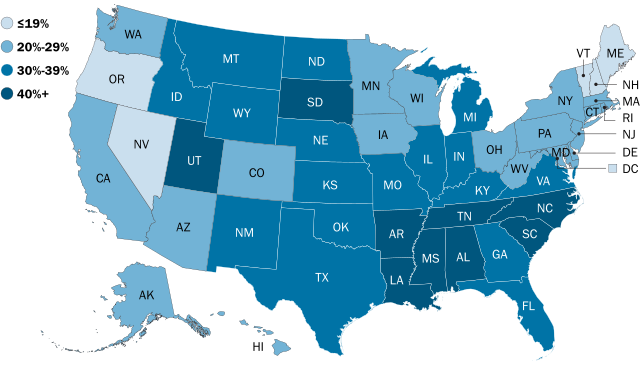
Data: Household Pulse Survey; Note: Adults who say they never attend a service or attend less than once a year; Map: Alice Feng/Axios

Vermont (75%), New Hampshire (66%) and Maine (66%) have the highest share of adults who say they never or seldom attend church or religious services, compared to the national average of 49%, per a new Axios analysis of Household Pulse Survey data.

Why it matters: More than three-quarters of Americans say religion's role in public life is shrinking, per a recent Pew Research Center survey — the highest level since the group first started tracking such sentiment in 2001.Many Americans are unhappy about that, with about half of adults telling Pew both that "religion is losing influence and that this is a bad thing."
About 57% of adults say that religion has a positive impact on American life, per Pew.

The other side: Mississippi (32%), Alabama (36%) and Louisiana (37%) have the lowest share of adults who say they never or seldom attend services.


Thursday, November 2, 2023

The Decline of Electoral Competition

David A. Lieb and Emily Wagster Pettus at AP:
More than four-fifths of Mississippi’s legislative candidates will have no major-party opposition in the Nov. 7 general election. And more than half of this year’s winners will have faced no other Republicans or Democrats in either the primary or the general election.

...

Though Mississippi represents an extreme example, it highlights a national decline in competition for state legislative seats. New research suggests the reasons are more complex than mere voter satisfaction with incumbents. It also raises questions about the ability of American voters to hold their elected representatives accountable.

In some states, “there’s so many uncontested seats that one party wins the chamber before an election takes place,” said Steven Rogers, a political scientist at Saint Louis University who focuses on state legislatures.

A democracy “relies on this notion that the people will have some sort of choice,” Rogers added. But “without someone running for office, there isn’t really a choice.”

In Mississippi, the percentage of legislative seats with no major-party opposition in the general election has risen steadily from 63% in 2011 to 85% this year. The percentage with no Republican or Democratic challengers in either the primary or the general election has grown from 45% to 57% over that same time, according to data compiled for The Associated Press by Ballotpedia, a nonprofit organization that tracks elections.

Sunday, September 19, 2021

Mississippi Burning (With COVID)


Monday, December 16, 2019

America's Health Rankings

America's Health Rankings analysis of America's Health Rankings composite measure, United Health Foundation, AmericasHealthRankings.org, Accessed 2019.
  • Healthiest State: Vermont: 0.850
  • Least-healthy State: Mississippi: -1.005
  • Definition: Weighted sum of the number of standard deviations each core measure is from the national average.
National Highlights:
  • Since 2012, smoking decreased 24% from 21.2% to 16.1% of adults
  • Since 2012, obesity increased 11% from 27.8% to 30.9% of adults
  • Since 2003, air pollution decreased 36% from 13.2 to 8.4 micrograms of fine particles per cubic meter
  • Since peaking in 1993, violent crime decreased 50% from 758 to 381 offenses per 100,000 population
  • Low birthweight increased 4% from 8.0% to 8.3% of live births in the past three years, and 19% since 1993
  • Since 2012, diabetes increased 15% from 9.5% to 10.9% of adults
  • In the past four years, frequent mental distress increased 13% from 11.0% to 12.4% of adults
  • Since 1990, infant mortality decreased 43% from 10.2 to 5.8 deaths per 1,000 live births
  • In the past two years, mental health providers increased 13% from 218.0 to 247.4 per 100,000 population
  • Drug deaths increased 37% from 14.0 to 19.2 deaths per 100,000 population in the past three years, and 104% since 2007

Thursday, December 14, 2017

Health Rankings: "Mississippi Has the Greatest Opportunity for Improvement in Overall Health"

America’s Health Rankings® presents its 28th Annual Report, providing new insights to the longest-running assessment of the nation’s health on a state-by-state basis. The 2017 report looks at 35 measures covering behaviors, community and environment, policy, clinical care and outcomes data. The report also serves as a benchmark for states – and the nation – to measure progress, identify emerging trends and drive action for improving public health.
...

Across the U.S., the premature death rate (the number of years of potential life lost before age 75) increased for the third straight year, reaching 7,214 years lost before age 75 per 100,000 population. This recent rise is concerning, particularly after the
premature death rate declined dramatically by 20 percent from 1990 to 2015.

2017 also saw increases in the rates of cardiovascular and drug deaths nationwide. Cardiovascular deaths increased in the U.S. for the second consecutive year. The rate among blacks is significantly higher than the rate among whites, Hispanics, Asians
and American Indians/Alaska Natives. Drug deaths continued on an upward trend, increasing by 7 percent to the highest level recorded by America’s Health Rankings (15.0 deaths per 100,000 population) and were particularly high among whites
...

This year, Massachusetts ranks as the healthiest state, while Hawaii — which has held the top spot for the past five years — drops to second. Vermont (No. 3), Utah (No. 4) and Connecticut (No. 5) round out the top five states for overall health.
For the second year in a row, Mississippi (No. 50) has the greatest opportunity for improvement in overall health. Louisiana (No. 49), Arkansas (No. 48) and Alabama (No. 47) maintained their rankings from last year, while West Virginia fell three places (No. 46) to round out the five states with the most significant areas of opportunity for improvement in health and well-being.

Friday, June 30, 2017

Federalism and the "Election Integrity" Commission

From the Mississippi Secretary of State:
“Our Office has not received any correspondence from the Presidential Advisory Commission on Election Integrity. A copy of such correspondence to another Secretary of State has been forwarded to us. As all of you may remember, I fought in federal court to protect Mississippi voters’ rights for their privacy and won. (See True the Vote v. Hosemann, 43 F.Supp.3d 693 (S.D. Miss. 2014))
In the event I were to receive correspondence from the Commission requesting the following,
‘if publicly available under the laws of the state, the full first and last names of all registrants, middle names or initials if available, addresses, dates of birth, political party (if recorded in your state), last four digits of social security number if available, voter history (elections voted in) from 2006 onward, active/inactive status, cancelled status, information regarding any felony convictions, information regarding voter registration in another state, information regarding military status, and overseas citizen information,’
My reply would be: They can go jump in the Gulf of Mexico and Mississippi is a great State to launch from.
Mississippi residents should celebrate Independence Day and our State’s right to protect the privacy of our citizens by conducting our own electoral processes.

Monday, February 18, 2013

The Constitution and Slavery

The Constitution's provisions dealing with slavery remain newsworthy even in 2013.

Ordinary people have played a part in constitutional history.  A student was crucial in adding the 27th Amendment. At The Atlantic, Adam Clark Estes writes:
A middle-aged recent immigrant from India recently set into motion a series of events that eventually led to Mississippi finally retifying the Constitutional amendment banning slavery. The rousing finale of the movie Lincoln served as inspiration. It sounds like a joke, but it's true. And even though it's been nearly 150 years since that fateful day in the Capitol in 1864, Mississippi's becoming the final state to officially ratify the Thirteenth Amendment serves as the final punctuation mark on a dark chapter in American history.

The circumstances for Dr. Ranjan Batra almost inadvertently inserting herself into Mississippi state history are accidental at best. After seeing Lincoln in theaters last November, he went home and did a little bit of Internet research only to discover the Mississippi never got around to actually ratifying the amendement. The state did vote to ratify the amendment back in 1995, nearly 20 years after Kentucky, the second-to-last state to ratify the amendment, held its vote. However, through an apparent clerical error, Mississippi never officially notified the United States Archivist of the ratification, meaning that they've officially been on the side of slavery for a century-and-a-half. (That sounds kind of sensational when you put it like that, but heck, you'd think the state would double check on an issue as big as this.) Batra and his friend Ken Sullivan reported the mistake up the chain of command, and this month, Mississippi finally sent in the paperwork to complete its belated ratification of the Thirteen Amendment.
Emory University President James Wagner has infuriated many on his campus and scholars elsewhere by using the president's letter in the new issue of Emory Magazine to say that the "three-fifths compromise" of the U.S. Constitution was a model for how people who disagree can work together for "a common goal."
Following an explosion of social media criticism Saturday as word of Wagner's letter spread, he released an apology. "To those hurt or confused by my clumsiness and insensitivity, please forgive me," he wrote. (The apology currently appears on top of the original letter on Emory's website, linked to in the previous paragraph.)
The three-fifths compromise expanded the political clout of the slave states by codifying that black slaves counted for purposes of allocating seats in the House of Representatives as 60 percent of a white person (even though the slave states gave black people 0 percent of the voting or other rights of white people). To many African Americans, the three-fifths compromise is among the more blatant events in which the founders of the United States explicitly denied the humanity of black people.