Search This Blog

Showing posts with label naturalization. Show all posts

Monday, July 5, 2021

Promoting American Citizenship


A Friday release from U.S. Citizenship and Immigration Services:
Today the Department of Homeland Security’s U.S. Citizenship and Immigration Services released the Interagency Strategy for Promoting Naturalization (PDF, 3.77 MB), a whole-of-government approach to breaking down barriers to U.S. citizenship and promoting naturalization to all who are eligible, as outlined in President Biden’s Executive Order 14012.

Becoming a United States citizen is a tremendous privilege,” said Secretary Alejandro N. Mayorkas. “New citizens, strengthened with the power and responsibilities that American citizenship brings, make our Nation better. This strategy will ensure that aspiring citizens are able to pursue naturalization through a clear and coordinated process.”

This report reflects the collaboration of USCIS, the Department of Education, Department of Health and Human Services, Department of State, Department of Labor, Department of Housing and Urban Development, Department of Defense, Department of Justice, Department of Veterans Affairs, Department of Agriculture, and the Social Security Administration, who are part of the interagency Naturalization Working Group. This working group was established pursuant to the President’s executive order to prioritize citizenship education and awareness through capacity building and expanded partnerships, which is at the heart of the interagency strategy.

“USCIS remains committed to empowering immigrants to pursue citizenship along with the rights and opportunities that come with it. It is fitting that this report is being released days before our nation’s 245th birthday. There is no greater testament to the strength of America than our willingness to encourage others to join us as U.S. citizens as we work together to build a more perfect union,” said USCIS Acting Director Tracy Renaud.

“We look forward to the work ahead in welcoming and supporting aspiring Americans and equipping them with the tools they need to be successful in their journey to citizenship, and beyond.”

Since the beginning of the Biden-Harris administration, USCIS has taken a number of steps to reduce barriers to naturalization and restore confidence in our nation’s legal immigration system. More information on naturalization policies issued since January 2021 is available on the USCIS website (PDF, 972.45 KB).

Tuesday, August 18, 2020

Discouraging Immigration


The price for naturalization will jump to $1,170 or $1,160 for online applications. The rule will also lower the income threshold to qualify for a fee waiver and eliminate the partial subsidy for the application.
Almost all other exceptions that allowed immigrants to waive the fee will be eliminated, including extenuating financial hardship and means-tested public benefits, like food stamps. Only some protected immigrants, including victims of domestic violence and human trafficking, will remain eligible.
Quinn Owen at ABC:
The federal government agency that handles United States asylum requests, processes visa applications and grants citizenship is preparing to furlough most of its employees while would-be citizens remain stuck waiting to get naturalized ahead of the November election.
Originally planned for the beginning of August, the furloughs were bumped back to the end of the month after Democrats and independent immigration experts questioned whether such action was necessary amid the coronavirus pandemic.
...
Joseph Edlow, the U.S. Citizenship and Immigration Services' deputy director, told lawmakers at the end of July that the agency was able to catch up on its backlog of 100,000 pending naturalization ceremonies delayed by the pandemic. However, the average number of monthly naturalizations still trails far below prior years by tens of thousands, according to data from the Department of Homeland Security.
"All USCIS operations, including naturalization ceremonies, will be impacted by a furlough," spokesperson Joe Sowers said in a statement. "At this time, we do not have the number of naturalization ceremonies that will be impacted. In the event of a furlough, we will continue to conduct naturalization ceremonies, but we anticipate it will be on a more limited basis."
An analysis from the Migration Policy Institute found budget problems at USCIS -- which is almost entirely funded by the immigration application fees it collects -- were apparent well before the pandemic and likely the result of ... "extreme vetting" of applicants.

Monday, June 22, 2020

Drive-Through Naturalization

From the Administrative Office of the U.S. Courts
Federal judges in the Motor City are embracing a novel approach to welcoming people eager to take their citizenship oaths in the age of coronavirus: Drive-through naturalization ceremonies.
This month in Detroit, federal district and magistrate judges began swearing in new citizens in drive-through ceremonies in a parking structure at the U.S. Citizenship and Immigration Services (USCIS) field office.
Citizens-to-be drive into the parking structure, are checked in by USCIS employees clad in protective gear, and then roll up to a podium where a federal judge swears them in – all without ever leaving their vehicles. The new process eliminates the need for people to gather for indoor ceremonies at the Theodore Levin U.S. Courthouse in downtown Detroit, in the Eastern District of Michigan.
Image of a drive-through naturalization ceremony

Saturday, July 15, 2017

Incompetence, Continued

Many posts have described the incompetence of the Trump administration.

The latest:


Tuesday, July 11, 2017

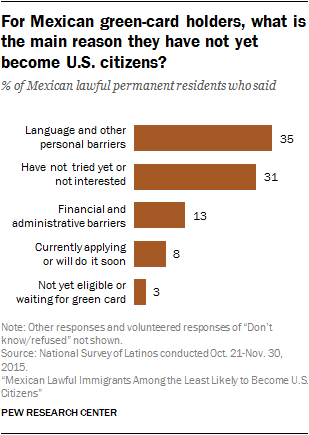
Mexican Immigrants Lag in Naturalization

Ana Gonzalez-Barrera writes at Pew:
Overall, 11.9 million of the nation’s 45 million immigrants in 2015 held lawful permanent residence (LPR) status – that is, they held “green cards,” according to Pew Research Center estimates. Of this number, most (9.3 million) had met the eligibility requirements – including length of residence – to apply for U.S. citizenship in 2015.1 Mexicans made up 37% of this group and constituted the single largest group of green-card holders without U.S. citizenship by country of origin.2

In the United States, the citizenship, or naturalization, rate among all lawful immigrants steadily increased from 1995 to 2005, rising from 47% to 62%. Until about 2005, the naturalization rate among lawful immigrants from Mexico also increased steadily, but did so more rapidly (from 20% in 1995 to 38% in 2005), narrowing the gap between Mexicans and other immigrants. However, between 2005 and 2010, the naturalization rate of Mexican green-card holders leveled off, even as the rate for lawful permanent residents from other parts of the globe continued to rise. Only in the period from 2011 to 2015 did the rate of naturalization among eligible Mexican immigrants significantly increase again at a pace higher than that of other lawful U.S. immigrants – going from 38% to 42% among Mexicans, compared with a 2-percentage-point increase, from 72% to 74% among non-Mexican immigrants.

Thursday, April 27, 2017

Denaturalization, Citizenship, and Speeding

Yesterday the court heard oral argument in Maslenjak v. United States, which asks whether a naturalized U.S. citizen can be stripped of her citizenship in a criminal proceeding based on an immaterial false statement. Amy Howe analyzes the argument for this blog. In The New York Times, Adam Liptak reports that several of the “justices seemed taken aback” by the idea “that the government may revoke the citizenship of Americans who made even trivial misstatements in their naturalization proceedings.” Additional coverage of the argument comes from Jess Bravin in The Wall Street Journal, who reports that “[s]kepticism over the Trump administration’s broad view of government power didn’t translate into sympathy for Divna Maslenjak, the Bosnian Serb immigrant who filed the appeal.”
From the transcript of oral argument: 
CHIEF JUSTICE ROBERTS: But, scrupulously, I -- I looked at -- on the naturalization form, there is a question. It's Number 22. "Have you ever" -- and they've got "ever" in bold point --
MR. PARKER: Uh-huh.
CHIEF JUSTICE ROBERTS: -- "committed,
assisted in committing, or attempted to commit a crime or offense for which you were not arrested?" Some time ago, outside the statute of limitations, I drove 60 miles an hour in a 55-mile-an-hour zone. (Laughter.)
MR. PARKER: I'm sorry to hear that.
CHIEF JUSTICE ROBERTS: I was -- I was not arrested. Now, you say that if I answer that question no, 20 years after I was naturalized as a citizen, you can knock on my door and say, guess what, you're not an American citizen after all.
MR. PARKER: Well --
CHIEF JUSTICE ROBERTS: Is that right?
MR. PARKER: If -- well, I would say two things. First, that is how the government would interpret that, that it would require you to disclose those sorts of offenses.
CHIEF JUSTICE ROBERTS: Oh, come on. You're saying that on this form, you expect everyone to list every time in which they drove over the speed limit --
MR. PARKER: No.
CHIEF JUSTICE ROBERTS: -- except when they were arrested.
MR. PARKER: Well, what I think the -- what I think that particular question demonstrates is -- and I will readily acknowledge, number one, that is a very broad question, and, number two, and I think that there is a great deal of ambiguity in what exactly is meant by "crime and offense." And --
CHIEF JUSTICE ROBERTS: Well, but just -- it's worse. If you look in Black's --
(Laughter.)
CHIEF JUSTICE ROBERTS: In Black's Law Dictionary, I looked up what's an offense? And this is what it says: It says it's a violation of the law, a crime, often a minor one.
MR. PARKER: Uh-huh.
CHIEF JUSTICE ROBERTS: So you really are looking for the listing of every time somebody drove over the speed limit.

Friday, August 30, 2013

Residents Who Forgo Citizenship

The New York Times reports on legal US residents who choose not to become citizens:
According to some estimates, about 40 percent of all people who hold green cards, the gateway to citizenship, do not naturalize.
Of those, many may want to apply but are deterred by a variety of reasons, including the $680 application fee or the requirement that most applicants must prove they can read, write and speak basic English, immigrants’ advocates said. Some countries — including Japan, China and Iran — generally do not permit their citizens to acquire a second nationality, forcing a difficult choice.
But alongside those potential applicants, there is a vast population of green card holders who have everything they need to naturalize, including the language skills, money, sufficient time of residence in the United States, permission from their native countries and a clean criminal record. All they lack is the desire.
They simply do not want it — or want it enough — and cite various reasons, including an overriding patriotism for their native country, disaffection for the policies of the United States government, even simple fecklessness.
“So often in textbooks about immigration, the cover illustration is the naturalization ceremony with the American flag and a group of immigrants, highly diverse by race,” said Alan Hyde, a Rutgers University professor who teaches immigration law and was a co-author of a recent study about why some people do not naturalize. “So much that is written on immigration just assumes that they come, they assimilate, they get green cards and they naturalize.”
But, he added, a different reality exists for so many other immigrants — those who do not want to naturalize. “Most people don’t know it’s a distinctive feature of America,” Mr. Hyde said.

Tuesday, February 5, 2013

Immigrants from Mexico and Naturalization

The Pew Hispanic Center reports on legal residents who have not yet become citizens:
Nearly two-thirds of the 5.4 million legal immigrants from Mexico who are eligible to become citizens of the United States have not yet taken that step. Their rate of naturalization—36%—is only half that of legal immigrants from all other countries combined, according to an analysis of Census Bureau data by the Pew Hispanic Center, a project of the Pew Research Center.
Creating a pathway to citizenship for immigrants who are in the country illegally is expected to be one of the most contentious elements of the immigration legislation that will be considered by Congress this year. Mexican immigrants are by far the largest group of immigrants who are in the country illegally—accounting for 6.1 million (55%) of the estimated 11.1 million in the U.S. as of 2011.
Mexicans are also the largest group of legal permanent residents—accounting for 3.9 million out of 12 million. The Center’s analysis of current naturalization rates among Mexican legal immigrants suggests that creating a pathway to citizenship for immigrants in the country illegally does not mean all would pursue that option. Many could choose an intermediate status—legal permanent resident—that would remove the threat of deportation, enable them to work legally and require them to pay taxes, but not afford them the full rights of U.S. citizenship, including the right to vote.
A nationwide survey of Hispanic immigrants by the Pew Hispanic Center finds that more than nine-in-ten (93%) who have not yet naturalized say they would if they could. Asked in an open-ended question why they hadn’t naturalized, 26% identified personal barriers such as a lack of English proficiency, and an additional 18% identified administrative barriers, such as the financial cost of naturalization. The survey also revealed that among Hispanic legal permanent residents, just 30% say they speak English “very well” or “pretty well.”

Wednesday, July 4, 2012

Citizenship on the Fourth of July

Independence Day is a good time to look at citizenship and naturalization.

CNN reports:
Jutka Emoke Barabas remembers that jittery feeling well. She was naturalized in 2000 in Honolulu, where she still lives, and is one of several CNN iReporters who spoke aboutwhy they chose to become American citizens. "Everyone arrived too early and we found ourselves standing and waiting, hardly able to contain our excitement," she said. "Everyone seemed to speak at the same time as they shared their stories with one another." There was a soldier from Cambodia, and Emoke Barabas herself, a political refugee from Hungary.
As a writer with dissenting views, Emoke Barabas said she had been thrown in a Romanian prison under former dictator Nicolae Ceausescu. Her father showed her a photo of the Statue of Liberty, telling her, "This is the place where freedom lives." After her release, she said she made it to Switzerland and, eventually, to the United States in 1990. Ten years later, she became a U.S. citizen.
"For me, American citizenship means freedom of expression and to live and work in a free country ... and not have to be afraid of being arrested or harassed because of owning certain common books or pictures," said Emoke Barabas. She also feels a sense of responsibility to her adopted country. "To be an American is not just a great honor, but also an obligation to do more and reach higher."
NPR reports:
Forty-four soldiers and Marines in Afghanistan are celebrating this Fourth of July as American citizens for the first time after their naturalization ceremony at Kandahar Air Field.
...
Among those preparing to recite the oath was Griselda Murorodarte. The 21-year-old Army specialist was born in Mexico and grew up in California.
She said it's important for her to become a U.S. citizen.
"I do wear the flag on my right shoulder, and I proudly wear it, and now I can proudly say I'm an American citizen," she said.
When Murorodarte was 4, her mother took her and her sister to the U.S. to escape a bad family situation in southern Mexico. She said she owes everything to her mother because of all the sacrifices she made for her to be where she is today.
Murorodarte said she knew that joining the Army would allow her to get her citizenship more quickly, but the access to educational opportunities influenced her more. She's not focused on any of that right now, though.
"Honestly, my mindset at the moment is duty," she said. "Mission comes first, but this is a very special day for me and I'm always going to remember this."
A week ago, The Los Angeles Daily News reported:
Joaquin Arciago Guzman could barely recite the Oath of Allegiance but did get up from his wheelchair and put his hand over his heart to become - at age 102 - a naturalized American citizen Wednesday. | See photo gallery.
The moment marked a rare achievement for the North Hollywood man - nationwide only 27 people older than age 100 have become U.S. citizens in at least the past 50 years.
"I'm happy," the Philippines-born immigrant said in Tagalog after the ceremony at the Los Angeles Convention Center.

Sunday, August 1, 2010

Citizenship and Military Service

In our book, we note the longstanding connection between citizenship and military service. A controversial memo (see Friday post) by US Citizenship and Immigration Services has at least one provision that enjoys bipartisan support because of this connection. The New York Times reports:

According to the memo, one of those changes has been quietly put into practice since May. The new policy allows illegal immigrants who are spouses, parents and children of American citizens serving in the military to complete the process of becoming legal residents without having to leave the United States — a procedure that is known in immigration law terms as granting parole. The memo says agency officials approved the new parole approach “to preserve family unity and address Department of Defense concerns regarding soldier safety and readiness for duty.”

In a letter on July 9, 18 members of the House, including nine Republicans, urged Homeland Security Secretary Janet Napolitano to make broader use of that measure and several others to “provide some relief” to active-duty soldiers with close relatives who did not have legal immigration status. The measures the lawmakers advocated are also proposed in the immigration agency’s memo, including the broader use of “deferred action,” a power that allows immigration authorities to cancel deportations.

Among the Republicans signing the letter were Representatives William M. Thornberry of Texas and Representative Michael R. Turner of Ohio, both members of the House Armed Services Committee, as well as Representatives Mike Pence of Indiana and Sam Johnson of Texas. Mr. Turner and Mr. Johnson are staunch opponents of amnesty for illegal immigrants. The letter was also signed by Representative Zoe Lofgren of California, the Democrat who is chairwoman of the House immigration subcommittee.

In the Philadelphia Inquirer, Silvio Laccetti offers historical context:

Roman ideals shaped our Founding Fathers' thinking on citizenship. To understand the value of the status in ancient Rome, one need only look to the experience of the apostle Paul. Arrested on arrival in Jerusalem for his preachings, Paul would have been condemned to death if tried there. But because he was a Roman citizen, he was able to appeal to Caesar and be tried in Rome.

A common Roman practice continued in modern times is the granting of citizenship to those who serve in the military. Those visiting the National Constitution Center's "Ancient Rome & America" exhibition, which closes after this weekend, learned about Infante Veneto, who was given full rights of citizenship upon his military discharge in A.D. 93. His documentation is on display next to that of Thomas Lomax, an American who obtained citizenship after one year of residency and one year of military service in 1864.

Also see:


Monday, July 12, 2010

Video on Naturalization

From ReasonTV, a libertarian site:

Thursday, May 13, 2010

Taking Away Citizenship

Our chapter on citizenship discusses circumstances under which the government may strip an American of citizenship. There is little doubt that it can do so with a naturalized citizen who committed fraud in the process of naturalization. According to legal scholar Peter Schuck, the Times Square bombing suggests other circumstances.

Under a 1940 statute that is still in force, the government can de-nationalize citizens who serve in a foreign military; vote in a foreign election; swear allegiance to, hold office, or naturalize in a foreign state; expressly renounce their citizenship before certain U.S. officials; or conspire to make war against the nation.

But a 1967 Supreme Court decision, Afroyim v. Rusk, held that Congress cannot revoke citizenship without the citizen's consent. Thus, in the case of the Times Square bomber, the government would have to prove that when he committed any of the actions listed in the statute, he intended to relinquish his citizenship.

In a 1980 case, Vance v. Terrazas, the Court reaffirmed this "intent to relinquish" requirement, but allowed the government to prove it by a mere "preponderance of the evidence." Afroyim and Terrazas, which were both 5-4 decisions, accepted that a jury might infer intent to relinquish citizenship based on conduct—that is, even if the individual didn't utter the magic words "I intend to renounce my citizenship"—so long as he had fair opportunity to show otherwise.

The question, then, is which acts might prove the specific intent demanded by these two rulings. In Shahzad's case, if the government can show that he placed a bomb in Times Square at the behest of a terrorist group seeking to kill people simply because they are Americans, I believe that it should easily suffice. Unlike the citizen's act in Afroyim—voting in an Israeli election—the Times Square plot precludes any notion of allegiance.