
The report also notes that the Mexico to United States corridor is the largest at nearly 11 million people.


Many posts have discussed immigration.
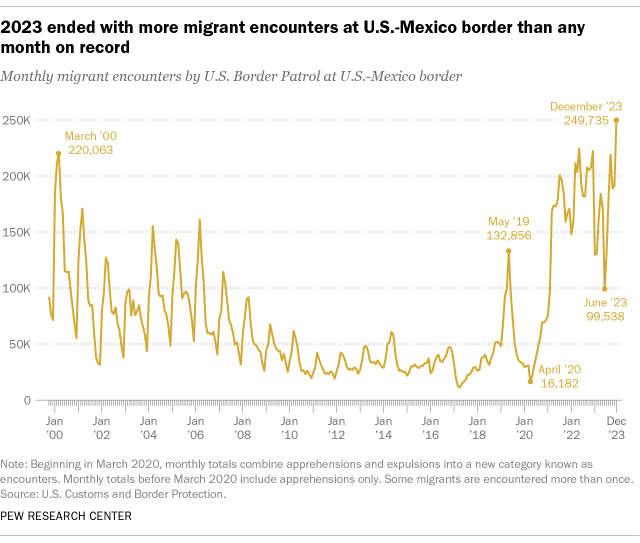
The U.S. Border Patrol had nearly 250,000 encounters with migrants crossing into the United States from Mexico in December 2023, according to government statistics. That was the highest monthly total on record, easily eclipsing the previous peak of about 224,000 encounters in May 2022.
For 32 states, the most common country of birth among respondents who said they were born outside the US was Mexico. Therefore, the map above looks at the country other than Mexico that is the birthplace of the most foreign-born respondents in the survey.
India tops that list in 21 states. Several states have Canada as a major source of immigrants. Several Asian, African, and Central American countries also have large immigrant populations in various states.
The United States stands out to many around the world as the country their own nation can rely on most, according to a new Pew Research Center survey. Pluralities or majorities in around half of the 17 countries where an open-ended question was asked named the U.S. as their most dependable ally going forward. At the same time, substantial shares of people in some countries also perceive Washington as their greatest threat.
Israelis are the most likely to name the U.S. as a reliable partner (82%) among the countries surveyed. In fact, no more than 2% of Israelis name any other country as a dependable ally. In recent years, Israelis have diverged from people in most other countries surveyed with their widespread sense that relations with the U.S. have improved in recent years and that the U.S. is doing more to address global problems.
...
Substantial shares in some countries also perceive Washington as their greatest threat – even in some in which the U.S. is the most named top ally. In Mexico, 56% say the U.S. is the greatest threat to their country, while 27% cite the U.S. as their most dependable ally (around 5% say both, concurrently). ... The other countries with the biggest shares of people naming the U.S. as a threat include Turkey (46%), Argentina (40%), Brazil (18%), Nigeria (14%) and Tunisia (12%).
Launched in 1969 and lasting just 20 days, Operation Intercept was ostensibly meant to stem the flow of illegal drugs, including marijuana, into the United States. The idea was to add agents to the border to help better intercept the contraband. “In reality, however, it was designed not to interdict narcotics but to publicize the new administration’s war on crime and force Mexican compliance with Washington’s anti-drug campaign,” political science professor Richard B. Craig wrote in 1980.
At the time, newspapers deemed it the “largest peacetime search and seizure operation in history.” The operation was planned by G. Gordon Liddy, the former FBI agent who later helped orchestrate the Watergate break-in; the State Department was effectively shut out of the planning process for the operation.
Operation Intercept resulted in a “near shutdown of traffic” across the southern border. There were major backups at the border; instead of random searches, everyone was searched; legal laborers and commerce couldn’t cross; and Mexico, in response to this unilateral approach to a bilateral issue, began a boycott of U.S. goods. Also, almost no marijuana was actually seized; traffickers just found other, safer ways in.
About three weeks later, the United States abandoned the plan in favor of Operation Cooperation with Mexico. Some suggest that the plan worked — Mexico, the thinking goes, was more keen to cooperate with the United States after Operation Intercept. Others suggest that Operation Intercept had lasting international consequences and serves as a cautionary tale against unilateral action on multilateral issues.
The number of unauthorized immigrants in the U.S. fell to its lowest level in more than a decade, according to new Pew Research Center estimates based on 2016 government data. The decline is due almost entirely to a sharp decrease in the number of Mexicans entering the country without authorization.
But the Mexican border remains a pathway for entry by growing numbers of unauthorized immigrants from El Salvador, Guatemala and Honduras. Because of them, Central America was the only birth region accounting for more U.S. unauthorized immigrants in 2016 than in 2007.
There were 10.7 million unauthorized immigrants living in the U.S. in 2016, down from a peak of 12.2 million in 2007, according to the new estimates.
The total is the lowest since 2004. It is tied to a decline of 1.5 million people in the number of Mexican unauthorized immigrants from 2007 to 2016. Nevertheless, Mexico remains the country of origin for 5.4 million unauthorized immigrants, or roughly half of the U.S. total
One might think that colonias are just communities of immigrants living in the United States illegally, but most colonia residents are full-fledged American citizens. As citizens and taxpayers, residents demand and deserve the same basic government services as everyone else.
This begs the question: How does the United States, one of the richest countries in the world, allow third-world shantytowns to exist within its borders and house its citizens?
Colonias are communities usually built near the U.S.-Mexico border by poor Hispanic immigrants. For the federal government, the defining element of a colonia is that it has no access to clean water. These communities are the result of Texas’s light regulatory system combined with the construction of colonias on cheap, unused land outside of established city limits.
Colonia land is so cheap partly because it is prone to flooding. Children often have trouble attending school because they cannot reach school buses after overnight thunderstorms flood the streets near their houses. This further deprives families of education as a path out of poverty.
Overall, 11.9 million of the nation’s 45 million immigrants in 2015 held lawful permanent residence (LPR) status – that is, they held “green cards,” according to Pew Research Center estimates. Of this number, most (9.3 million) had met the eligibility requirements – including length of residence – to apply for U.S. citizenship in 2015.1 Mexicans made up 37% of this group and constituted the single largest group of green-card holders without U.S. citizenship by country of origin.2
In the United States, the citizenship, or naturalization, rate among all lawful immigrants steadily increased from 1995 to 2005, rising from 47% to 62%. Until about 2005, the naturalization rate among lawful immigrants from Mexico also increased steadily, but did so more rapidly (from 20% in 1995 to 38% in 2005), narrowing the gap between Mexicans and other immigrants. However, between 2005 and 2010, the naturalization rate of Mexican green-card holders leveled off, even as the rate for lawful permanent residents from other parts of the globe continued to rise. Only in the period from 2011 to 2015 did the rate of naturalization among eligible Mexican immigrants significantly increase again at a pace higher than that of other lawful U.S. immigrants – going from 38% to 42% among Mexicans, compared with a 2-percentage-point increase, from 72% to 74% among non-Mexican immigrants.
Donald Trump may be one of Barack Obama's toughest critics, but when it comes to the president's use of executive orders to circumvent Congress, the Republican sees him as a role model.
Trump has already promised to be as aggressive as Obama on executive orders on a wide range of issues. Early in his campaign, for instance, he vowed to use the power of the pen to give all cop killers the death penalty. More recently, in his response to the shooting death of 49 people inside an Orlando gay club this month, he pledged to use executive power to implement one of his signature proposals: A temporary ban on Muslim immigration (even though the shooter was born in New York).
,,,
In addition to the Muslim ban, here are other policies Trump has proposed that he could accomplish without help from Congress:
...
• Tighten regulations on money-transfer companies: The cornerstone of Trump's candidacy has been a promise to build a wall along the U.S.-Mexico border. While Congress approves spending for construction projects, Trump says he can force Mexico to pay for it by taking control of an estimated $26 billion that is wired to Mexico from the U.S. every year.
Trump has said he would halt these remittances “on day one” by rewriting banking rules to expand the federal regulations on companies like Western Union and PayPal. He'd then add a new rule to block undocumented immigrants from wiring money outside the borders.
Trump’s administration would have the authority to write these rules, said Peter Wallison, former White House counsel in the Reagan administration. But Wallison and others—including Republicans and Democrats—questioned the practicality of implementing such a plan. “The notion that we’re going to track every Western Union bit of money that’s being sent to Mexico, you know, good luck with that,” Obama said after Trump unveiled his proposal in April.
With more than 40 million immigrants, the United States is the top destination in the world for those moving from one country to another. Mexico, which shares a nearly 2,000-mile border with the U.S., is the source of the largest wave of immigration in history from a single country to the United States.
But today’s volume of immigrants, in some ways, is a return to America’s past. A century ago, the U.S. experienced another large wave of immigrants. Although smaller at 18.2 million, they hailed largely from Europe. Many Americans can trace their roots to that wave of migrants from 1890-1919, when Germany dominated as the country sending the most immigrants to many of the U.S. states, although the United Kingdom, Canada and Italy were also strongly represented.
In 1910, Germany was the top country of birth among U.S. immigrants, accounting for 18% of all immigrants (or 2.5 million) in the United States. Germans made up the biggest immigrant group in 17 states and the District of Columbia, while Mexico accounted for the most immigrants in just three states (Arizona, New Mexico and Texas). Behind Germany, the second-most number of immigrants in the U.S. were from Russia and the countries that would become the USSR (11%, or 1.6 million).
A record 33.7 million Hispanics of Mexican origin resided in the United States in 2012, according to an analysis of Census Bureau data by Pew Research Center. This estimate includes 11.4 million immigrants born in Mexico and 22.3 million born in the U.S. who self-identified as Hispanics of Mexican origin.
Mexicans are by far the largest Hispanic-origin population in the U.S., accounting for nearly two-thirds (64%) of the U.S. Hispanic population in 2012.1 Hispanics of Mexican origin are also a significant portion of the U.S. population, accounting for 11% overall.
The size of the Mexican-origin population in the U.S. has risen dramatically over the past four decades as a result of one of the largest mass migrations in modern history. In 1970, fewer than 1 million Mexican immigrants lived in the U.S. By 2000, that number had grown to 9.8 million, and by 2007 it reached a peak of 12.5 million (Pew Hispanic Center, 2011). Since then, the Mexican-born population has declined as the arrival of new Mexican immigrants has slowed significantly (Passel et al., 2012). Today, 35% of Hispanics of Mexican origin were born in Mexico. And while the remaining two-thirds (65%) were born in the U.S., half (52%) of them have at least one immigrant parent.
A national opinion survey of Mexico by the Pew Research Center, conducted March 4-17 among 1,000 adults, finds that roughly two-thirds (66%) of Mexicans have a favorable opinion of the U.S. – up from 56% a year ago and dramatically higher than it was following the passage of Arizona’s restrictive immigration law in 2010, when favorable Mexican attitudes toward the United States slipped to 44%.
...
More than 11 million Mexicans live in the U.S., including about 6 million who are in the country illegally. Mexicans are divided on whether this is good or bad for their country; 44% say it is good for Mexico that many of its citizens live in the U.S., and an equal share say this is bad for Mexico.
About six-in-ten Mexicans (61%) say they would not move to the U.S. even if they had the means and opportunity to do so. However, a sizable minority (35%) say they would move to the U.S. if they could, including 20% who say they would emigrate without authorization.
Mexicans are less likely than they were a year ago to say that people from their country who move to the U.S. have a better life there; 47% say life is better in the U.S., compared with 53% in 2012. About one-in-five (18%) say Mexicans have a worse life in the U.S., while 29% say it is neither better nor worse. However, among those who have close friends or relatives living in the U.S., 70% say these friends or relatives have achieved their goals, while just 25% believe they have been disappointed.
Three-in-ten Mexicans say they personally know someone who went to the U.S. but returned to Mexico because the person could not find work. About a quarter (27%) know someone who has been deported or detained by the U.S. government for immigration reasons in the last 12 months.
The move to overhaul the nation's immigration system has stirred controversy in part over the issue of offering citizenship to the estimated 11 million illegal immigrants in the country.
But judging by the last time the U.S. opened such a path for illegal immigrants then in the country, many fewer than 11 million likely would become citizens. After the 1986 immigration overhaul, fewer than half of those eligible became naturalized.
A key reason: the government's requirements for would-be citizens. The immigrants must shell out at least $680, pass an oral exam, present five years' worth of tax returns and submit to a background check for things such as criminal convictions.
"People think it's automatic, short and easy," said Dan Siciliano, a Stanford Law School professor who studies immigration. In reality, he said, "the pathway to citizenship is onerous."
A bipartisan Senate proposal supports a path to citizenship; some House Republicans have taken a skeptical position.
Under the 1986 move to open the way for illegal immigrants to eventually become citizens, only 40% of the 2.7 million immigrants who received a green card, or permanent legal residency, had become naturalized citizens by 2009, according to a 2010 study by the Department of Homeland Security.The Pew Research Hispanic Center reports:
Nearly two-thirds of the 5.4 million legal immigrants from Mexico who are eligible to become citizens of the United States have not yet taken that step. Their rate of naturalization—36%—is only half that of legal immigrants from all other countries combined, according to an analysis of Census Bureau data by the Pew Hispanic Center, a project of the Pew Research Center.
Creating a pathway to citizenship for immigrants who are in the country illegally is expected to be one of the most contentious elements of the immigration legislation that will be considered by Congress this year. Mexican immigrants are by far the largest group of immigrants who are in the country illegally—accounting for 6.1 million (55%) of the estimated 11.1 million in the U.S. as of 2011.
Mexicans are also the largest group of legal permanent residents—accounting for 3.9 million out of 12 million. The Center’s analysis of current naturalization rates among Mexican legal immigrants suggests that creating a pathway to citizenship for immigrants in the country illegally does not mean all would pursue that option. Many could choose an intermediate status—legal permanent resident—that would remove the threat of deportation, enable them to work legally and require them to pay taxes, but not afford them the full rights of U.S. citizenship, including the right to vote.
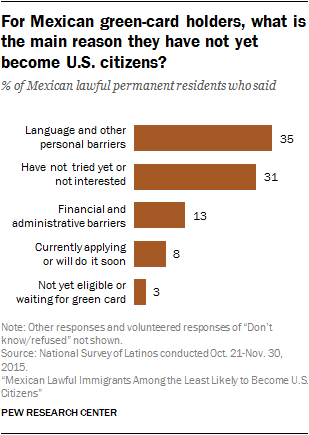
A nationwide survey of Hispanic immigrants by the Pew Hispanic Center finds that more than nine-in-ten (93%) who have not yet naturalized say they would if they could. Asked in an open-ended question why they hadn’t naturalized, 26% identified personal barriers such as a lack of English proficiency, and an additional 18% identified administrative barriers, such as the financial cost of naturalization. The survey also revealed that among Hispanic legal permanent residents, just 30% say they speak English “very well” or “pretty well.”
As lawmakers in the United States ponder the shape and form of comprehensive immigration reform, residents of Mexico -- the country that has been the largest source of U.S.-bound immigration over the past decade -- are no more likely than U.S. residents are to express a desire to leave their home country. Eleven percent of Mexicans say they would leave their homeland if given the opportunity -- a decline of about half from 21% in 2007. Likewise, the 11% of Americans who would emigrate has changed little over the past four years.
The U.S. has long prided itself on its ability to attract rather than lose residents, and some have seen Mexico as the main hub for U.S.-bound immigration. The Gallup data call into question these long-held assumptions because as many Mexicans would leave Mexico as Americans would leave America.
The percentage of Mexicans willing to leave Mexico changed significantly over 2012. In December 2012, Mexico's desire to migrate statistic was 11% -- identical to that of the U.S. An earlier survey in May 2012, conducted during a presidential campaign that reportedly stoked popular anxieties as to the future direction of the country, found the percentage at a higher 17%, a result that may be a one-time anomaly. Overall, for 2012, an average of 14% of Mexicans said they would leave their country, a result that is not statistically significant when compared with the 11% of U.S. residents that would leave if given the opportunity


Nearly two-thirds of the 5.4 million legal immigrants from Mexico who are eligible to become citizens of the United States have not yet taken that step. Their rate of naturalization—36%—is only half that of legal immigrants from all other countries combined, according to an analysis of Census Bureau data by the Pew Hispanic Center, a project of the Pew Research Center.
Creating a pathway to citizenship for immigrants who are in the country illegally is expected to be one of the most contentious elements of the immigration legislation that will be considered by Congress this year. Mexican immigrants are by far the largest group of immigrants who are in the country illegally—accounting for 6.1 million (55%) of the estimated 11.1 million in the U.S. as of 2011.
Mexicans are also the largest group of legal permanent residents—accounting for 3.9 million out of 12 million. The Center’s analysis of current naturalization rates among Mexican legal immigrants suggests that creating a pathway to citizenship for immigrants in the country illegally does not mean all would pursue that option. Many could choose an intermediate status—legal permanent resident—that would remove the threat of deportation, enable them to work legally and require them to pay taxes, but not afford them the full rights of U.S. citizenship, including the right to vote.
A nationwide survey of Hispanic immigrants by the Pew Hispanic Center finds that more than nine-in-ten (93%) who have not yet naturalized say they would if they could. Asked in an open-ended question why they hadn’t naturalized, 26% identified personal barriers such as a lack of English proficiency, and an additional 18% identified administrative barriers, such as the financial cost of naturalization. The survey also revealed that among Hispanic legal permanent residents, just 30% say they speak English “very well” or “pretty well.”
The story of the Hoover Dam has also been heavily tinted in rose and sepia. Asian-Americans were forbidden from working on the project, while African-Americans were limited to menial labor and accounted for less than 1 percent of the work force. In August 1931, work halted as construction bosses faced off against striking laborers, who had just seen their wages slashed even as the punishing heat of the Nevada summer killed more than a dozen men in barely a month. (Dozens more are believed to have died from other hazardous work conditions covered up by the project managers.) The heroic endeavor only got back on track after all the workers were threatened with immediate dismissal.Republicans such as Mitt Romney make mistakes as well.
Speaking before a veterans’ group in San Diego on Memorial Day, for example, he made the seemingly uncontroversial assertion that the United States is “unique” and “exceptional in the history of the world” as the only nation that “has been willing to lay down the lives of hundreds of thousands of sons and daughters and take no land in return.” (It is a line he had used on previous occasions, attributing it to Israeli President Shimon Peres.)
No one in the crowd seemed to notice the incongruity of Mr. Romney’s making this declaration on soil that once formed part of the Republic of Mexico. San Diego fell to the United States after troops under Capt. John C. Frémont marched into the city in July 1846, hauled down the Mexican flag and imposed martial law. Over the following six months, American troops fought intermittent skirmishes against local partisans, culminating in a pitched battle in which 21 American soldiers were killed. American control of California — along with other lands making up more than half of Mexico’s prewar territory — was confirmed in 1848 when the Treaty of Guadalupe Hidalgo ended the Mexican-American War.
Though she was born in Weslaco in 1982, Brenda Vazquez swore to a Customs and Border Protection officer that she was born in Mexico and is not a U.S. citizen.
Desperate for the end of what she says was hours of intense questioning at a Brownsville international bridge, she signed a statement denying her citizenship.
A petition filed in federal court last week states that Vazquez made the false statement on Feb. 19 after seven hours of intimidation from a Customs and Border Protection officer.
The petition says the officer seized the Texas driver’s license and U.S. birth certificate she pre-sented when returning from a visit to Matamoros.
Customs and Border Protection officials did not respond to repeated requests from The Brownsville Herald for comment for this article.
Vazquez’s petition alleges that the CBP officer repeatedly threatened her and told her she had no right to an attorney until she signed the statement of noncitizenship.
The petition states that Vazquez’s documents were taken from her and that she was forced to return to Mexico.
She remains in Matamoros, unable to cross to the U.S., and has retained an attorney, Jaime Diez of Brownsville, to help her.
The cresting of the great generation-long wave of legal and illegal immigration from Mexico won't meaningfully affect the political leverage of Hispanics in the U.S. for decades, if ever. But some Hispanic leaders worry that their political influence will ebb in November nonetheless.
The Pew Hispanic Center drew widespread attention last month when it reported that the seemingly unending migration flow that had brought some 12 million Mexicans, both legally and illegally, to the U.S. over the past four decades had ceased, if not reversed. Using Census and other data from both nations, Pew estimated that from 2005 to 2010, 1.37 million Mexicans arrived in the U.S. (both legally and illegally) while 1.39 million Mexicans already in the U.S. migrated in the opposite direction. "While it is not possible to say so with certainty," Pew concluded, "the trend lines within this latest five-year period suggest that return flow to Mexico probably exceeded the inflow from Mexico during the past year or two."
If sustained, this trend will affect the growth of the Mexican-American population over the long term (especially the very long term). But most experts agree it will have little impact on the evolution of the Hispanic electorate in the U.S. for at least the next several decades.
"If you are talking a whole generation out, say 2050, it does make a difference," says Jeffrey Passel, the Pew senior demographer who wrote the study. "But if you are talking about 8, 10, 12 years, the answer is: probably not very much."
The reason is that immigration is no longer the key to the growth of the Mexican-American population overall, and it is even less important to the rise of Hispanics in the electorate. As Pew calculated in 2011, new immigrants accounted for only a little over one-third of the 11.4 million increase in the Mexican-American population from 2000 to 2010. By contrast, Mexican-American children born in the U.S. represented 63 percent of the group's growing population over that decade.