Search This Blog

Showing posts with label 17th Amendment. Show all posts

Saturday, April 27, 2013

Congress and Experience

An earlier post noted that only 21 senators of the 113th Congress were serving in either chamber at the time of the last big tax reform (1985-86).  Since then,  Daniel Inouye (D-HI) has died and John Kerry (D-MA) has become secretary of state, leaving just 19.

With the retirement of Senator Max Baucus (D-MT), Chris Wilson writes at Yahoo News about the departures of veteran senators in recent years:
The flight of the old-timers is neatly captured by a pair of simple statistics: When the 110th Congress convened on Jan. 3, 2007,the 100 senators had a combined 1,328 years of experience in theUnited States Senate. When the 113th Congress convened last January, that figure had fallen to 1,040.
Baucus, D-Mont., is the sixth veteran Democratic senator to head for the exits rather than run for reelection next year. Even if every other current senator stays put, the 114th session of the Senate will have fewer than 1,000 combined years of incumbency for the first time since 1985.
...

The peak Senate tenure in 2007 is a particularly impressive statistic given that 12 of those 100 senators had just been elected to the chamber in the previous election. If you switch to the House view, you see a much more responsive graph, with huge dips after Watergate and during President Bill Clinton’s first term. That makes sense; a senator has a two-in-three chance of dodging a politically toxic year for congress, like 2006 or 2010,while House members have to face voters every two years.
If you study the graph of Senate tenure carefully, you can also see a significant dip in the early twentieth century as states moved to direct election of senators—a policy enshrined in the 17th amendment, adopted in 1913.

Wednesday, April 3, 2013

Senate Nominations

In our chapters on political parties and elections, we discuss ways in which parties nominate candidates for office.  At The Atlantic, Charles Cook writes:
Tennessee state Sen. Frank Nicely, a Republican from Strawberry Plains, has introduced S.B. 471, which would, beginning in 2016, eliminate party primaries for the U.S. Senate in Tennessee. Members of the state Legislature would instead select the nominees. Republican House and Senate caucuses would pick the GOP nominee, and their Democratic counterparts would select their candidate. State Rep. Harry Brooks, R-Knoxville, has also introduced the bill in the Tennessee General Assembly.

My first reaction was to be dismissive. In Washington, as in state legislatures around the country, we often see goofy bills and resolutions introduced, but most thankfully die without any action being taken. But what really got my attention was the news that the Tennessee Senate's State and Local Government Committee voted 7-1 last week to advance the bill. And, no, this isn't an April Fool's joke.

My second reaction was, why stop there? Why not just repeal the 17th Amendment to the Constitution and go back to the way things were before 1913 when voters had no say at all, and state legislatures elected U.S. senators? The 17th Amendment calls for the popular election of U.S. senators but is silent on nominations; indeed, the Constitution is silent on the whole issue of political parties.

As a result, states pretty much have a free hand in determining how nominees are selected. Utah has a two-step process whereby a candidate must clear a 60 percent threshold in the state convention to avoid a statewide primary election; if no candidate receives 60 percent of the vote, the top two candidates move on to a primary. In 2010, this process resulted in incumbent Republican Robert Bennett, one of the ablest U.S. senators to serve in a long time, not even making it onto a primary ballot. By most counts, Bennett would have easily won a primary, but in a Tea Party-packed convention process, he came up short -- his vote in favor of the Troubled Asset Relief Program was his biggest sin.

Virginia has an odd system in which the parties decide whether the state holds a convention or a primary each election cycle. Neither Utah nor Virginia has a process that should be emulated; indeed, with cynicism about government increasing, is this really a good time to cut voters out of the process? Why let state legislators choose who should be the Senate nominee?
Actually, there is serious criticism of the 17th Amendment. Citing concerns for federalism, some thoughtful writers have suggested repeal.

See here for an excellent book on the topic.

Monday, December 17, 2012

African American Senators

South Carolina Governor Nikki Haley today announced that she will appoint Representative Tim Scott (R-SC) to succeed Jim DeMint in the United States Senate. DeMint is leaving to head the Heritage Foundation.

The appointment has symbolism.  An Indian American female governor has named an African American to be a US senator from the first state to secede from the Union.  Scott will be the first African American senator from the South since Reconstruction, and only the seventh African American senator in all of American history.

The United States Senate lists the other six:


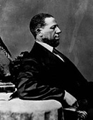
Hiram Revels
Photograph of Senator Hiram Revels
Hiram Revels (R-MS)
Hiram Revels of Mississippi became the first African American senator in 1870.  Born in North Carolina in 1827, Revels attended Knox College in Illinois and later served as minister in the African Methodist Episcopal Church in Baltimore, Maryland.  He raised two black regiments during the Civil War and fought at the battle of Vicksburg in Mississippi.  The Mississippi state legislature sent him to the U.S. Senate during Reconstruction where he became an outspoken opponent of racial segregation.  Although Revels served in the Senate for just a year, he broke new ground for African Americans in Congress.  (Photo: Library of Congress)
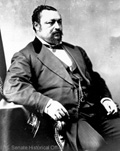
Blanche K. Bruce
bruce
Born into slavery in 1841, Blanche K. Bruce spent his childhood years in Virginia where he received his earliest education from the tutor hired to teach his master's son.  At the dawn of the Civil War, Bruce escaped slavery and traveled north to  begin a distinguished career in education and politics. Elected to the Senate in 1874 by the Mississippi state legislature, he served from 1875 to 1881. In 2002, the Senate commissioned a new portrait of Bruce, now on display in the U.S. Capitol.  (Photo: Library of Congress)


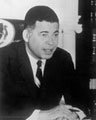
Edward Brooke
brooke
The first African American elected to the Senate by popular vote, Edward Brooke of Massachusetts served two full terms, from 1967 to 1979. Born in Washington, D.C. in 1919, Brooke graduated from Howard University before serving in the United States Army during World War II.  After the war, he received a law degree from Boston University. During his Senate career he championed the causes of low-income housing and an increased minimum wage, and promoted commuter rail and mass transit systems. He also worked tirelessly to promote racial equality in the South.  (Photo: Senate Historical Office)
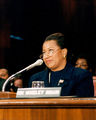
Photo of Carol Moseley Braun
Some called 1992 the "Year of the Woman." More women than ever before were elected to political office in November of that year, and five of them came to the U.S. Senate.  Carol Moseley Braun of Illinois not only joined that class on January 3, 1993, but also became the first African American woman ever to serve as U.S. Senator.  During her Senate career, Moseley Braun sponsored progressive education bills and campaigned for gun control. Moseley Braun left the Senate in January of 1999, and soon after became the U.S. Ambassador to New Zealand, a position she held until 2001. Moseley Braun ran for the Democratic nomination for president in 2004. (Photo: Senate Historical Office)
Barack Obama
Senator Barack Obama of Illinois
Barack Obama (D-IL)
Barack Obama was born in Hawaii on August 4th, 1961. He received his earliest education in Hawaii and Indonesia, and then graduated from Columbia University in 1983. He moved to Chicago in 1985 to work for a church-based group seeking to improve living conditions in poor neighborhoods. In 1991, Obama graduated from Harvard Law School where he was the first African American president of the Harvard Law Review. He served in the Illinois state senate from 1997 to 2004. Elected to the United States Senate in November of 2004, he took the oath of office and became the fifth African American to serve in the Senate on January 3, 2005. On November 4, 2008, Barack Obama was elected as the 44th President of the United States.
Roland W. Burris
Senator Roland Burris
Born in Centralia, Illinois, on August 3, 1937, Roland Burris earned a Bachelor of Arts degree in political science from Southern Illinois University Carbondale and a Juris Doctor degree from Howard University. After finishing law school in 1963, Burris became the first African American to work as a national bank examiner for the Treasury Department. When Burris was elected comptroller of Illinois in 1978, he was the first African American to win a statewide election in Illinois. After serving more than ten years as comptroller, he became attorney general of Illinois. Appointed to the Senate on December 31, 2008, Burris filled the vacancy caused by the resignation of Barack Obama.

Thursday, December 6, 2012

Note to Governor Haley: DON'T DO IT!

The 17th Amendment (1913) established direct election of senators, as well as a means of filling vacant Senate seats. It lets state legislatures empower the governor to appoint a replacement to complete the term or to hold office until a special election.  

Senator Jim DeMint (R-SC) has announced that he will resign from the Senate to head the Heritage Foundation. There is some speculation that Governor Nikki Haley might fill the slot herself. As several other governors have done, she could resign from office and have her successor name her to the Senate -- a maneuver amounting to self-appointment.  That move would be a big mistake. In 2009, Ken Rudin explained at NPR that voters resent self-appointment and governors usually lose when they try it.  He offered the complete list of governors appointed to the Senate and the result of the succeeding election:
Montana, 1933 — Sen. Thomas Walsh (D) died. Gov. John Erickson (D) appointed self, lost 1934 primary.
Kentucky, 1939 — Sen. Marvel Logan (D) died. Gov. Happy Chandler (D) appointed self, won elections in 1940 and 1942.
Nevada, 1945 — Sen. James Scrugham (D) died. Gov. Edward Carville (D) appointed self, lost 1946 primary.
Idaho, 1945 — Sen. John Thomas (R) died. Gov. Charles Gossett (D) appointed self, lost 1946 primary.
Wyoming, 1960 — Sen.-elect Keith Thomson (R) died. Gov. John J. Hickey (D) appointed self, lost 1962 election.
New Mexico, 1962 — Sen. Dennis Chavez (D) died. Gov. Edwin Mechem (R) appointed self, lost 1964 election.
Oklahoma, 1963 — Sen. Robert Kerr (D) died. Gov. J. Howard Edmondson (D) appointed self, lost 1964 primary.
South Carolina, 1965 — Sen. Olin Johnston (D) died. Gov. Donald Russell (D) appointed self, lost 1966 primary.
Minnesota, 1977 — Sen. Walter Mondale (D) elected vice president. Gov.Wendell Anderson (D) appointed self, lost 1978 election.

Friday, October 22, 2010

Repeal the 17th Amendment?

Some in the "tea party" movement would repal the 17th Amendment (direct election of senators). The Los Angeles Times disapproves:

Restoring the original political order to which many tea partyers seem to be drawn would require the repeal of more amendments than one.

For example, America was a different place before the adoption of the 14th Amendment, added after the Civil War. Like the 13th Amendment, which abolished slavery, and the 15th, which barred racial discrimination in voting, the 14th Amendment overrode what had once been seen as state prerogatives. It is best known for its definition of citizenship: "All persons born or naturalized in the United States, and subject to the jurisdiction thereof, are citizens of the United States and of the state wherein they reside." But it also profoundly altered the relationship between the states and the federal government.

The 14th Amendment also says: "No state shall make or enforce any law which shall abridge the privileges or immunities of citizens of the United States; nor shall any state deprive any person of life, liberty, or property, without due process of law; nor deny to any person within its jurisdiction the equal protection of the laws." And it gives Congress the power "to enforce, by appropriate legislation, the provisions of this article" (as it did in enacting civil rights legislation). If tea partyers want to restore the autonomy of the states, the 14th Amendment would have to go, along with the 17th.

Other amendments to the Constitution have expanded political participation, sometimes at the expense of state's rights. That was true not only of the 15th and 17th Amendments but also of the 19th, giving women the right to vote nationwide, and the 26th, granting 18-year-olds the franchise. The latter two amendments limited the states' ability to define qualifications for voting.

The Constitution is worthy of veneration, but many of its most admirable features didn't originate in the era of the three-cornered hats sported by some tea party activists. That includes the rights of the voters to choose — and remove — their senators

Berkeley law professor John Yoo takes a different view:

There’s a lot of truth to the argument that the enactment of the 17th Amendment undermined federalism. State legislatures have a greater institutional incentive to protect federalism than do the people of a state. The people of a state may want to expand federal program spending in order to get their share of tax revenues, even at the expense of greater national power over issues reserved to the states. Although they are also elected by the people, state legislators have more of an incentive to protect the original distribution of powers between the national and state governments.

Here is what James Madison had to say about the matter (during congressional discussion of the Bill of Rights in 1789):

[T]he State Legislatures will jealously and closely watch the operations of this Government, and be able to resist with more effect every assumption of power, than any other power on earth can do; and the greatest opponents to a Federal Government admit the State Legislatures to be sure guardians of the people’s liberty.

The 17th Amendment weakened the states’ ability to resist the expansion of federal powers. The problem is that there is no point to trying to fix this problem — an effort to amend the Constitution will be fruitless. It requires two-thirds of the Congress and three-quarters of the states. The Tea Partiers would be well advised to devote their efforts to achieving significant limits on the federal government — such as limiting federal spending, cutting taxes, and reversing Obamacare — that don’t demand an amendment to the Constitution. They will have a limited political window to apply their political capital; constitutional amendments will only waste it.

Friday, May 14, 2010

Enlarge the House? Repeal the 17th Amendment?

In Forbes, Bruce Bartlett writes:
Congress' dysfunction is becoming so obvious and overwhelming that radical reforms are necessary. I think a key reason for the dysfunction is that neither the House nor the Senate is constituted the way they were originally designed by the Founding Fathers. Members of the House represent far too many people today and senators no longer represent the states as states.

His proposal: increase the size of the House and repeal the 17th Amendment, which provides for direct election of senators. The first would require only a statute. The second would require a constitutional amendment and would return the election of US senators to state legislatures.

A few weeks ago, also in Forbes, Joshua Spivack argued against such a measure, warning that it would effectively nationalize state legislative elections.

Tuesday, April 13, 2010

What's Wrong with this Sentence?

Adam Clayton Powell IV announced that he would challenge Rep. Charles Rangel (D-NY) in the Democratic primary. Rangel originally won the seat after defeating Powell's father in a primary. The New York Times report on the challenge contains an odd passage. Can you spot the mistake?
During a colorful, freewheeling news conference, Mr. Powell speculated — apparently, without any direct knowledge — that Mr. Rangel would seek re-election and then resign, to control the appointment of his successor -- a suggestion that aides to Mr. Rangel immediately dismissed.
Time's up. Under the Constitution, there is no way to get a House seat by appointment. Filling a vacancy requires a special election. (The Seventeenth Amendment does allow for the temporary appointment of senators, but that provision does not apply to the House.) Online comments following the story suggested that the passage probably referred to New York election law, which enables party leaders to control nominations in special elections.