Search This Blog

Showing posts with label South Carolina. Show all posts

Friday, January 18, 2019

Union Membership in 2018

The union membership rate--the percent of wage and salary workers who were members of unions--was 10.5 percent in 2018, down by 0.2 percentage point from 2017, the U.S. Bureau of Labor Statistics reported today. The number of wage and salary workers belonging to unions, at 14.7 million in 2018, was little changed from 2017. In 1983, the first year for which comparable union data are available, the union membership rate was 20.1 percent and there were 17.7 million union workers
...
Highlights from the 2018 data: --The union membership rate of public-sector workers (33.9 percent) continued to be more than five times higher than that of private-sector workers (6.4 percent). (See table 3.) 
--The highest unionization rates were among workers in protective service occupations (33.9 percent) and in education, training, and library occupations (33.8 percent). (See table 3.) --Men continued to have a higher union membership rate (11.1 percent) than women (9.9 percent). (See table 1.)
--Black workers remained more likely to be union members than White, Asian, or Hispanic workers. (See table 1.)
--Nonunion workers had median weekly earnings that were 82 percent of earnings for workers who were union members ($860 versus $1,051). (The comparisons of earnings in this release are on a broad level and do not control for many factors that can be important in explaining earnings differences.) (See table 2.)
--Among states, Hawaii and New York had the highest union membership rates (23.1 percent and 22.3 percent, respectively), while North Carolina and South Carolina had the lowest (2.7 percent each). (See table 5.) 

Monday, December 17, 2012

African American Senators

South Carolina Governor Nikki Haley today announced that she will appoint Representative Tim Scott (R-SC) to succeed Jim DeMint in the United States Senate. DeMint is leaving to head the Heritage Foundation.

The appointment has symbolism.  An Indian American female governor has named an African American to be a US senator from the first state to secede from the Union.  Scott will be the first African American senator from the South since Reconstruction, and only the seventh African American senator in all of American history.

The United States Senate lists the other six:


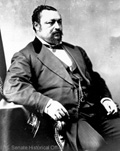
Hiram Revels
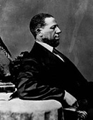
Photograph of Senator Hiram Revels
Hiram Revels (R-MS)
Hiram Revels of Mississippi became the first African American senator in 1870.  Born in North Carolina in 1827, Revels attended Knox College in Illinois and later served as minister in the African Methodist Episcopal Church in Baltimore, Maryland.  He raised two black regiments during the Civil War and fought at the battle of Vicksburg in Mississippi.  The Mississippi state legislature sent him to the U.S. Senate during Reconstruction where he became an outspoken opponent of racial segregation.  Although Revels served in the Senate for just a year, he broke new ground for African Americans in Congress.  (Photo: Library of Congress)
Blanche K. Bruce
bruce
Born into slavery in 1841, Blanche K. Bruce spent his childhood years in Virginia where he received his earliest education from the tutor hired to teach his master's son.  At the dawn of the Civil War, Bruce escaped slavery and traveled north to  begin a distinguished career in education and politics. Elected to the Senate in 1874 by the Mississippi state legislature, he served from 1875 to 1881. In 2002, the Senate commissioned a new portrait of Bruce, now on display in the U.S. Capitol.  (Photo: Library of Congress)


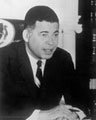
Edward Brooke
brooke
The first African American elected to the Senate by popular vote, Edward Brooke of Massachusetts served two full terms, from 1967 to 1979. Born in Washington, D.C. in 1919, Brooke graduated from Howard University before serving in the United States Army during World War II.  After the war, he received a law degree from Boston University. During his Senate career he championed the causes of low-income housing and an increased minimum wage, and promoted commuter rail and mass transit systems. He also worked tirelessly to promote racial equality in the South.  (Photo: Senate Historical Office)
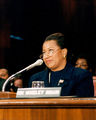
Photo of Carol Moseley Braun
Some called 1992 the "Year of the Woman." More women than ever before were elected to political office in November of that year, and five of them came to the U.S. Senate.  Carol Moseley Braun of Illinois not only joined that class on January 3, 1993, but also became the first African American woman ever to serve as U.S. Senator.  During her Senate career, Moseley Braun sponsored progressive education bills and campaigned for gun control. Moseley Braun left the Senate in January of 1999, and soon after became the U.S. Ambassador to New Zealand, a position she held until 2001. Moseley Braun ran for the Democratic nomination for president in 2004. (Photo: Senate Historical Office)
Barack Obama
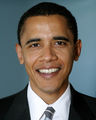
Senator Barack Obama of Illinois
Barack Obama (D-IL)
Barack Obama was born in Hawaii on August 4th, 1961. He received his earliest education in Hawaii and Indonesia, and then graduated from Columbia University in 1983. He moved to Chicago in 1985 to work for a church-based group seeking to improve living conditions in poor neighborhoods. In 1991, Obama graduated from Harvard Law School where he was the first African American president of the Harvard Law Review. He served in the Illinois state senate from 1997 to 2004. Elected to the United States Senate in November of 2004, he took the oath of office and became the fifth African American to serve in the Senate on January 3, 2005. On November 4, 2008, Barack Obama was elected as the 44th President of the United States.
Roland W. Burris
Senator Roland Burris
Born in Centralia, Illinois, on August 3, 1937, Roland Burris earned a Bachelor of Arts degree in political science from Southern Illinois University Carbondale and a Juris Doctor degree from Howard University. After finishing law school in 1963, Burris became the first African American to work as a national bank examiner for the Treasury Department. When Burris was elected comptroller of Illinois in 1978, he was the first African American to win a statewide election in Illinois. After serving more than ten years as comptroller, he became attorney general of Illinois. Appointed to the Senate on December 31, 2008, Burris filled the vacancy caused by the resignation of Barack Obama.

Thursday, December 6, 2012

Note to Governor Haley: DON'T DO IT!

The 17th Amendment (1913) established direct election of senators, as well as a means of filling vacant Senate seats. It lets state legislatures empower the governor to appoint a replacement to complete the term or to hold office until a special election.  

Senator Jim DeMint (R-SC) has announced that he will resign from the Senate to head the Heritage Foundation. There is some speculation that Governor Nikki Haley might fill the slot herself. As several other governors have done, she could resign from office and have her successor name her to the Senate -- a maneuver amounting to self-appointment.  That move would be a big mistake. In 2009, Ken Rudin explained at NPR that voters resent self-appointment and governors usually lose when they try it.  He offered the complete list of governors appointed to the Senate and the result of the succeeding election:
Montana, 1933 — Sen. Thomas Walsh (D) died. Gov. John Erickson (D) appointed self, lost 1934 primary.
Kentucky, 1939 — Sen. Marvel Logan (D) died. Gov. Happy Chandler (D) appointed self, won elections in 1940 and 1942.
Nevada, 1945 — Sen. James Scrugham (D) died. Gov. Edward Carville (D) appointed self, lost 1946 primary.
Idaho, 1945 — Sen. John Thomas (R) died. Gov. Charles Gossett (D) appointed self, lost 1946 primary.
Wyoming, 1960 — Sen.-elect Keith Thomson (R) died. Gov. John J. Hickey (D) appointed self, lost 1962 election.
New Mexico, 1962 — Sen. Dennis Chavez (D) died. Gov. Edwin Mechem (R) appointed self, lost 1964 election.
Oklahoma, 1963 — Sen. Robert Kerr (D) died. Gov. J. Howard Edmondson (D) appointed self, lost 1964 primary.
South Carolina, 1965 — Sen. Olin Johnston (D) died. Gov. Donald Russell (D) appointed self, lost 1966 primary.
Minnesota, 1977 — Sen. Walter Mondale (D) elected vice president. Gov.Wendell Anderson (D) appointed self, lost 1978 election.

Friday, January 6, 2012

Religion and the Upcoming Primaries

At Gallup, Frank Newport offers data about religion in the next three primary states:
The three remaining states with GOP primaries this month -- New Hampshire, South Carolina, and Florida -- present very different religious profiles, and therefore different religious contexts for the Republican candidates’ campaigns. 
The biggest religious distinction is between New Hampshire, which holds its primary Jan. 10, and South Carolina, which has its primary on Saturday, Jan. 21. New Hampshire is one of the least religious states in the union by any measure, while South Carolina is one of the most religious states. 
I base this analysis of the relative religiosity of the states on two measures: self-reported church attendance, and the percentage of residents who do not have a formal religious identity. 


NH
SC
Florida
USA
Attend at least monthly
35%
66%
57%
54%
No Formal Rel. Identity
22%
10%
13%
14%
 ...
New Hampshire would be relative fertile ground for Santorum -- in the abstract -- given that it has a higher than average Catholic population. One problem with this assumption arises from my analysis of data from December indicated that Catholics nationally were no more likely to support either Santorum or Newt Gingrich (the other Catholic in the race) than any other candidate. So it’s not clear if Santorum will benefit politically from New Hampshire’s disproportionate Catholic skew.

On the other hand, the relative irreligiousness of New Hampshire residents would suggest that Santorum has no particularly strong religious constituency to play to leading up to next Tuesday's primary. This in theory may be less auspicious for Santorum’s chances of beating expectations in the Granite State.

...
The high level of religiosity of the residents of South Carolina would seem to be a plus for Santorum’s religious-centric, family-value-oriented campaign positioning. The low percentage of Catholics in South Carolina, on the other hand, does not give him any religious-branding advantage, and its possible that Protestants may have some lingering suspicion of Catholics, given that they are relatively rare in the Palmetto state.

Romney would appear to face a more significant challenge in South Carolina. As noted, our national polling suggests that highly religious Protestants Republicans are somewhat less likely to support Romney than the national average. And there are a lot of these in South Carolina.

Friday, December 30, 2011

Courts and Federalism

As we explain in our chapter on federalism, courts have played a key role in defining the boundaries between state and federal authority.  Recent news stories illustrate the point.

At The Los Angeles Times, Julie Cart reports:
A federal judge on Thursday temporarily halted California's ability to enforce rules to reduce the carbon footprint of transportation fuels, effectively taking the regulatory teeth out of the state's year-old program.
U.S. District Judge Lawrence O'Neill issued a preliminary injunction that ruled the California Air Resources Board's low-carbon fuel regulations violated the U.S. Constitution's commerce clause by discriminating against crude oil and biofuels producers located outside California.
The regulations require producers, refiners and importers of gasoline and diesel to reduce the carbon footprint of their fuel by 10% over the next decade, as part of California's landmark global-warming law aimed at reducing greenhouse gas emissions to 1990 levels by 2020.
The regulation calculates the life cycle of fuels from their extraction — or cultivation, in the case of biofuels such as corn-based ethanol — to their combustion. For example, the state considers how corn is grown, harvested and converted to ethanol intended for California gas tanks, a life-cycle evaluation called "seeds to wheels."
Also at The Los Angeles Times David G. Savage and Carol J. Williams write:
Federal judges have blocked strict new immigration laws adopted by conservative legislatures in half a dozen states, including a ruling last week that said South Carolina may not set up a "street-level dragnet" to stop and arrest illegal immigrants.
But immigrant rights advocates who have cheered those rulings may soon find their luck has run out as those rulings head for the Supreme Court. Legal experts believe the high court's conservative majority will take a sharply different approach.
...
When Congress last revised the immigration laws, it said states may "cooperate" with the federal government in "the identification, apprehension, detention or removal of aliens not lawfully present in the United States." The states that have passed restrictive laws say that's exactly what they are doing.
The Obama administration disagrees. In its legal arguments against Arizona's law, the administration says the state's policies conflict with the federal government's emphasis on deporting violent criminals, drug dealers and smugglers who are in the country illegally, not the hundreds of thousands of otherwise law-abiding illegal immigrants who may be living and working here.
But in May, the Supreme Court signaled skepticism about a similar argument.The justices upheld another Arizona law that punished employers who hire illegal workers. In his opinion, Chief Justice John G. Roberts Jr. sounded a states' rights theme and set a "high threshold" for striking down a state law on the grounds that it conflicted with the aims of the federal government.

In a newly released study on the state immigration laws, the National Conference of State Legislatures (NCSL) reports that in 2011, state legislators from across the country introduced 1,607 bills and resolutions relating to immigrants and refugees. This is a significant increase from 2010, when 46 states considered more than 1,400 bills and resolutions pertaining to immigrants. As of Dec. 7, 2011, 42 states and Puerto Rico had enacted 197 new laws and 109 new resolutions, for a total of 306.

Thursday, October 6, 2011

Gingrich in South Carolina

Our chapter on elections and campaigns discusses the presidential nomination process. During the 2012 campaign, Newt Gingrich has found that it is difficult, as The State (SC) reports:

Gingrich also has been abandoned by his presidential campaign staff in South Carolina — including former S.C. GOP chairman Katon Dawson and political consultant Walter Whetsell — who quit and joined Texas Gov. Rick Perry’s campaign.

“He was reasonably popular back (in the ’90s). He was the ying to Clinton’s yang,” Neal Thigpen, a political science professor at Florence’s Francis Marion University, said of Gingrich. “He’s just run into trouble on every front . ... I don’t see him doing all that well here.”

Last month, only 5.6 percent of likely S.C. Republican primary voters said they would vote for Gingrich, according to a poll by Winthrop University. Even fewer — 1.6 percent — said they thought Gingrich would win the nomination.

...

His most recent campaign reports show he is more than $1 million in debt. The next round of fundraising reports are not due until Oct. 15, and Gingrich declined to say how much money he had raised. Asked if he still was in debt, he said, “A little bit.”

So far, Gingrich’s campaign has been “living off the land,” as Thigpen put it. Gingrich said he was on the road 24 days in September, and he has taken part in every GOP debate, including a nationally televised forum in Columbia last month sponsored by U.S. Sen. Jim DeMint. There, Gingrich captured much of the applause.

Unfortunately for Gingrich, applause does not necessary mean votes.


Wednesday, August 10, 2011

Perry to Run?

Our chapter on elections and campaigns looks at presidential primaries. Our chapter on political parties explains the importance of the South in GOP politics. The 2012 race is a good case study for both chapters. Texas Governor Rick Perry is reportedly announcing presidential bid in South Carolina this weekend. According to a story appearing in The San Antonio Express-News:

Scott E. Buchanan, associate professor of political science at The Citadel in Charleston and executive director of the Citadel Symposium on Southern Politics, said South Carolina has been vital for GOP nominees. He noted that every one since 1980 had to win the state on the way to the Republican nomination.


“First, it is a small enough state that one can do a lot of personal campaigning,” Buchanan said by e-mail. “Secondly, it is one of the most conservative states in the Union, so it is vital for a GOP candidate to have good bona fides as a conservative to win the state. Third, S.C. is the first southern state to hold a primary. To some degree, the rest of the South takes a cue from S.C. as to who is the ‘front runner' in the contest.”