Search This Blog

Showing posts with label Syria. Show all posts

Saturday, May 4, 2019

OANN: Source Laundering for Russia

One America News Network is an outlet for Russian propaganda. Lately it ran a story claiming that the White Helmets, a humanitarian group in Syria, staged fake chemical attacks to stir up retaliation against Assad. Kevin Poulsen at The Daily Beast.
This cable news smear traces directly to a frenzied disinformation campaign by Russia aimed at linking the White Helmets to a broad range of wrongdoing: things like running a black market in human organs, colluding with terrorists and faking Assad’s chemical weapons attacks. Moscow has been relentless in pushing these claims, tirelessly falsifying videos and photographs, creating phony news outlets and fake think tanks to do so. Some of the same GRU officers involved in the 2016 election interference created fake freelance journalists to pitch stories smearing the White Helmets to legitimate news outlets.
...
Russia’s disinformation about the White Helmets has come to dominate search results, thanks to prominent American trolls, Russian government outlets like the RT network and Sputnik, and a handful of alternative news websites surrounded by a social media echo chamber.
...
The network has a history with fake news. Last year it reported that California lawmakers were considering a bill to outlaw the sale of Bibles in the state, and Sharp’s earlier work includes a segment pushing the noxious Seth Rich conspiracy. The networks recent hires include notorious Pizzagate pusher Jack Posobiec, who joined as a political correspondent.
Although the latest Nielsen report ranks OANN’s ratings somewhere below the Tennis Channel, there’s enormous value to Moscow in getting its fake White Helmets news repeated in any American newscast, said former FBI agent Clint Watts, a research fellow at the Foreign Policy Research Institute.
“It’s source laundering,” Watts told the Daily Beast. “Then they can recirculate the story as an organic American story, and that could travel further than if it’s only on RT and Sputnik… The more places it shows up the more it looks like it’s not a single source origin story.”

Saturday, April 14, 2018

Miles's Law and the Syria Strike


On August 27, 2013, Newt Gingrich wrote:
News that the United States is considering a military strike on Syria in response to the Bashar al-Assad regime's suspected use of chemical weapons suggests we could soon see an American bombing campaign on the war-torn country.
The atrocities that took place in Syria recently, such as those that have been taking place there for almost two years, are deplorable and inhuman.

Before bombing Syria over the regime's latest crimes, however, we should stand back and ask, "And then what?"
A brief bombing campaign in Syria might make the United States and its allies feel like they are doing something, but it will prove nothing.
We have already abstained from getting involved in the civil war for two years and have chosen not to respond to evidence (albeit less clear) of another chemical attack this year.

We have already concluded that as terrible as the civil war is, it cannot be our war. The bombing will not change this -- and then what?

Tuesday, February 7, 2017

Public Opinion on Immigration

Karlyn Bowman, Eleanor O'Neil, Heather Sims write at AEI:
  • The ban: Hypothetical questions asked in the fall of 2016 and early this year about temporary or permanent bans on immigrants from areas with a history of terrorism produced mixed results. In most surveys that asked whether Muslims who were not US citizens should be banned from entering the US, a majority of Americans were opposed.
  • Syrian refugees: Historically, Americans have generally been unwelcoming toward refugees. In the current context, question wording matters: In October 2016, 54 percent said the United States did not have a responsibility to accept refugees from Syria (Pew Research Center), but in September, 61 percent said we should allow Syrian refugees who want to come to America to do so “as long as they go through a security clearance process” (CBS News).
  • The wall: Polls conducted after the November election showed around four in 10 supported building a wall along the border with Mexico; 55 percent to 60 percent opposed doing so. Around three-quarters didn’t believe Mexico will pay for a wall (Quinnipiac University, CBS News, ABC News/Washington Post).
  • Unauthorized immigrants: In January, 59 percent of registered voters said illegal immigrants currently living in the United States should be allowed to stay and eventually apply for citizenship, and 9 percent thought they should be allowed to stay but not be allowed to apply for citizenship. Twenty-five percent said they should be required to leave the country (Quinnipiac University). Sixty-five percent in an October 2016 CBS News poll said illegal immigrants coming to this country today mostly take jobs Americans don’t want; 25 percent said they take jobs away from American citizens.
  • Immigration overall: The first time Pew Research Center asked people about immigrants’ effect on the country in 1994, 63 percent said immigrants were “a burden on our country because they take our jobs, housing, and health care.” In December 2016, an identical percentage gave the opposite response, saying “immigrants today strengthen our country because of their hard work and talents.” Although feelings have grown more positive, Americans remain divided on what the proper level of immigration should be. In the Gallup Organization’s latest poll from 2016, 38 percent said it should be decreased, while the same percentage said it should be kept at its present level. Twenty-one percent said it should be increased.

Sunday, November 22, 2015

Attitudes Toward Refugees

Historically, Americans have been skeptical about accepting refugees.  Below, Gallup supplies data going back to the 1930s.

Americans did welcome the Vietnamese boat people  One exception was California Governor Jerry Brown, as Kerry Picket reported last year:
In 1975, Jerry Brown complained, that the federal government wanted to “dump Vietnamese on” California. “We can’t be looking 5,000 miles away and at the same time neglecting people who live here,” Newsweek reported at the time. According to The Washington Post, Larry Engelmann’s Tears Before the Rain: An Oral History of the Fall of South Vietnam, writes that Julia Vadala Taft, who led the interagency task force for refugee resettlement, remembered Brown’s opposition.
“The new governor of California, Jerry Brown, was very concerned about refugees settling in his state. Brown even attempted to prevent planes carrying refugees from landing at Travis Air Force Base near Sacramento. . . . The secretary of health and welfare, Mario Obledo, felt that this addition of a large minority group would be unwelcome in California. And he said that they already had a large population of Hispanics, Filipinos, blacks, and other minorities.”

shortened_table

Thursday, November 19, 2015

Vetting Refugees

Jerry Markon reports at The Washington Post:
“I don’t, obviously, put it past the likes of ISIL to infiltrate operatives among these refugees, so that’s a huge concern of ours,” Director of National Intelligence James Clapper said at a security industry conference in September, using another name for the Islamic State. He added that the government has “a pretty aggressive program” for screening refugees but that he is less confident about European nations.
FBI Director James Comey added in congressional testimony last month that “a number of people who were of serious concern” slipped through the screening of Iraq War refugees, including two arrested on terrorism-related charges. “There’s no doubt that was the product of a less than excellent vetting,” he said.
Although Comey said the process has since “improved dramatically,” Syrian refugees will be even harder to check because, unlike in Iraq, U.S. soldiers have not been on the ground collecting information on the local population. “If we don’t know much about somebody, there won’t be anything in our data,” he said. “I can’t sit here and offer anybody an absolute assurance that there’s no risk associated with this.”
ABC reports:
Of the 31 states that have declared their opposition to taking in Syrian refugees, one state, Kentucky, has a specific reason to be wary of the background check process: previously twoIraqi refugees who settled in Bowling Green turned out to be al Qaeda-linked terrorists with the blood of American soldiers on their hands, an ABC News investigation found. Both pleaded guilty to terror-connected charges after trying to acquire heavy weapons while in America’s heartland.
The 2013 ABC News investigation also revealed that several dozen other suspected terrorist bombmakers, including some who were believed to have targeted U.S. troops, may have mistakenly been allowed to move to the U.S. as Iraq and Afghanistan War refugees, among the tens of thousands of innocent immigrants.
The Obama administration insists now that Syrian refugees are subjected to intense vetting before they’re allowed to settle in the U.S. and that a vast majority of the millions of refugees the U.S. has resettled since the 1970s are normal, peaceful people, but the program has had serious security problems before. In 2009, a flaw in background screening of Iraqi refugees allowed the two al Qaeda-linked terrorists to settle in Bowling Green and led to a temporary suspension of the refugee program, officials told ABC News in a 2013 investigation.

Sunday, November 15, 2015

Americans and ISIS

In light of the discussions following the Paris attacks, it is important to remember this piece from Justin McCarthy at Gallup:
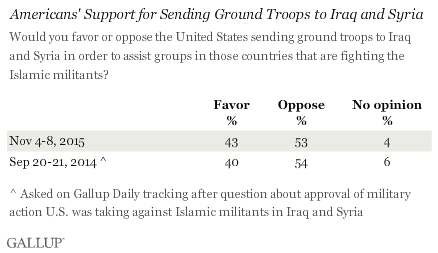
As the U.S. intensifies its airstrikes against Islamic State militants in Syria and Iraq, Americans are more likely to oppose (53%) than support (43%) sending U.S. ground troops to these countries to help groups there fight the militants. These figures haven't changed significantly since September 2014 after President Barack Obama launched airstrikes against the Islamic State group and other militant groups.
Trend: Americans' Support for Sending Ground Troops to Iraq and Syria
On November 12, CBS reported:
Americans' evaluations of how the U.S. fight against ISIS in Iraq and Syria is going are now at their worst level since the question was first asked in this poll about one year ago. Seventy-two percent now say that fight is going badly, up from 64 percent in August. Only 21 percent of Americans say it is going well, down from 28 percent.

Friday, February 13, 2015

AUMF Against ISIS

The president is asking Congress for authorization to use military force.  Note that no president has ever acknowledged the constitutionality of the War Powers Resolution or declared that such AUMFs
TO THE CONGRESS OF THE UNITED STATES:
The so-called Islamic State of Iraq and the Levant (ISIL) poses a threat to the people and stability of Iraq, Syria, and the broader Middle East, and to U.S. national security. It threatens American personnel and facilities located in the region and is responsible for the deaths of U.S. citizens James Foley, Steven Sotloff, Abdul-Rahman Peter Kassig, and Kayla Mueller. If left unchecked, ISIL will pose a threat beyond the Middle East, including to the United States homeland.
I have directed a comprehensive and sustained strategy to degrade and defeat ISIL. As part of this strategy, U.S. military forces are conducting a systematic campaign of airstrikes against ISIL in Iraq and Syria. Although existing statutes provide me with the authority I need to take these actions, I have repeatedly expressed my commitment to working with the Congress to pass a bipartisan authorization for the use of military force (AUMF) against ISIL. Consistent with this commitment, I am submitting a draft AUMF that would authorize the continued use of military force to degrade and defeat ISIL.
My Administration's draft AUMF would not authorize long‑term, large-scale ground combat operations like those our Nation conducted in Iraq and Afghanistan. Local forces, rather than U.S. military forces, should be deployed to conduct such operations. The authorization I propose would provide the flexibility to conduct ground combat operations in other, more limited circumstances, such as rescue operations involving U.S. or coalition personnel or the use of special operations forces to take military action against ISIL leadership. It would also authorize the use of U.S. forces in situations where ground combat operations are not expected or intended, such as intelligence collection and sharing, missions to enable kinetic strikes, or the provision of operational planning and other forms of advice and assistance to partner forces.
Although my proposed AUMF does not address the 2001 AUMF, I remain committed to working with the Congress and the American people to refine, and ultimately repeal, the 2001 AUMF. Enacting an AUMF that is specific to the threat posed by ISIL could serve as a model for how we can work together to tailor the authorities granted by the 2001 AUMF.
I can think of no better way for the Congress to join me in supporting our Nation's security than by enacting this legislation, which would show the world we are united in our resolve to counter the threat posed by ISIL.
BARACK OBAMA
THE WHITE HOUSE,
February 11, 2015.
John Yoo disagrees:
[A] closer reading of the Obama proposal reveals severe flaws that undermine this purpose. First, and most glaring, the authorization will have only a three-year lifespan, after which Congress would have to pass a new law to resurrect the war. No important declaration of war or authorization to use force has ever had such a sunset, because no armed conflict will ever obey an arbitrary deadline. Even the Framers, removed by centuries from our modern battlefield with its non-state enemies and asymmetric tactics, understood this. Alexander Hamilton argued against critics of the Constitution who wanted to impose similar limits on the government’s war powers (such as forcing armies to disband every year): Because the “circumstances that endanger the safety of nations are infinite,” he wrote in Federalist 23, “no constitutional shackles can wisely be imposed on the power.”
Hamilton and our Constitution’s Framers understood that war was so unpredictable that it could not be dictated by rules beforehand. But this is exactly the course on which the White House’s Authorization for Use of Military Force (AUMF) would set the nation. It makes little sense to announce to your enemies in advance when you will stop fighting. A three-year deadline will have the same harmful effects that Obama’s arbitrary withdrawal dates in Iraq and Afghanistan did. Groups and nations opposed to the United States, such as the Taliban in Afghanistan, ISIS in Syria and Iraq, and Iran in the Middle East, will simply wait us out. Or they may employ destructive delaying tactics in the hopes that war-weariness will lead a small minority in Congress to block a reauthorization in 2018. Try to imagine that, on December 8, 1941, President Franklin D. Roosevelt had asked Congress for a declaration of war that would last only three years. It is impossible, because FDR took war seriously and understood that our enemies fight not according to our plans, but according to their own.

Thursday, September 11, 2014

The President, ISIS, and War Powers

President Obama says that he has authority to act against ISIS because of the War Powers Act and the congressional authorization for the Iraq War. Andrew Rudelevige writes at The Washington Post  that neither rationale holds up.
First, the Obama administration has not actually filed any reports under the War Powers Act (or rather Resolution — thus, the “WPR”). The president has indeed sent a number of letters to Congress about the Islamic State and Iraq since June — the latest such is dated September 8 — but these are simply to keep Congress “fully informed.” Doing so is “consistent with the War Powers Resolution” (my emphasis) — but the president never says he is reporting “pursuant to” the WPR, as a consequence of that statute, as required by section 4(a)(1). The “consistent with” is boilerplate language that far predates Obama — presidents have rarely admitted that the WPR is binding or even constitutional — but the letters do not concede that the WPR limits his authority in any way. Indeed, in each letter Obama claims that he is acting “pursuant to my constitutional authority to conduct U.S. foreign relations and as Commander in Chief and Chief Executive.”
...
How about the authorization to use force in Iraq (P.L. 107-243), passed nearly 12 years ago? Is that a “specific statutory authorization” for the present circumstance? Had the Bush administration’s preferred text been adopted in 2002, Congress would have given the president power “to use all means” to “restore international peace and security in the region,” i.e., the entire Middle East, and Obama would have a great case. But the actual resolution states:
The President is authorized to use the Armed Forces of the United States as he determines to be necessary and appropriate in order to -- (1) defend the national security of the United States against the continuing threat posed by Iraq; and (2) enforce all relevant United Nations Security Council resolutions regarding Iraq.
Thus the authorization is for the use of force against (the state of) Iraq, rather than in Iraq. The Security Council resolutions referred to deal with weapons of mass destruction; with “repression of its civilian population”; and with “threatening its neighbors.” The Islamic State may be doing some of these things, but Iraq itself is not; indeed, the threat to the United States from Iraq’s government seems to be from the latter’s incompetence. Potential attacks within Syria’s borders seem even more removed from the authorization’s intent.

Friday, September 13, 2013

Trust and International Problems

Americans' trust and confidence in the federal government's ability to handle international problems has reached an all-time low, with 49% saying they have a great deal or a fair amount of confidence, two percentage points below the previous low of 51% recorded in 2007.

These new data come from Gallup's annual Governance survey, conducted Sept. 5-8, 2013, while Congress was debating the use of military force in Syria, but prior to President Barack Obama's nationally televised address on Syria, and Russia's proposal to avert U.S. military action.

Between 57% and 66% of Americans said they had a great deal or a fair amount of confidence in the U.S. government to handle international problems during Obama's first term. This represents a generally higher level of confidence than Americans expressed during the latter years of the Bush administration, when the U.S. was engaged in protracted wars in Iraq and Afghanistan.

Monday, September 9, 2013

Harry Reid Misquotes Dante

The Senate Majority Leader should have a word with his speechwriter. From a speech today:
As you enter the exhibits at the Holocaust Memorial Museum in Washington, you see a quote from Dante’s famous Inferno. This is what it says: “The hottest places in hell are reserved for those who, in times of great moral crisis, maintain their neutrality.
The quotation does appear on artwork at the museum:


But the line does not come from Dante.  Rather, it is JFK's very loose paraphrase of Dante.

Respectfully Quoted explains:
  This remark may have been inspired by the passage from Dante Alighieri’s La Comedia Divina, trans. Geoffrey L. Bickersteth, “Inferno,” canto 3, lines 35–42 (1972):        by those disbodied wretches who were loth        when living, to be either blamed or praised.… … … … … …Fear to lose beauty caused the heavens to expel        these caitiffs; nor, lest to the damned they then        gave cause to boast, receives them the deep hell.
What's more, Dante depicts the 9th circle of Hell as cold, not hot.


Kerry Comments

Earlier Monday, Kerry said that al-Assad "could turn over every single bit of his chemical weapons to the international community in the next week."
But speaking at a news conference with British Foreign Secretary William Hague, Kerry described that as an impossible scenario.
"He isn't about to do it and it can't be done obviously," Kerry said.
The State Department later sought to clarify Kerry's comment as a "rhetorical argument," and a U.S. official called the secretary of state's remarks a "major goof."
"His point was that this brutal dictator with a history of playing fast and loose with the facts cannot be trusted to turn over chemical weapons, otherwise he would have done so long ago," State Department spokeswoman Jen Psaki said. "That's why the world faces this moment."
At The Atlantic, James Fallows writes that another Kerry goof crystallizes some larger impression:
That is of course the significance of today's unfortunate stumble by Secretary of State John Kerry, who said in London that any strike in Syria would be "unbelievably small."
We will be able to hold Bashar al-Assad accountable without engaging in troops on the ground or any other prolonged kind of effort in a very limited, very targeted, short-term effort that degrades his capacity to deliver chemical weapons without assuming responsibility for Syria's civil war. That is exactly what we are talking about doing -- unbelievably small, limited kind of effort.
You know what he meant. He was advancing the argument for a contained, "surgical," pinpoint, etc., effort that would be big enough to let Assad and future dictators know the cost of using chemical weapons, yet not so broad as to entrap the United States in the ongoing (horrific) civil war. If the two words that had come to his mind in real time had been "unbelievably precise" rather than "unbelievably small," no one would have blinked.
But this is the undertaking that the same Secretary Kerry just finished telling us was our moment's moral crossroads, our Munich. And we will rise to that challenge with a response that is "unbelievably small."

Sunday, September 8, 2013

Morality and Foreign Policy

As we explain in our chapter on foreign policy and national security, there has always been a strain  of moralism in American foreign policy (think of Wilson and the Fourteen Points).  But it has not always been a dominant strain in public opinion.  Pew reports:
Supporters of a U.S.-led military strike against Syria have largely framed the issue as a matter of protecting global security by enforcing international law. Speaking Friday at the G-20 summit in Russia,President Obama stressed that the international norm against using chemical weapons must be maintained if that and other norms are to have any meaning.
But proponents of taking military action also have sought to cast the move as a moral imperative. “This is not the time to be spectators to a slaughter,” Secretary of State John Kerry told the Senate Foreign Relations Committee on Tuesday. “Neither our country nor our conscience can afford the cost of silence.” In his comments on Friday, Obama implicitly compared the debate over Syria to international inaction during the Rwandan genocide.
While the data from different surveys taken at different times varies, Americans generally are less willing to support foreign policies on moral or humanitarian grounds than when they are cast as directly benefiting the United States or its allies.


Saturday, September 7, 2013

President Obama's 2002 Iraq Speech

Barack Obama, then a little-known state senator in Illinois, gave a speech against the Iraq War on October 2, 2002.  Years later, that speech enabled him to say that he had opposed the war while many other leading Democrats had supported it.  As Congress debates the wisdom of intervention in Syria, it is worth quoting at length:
What I am opposed to is a dumb war. What I am opposed to is a rash war. What I am opposed to is the cynical attempt by Richard Perle and Paul Wolfowitz and other armchair, weekend warriors in this administration to shove their own ideological agendas down our throats, irrespective of the costs in lives lost and in hardships borne.

What I am opposed to is the attempt by political hacks like Karl Rove to distract us from a rise in the uninsured, a rise in the poverty rate, a drop in the median income — to distract us from corporate scandals and a stock market that has just gone through the worst month since the Great Depression. That's what I'm opposed to. A dumb war. A rash war. A war based not on reason but on passion, not on principle but on politics. Now let me be clear — I suffer no illusions about Saddam Hussein. He is a brutal man. A ruthless man. A man who butchers his own people to secure his own power. He has repeatedly defied UN resolutions, thwarted UN inspection teams, developed chemical and biological weapons, and coveted nuclear capacity. He's a bad guy. The world, and the Iraqi people, would be better off without him.

But I also know that Saddam poses no imminent and direct threat to the United States or to his neighbors, that the Iraqi economy is in shambles, that the Iraqi military a fraction of its former strength, and that in concert with the international community he can be contained until, in the way of all petty dictators, he falls away into the dustbin of history. I know that even a successful war against Iraq will require a U.S. occupation of undetermined length, at undetermined cost, with undetermined consequences. I know that an invasion of Iraq without a clear rationale and without strong international support will only fan the flames of the Middle East, and encourage the worst, rather than best, impulses of the Arab world, and strengthen the recruitment arm of al-Qaida. I am not opposed to all wars. I'm opposed to dumb wars.
Surprisingly, Organizing for Action still posts a video about the 2002 speech:

Friday, September 6, 2013

Opinion and Syria

Gallup reports:
Americans' support for the United States' taking military action against the Syrian government for its suspected use of chemical weapons is on track to be among the lowest for any intervention Gallup has asked about in the last 20 years. Thirty-six percent of Americans favor the U.S. taking military action in order to reduce Syria's ability to use chemical weapons. The majority -- 51% -- oppose such action, while 13% are unsure.
 Views on Proposed U.S. Military Actions Before Commencement of Such Actions

Thursday, September 5, 2013

Dwindling Ranks of Veterans

At Pew, Drew DeSilver writes that veterans make up a declining share of Congress and the country as a whole.
Twenty senators (20%) and 89 representatives (20.5%) are veterans, according to the authoritative Vital Statistics on Congress, published by The Brookings Institution. Among the Senate’s notable veterans: Republicans John McCain (Ariz.) and Lindsey Graham (S.C.), both strong supporters of taking action against Syria; Iowa Democrat Tom Harkin and Kansas Republican Pat Roberts, both of whom have expressed skepticism or outright opposition; and Massachusetts Democrat Ed Markey, who voted “present” on the Syria resolution Wednesday.
Not all that long ago, military service was practically a requirement for serving in Congress. The high point in recent decades was the 95th Congress (1977-78) when, following an influx of Vietnam-era veterans, a combined 77% of the House and Senate had served in the armed forces. But as World War II veterans have retired and relatively few Americans enlist in the all-volunteer armed forces, veterans account for a smaller and smaller share of Congress.
That reflects the wider trend in U.S. society. According to Census figures, veterans currently make up about 7% of the overall population, down from 13.7% in 1970 — when the Vietnam War was raging and the draft was still in place. As a 2011 Pew Research Center report noted, the post-9/11 wars in Iraq and Afghanistan have been fought by a historically small U.S. military; this has contributed to a distance between the military and civilian society. While Americans overwhelmingly say they feel proud of those who’ve served and appreciate their sacrifices, 71% say most Americans know little or nothing about the problems faced by military personnel; about as many (74%) oppose reinstating a draft.
As noted earlier , the 2012 election marked the first time since 1932 that neither party nominated a veteran for either president or vice president.

Monday, September 2, 2013

Syria and Vietnam

In 1965, Lyndon Johnson’s national-security adviser, McGeorge Bundy, acknowledged the uncertainty of the Vietnam War in a memo to his boss: “We cannot assert that a policy of sustained reprisal will succeed in changing the course of the contest in Vietnam. It may fail, and we cannot estimate the odds of success with any accuracy.”
...

Back in the day—as America plunged itself ever more deeply into Vietnam, Bundy also told Johnson that “even if it fails, the policy will be worth it.” In that sense, Vietnam demonstrated America’s resolve to stand up against the Soviet Empire in the midst of the Cold War, and in the words of the late John F. Kennedy, “pay any price, bear any burden, meet any hardship.”

But Syria? No. At best, American involvement in Syria would be a military commitment taken in the aftermath of Barack Obama’s having carelessly tossed out the phrase “red line,” in the course of a reelection campaign.
The Pentagon Papers were a classified official history of the Vietnam war, which Daniel Ellsberg leaked to the New York Times.  An excerpt:
"Humiliation" was much on the minds of those involved in the making of American policy for Vietnam during the spring and summer of 1965. The word, or phrases meaning the same thing, appears in countless memoranda. No one put it as starkly as Assistant Secretary of Defense John McNaughton, who in late March assigned relative weights to various American objectives in Vietnam. In McNaughton's view the principal U.S. aim was "to avoid a humiliating US defeat (to our reputation as a guarantor)." To this he assigned the weight of 70%. Second, but far less important at only 20% was "to keep SVN [South Vietnam, then a separate country] (and then adjacent) territory from Chinese hands." And a minor third, at but 10%, was "to permit the people of SVN to enjoy a better, freer way of life."

Sunday, September 1, 2013

Congress and Syria

According to The Washington Post, the president told chief of staff Denis McDonough that there were two reasons why he abruptly decided to seek congressional authorization for a military strike on Syria.
He wanted there to be political accountability — lawmakers from both parties, he believed, should be on the record in support or against the war.

Obama told advisers that congressional support, far from certain, given the animosity that extends the length of Pennsylvania Avenue, would ultimately strengthen support for the war and perhaps protect public opinion for a sustained operation.

The other reason? Unlike the U.S.-led military operation in Libya in 2011 — which was supported by the U.N. Security Council and the Arab League — the United States did not have the same level of international backing.

Obama’s proposal to invite Congress dominated the Friday discussion in the Oval Office. He had consulted almost no one about his idea. In the end, the president made clear he wanted Congress to share in the responsibility for what happens in Syria.

As one aide put it, “We don’t want them to have their cake and eat it, too.”