Showing posts with label Cuba. Show all posts
Showing posts with label Cuba. Show all posts
Saturday, October 22, 2022
Thursday, February 24, 2022
JFK Calls Out Russian Lies
John F. Kennedy, Radio and Television Report to the American People on the Soviet Arms Buildup in Cuba Online by Gerhard Peters and John T. Woolley, The American Presidency Project https://www.presidency.ucsb.edu/node/236392
In this speech, John F. Kennedy revealed the Cuban Missile Crisis to the American public.
The size of this undertaking makes clear that it has been planned for some months. Yet only last month, after I had made clear the distinction between any introduction of ground-to-ground missiles and the existence of defensive antiaircraft missiles, the Soviet Government publicly stated on September 11 that, and I quote, "the armaments and military equipment sent to Cuba are designed exclusively for defensive purposes," that, and I quote the Soviet Government, "there is no need for the Soviet Government to shift its weapons . . . For a retaliatory blow to any other country, for instance Cuba," and that, and I quote their government, "the Soviet Union has so powerful rockets to carry these nuclear warheads that there is no need to search for sites for them beyond the boundaries of the Soviet Union." That statement was false.
Only last Thursday, as evidence of this rapid offensive buildup was already in my hand, Soviet Foreign Minister Gromyko told me in my office that he was instructed to make it clear once again, as he said his government had already done, that Soviet assistance to Cuba, and I quote, "pursued solely the purpose of contributing to the defense capabilities of Cuba," that, and I quote him, "training by Soviet specialists of Cuban nationals in handling defensive armaments was by no means offensive, and if it were otherwise," Mr. Gromyko went on, "the Soviet Government would never become involved in rendering such assistance." That statement also was false.


Saturday, November 26, 2016
Castro: Arde in Regnum Phasmatis
Four days before he died, JFK spoke about Castro to the Florida Chamber of Commerce:
Two postscripts:
JFK tried very hard to kill Castro. See the Church Committee report.
Trump violated the embargo.
... I do not think that there is any doubt that Fidel Castro, as a symbol of revolt in this hemisphere, has faded badly. Every survey, every report, I think every newspaperman, every publisher, would agree that because Mr. Castro has embraced the Soviet Union and made Cuba its satellite, that the appeal that he had in the late fifties and early sixties as a national revolutionary has been so badly damaged and scarred that as a symbol, his torch is flickering. We have not been successful in removing Mr. Castro. We should realize that that task is one which involves not only the security of the United States, but other countries. It involves possibilities of war. It involves danger to people as far away as West Berlin, Germany, countries which border upon the Soviet Union in the Middle East, all the countries that are linked to us in alliance, as the Soviet Union is so intimately linked with Cuba.
So we have attempted to isolate Cuba in the hope that some day Cuba will be free and that the pressures of life in Cuba will make it more obvious to people around this hemisphere that communism does not offer a shortcut to economic well-being. The gross national product of Cuba is 25 percent below what it was in 1958. The Soviet Union today is giving $450 million worth of assistance every year to Cuba. They are pouring into Cuba--and this should be a source of concern to us, because Latin America is still before us, and the challenge of Latin America--they are giving as much aid to Cuba alone as we are giving to all of Latin America. That is not a statistic in which I take particular pride, but it does indicate how heavy is their commitment and how successful so far has been their support.
Some Soviet troops still remain, not as armed units. There has been a substantial withdrawal, but there is a good deal of unfinished business in Cuba.
In answer to your question, Mr. Castro still is in control in Cuba, and still remains a major danger to the United States.
Two postscripts:
JFK tried very hard to kill Castro. See the Church Committee report.
Trump violated the embargo.
Sunday, December 21, 2014
Cuba
From Human Rights Watch:
The government continues to rely on arbitrary detention to harass and intimidate individuals who exercise their fundamental rights. The Cuban Commission for Human Rights and National Reconciliation—an independent human rights group the government views as illegal—received over 3,600 reports of arbitrary detentions from January through September 2013, compared to approximately 2,100 in 2010.
The detentions are often used preemptively to prevent individuals from participating in events viewed as critical of the government, such as peaceful marches or meetings to discuss politics. Many dissidents are beaten and threatened when detained, even if they do not try to resist.
Security officers virtually never present arrest orders to justify detentions and threaten detainees with criminal sentences if they continue to participate in “counterrevolutionary” activities. In some cases, detainees receive official warnings, which prosecutors may later use in criminal trials to show a pattern of delinquent behavior. Dissidents said these warnings aim to discourage them from participating in activities seen as critical of the government.
Victims of such arrests may be held incommunicado for several hours to several days. Some are held at police stations, while others are driven to remote areas far from their homes where they are interrogated, threatened, and abandoned.
On August 25, 2013, more than 30 women from the Damas de Blanco (Ladies in White)—a group founded by the wives, mothers, and daughters of political prisoners and which the government considers illegal—were detained after attending Sunday mass at a church in Santiago, beaten, forced onto a bus, and left at various isolated locations on the city’s outskirts. The same day, eight members of the group in Havana and seven more in Holguín were arbitrarily detained as they marched peacefully to attend mass.From Freedom House:
The Cuban news media are owned and controlled by the state. The independent press is considered illegal and their publications “enemy propaganda.” Government agents routinely infiltrate the ranks of independent journalists and report on their activities, often accusing them of being mercenaries working at the behest of foreign powers. Independent journalists, particularly those associated with the island’s dozen small independent news agencies or human rights groups, are subject to harassment. Nevertheless, some state media have begun to cover previously taboo topics, such as corruption in the health and education sectors. The national newspaper Granma has begun to publish letters to the editor complaining about economic issues, and state television, while generally a mouthpiece of the PCC, has recently inaugurated a new program, Cuba Dice (Cuba Says), that features “man-on-the-street” interviews. A number of publications associated with the Roman Catholic Church have emerged as key players in debates over the country’s future, including Espacio Laical, Palabra Nueva, and Convivencia. Low-circulation academic journals such as Temas are similarly able to adopt a relatively open and critical posture, given their limited mass appeal.
Access to the internet remains tightly controlled and prohibitively expensive. The estimated effective internet penetration rate is 5 percent, one of the lowest in the world, while nearly 30 percent of the population has occasional access to e-mail and a circumscribed, domestic “intranet.” In June 2013, the government announced the opening of 118 “Nauta” internet cafés across the island, increasing public access. However, one hour of computer time at these cafés costs the equivalent of a week’s average salary, and users are required to show identification and sign a pledge not to engage in “subversive” activities online. Household access to the internet is not currently available to the public, with only a select few permitted to legally connect at home. There are plans to begin enabling access via smartphones, but prices are expected to be prohibitive for the vast majority of the population.
Thursday, December 18, 2014
Cuba and the Constitution
Does the president have power to reestablish full diplomatic relations with Cuba?
Article II, section 3 of the Constitution says that the president shall "receive Ambassadors and other public Ministers." In our textbook, we write:
Article II, section 3 of the Constitution says that the president shall "receive Ambassadors and other public Ministers." In our textbook, we write:
According to a generally accepted interpretation, this power means that the president decides whether to recognize foreign governments after a revolution or regime change. More generally, this power to shape the content of talks with foreign diplomatsit implies the power to define U.S. policy and run the day-to-day business of foreign affairs. Unlike Congress, the chief executive sits atop a bureaucracy that is responsible for defense and foreign affairs, and so has ready access to information. Unlike Congress, a single leader can act with dispatch, consistency, and secrecy, especially in a crisis.Findlaw notes:
Ambassadors and other public ministers'' embraces not only ''all possible diplomatic agents which any foreign power may accredit to the United States,'' 569 but also, as a practical construction of the Constitution, all foreign consular agents, who therefore may not exercise their functions in the United States without an exequatur from the President. 570 The power to ''receive'' ambassadors, et cetera, includes, moreover, the right to refuse to receive them, to request their recall, to dismiss them, and to determine their eligibility under our laws. 571 Furthermore, this power makes the President the sole mouthpiece of the nation in its dealing with other nations.But there are certain things that Congress can do. Buzzfeed reports:
"I anticipate I’ll be the chairman of the Western Hemisphere subcommittee on the Foreign Relations Committee” in the new Congress, Florida Sen. Marco Rubio said in a press conference hours after the release of American prisoner Alan Gross from a Cuban prison was announced along with the administration’s plans to normalize relations with Cuba, including opening an embassy there.Amanda Taub writes at Vox:
“I anticipate we’re going to have a very interesting couple of years discussing how you’re going to get an ambassador nominated and how you’ll get an embassy funded,” Rubio, an ardent opponent of lifting the Cuban embargo, said.
...A Senate Democratic appropriations aide acknowledged the administration also can’t simply repurpose funds that have already been appropriated to the State Department, explaining, “Any reprogramming must be approved by the Appropriations Committee,” which, starting in January, will be controlled by Republicans.
Legally, the President cannot unilaterally lift the embargo. Many of the restrictions are codified in legislation that only Congress can change. However, the President does have the authority to make sweeping changes how the embargo works in practice. If he chooses to exercise his full executive authority, there may be little left of the embargo for Congress to repeal...[The] President can make sanctions less restrictive in practice by exercising his licensing authority under the current laws. The executive branch has the authority under current law to issue licenses that permit US citizens and corporations to do business with Cuba, travel there, and send money to family members there. The president isn't making licenses for those activities universally available, but he will make them easier to get.
Friday, January 4, 2013
Detainees and Signing Statements
Previous posts have discussed presidential signing statements, which direct the executive branch how to carry out a new law. Presidents have sometimes used signing statements to claim authority to override or bypass provisions of laws. The New York Times reports:
President Obama set aside his veto threat and late Wednesday signed a defense bill that imposes restrictions on transferring detainees out of military prisons in Afghanistan and Guantánamo Bay, Cuba. But he attached a signing statement claiming that he has the constitutional power to override the limits in the law.
The move awakened a dormant issue from Mr. Obama’s first term: his broken promise to close the Guantánamo prison. Lawmakers intervened by imposing statutory restrictions on transfers of prisoners to other countries or into the United States, either for continued detention or for prosecution.
... President George W. Bush ... used signing statements to advance sweeping theories of presidential power and challenged nearly 1,200 provisions over eight years — more than twice as many as all previous presidents combined.
The American Bar Association has called upon presidents to stop using signing statements, calling the practice “contrary to the rule of law and our constitutional system of separation of powers.” A year ago, the group sent a letter to Mr. Obama restating its objection to the practice and urging him to instead veto bills if he thinks sections are unconstitutional.
As a presidential candidate, Mr. Obama sharply criticized Mr. Bush’s use of the device as an overreach. Once in office, however, he said that he would use it only to invoke mainstream and widely accepted theories of the constitutional power of the president.
Sunday, October 28, 2012
Cuban Missile Crisis: JFK Calls Former Presidents
On October 28, 1962, JFK called former president Hoover, Truman, and Eisenhower about the apparently successful resolution of the Cuban Missile Crisis.
It is hard to believe, but all three old men would outlive the youthful chief executive.
It is hard to believe, but all three old men would outlive the youthful chief executive.
Cuban Missile Crisis: October 28, 1962
Fifty years ago today, the United States marked the final day of the Cuban Missile Crisis.
Two years ago, Andrew Glass wrote at Politico:
Two years ago, Andrew Glass wrote at Politico:
On this day in 1962, the Cuban missile crisis, which threatened to start a superpower war, came to a close when Soviet leader Nikita Khrushchev agreed to remove 42 intermediate-range nuclear missiles from Cuba. For its part, Washington promised not to invade the Communist island, while pledging (secretly) to dismantle its own missiles in Italy and Turkey.At the Council on Foreign Relations, James M. Lindsay writes:
Confident that the crisis was headed to a peaceful and satisfactory conclusion, Kennedy called former presidents Herbert Hoover, Harry Truman, and Dwight Eisenhower. He told them only what was in the news. He didn’t tell them about the secret promise he had made to remove the Jupiter missiles from Turkey. The former presidents not surprisingly applauded Kennedy’s skill in forcing Khrushchev to capitulate.
Not everyone one was pleased that the missile crisis had been resolved peacefully. Fidel Castro was outraged. He would later lead his fellow Cubans in chants of “Nikita, mariquita, lo que se da no se quita!” (“Nikita, you little homosexual, what is given should not be taken back!”)
None of that was a concern for JFK. After calling presidents Truman and Eisenhower, he turned to his brother, Attorney General Robert Kennedy, and invoked the memory of Abraham Lincoln. “This is the night I should go to the theater,” said the president. RFK replied, “If you go, I want to go with you.”
Saturday, October 27, 2012
Cuban Missile Crisis: October 27, 1962
From the JFK Library:
More from the JFK Library:
A second letter from Moscow demanding tougher terms, including the removal of obsolete Jupiter missiles from Turkey, is received in Washington. Over Cuba, An American U-2 plane is shot down by a Soviet-supplied surface-to-air missile and the pilot, Major Rudolph Anderson, is killed. President Kennedy writes a letter to the widow of USAF Major Rudolf Anderson, Jr., offering condolences, and informing her that President Kennedy is awarding him the Distinguished Service Medal, posthumously.A PBS documentary describes the shoot-down:
\
More from the JFK Library:
At a tense meeting of the Executive Committee, President Kennedy resists pressure for immediate military action against the SAM sites. At several points in the discussion, Kennedy insists that removal of the American missiles in Turkey will have to be part of an overall negotiated settlement. The Committee ultimately decides to ignore the Saturday letter from Moscow and respond favorably to the more conciliatory Friday message. Air Force troop carrier squadrons are ordered to active duty in case an invasion is required.
Later that night, Robert Kennedy meets secretly with Ambassador Anatoly Dobrynin. They reach a basic understanding: the Soviet Union will withdraw the missiles from Cuba under United Nations supervision in exchange for an American pledge not to invade Cuba. In an additional secret understanding, the United States agrees to eventually remove the Jupiter missiles from Turkey.
Friday, October 26, 2012
Cuban Missile Crisis: October 26, 1962
A Soviet-chartered freighter is stopped at the quarantine line and searched for contraband military supplies. None are found and the ship is allowed to proceed to Cuba. Photographic evidence shows accelerated construction of the missile sites and the uncrating of Soviet IL-28 bombers at Cuban airfields.

In a private letter, Fidel Castro urges Nikita Khrushchev to initiate a nuclear first strike against the United States in the event of an American invasion of Cuba.
John Scali, ABC News reporter, is approached by Aleksander Fomin of the Soviet embassy staff with a proposal for a solution to the crisis.
Later, a long, rambling letter from Khrushchev to Kennedy makes a similar offer: removal of the missiles in exchange for lifting the quarantine and a pledge that the U.S. will not invade Cuba.Recording of a telephone conversation with JFK. State Department Spokesman Lincoln White, and Press Secretary to the President Pierre Salinger. They discuss White’s comments to the press concerning the Cuban Missile Crisis, press reaction, and procedures for releasing further statements.
Thursday, October 25, 2012
Cuban Missile Crisis: October 25, 1962
From the JFK Library:

Knowing that some missiles in Cuba were now operational, the president personally drafts a letter to Premier Khrushchev, again urging him to change the course of events. Meanwhile, Soviet freighters turn and head back to Europe. The Bucharest, carrying only petroleum products, is allowed through the quarantine line. U.N. Secretary General U Thant calls for a cooling off period, which is rejected by Kennedy because it would leave the missiles in place.
Much public debate between the United States and the Soviet Union took place in the halls of the United Nations. During the debate in the Security Council, the normally courteous U.S. Ambassador Adlai Stevenson aggresivrely confronted his Soviet U.N. counterpart Valerian Zorin with photographic evidence of the missiles in Cuba.

Cuban Missile Crisis: Inside the Mind of a President
This page of JFK's random notes during an October 25, 1962 EXCOMM meeting suggests what presidents think about: "decisions" and "leaders."

Wednesday, October 24, 2012
Cuban Missile Crisis: October 24, 1962
The Hollywood version:
10:00A.M.: The ExComm meets to consider the situation in Cuba. According to Robert Kennedy 's memoirs on the crisis, the meeting "seemed the most trying, the most difficult, and the most filled with tension." Robert McNamara tells the group that Soviet ships approaching the quarantine line show no indications of stopping and that two Soviet ships, the Gagarin and the Komiles, are within a few miles of the line. Naval intelligence then reports that a Soviet submarine has moved into position between the two ships. McNamara states that the aircraft carrier USS Essex has been directed to make the first interception, and that antisubmarine tactics, including the use of small explosives, has been ordered to prevent the Soviet submarine from interfering with the blockade.
According to Robert Kennedy , the president asks, "Isn't there some way we can avoid our first exchange with a Russian submarine--almost anything but that?" McNamara replies, "No, there's too much danger to our ships...Our commanders have been instructed to avoid hostilities if at all possible, but this is what we must be prepared for, and this is what we must expect." At 10:25A.M., a new intelligence message arrives and John McCone announces: "We have a preliminary report which seems to indicate that some of the Russian ships have stopped dead in the water." Dean Rusk leans over to McGeorge Bundy and says, "We're eyeball to eyeball and I think the other fellow just blinked." President Kennedy directs that no ship be intercepted for at least another hour while clarifying information is sought.At the Council on Foreign Relations, James M. Lindsay offers an important qualification:
Rusk’s comment became the iconic line of the Cuban missile crisis. But it was misleading in a critical way. It implied that U.S. and Soviet ships were in close proximity if not actually steaming straight for each other. The men gathered around JFK on the morning of October 24 certainly thought that was the case; McCone even recorded a note later in the day that a U.S. Navy vessel had confronted a Soviet ship at virtually the same time he received the intelligence bulletin in the White House. The incident didn’t take place. In fact, the two closest Soviet ships were more than five hundred nautical miles from the quarantine line and headed back to the Soviet Union.The crisis was far from over. Back to the Nuclear Files timeline:
9:24P.M.: The State Department receives a letter for President Kennedy from Premier Khrushchev . At 10:52P.M., the message is read to Kennedy. Khrushchev writes, "if you coolly weigh the situation which has developed, not giving way to passions, you will understand that the Soviet Union cannot fail to reject the arbitrary demands of the United States." Khrushchev warns that the Soviet Union views the blockade as "an act of aggression" and that, as a consequence, he will not instruct Soviet ships bound for Cuba to observe the quarantine.
At the direction of the Joint Chiefs of Staff, SAC increases its alert posture to DEFCON 2 for the first time in history. Thomas Powers, the commander-in-chief of SAC, believed, as he later wrote, that while discreet preparations had been appropriate before, it was now "important for [the Soviets] to know of SAC's readiness." Consequently, Powers decides on his own authority to transmit uncoded messages to SAC commanders noting that SAC plans are well prepared and that the alert process was going smoothly.
At the request of President Kennedy , the Defense Department drafts two separate plans to increase civil defense preparations during a possible military engagement with Cuba. The first outlines civil defense measures which could be taken in the vicinity of targets close to Cuba under attack with conventional weapons, while the second suggests measures which could be taken in response to possible nuclear attack within MRBM range.
Tuesday, October 23, 2012
Cuban Missile Crisis: October 23, 1962
Last night, Bob Schieffer opened the debate by mentioning the Cuban Missile Crisis.
The JFK Library lays out the events of this day in 1962:
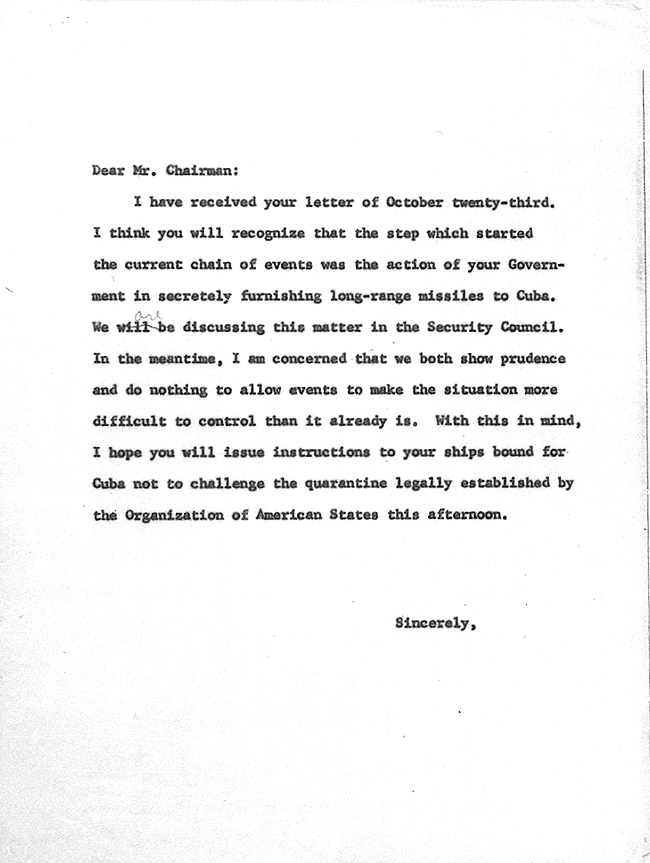
The JFK Library lays out the events of this day in 1962:
Assistant Secretary of State for Inter-American Affairs Edwin Martin seeks a resolution of support from the Organization of American States. Ambassador to the United Nations Adlai Stevenson lays the matter before the U.N. Security Council. The ships of the naval quarantine fleet move into place around Cuba. Soviet submarines threaten the quarantine by moving into the Caribbean area. Soviet freighters bound for Cuba with military supplies stop dead in the water, but the oil tanker Bucharest continues towards Cuba. In the evening Robert Kennedy meets with Ambassador Dobrynin at the Soviet Embassy.
After the Organization of American States endorsed the quarantine, President Kennedy asks Khrushchev to halt any Russian ships heading toward Cuba. The president's greatest concern is that a US Navy vessel would otherwise be forced to fire upon a Russian vessel, possibly igniting war between the superpowers.JFK's message to Khrushchev:
Monday, October 22, 2012
Cuban Missile Crisis: October 22, 1962 -- the Speech
On this date in 1962, John F. Kennedy made a national television broadcast announcing that the Soviets had placed offensive missiles in Cuba and that the United States would blockade the island:
Sunday, October 21, 2012
Cuban Missile Crisis: JFK Calls Eisenhower
On October 22, 1962, just before going on television to reveal the Cuban Missile Crisis to the American people, JFK consulted with former president Eisenhower:
Cuban Missile Crisis: October 21, 1961
On this date in 1962 -- a Sunday, like today -- the general public still did not know that the Cuban Missile Crisis was under way.
At the Council on Foreign Relations, James M. Lindsay writes:


At the Council on Foreign Relations, James M. Lindsay writes:
Kennedy began his Sunday by attending 9:00 a.m. Mass at St. Stephen’s Church as he usually did. After returning to the White House, he met with Secretary of State Dean Rusk and Secretary of Defense Robert McNamara and reaffirmed the decision he hadmade the day before to impose a blockade on Cuba. He then met with Gen. Walter Sweeney, the head of the U.S. Air Force Tactical Air Command. The general confirmed what the president had learned in earlier discussions with the ExCom: an air strike wouldreliably destroy at most 90 percent of the Soviet missiles. So when the planes returned home, some working Soviet missiles could still be pointed at the United States.
Kennedy spent his afternoon meeting with the ExCom. The group went line-by-line through the speech that Ted Sorensen had drafted for the president to give to the nation the next night, weighing the political and diplomatic consequences of every sentence. One issue was whether Kennedy should call what the United States was about to do a “blockade” or a “quarantine.” Rusk noted that “The legal meaning of the two words is identical”; stopping ships on the high seas would constitute an act of war under international law regardless of what Washington called it. He preferred calling what the United States was about to do a “quarantine,” however, because it would allow the administration to avoid unflattering comparisons to the blockade that the Soviets had imposed on Berlin in 1948 and 1949. Kennedy accepted Rusk’s point and directed that the term “quarantine” be used.From the National Security Archive:


Saturday, October 20, 2012
Cuban Missile Crisis: October 20, 1962
From the Nuclear Files timeline:

9:00A.M.: ExComm [the Executive Committee of the National Security Council, an ad hoc group formed to make recommendations to the president] meetings continue at the State Department. Final planning for the implementation of a naval blockade is completed, and Theodore Sorensen's draft speech for President Kennedy is amended and approved. As McNamara leaves the conference room, he reportedly phones the Pentagon and orders four tactical squadrons to be readied for a possible airstrike on Cuba. McNamara explains to an official who overhears the conversation, " If the president doesn't accept our recommendation, there won't be time to do it later."
2:30P.M.: President Kennedy meets with the full group of planning principals. He notes that the airstrike plan as presented is not a "surgical" strike but a massive military commitment that could involve heavy casualties on all sides. As if to underscore the scale of the proposed U.S. military attack on Cuba, one member of the JCS reportedly suggests the use of nuclear weapons, saying that the Soviet Union would use its nuclear weapons in an attack. President Kennedy directs that attention be focused on implementing the blockade option, calling it the only course of action compatible with American principles. The scenario for the full quarantine operation, covering diplomatic initiatives, public statements, and military actions, is reviewed and approved. Kennedy's address to the nation is set for October 22, at 7:00P.M.From the National Geospatial Intelligence Agency:
...
Late night: James Reston, Washington Bureau Chief for the New York Times, phones George Ball and McGeorge Bundy to ask why there is such a flurry of activity in Washington. Reston is given a partial briefing on the Cuban situation but is requested to hold the story in the interests of national security.
Mariel, on the northwestern coast of Cuba, served as a major port of entry for Soviet goods and as a Cuban naval base. NPIC analysts monitored imagery of the port to gauge whether additional Soviet materials were brought in to add to the already growing threat. The Soviets attempted to send four “Foxtrot” diesel submarines to Cuba during the crisis. Intelligence gathering provided by NPIC and other agencies resulted in the U.S. Navy successfully forcing three subs to the surface before turning them around, with the fourth turning back in mid-journey, still submerged.
Friday, October 19, 2012
Cuban Missile Crisis: October 19, 1962
In Springfield, Illinois, the Journal-Register reports on JFK's effort to keep up the appearance of normality in the early days of the Cuban Missile Crisis:

The nation knew nothing about what was happening, of course, and that includes the thousands in Springfield who went to see the president just three days into the crisis on October 19, 1962, as he began a swing through several Midwestern states and the west campaigning on behalf of Democratic congressional candidates. Just a day before arriving in Springfield, Kennedy and Soviet Foreign Minister Andrei Gromyko met for two hours in the Oval Office where Gromyko told Kennedy Soviet aid to Cuba was meant only for defensive capabilities.
Despite the intense discussions and strategy sessions with his civilian and military advisors on how to respond to the situation, the White House thought that having Kennedy stay on his normal schedule would create the impression nothing was amiss. In the meantime, the Joint Chiefs of Staff urged Kennedy to respond with military force, including an airstrike. But Kennedy resisted.
The day after he was in Springfield the president’s press secretary announced that Kennedy suffered from an “upper respiratory infection” and abruptly cancelled the rest of his trip. The president returned to Washington.David A. Welch and James G. Blight write:
On October 19, the CIA reported the construction of twelve SS-5 launch pads, likely to be operational in December, and more importantly, three SS-4 sites with four launchers each, two sites of which were reported to be operational already.4 American intelligence also revealed the presence of forty-two 11-28 light bombers, capable of delivering nuclear weapons to a range of approximately 600 miles.
Subscribe to:
Posts (Atom)