Search This Blog

Showing posts with label debates. Show all posts

Sunday, March 24, 2024

Congress: Neither Productive Nor Deliberative


The U.S. Congress is navigating yet another government funding deadline — the eighth in less than six months — and are at an impasse over sending aid to key allies in Ukraine, Taiwan and Israel. Divisions among Republicans in the House and Senate killed a major bipartisan border policy bill. Reforms to bedrock programs like Medicare and Social Security are desperately needed but no closer to getting passed. Meanwhile, the House of Representatives spent close to a month without a speaker last year due to infighting between moderate and hard right factions of the Republican party.

When U.S. Representative Chip Roy, a Republican from Texas, begged his colleagues in November to “give me one thing I can campaign on and say we did,” he was articulating what many lawmakers and observers were feeling: Congress isn’t working.


Wednesday, June 29, 2022

Campus Climate

Daniel Stid:
Recurring Knight Foundation / Ipsos surveys of college students show that the proportion of students who say their free speech rights are secure has dropped from 73% in 2016 to 47% in 2021. The decline is driven primarily by students who identify as Republican (-25%) and Independent (-13%) vs. those who identify as Democratic (-2%). In 2021, 65% of students agreed “the climate at their school or on their campus prevents some people from saying things they believe because others might find it offensive.” This is up more than 10% from 2016.

The Heterodox Academy’s 2021 Campus Expression Survey offers another sobering snapshot. The good news is that “88% of students agreed that colleges should encourage students and professors to interact respectfully with people whose beliefs differ from their own.” The bad news: “63% of students agreed that the climate on their campus prevents people from saying things that they believe.” In aggregate, 60% of students reported being reluctant to discuss at least one of five potentially controversial topics in their classrooms: politics, religion, race, sexual orientation, or gender. And here too there is a clear progressive political skew. Students identifying as Republican and Independent reported being more reluctant to discuss these topics than their Democratic counterparts.

The strong signals pointing to the diminishment and political skewing of freedom of expression and viewpoint diversity in higher education parallel those in other domains. We see similar patterns in journalism, media, and entertainment companies, professional services firms, philanthropic foundations, and many of the nonprofit groups they support.

Correlation is not causation, but the vast majority of up and coming employees in these organizations have something in common. They have spent four or more years being acclimatized in colleges and universities en route to what are currently the commanding heights of our society and culture. The worldviews and politics of the 38% of American adults who have at least a bachelor’s degree are diverging from those of the 62% who do not. Widening educational polarization is not good for a liberal democracy bedeviled by mounting populist disdain for elites.

As some of us have been noticing, and Ryan Grim recently reported in telling detail, it is not even good for progressive organizations and causes. To the great detriment of their missions, they are increasingly prone to Bolshevik vs. Menshevik-style infighting and stance taking. Colleges and universities must do better in preparing their students to participate productively amid the rough and tumble of our disputatious democracy–and the full sweep of viewpoints they will encounter within it.

Wednesday, April 13, 2022

Real Debate is Missing on Capitol Hill

 Kevin Kosar at The Hill:

Major debates on the floor of the Senate and House of Representatives are increasingly rare. This is not by accident.

Leaders in both chambers do all they can to prohibit arguing between legislators when bills are brought to a vote. The House precludes debate by adopting closed rules before voting on a bill. Said rules limit debate to mere minutes and forbid legislators from offering amendments. The Senate achieves much the same by operating under unanimous consent agreements, wherein the majority leader gets each senator to agree to not speak on the legislation to be voted upon, and to forgo the ability to offer amendments.

How it came to be that some of the most garrulous of all Americans — politicians — agreed not to debate is a long, complicated story.

Partly, it is an adaptation to the presence of television cameras. What person who has to run for reelection wants to admit that someone from the other party has a stronger point, and then, heaven forbid, accept a change to a bill?

Partly, the present situation also is an adaptation to the intense conflict between the political parties and attendant mutual distrust. Over the past 30 years, partisan control of the chambers has shifted back and forth between Democrats and Republicans at a rate not seen since the period immediately after the Civil War. Whomever is the majority wants to defend their majority and therefore views honest debate as threatening. The leader of the majority party does not want to have a vote on legislation fail, let amendments be offered, or even permit the expression of views for fear they might make his or her party look bad before the public eye. Party leaders’ desire to manage public opinion, which is a bit of a fool’s errand, trumps the responsibilities of governance.

Thursday, October 8, 2020

Virtual Debate, 1960

Thursday, October 6, 2016

Dab

Four years ago, Rep. Loretta Sanchez did a "Call Me Maybe" video.

At The Los Angeles Times, Christine Mai-Duc reports on the California Senate debate between Sanchez and Kamala Harris:
After being interrupted by the moderator several times, Sanchez finally stopped, pausing to strike a pose as Harris looked on. 
What happened next was at first a mystery.
For viewers at home, the camera showed just a reaction from Harris, who bit her lip and looked to the audience, eyes wide. To see Harris' face, go to 55 minutes and 29 seconds in the video below.
Laughing, Harris says, "So, there's a clear difference between the candidates in this race."
But a photo captured by Los Angeles Times photographer Rick Loomis appears to show Sanchez in a pose resembling "the dab," a dance move created by rap group Migos and popularized by NFL star Cam Newton.
 Kamala Harris watches as rival Loretta Sanchez strikes a pose after her closing statement at their debate at Cal State L,A. ( Rick Loomis / Los Angeles Times )

Those in the room were left to wonder what exactly the pose meant, Loomis said, but it did not seem to be a curtsy or a bow.

Then, this Twitter video surfaced: It does appear that Sanchez, in fact, "dabbed."

Tuesday, September 27, 2016

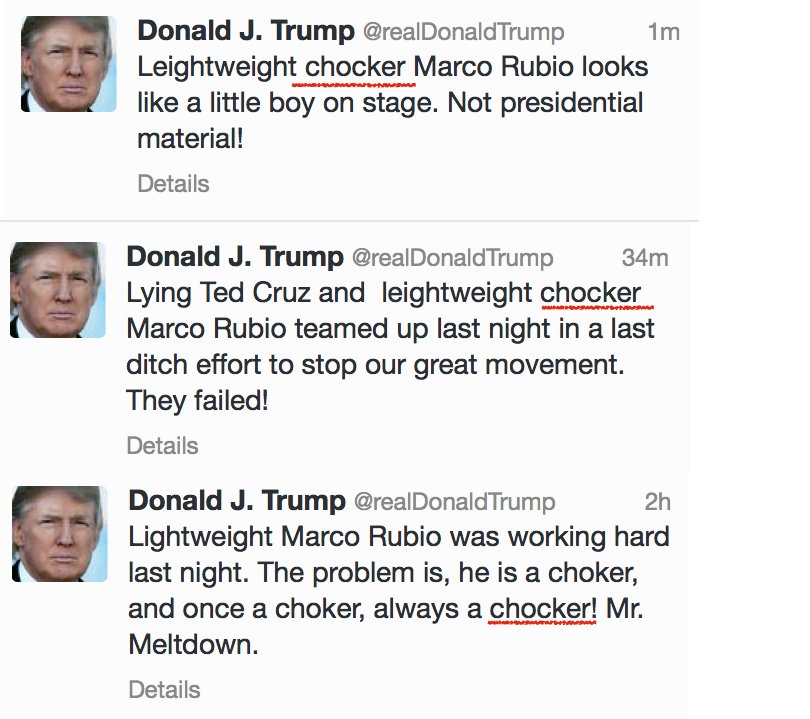
"Chocker"

 Breanne Deppisch and Elise Viebeck report at The Washington Post:
THE BIG IDEA: The consensus that Donald Trump badly lost the first debate gelled overnight. Liberals predictably panned the GOP nominee’s performance on Long Island, but some of the harshest reviews are coming from conservative thought leaders who had been starting to come around.
-- Instant reaction:
Republican pollster Frank Luntz conducted a focus group of undecided voters in Pennsylvania. Sixteen said Hillary Clinton won. Five picked Trump, per CBS News.
In a Florida focus group organized by CNN, 18 of 20 undecided voters picked Clinton as the winner.
Not one of 29 undecided voters in an Ohio focus group organized by Park Street Strategies thought Trump prevailed, while 11 picked Clinton and the rest said neither. By a two-to-one margin, the group thought Clinton had the better tone and, by a three-to-one margin, they thought she came across as more knowledgeable candidate on the issues.
A CNN/ORC flash poll found that 62 percent said the Democrat won, compared to 27 percent who picked Trump. That’s on par with 2012, when Mitt Romney was seen as the winner of the first debate.
In a separate instant-poll from the Democratic firm Public Policy Polling, 51 percent said Clinton won and 40 percent picked Trump.
Eight in 10 insiders in the key battleground states thought Clinton performed better, including 57 percent of Republicans, according to the Politico Caucus survey.


Saturday, October 31, 2015

Cloistering in Academia and Journalism

Arthur Brooks writes at The New York Times:
Unfortunately, new research also shows that academia has itself stopped short in both the understanding and practice of true diversity — the diversity of ideas — and that the problem is taking a toll on the quality and accuracy of scholarly work. This year, a team of scholars from six universities studying ideological diversity in the behavioral sciences published a paper in the journal Behavioral and Brain Sciences that details a shocking level of political groupthink in academia. The authors show that for every politically conservative social psychologist in academia there are about 14 liberal social psychologists.

Why the imbalance? The researchers found evidence of discrimination and hostility within academia toward conservative researchers and their viewpoints. In one survey cited, 82 percent of social psychologists admitted they would be less likely to support hiring a conservative colleague than a liberal scholar with equivalent qualifications.
This has consequences well beyond fairness. It damages accuracy and quality. As the authors write, “Increased political diversity would improve social psychological science by reducing the impact of bias mechanisms such as confirmation bias, and by empowering dissenting minorities to improve the quality of the majority’s thinking.
At The Washington Examiner, Timothy Carney writes of a "cloistering effect," which affects journalism as well as academia.  This week's GOP debate was an example:
But remember, the nature of media's liberal bias is mostly this: they are themselves liberal, and they know very few conservatives, so they find it hard to see things from the conservative perspective.
As a result, the biggest manifestation of bias in the debate: Almost no questions were asked from a conservative perspective.
This is a debate for the Republican nomination. A clear majority of GOP primary voters identify as conservatives (84 percent in Iowa, 53 percent in New Hampshire, and 68 percent in South Carolina, for three examples). Why not ask of the candidates the sort of questions the voters would ask?
They could have asked Kasich: "Why did you increase Medicaid under Obamacare in Ohio?" They could have asked Trump, "How can eminent domain for corporate gain be squared with free-enterprise views?" They could have asked Rubio about sugar subsidies, or Cruz if his "defund Obamacare" fight did any good, or Jeb Bush about his support for more immigration. They could have asked Christie about his liberal court appointments.
...
Conservatives are a foreign species to reporters. Some of the reporters treat conservatives with hostility, but usually, they end up just not getting us. As a result, we have a debate where most of the questions range from silly to irrelevant.

Monday, June 2, 2014

Twitter, Debates, and Deliberation

Social scientists’ analysis of 290,119,348 tweets from 193,522 “politically engaged” Twitter users during the 2012 presidential campaign conventions and debates found little creative thinking, and a slavish blitz of retweeting “elites” like @billmaher and @seanhannity.
“Frankly, we’re rather disappointed,” says Cornell’s Drew Margolin. “Social media has so much potential to improve the diversity of voices and quality of exchanges in political discussion by giving individuals the technological capability to compete with the mass media in disseminating information, setting agendas and framing conversation.”
Instead, says the Cornell assistant professor of communication (co-author of a May 2014 PLoS ONE report, “Rising Tides or Rising Stars? Dynamics of Shared Attention on Twitter during Media Events”), “during live media events when the largest number of people are paying attention, people move away from this deliberative potential by replacing existing interpersonal social dynamics with increased collective attention to existing ‘stars.’”
Those stars would be Twitter users like the liberal comedian Bill Maher ’78, the most retweeted in three of the four candidate debates, and Sean Hannity, the conservative media personality who popularly opined, “Middle class crushed last 4 years” during the third debate.

Wednesday, July 24, 2013

Lincoln at Galesburg

President Obama has frequently compared himself to Abraham Lincoln, at least by implication.  On one occasion, he erred by using a spurious Lincoln quotation.

Today, the president is speaking today at Knox College in Galesburg, Illinois.   On October 7, 1858, Abraham Lincoln had his fifth debate there with Stephen A. Douglas (who had once served as a judge, hence Lincoln's reference to "Judge Douglas.")  Lincoln made a key point about the Declaration:
The Judge has alluded to the Declaration of Independence, and insisted that negroes are not included in that Declaration; and that it is a slander upon the framers of that instrument, to suppose that negroes were meant therein; and he asks you: Is it possible to believe that Mr. Jefferson, who penned the immortal paper, could have supposed himself applying the language of that instrument to the negro race, and yet held a portion of that race in slavery? Would he not at once have freed them? I only have to remark upon this part of the Judge's speech (and that, too, very briefly, for I shall not detain myself, or you, upon that point for any great length of time), that I believe the entire records of the world, from the date of the Declaration of Independence up to within three years ago, may be searched in vain for one single affirmation, from one single man, that the negro was not included in the Declaration of Independence; I think I may defy Judge Douglas to show that he ever said so, that Washington ever said so, that any President ever said so, that any member of Congress ever said so, or that any living man upon the whole earth ever said so, until the necessities of the present policy of the Democratic party, in regard to slavery, had to invent that affirmation. And I will remind Judge Douglas and this audience, that while Mr. Jefferson was the owner of slaves, as undoubtedly he was, in speaking upon this very subject, he used the strong language that "he trembled for his country when he remembered that God was just;" and I will offer the highest premium in my power to Judge Douglas if he will show that he, in all his life, ever uttered a sentiment at all akin to that of Jefferson.

Tuesday, June 18, 2013

Get Hoffa

On September 26, 1960, in his first debate with Richard Nixon, JFK said:  "I'm not satisfied when I see men like Jimmy Hoffa - in charge of the largest union in the United States - still free."

Hoffa responded:  "What was he really trying to say? That if elected president he will put Hoffa in jail without trial? Or that he will insist upon an indictment, trial and conviction regardless of the merits?"

After his election JFK appointed his brother Robert F. Kennedy as Attorney General.  RFK appointed a special unit informally called the "Get Hoffa Squad."  Victor Navasky wrote that "Robert Kennedy allowed the pursuit of justice to look like the pursuit of Hoffa. `You can't have even-handed justice and personal justice at the same time,' [former Atttorney General] Ramsey Clark comments."

Friday, March 22, 2013

Lincoln-Douglas Debates? Not Exactly


Robert Costa writes at National Review Online:
Newt Gingrich may have run in the wrong cycle.

The former House speaker, long a proponent of Lincoln-Douglas debates, should be a fan of the Republican National Committee’s latest idea for the 2016 presidential primary: Lincoln-Douglas debates, which would enable candidates to make lengthy policy points without an over-intrusive moderator.

Reince Priebus, the RNC chairman, told reporters today at a National Review briefing that he is considering “Lincoln-Douglas-type debates.”

“Everything’s on the table, but the most important thing is that we have a reasonable amount of debates — allow our candidates to be featured, allow everyone plenty of time to make their case,” Priebus said. “I mean, what happened last time was a free-for-all, and it just shouldn’t happen again.”
 Priebus might not literally mean "Lincoln-Douglas-type debates."  The first candidate would speak for sixty minutes.  The second would speak for ninety minutes.  And the first would then have thirty minutes for a reply.  Click here to see complete reenactments, courtesy of C-SPAN.

Friday, November 2, 2012

Political Videos Online

Political videos are big this year, as Pew reports:
55% of registered voters have watched political videos online this election season. We asked about six different types of political videos and found that, among registered voters who use the internet:
  • 48% watch video news reports about the election or politics
  • 40% watch previously recorded videos of candidate speeches, press conferences, or debates
  • 39% watch informational videos online that explain a political issue
  • 37% watch humorous or parody videos dealing with political issues
  • 36% watch political advertisements online
  • 28% watch live videos of candidate speeches, press conferences, or debates
We also find that political videos are highly social. Some 52% of registered voters say that other people have recommended political videos for them to watch this election season, with social networking sites playing a prominent role in this process. In addition, 19% of registered voters have recommended online political videos for other people to watch.

Wednesday, October 24, 2012

Bayonets

ABC News reports:
The most memorable line of Monday night’s debate was President Obama’s pointed “horses and bayonets” jab at Mitt Romney for questioning what Romney said was a shrinking U.S. Navy.
Obama responded that Romney “hasn’t spent enough time looking at how our military works. ” He added, “You mentioned the Navy, for example, and that we have fewer ships than we did in 1916. Well, governor, we also have fewer horses and bayonets, because the nature of our military’s changed.”
Horses and bayonets quickly became a Twitter punchline, but while they may no longer be needed for bayonet charges, it turns out the Pentagon still owns a hefty arsenal of bayonets.
The Army said today it has 419,155 bayonets in its inventory. The Marine Corps has another 195,334 bayonets that it bought in 2004 and it plans on buying 175,061 more bayonets this year. A Marine official says it’s not accurate to add the two totals together as the new ones will include replacements for ones already in service as well as additional stocks.
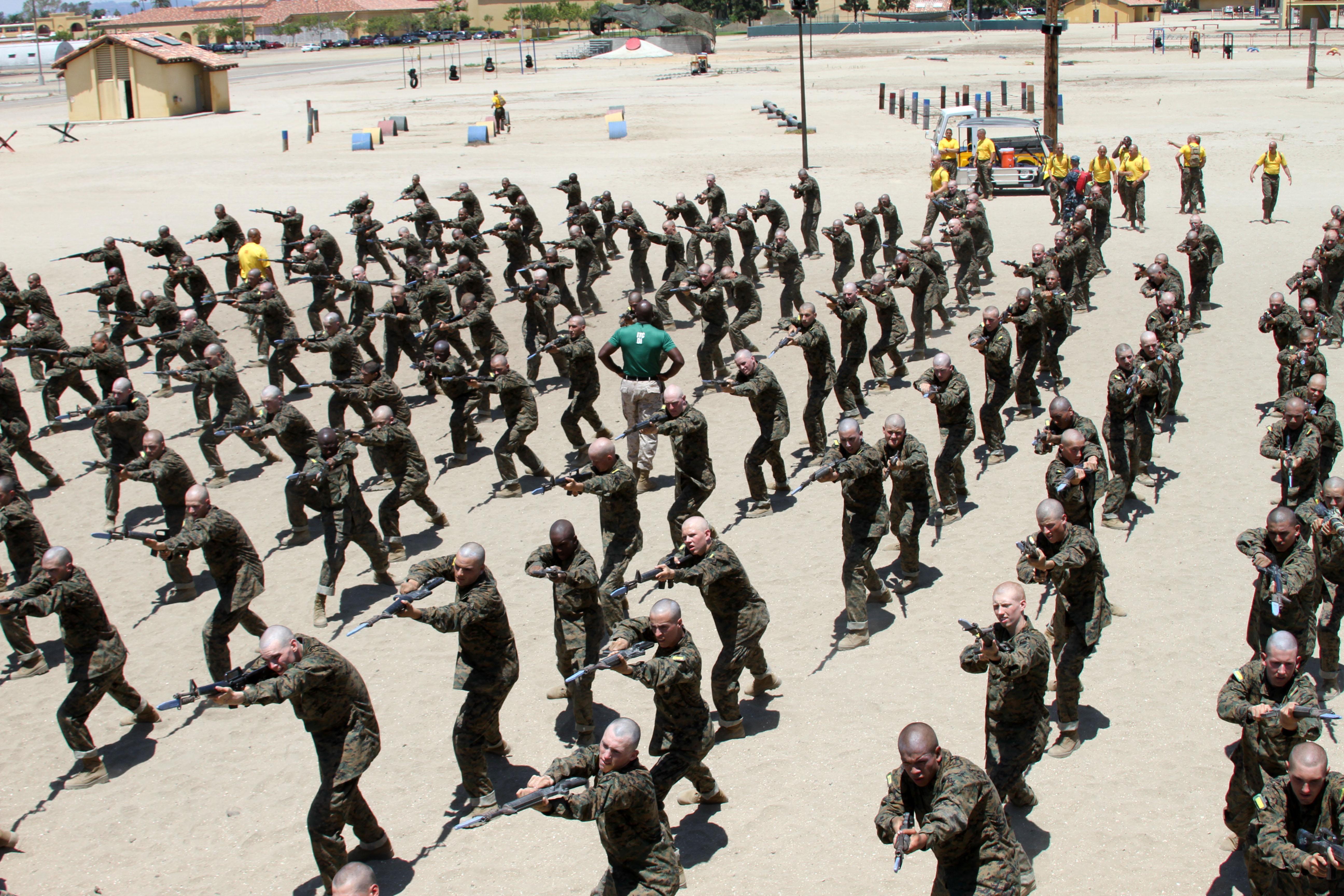
Aboard Marine Corps Recruit Depot San Diego, Staff Sgt. Leon S. Parker tells recruits how to use bayonets,  July 24, 2012:


At The Wall Street Journal, Julian E. Barnes writes:  "In 1916, Army and Marine Corps forces were relatively small, the World War I buildup having not begun. There were about 200,000 active duty Army soldiers and about 14,000 Marines, making it unlikely that there were more than the approximately 614,000 bayonets in the inventory today."

Tuesday, October 23, 2012

Names and Words Not Mentioned in the Foreign Policy Debate

The transcript of last night's debate reveals some odd omissions in what was supposed to be a discussion of foreign policy and national security:
  • War Powers
  • Constitution
  • American exceptionalism
  • Immigration
  • Drugs, narcotics
  • Poverty
  • National Security Council
  • Peace Corps
  • CIA
  • Mexico
  • South America
  • Central America
  • Canada
  • Germany
  • European Union
  • NATO
  • G8
  • Free trade
  • Guantanamo
  • World Trade Organization
  • National Guard
  • Reserves
  • Marines
  • Central Command
  • Susan Rice
  • Hillary Clinton


Friday, October 5, 2012

The President and the Bubble

In What It Takes, a great book about the 1988 presidential race, Richard Ben Cramer noted that high-level politicians live in a "bubble" that seals them off from everyday life.  Toward the end, Cramer reflected on the what the bubble had done to George H.W. Bush after he won:
The White House is the thickest and shiniest bubble of all.
It’s not just that we can’t see him. From the White House, he can’t see anything outside. Why didn’t Bush get it?
Well, the White House was running like a top! Everyone who walked into his office had a wonderful job — and were excited by the swell things they were doing for the country and its people. Every microphone over which he peered had a thousand faces upturned to his, ready to cheer his every applause line. If he left Washington, every tarmac on which Air Force One touched down had a line of prosperous people in suits, to pump Bush’s hand and tell him things were, we were, he was . . . great!
At McClatchy Newspapers, Lesley Clark suggests that the bubble might have been responsible for President Obama's sub-par debate performance:
“He’s a guy who has no pushback on anything, ever,” said Charlie Cook, an independent political analyst and editor and publisher of The Cook Political Report. “He’s not doing press conferences, he’s got little interaction with members of Congress and he’s surrounded with acolytes. I think it showed.”
Obama has held fewer press conferences and question-and-answer sessions with reporters than his recent predecessors, according to statistics compiled by Martha Joynt Kumar, a Towson University political science professor who studies the presidency and keeps detailed records of Obama’s press interactions.
“He prefers to be in situations where he feels he has all the facts,” Kumar said. “But the world of the president is a world of imperfection.”
She noted that former Presidents George W. Bush and Bill Clinton engaged more often in short question-and-answer sessions with reporters, “knowing that they’d have to deliver answers to questions that they might not have anticipated.”

Read more here: http://www.charlotteobserver.com/2012/10/05/3578251/obama-debate-stumble-might-stem.html#storylink=cpy

Thursday, October 4, 2012

Reaction Shots

Eight years ago, the Democratic National Committee made an ad featuring reaction shots of President George H.W. Bush in his first debate with John Kerry:


The Republican National Committee has now returned the favor:

f

Monday, May 28, 2012

Deliberation and the Language of Congress

The Sunlight Foundation has published an analysis of congressional rhetoric.  Lisa Mascaro writes at The Los Angeles Times:
If it sounds like the debates in Congress have devolved into those of teenagers, it's because they have.
Discourse in the House and Senate has dropped a full grade level — to the equivalent of high school sophomore, according to a new study.
Call this the dumbing down of Congress in a partisan age. Or a shift to plain-spoken populism ignited by the new class of tea party Republicans.
But what has become clear in the new research is that the soaring oratory that once filled the floors of the House and Senate with million-dollar diction and sophisticated syntax is making way for a more modest approach.
"Congress is changing as an institution, and what you see is more and more members gearing their speeches as sound bites or YouTube clips," said Lee Drutman, a senior fellow at the nonpartisan Sunlight Foundation, which compiled the study released Monday.
"You can [hark] back to a golden age of Congress when members quoted Shakespeare on the floor and really engaged in debate and talked to each other and tried to reason back and forth," he said.
Or not.  More than a century and a half ago, Tocqueville wrote:
There is hardly a congressman prepared to go home until he has at least one speech printed an sent to his constituents, and he won't let anybody interrupt his harangue until he has made all his useful suggestions about the twenty-four states of the Union, and especially the district he represents. So his audience has to listen to great general truths which he often does not understand himself and makes a muddle of exposing, and very minute particulars which he has not much chance of verifying or explaining. Consequently, the debates of that great assembly are frequently vague and perplexed, seeming to be dragged, rather than to march, to the intended goal.
Indeed, as G.K. Chesterton explained, complex language may hide more than it reveals:
Most of the machinery of modern language is labour-saving machinery; and it saves mental labour very much more than it ought. Scientific phrases are used like scientific wheels and piston-rods to make swifter and smoother yet the path of the comfortable. Long words go rattling by us like long railway trains. We know they are carrying thousands who are too tired or too indolent to walk and think for themselves. It is a good exercise to try for once in a way to express any opinion one holds in words of one syllable. If you say "The social utility of the indeterminate sentence is recognized by all criminologists as a part of our sociological evolution towards a more humane and scientific view of punishment," you can go on talking like that for hours with hardly a movement of the gray matter inside your skull. But if you begin "I wish Jones to go to gaol and Brown to say when Jones shall come out," you will discover, with a thrill of horror, that you are obliged to think. The long words are not the hard words, it is the short words that are hard. There is much more metaphysical subtlety in the word "damn" than in the word "degeneration."

Wednesday, February 22, 2012

Line by Line

During the debate tonight, Mitt Romney promised that he would go through the budget line by line to root out wasteful spending.  The phrasing is familiar: President Obama has used it many times.  Here is a small sample:
  • September 26, 2008: And, absolutely, we need earmark reform. And when I'm president, I will go line by line to make sure that we are not spending money unwisely.
  • October 7, 2008: I want to go line by line through every item in the federal budget and eliminate programs that don't work and make sure that those that do work, work better and cheaper.
  • October 15, 2008: We need to eliminate a whole host of programs that don't work. And I want to go through the federal budget line by line, page by page, programs that don't work, we should cut. Programs that we need, we should make them work better.
  • February 23, 2009:   To start reducing these deficits, I've committed to going through ourbudget line by line to root out waste and inefficiency, a process that [budget director Peter Orszag] and our administration, our team, has already begun. And I'll soon be instructing each member of my Cabinet to go through every item in their budgets as well.
  • January 27, 2010: We will continue to go through the budget, line by line, page by page, to eliminate programs that we can't afford and don't work.
  • November 29, 2010: I promised to go through the budget line by line to eliminate programs that have outlived their usefulness, and in each of the budgets I've put forward so far, we've proposed approximately $20 billion in savings through shrinking or ending more than 120 of such programs.

Monday, January 23, 2012

Gingrich Bingo, 1.3

In time for the this week's debates, here is an updated  list of Newt Gingrich's favorite words and phrases. With the list in hand, you can use a Bingo generator to produce a card like this:


Bizarre
Grotesque
Anti-Job
Frankly
Academia
Vastly
Imagine
Transform
Profoundly
Radically
Nancy Pelosi
Dumb
Fundamentally
Empower
Unelected
Enormously
Choose
Anti-Family
Anti-American
Saul Alinsky
Reshape
Barack Obama
Change
Elite
Absurd

Or you may simply deploy the list for (non-alcoholic) drinking games. Either way, here are some of the many items that you can plug in (and feel free to give extra points for any reference to a battle in the Civil War or American Revolution):

Adverbs:

  • Frankly
  • Candidly
  • Fundamentally
  • Profoundly
  • Basically
  • Radically
  • Dramatically
  • Enormously
  • Extraordinarily
  • Vastly
Verbs:
  • Imagine
  • Change
  • Transform
  • Reform
  • Empower
  • Replace
  • Reshape
  • Choose
Negative adjectives:
  • Elite (also a noun)
  • Bizarre
  • Secular
  • Socialist
  • Grotesque
  • Radical
  • Absurd
  • Sick
  • Pathetic
  • Corrupt
  • Dumb
  • Centralized
  • Politically correct
  • Left-wing
  • Unelected
  • Anti-family, anti-job, anti-American
Negative nouns:
  • Bureaucracy
  • Welfare state
  • Entitlement
  • Big government
  • Elite
  • Machine (as in political machine)
  • Hollywood
  • Academia
  • Union bosses
  • Trial lawyers
Positive adjectives:
  • Conservative
  • Opportunity
  • Entrepreneurial
  • Transformational
  • Solutions-oriented
  • Pro-American
Heroes:
  • Ronald Reagan
  • Theodore Roosevelt
  • Pope John Paul II
  • Winston Churchill
  • Abraham Lincoln
Villains:
  • Saul Alinsky
  • Ben Bernanke
  • Jimmy Carter
  • Bill Ayers
  • Barack Obama
  • Barney Frank
  • Nancy Pelosi
  • Harry Reid