Search This Blog

Showing posts with label public service. Show all posts

Monday, September 14, 2026

Few Elected Officials Come Directly from the Working Class

Many posts have discussed economic and educational inequalityThe effects of inequality reach many corners of American life.

Nicholas Carnes and Noam Lupu at the American Academy of Arts and Sciences:

In the United States, about half of all jobs are working-class jobs: manual-labor jobs like construction worker, service-industry jobs like home health care worker, clerical jobs like receptionist, and informal-sector jobs like day laborer. These jobs are held by men and women, young and old, from every race and religion, across every part of the country. (For more on how researchers define working class, see the Frequently Asked Questions section at the end of the report.) Working-class jobs are occupations that don’t provide employees with much material security, that don’t require capital or extensive formal education, and that don’t give employees much autonomy. These working-class jobs are indispensable to the economy and to our society: modern life in the United States is unthinkable without the people who pave roads, repair electrical lines, style hair, move freight, work in factories, deliver packages, stock shelves, build houses, repair cars, clean hotel rooms, answer phones, dig trenches, cook and serve food in restaurants, clean hospitals, ring up groceries, fix potholes, and empty garbage.

Although working-class jobs are essential to our way of life, people from working-class jobs almost never go on to hold elected political office. A 2013 study found that working-class jobs made up 52 percent of the labor force, but fewer than 10 percent of city council members had working-class jobs, fewer than 3 percent of state legislators held or had come from working-class jobs, and the typical member of Congress had spent less than 2 percent of their entire precongressional career doing the kinds of jobs that employ most Americans.1

Similar patterns have been documented in every systematic study that has ever been conducted on this topic. In 2025, researchers found that fewer than 2 percent of U.S. state legislators had working-class jobs as their main or most recent occupations.2 A 2019 analysis in The New York Times found that only 12 of the 535 members of Congress serving at that time had ever held a working-class job.3 A 1979 study by the Insurance Information Institute, an advocacy group for the insurance industry, found that just 5 percent of U.S. state legislators had working-class jobs.4 A 1954 study by a political scientist at the University of North Carolina found that just 2 percent of members of Congress had been low-salary workers, wage earners, servants, or farm laborers.5 Throughout all of U.S. history, there has never been a session of Congress in which more than 2 or 3 percent of legislators had a working-class job when they first got into politics.6
Figure 1 compares the share of working-class jobs in the U.S. labor force to the most recent data we have on the rates at which people from working-class jobs become city council members, state legislators, members of Congress, governors, Supreme Court justices, and presidents. Viewed this way, it is clear that people from working-class jobs are rare in the halls of power in the United States. If working-class people were a political party, that party would make up about half of the electorate but just tiny percentages of our political institutions.

Figure 1: Working-Class Americans Rarely Hold Public Office in the United States
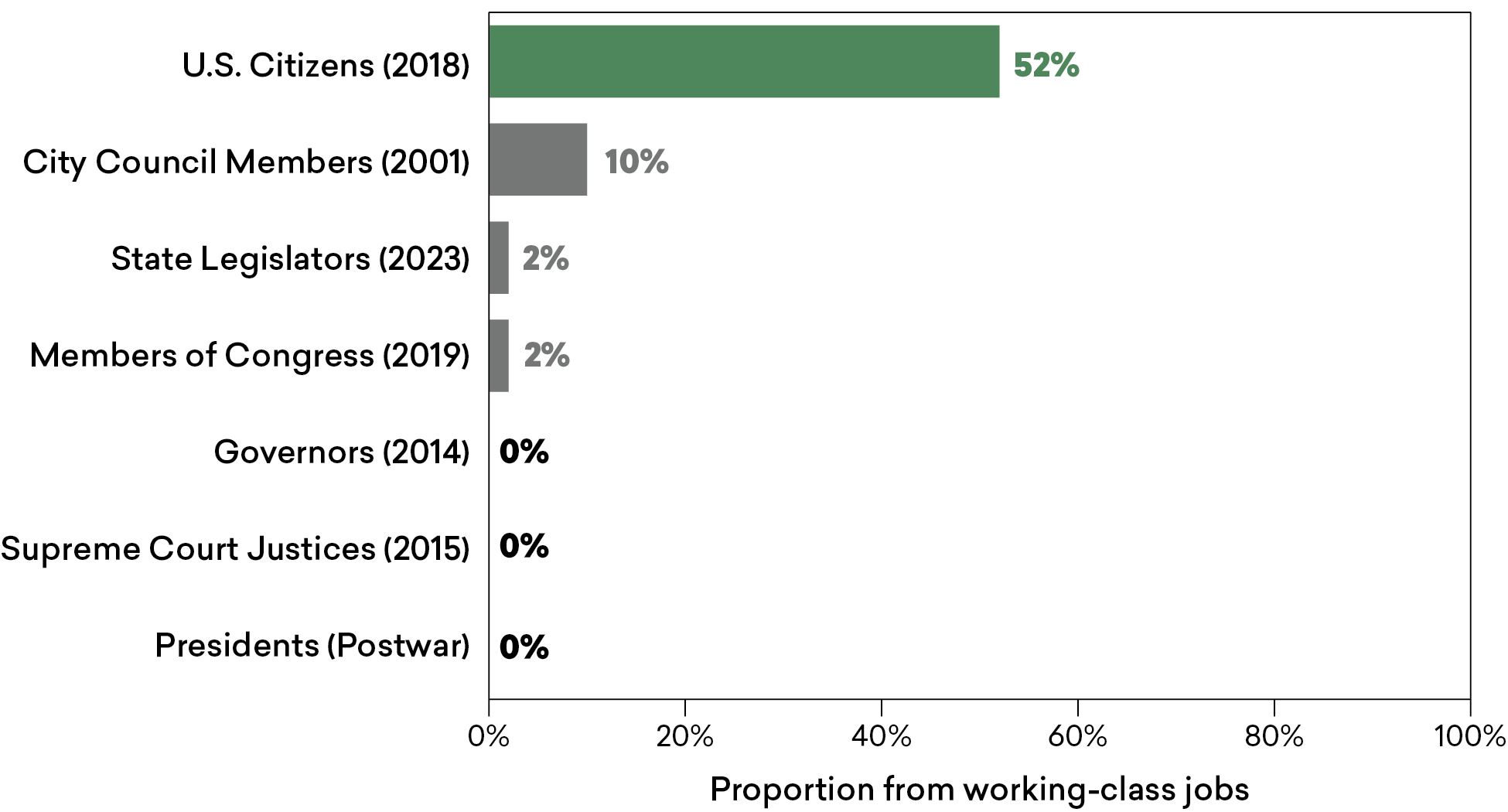
A bar graph that shows the proportion of people from the working class who are U.S. citizens (52 percent, in 2018), city council members (10 percent, in 2001), state legislators (2 percent, in 2023), members of Congress (2 percent, in 2019), governors (0 percent, in 2014), Supreme Court Justices (0 percent, in 2015), and presidents (0 percent, postwar).

Wednesday, August 5, 2026

Volunteering and Everyday Kindness

Many posts have discussed social capital, volunteering and civic virtue.


Stephanie Marken at Gallup:

The vast majority of U.S. youth, those aged 12 to 25, report participating in some type of formal public service or volunteering activity. But more than nine in 10 youth agree that everyday acts of kindness can be just as important as formal volunteering and say people can make a difference in their community without volunteering. Most youth report doing kind acts for others.

More than eight in 10 U.S. youth aged 12 to 25 (82%) report participating in some form of service. The most popular activities include donating goods or organizing donations (54%), environmental cleanup (35%), and volunteering at food banks or shelters (31%). More structured or civic-oriented activities are less common, ranging from volunteering at a hospital, care facility or senior center (15%) to writing letters to elected officials (13%) and participating in mission trips (8%).


Sunday, March 22, 2026

Troubled Public Service

 Many posts have discussed federal employment and bureaucracy.

From the Partnership for Public Service:
In 2025, the Trump administration took direct aim at our nation’s professional civil servants through numerous legally contested workforce reductions, haphazard agency restructuring efforts, the unilateral cancellation of government funding without approval from Congress and the weaponization of some federal agencies. This assault on federal civil servants and our national government has resulted in a demoralized and less engaged workforce that has made our country less safe, unhealthier and less prosperous. And when employee engagement suffers, as it has during this past year, our government’s ability to provide essential services to the public declines.

Last August, the Office of Personnel Management canceled the administration of its annual Federal Employee Viewpoint Survey, an instrument that has measured organizational performance across four administrations, including the first term of President Donald Trump, and fulfilled a legal requirement that agencies survey their workforces and make the data public. Consequently, government leaders have been lacking an essential tool that ensures they are effectively managing their workforce to meet the needs of the public.

As a result of this decision, the nonpartisan, nonprofit Partnership for Public Service administered its proprietary Public Service Viewpoint Survey to capture the impact of the administration’s actions on government performance and to continue our tradition of holding leaders accountable for improving their workplaces through programming like the Best Places to Work in the Federal Government®.

Unfortunately, the data is clear: The Trump administration has received a failing grade on its management of our government from those who serve our country—the federal workforce.

Our survey data and accompanying anonymous focus groups with federal employees provide stories and experiences of a workforce that has been systemically harassed as well as impeded from providing essential services to the public during the first year of the second Trump administration.

While the results of this survey are not directly comparable with the Office of Personnel Management’s annual FEVS, it contains similar questions and presents the best data source available about the state of federal employee engagement and the impact that it has on essential services for the public. The survey results represent the perspectives of 11,083 employees from across government. To ensure the results are valid and as representative as possible of the opinions of the workforce, we modeled our eligibility requirements and approach to response weighting based on the methodology of the 2024 Federal Employee Viewpoint Survey.

Wednesday, February 26, 2025

It Is Hard to Reduce the Debt


Over time, the federal workforce (full and part time) has shrunk as a percentage of the total U.S. population, from 1.1% in FY 1967 to 0.6% in 2018. In absolute terms, the federal workforce is slightly smaller than it was 50 years ago, even though the U.S. population has increased by two-thirds during that time period.7 Not only are the number of federal employees small compared to the population, but they also don’t cost very much. Compensation for federal employees cost $291 billion in 2019, or 6.6% of that year’s total spending.8

President Trump, Elon Musk, and their band of DOGE budget-cutters celebrate daily, even hourly targets to cut U.S. spending on everything from foreign aid to FAA personnel.Trump himself has teased a balanced budget — an impossibility without historic cuts to America's most popular programs, such as Social Security.

Why it matters: Their proposed cuts are but drips of water in America's overflowing bucket of debt — $36 trillion and counting. In fact, most days, America racks up more interest on its debt — $3 billion per day! — than DOGE can find in savings. That leaky bucket is the reality of your nation's finances.

This column is our attempt to clinically outline the facts about deficits — and efforts to reduce or eliminate them.

The big picture: Trump and Musk are correct that America is drowning in deficits. Some of it flows from silly spending on stale or even stupid programs. Those make for terrific X dunking: Agencies with more software licenses than employees! A $324,671 USDA grant for "Increasing DEIA Programming for Integrated Pest Management"! A $3 million Education Department contract "to write a report that showed that prior reports were not utilized by schools"!
But trimming fat is harder than it looks: 37% of the contract terminations on an initial list on DOGE's "Wall of Receipts" (417 out of 1,125) weren't expected to save any money, usually because it had already been spent.

And the only way to truly reduce the deficit is to target the very programs Trump refuses to touch — defense, Medicare, Medicaid and Social Security. They account for 86% of the budget.

Friday, November 29, 2024

Schedule F

Many posts have discussed federal employment and bureaucracy.

Rebecca Beitsch at The Hill:

President-elect Trump’s plans to reshape the federal workforce would allow him to fire wide swaths of career employees and replace them with political appointees — a move that comes as he has demanded loyalty at every level of government.

Trump has said he will reissue an order released in the waning days of his first administration that ends merit-based hiring for a number of federal jobs that work on policy, instead creating a new class of federal employees — Schedule F — that could be hired and fired just like political appointees.

 Bruce Mehlman:

Section 7511: The Pendleton Act of 1883 envisioned a professional U.S. civil service made up of experts who knew their fields, had to pass competence tests & could not be fired without due process. But the 1978 Civil Service Reform Act included a provision (now Section 7511 of Title 5 of the U.S. Code ) that stripped civil service protections for those “whose position has been determined to be of a confidential, policy-determining, policy-making or policy-advocating character.” There are 2.2M full-time federal employees (chart). Can President-elect Trump dismiss tens of thousands of career civil servants based on Section 7511, as he has vowed to do? Stay tuned.


Wednesday, January 24, 2024

Union Members 2023

Andrea Hsu at NPR:

Due to rapid growth in nonunion jobs in 2023, the share of U.S. workers who are union members actually fell slightly, according to new numbers from the Labor Department.

Just 10% of the U.S. workforce belonged to unions in 2023, down from 10.1% in 2022. That's the lowest in Labor Department records dating back to 1983

 From the Bureau of Labor Statistics:

The union membership rate--the percent of wage and salary workers who were members of unions--was 10.0 percent in 2023, little changed from the previous year, the U.S. Bureau of Labor Statistics reported today. The number of wage and salary workers belonging to unions, at 14.4 million, also showed little movement over the year. In 1983, the first year for which comparable data are available, the union membership rate was 20.1 percent and there were 17.7 million union workers. These data on union membership are collected as part of the Current Population Survey (CPS), a monthly sample survey of about 60,000 eligible households that obtains information on employment and unemployment among the nation's civilian noninstitutional population age 16 and over. For further information, see the Technical Note in this news release. 

Highlights from the 2023 data: 
--The union membership rate of public-sector workers (32.5 percent) continued to be more than five times higher than the rate of private-sector workers (6.0 percent). (See table 3.) 
--The highest unionization rates were among workers in education, training, and library occupations (32.7 percent) and protective service occupations (31.9 percent). (See table 3.)
--Men continued to have a higher union membership rate (10.5 percent) than women (9.5 percent). (See table 1.) 
--Black workers remained more likely to be union members than White, Asian, or Hispanic workers. (See table 1.) 
--Nonunion workers had median weekly earnings that were 86 percent of earnings for workers who were union members ($1,090 versus $1,263). (The comparisons of earnings in this news release are on a broad level and do not control for many factors that can be important in explaining earnings differences.) (See table 2.)
 --Among states, Hawaii and New York had the highest union membership rates (24.1 percent and 20.6 percent, respectively), while South Carolina and North Carolina had the lowest (2.3 percent and 2.7 percent, respectively). (See table 5.)


Tuesday, November 14, 2023

Strike Threat Against a Union

Emily Peck at Axios:
Labor unrest is so intense this year that even labor unions are facing internal staff rebellions.

Driving the news: The field staff of the National Education Association (NEA), the teachers' union, voted unanimously on Monday to authorize a strike.

State of play: The NEA is the largest union in the country, representing about 3 million education professionals from pre-school to graduate school — and its tiny staff of 48 employees has been without a contract since May 2023.
  • The vote by the Association of Field Service Employees is the latest sign of the strong labor resurgence. The AFL-CIO is facing similar issues with the union that represents its staff.
  • Unless the parties reach a deal this week, a two-day strike would begin Friday at midnight with a picket line in Atlanta at an NEA conference in Atlanta.

Sunday, September 3, 2023

Lost Unions

  At WSJ, Elisabeth Messenger argues that unions often put politics ahead of workers:

The American Federation of Teachers, with more than 1.6 million members, paints a rosy picture of financial prosperity, with $152 million in assets and a net financial-position improvement of $15 million since 2020. A closer examination, however, reveals an alarming trend: the union increased its membership dues while losing more than 10,000 members since 2020.

No wonder teachers are turning away from the union when only 34% of its spending goes toward acting on behalf of its members. The AFT diverts large sums to political activities, supporting left-wing causes and candidates, taking no account of the diverse political affiliations among its members. Political spending accounted for 17.3% of the AFT’s total outlays in the 2021-22 fiscal year. AFT President Randi Weingarten pulls in roughly $488,000 a year—more than eight times what a teacher makes.


The situation is arguably worse at the even larger National Education Association. It spent $49.2 million on political activities in 2021-22, surpassing the amount spent on membership representation by $3.5 million. Like the AFT, the NEA protected revenue from membership losses by hiking dues. The union’s emphasis on financial investment further highlights its shift away from representing teachers and toward building its own wealth.

Sunday, January 22, 2023

Few Young Adults Aspire to Careers in Public Service

Many posts have discussed public administration and public service.

On January 11-18, 2023, Generation Lab and Axios surveyed 824  young people, 18-29 years old, about career aspirations and priorities. 

  • Small, medium, and large businesses were roughly equally desired places to work (28%, 27%, and 31% respectively)
  • Nearly half of youth prioritize personal fulfillment and happiness, while only 8% prioritize societal impact
  • Just 14% of young people want to spend most of their career in government and non-profit sector.


Thursday, June 2, 2022

Civil Society and Government Reform

Many posts have discussed public administration and public service.

Daniel Stid:

The civil society actors now responding to our present challenges are not doing so within the boundaries of one organization or network but in a wide-ranging and self-organizing pattern. Consider, for example, the work of the policy advocates, practitioners, and scholars from across the ideological spectrum participating in the Fix Congress cohort. A scan of the hearings of the House Select Committee on the Modernization of Congress demonstrates how much its members have been relying on the cohort to advance their work. The Select Committee is something of a unicorn on Capitol Hill. Its scrupulously bipartisan proceedings, consensus-backed recommendations, practical agenda for institutional reform, and steady focus on implementation run counter to the standard narratives of a polarized, grandstanding, institutional-slashing, do-nothing Congress. But there it is, working away and making progress behind the scenes. The Fix Congress participants are standing shoulder-to-shoulder with committee members, informing their deliberations, serving as their sounding board, and helping others appreciate the importance of their work.

Additional nonprofits are stepping up to help legislators do better work at the federal and state levels. The Project on Government Oversight, the Lugar Center, and the Levin Center have been advising members and training congressional staff on how to conduct more effective and bipartisan oversight. The Levin Center is now rolling out resources and capacity-building assistance to support state legislators seeking to do likewise. Meanwhile, the Millennial Action Project has established bipartisan future caucuses of younger lawmakers in Congress and 30+ statehouses, helping them build networks and develop policy agendas they can pursue together.

When it comes to improving the federal executive branch, the Partnership for Public Service has been an indispensable organization for more than two decades. The Partnership highlights examples of excellence, innovation, and leadership among federal civil servants through its annual Service to America or Sammies awards. Its recurring assessments of federal employee engagement, organizational culture, and leadership (or the lack thereof) across agencies generate information that administration and cabinet leaders closely track and use. The Partnership conducts ongoing research to better understand and advance improvements in executive branch performance. Finally, it trains and coaches established and rising leaders throughout the federal workforce.

Multiple nonprofits work at all levels of government to build administrative capacity and results-driven implementation through the provision of technical assistance and training. This work is especially important in state and local agencies, where administrative resources and capabilities can be spotty. The Pew Trusts’ Results First Initiative has for a decade been an important resource for multiple states seeking to implement evidence-based policies. Results for America, the Kennedy School’s Government Performance Lab, and Third Sector have likewise teamed up with state and local government officials to help them identify and implement evidence-based solutions. Via their own growing teams and the public servants they are supporting, these nonprofits are steadily increasing the number of well-trained and dedicated people tackling our most vexing social problems.

Along similar lines, Code for America marshals technical assistance and resources to help government agencies harness technology and improve the delivery and citizen experience of public services. Drawing on their technological acumen and experience, Code for America has also articulated a vision of human-centered government that illuminates an appealing path forward in the digital age.

Another crucial line of work is inspiring and attracting talented people to serve in our governing institutions. This has been a longstanding emphasis of the Volcker Alliance, with its core belief that, “public service is a high calling, and it is critical to engage our most thoughtful and accomplished citizens in service to the public good.” The TechTalent Project has a similar but sharper focus on helping government at all levels recruit public servants with the technological skills agencies need to carry out their missions. TechCongress is working toward this same goal via fellowship programs that bring technologists into the first branch of the federal government. Their efforts are already paying off, as demonstrated by the growing sophistication of congressional hearings and legislative activities on technology issues.


Sunday, May 17, 2020

Public Health, Federalism, and Fragmentation

Alan Greenblatt at Governing:
To some extent, public health has been a victim of its own success. Over the past century, the focus of American health care has shifted from public health — which is concerned with infectious diseases and the overall well-being of the community — to treating individuals. Nearly all the health policy energy is devoted to debating questions about how many individuals should be covered and who should pay the bill.

As a result, public health is always a low priority, until it’s the highest possible priority. Public health is lucky to receive a penny or two out of every dollar spent on health care. Before the novel coronavirus struck, funding had been cut in half over the past decade for both public health emergency preparedness and response programs at the federal Centers for Disease Control and Prevention (CDC) and the federal hospital preparedness program.
Throughout American history, public health has been fragmented, with first local governments and later states playing a more active role than the federal government. After nearly every modern epidemic, panels of experts have called for Washington to play a more robust role. Those recommendations typically go nowhere.
The problem during the coronavirus crisis is not so much that the federal government hasn’t taken full charge, says John Auerbach, president of the Trust for America’s Health, a nonprofit that advocates for public health. There’s always been a “division of labor” between the levels of government in responding to public health emergencies. The problem is communication between those levels.
Typically, the federal government takes the lead role in setting the medical and scientific strategy, leaving its plans largely to states and localities to carry out, each offering consistent messages. Federal, state and local responses were well-coordinated following the Sept. 11, 2001, terrorist attacks, Hurricane Katrina, the H1N1 virus, Ebola and Zika, Auerbach says.
In response to COVID-19, however, the CDC has been virtually sidelined. Its daily briefings were canceled back in March. More recently, the White House vetoed a set of detailed guidelines that the CDC prepared for states, localities and businesses to follow in opening back up. In prior crises, you didn't have states competing against each other for resources.

Wednesday, January 23, 2019

Cost of the Shutdown: FBI and Coast Guard

From the FBI Agents Association:
If the FBI and Department of Justice ("DOJ") are not funded, the Agents will continue to face challenges in carrying out our mission to protect the nation. Some of the specific ways the shutdown affects our Agents and operations were highlighted in the FIBAA’s petition:
1. FBI Special Agents are subject to high security standards that include rigorous and routine financial background checks.… Missing payments on debts could create delays in securing or renewing security clearances, and could even disqualify Agents from continuing to serve in some cases.
2. The operations of the FBI require funding. As the shutdown continues, Special Agents remain at work for the American people without being paid, and FBI leadership is doing all it can to fund FBI operations with increasingly limited resources—this situation is not sustainable.
3. Pay uncertainty undermines the FBI’s ability to recruit and retain high-caliber professionals....The ongoing financial insecurity caused by the failure to fund the FBI could lead some FBIAgents to consider career options that provide more stability for their families.
Quotations from field agents:.
Two days ago, our financial office advised that the division has exhausted [Organized Crime Drug Enforcement Task Force ('OCDETF')] operational funding.… We are in the middle of a critical OCDETF investigation targeting kilo-quantity trafficking of  methamphetamine and heroin by street gang members…. Without money to pay sources and conduct controlled narcotics purchases, our task force is unable to continue these critical investigations. This task force is the only task force in this region specifically targeting interstate street gang criminal activities.
...
I have been working a long term MS-13 investigation for over three years. We have indicted 23 MS-13 gang members for racketeering, murder in aid of racketeering,  extortion, money laundering and weapons offenses.… Since the shutdown, I have not had a Spanish speaker in the Division. We have several Spanish speaking informants. We are only able to communicate using a three way call with a linguist in another division.

Tuesday, January 22, 2019

Shutdowns Cost Money

At NYT, Jim Tankersley explains why shutdowns cost money for taxpayers:

First, employees will get back pay for work that they could not do.
Paying employees for work they were not allowed to perform was the highest cost identified in a report the Obama administration commissioned that estimated the price of a 2013 government shutdown. President Barack Obama’s Office of Management and Budget estimated total compensation costs — pay and benefits — for workers affected by that shutdown at $2.5 billion. It lasted 16 days, which is shorter than the current shutdown.
Second, the government will miss out on collecting certain taxes and fees.

Third, it will owe other payments.
Laws called the Prompt Payment Act and the Cash Management Improvement Act require the federal government to pay interest on contracts, grants and other obligations that it is unable to fund during the shutdown. If, for example, NASA is unable to pay a contracting company on time during a shutdown, it will still have to pay that money once operations resume — plus some extra. The Prompt Payment interest rate for the first half of this year is 3.625 percent, according to the Treasury Department.
Finally, the shutdown will hurt the economy.
The longer the shutdown lasts, the faster the economy could fall. If the government stops issuing nutrition assistance for low-income families, if agencies can’t process federally backed home loans, if unpaid airport security workers call out sick en masse and air travel is strangled — that could add up to a major economic disruption.
Megan Cerullo at CBS:
Average weekly direct and indirect costs of the partial shutdown, which began Dec. 22, currently add up to $1.2 billion, according to Beth Ann Bovino, S&P Global's U.S. chief economist. Monday marked the start of the shutdown's fifth week, and the closure will have caused roughly $6 billion in damage to the economy if the government does not reopen by the end of the week, Bovino estimated in a recent research note.

And the average weekly cost of the shutdown is expected to grow as the damage to industries and consumers both widens and deepens. "The longer this shutdown drags on, the more collateral damage the economy will suffer," Bovino wrote.
Direct effects of the marathon shutdown include lost productivity from the hundreds of thousands of furloughed workers who haven't been paid since the Dec. 22 closure. While the precise impact has not been calculated, the Bureau of Economic Analysis estimates that federal employees' lost hours during a 16-day shutdown back in October 2013 reduced fourth-quarter GDP by 0.3 percentage points.

Tuesday, August 28, 2018

McCain Farewell

From the late Senator John McCain:
"My fellow Americans, whom I have gratefully served for sixty years, and especially my fellow Arizonans,

"Thank you for the privilege of serving you and for the rewarding life that service in uniform and in public office has allowed me to lead. I have tried to serve our country honorably. I have made mistakes, but I hope my love for America will be weighed favorably against them.

"I have often observed that I am the luckiest person on earth. I feel that way even now as I prepare for the end of my life. I have loved my life, all of it. I have had experiences, adventures and friendships enough for ten satisfying lives, and I am so thankful. Like most people, I have regrets. But I would not trade a day of my life, in good or bad times, for the best day of anyone else's.

"I owe that satisfaction to the love of my family. No man ever had a more loving wife or children he was prouder of than I am of mine. And I owe it to America. To be connected to America's causes – liberty, equal justice, respect for the dignity of all people – brings happiness more sublime than life's fleeting pleasures. Our identities and sense of worth are not circumscribed but enlarged by serving good causes bigger than ourselves.

"'Fellow Americans' – that association has meant more to me than any other. I lived and died a proud American. We are citizens of the world's greatest republic, a nation of ideals, not blood and soil. We are blessed and are a blessing to humanity when we uphold and advance those ideals at home and in the world. We have helped liberate more people from tyranny and poverty than ever before in history. We have acquired great wealth and power in the process.

"We weaken our greatness when we confuse our patriotism with tribal rivalries that have sown resentment and hatred and violence in all the corners of the globe. We weaken it when we hide behind walls, rather than tear them down, when we doubt the power of our ideals, rather than trust them to be the great force for change they have always been.

"We are three-hundred-and-twenty-five million opinionated, vociferous individuals. We argue and compete and sometimes even vilify each other in our raucous public debates. But we have always had so much more in common with each other than in disagreement. If only we remember that and give each other the benefit of the presumption that we all love our country we will get through these challenging times. We will come through them stronger than before. We always do.

"Ten years ago, I had the privilege to concede defeat in the election for president. I want to end my farewell to you with the heartfelt faith in Americans that I felt so powerfully that evening.

"I feel it powerfully still.'

"Do not despair of our present difficulties but believe always in the promise and greatness of America, because nothing is inevitable here. Americans never quit. We never surrender. We never hide from history. We make history.

"Farewell, fellow Americans. God bless you, and God bless America."

Wednesday, October 4, 2017

OLC: Nepotism Is Illegal

Josh Gerstein reports at Politico:
The Justice Department has released a series of recently overruled legal memos concluding that presidents cannot appoint their relatives to the White House staff or presidential commissions, even to unpaid posts.
In January, a career Justice Department official essentially declared the earlier opinions erroneous or obsolete, clearing the way for President Donald Trump's son-in-law, Jared Kushner, to take a senior adviser position in the White House. First daughter Ivanka Trump later took a similar official but unpaid slot under the same legal rationale.

The newly disclosed opinions, issued to the administrations of Richard Nixon, Jimmy Carter and Ronald Reagan and obtained by POLITICO Monday through a Freedom of Information Act request, detail how Justice Department lawyers concluded for decades that such appointments of family members were illegal under an anti-nepotism law passed in 1967.

Tuesday, October 3, 2017

Court Case on Unions

Nat Malkus at AEI:
Last week, the US Supreme Court announced that it would hear Janus v. American Federation of State, County, and Municipal Employees (AFSCME). While it is among the biggest cases on the court’s docket next year, it certainly holds the biggest stakes when it comes to public education. The case deals with mandatory union agency fees, which plaintiff Mark Janus, a child support specialist at the Illinois Department of Healthcare and Family Services, argues violate his First Amendment rights to free speech and free association.
Illinois state law “compels state employees to pay agency fees to an exclusive representative for speaking and contracting with the state over governmental policies.” In short, non-union employees must pay unions, as the exclusive employee representatives in collective bargaining, to negotiate contracts on their behalf. Janus has long been critical of both the union and forced association through agency fees. He wrote last year in the Chicago Tribune, “The First Amendment guarantees freedom of speech and freedom of association. I don’t want to be associated with a union that claims to represent my interests and me when it really doesn’t.”
Janus targets a 40-year-old precedent set by Abood v. Detroit Board of Education, which permits allowing agency fees as a means to avoid a “free rider” problem: non-union members benefiting from union representation in contract negotiations, but not paying for that service. Abood allows agency fees, so long as the fees are limited to the portion of membership dues used solely for collect bargaining, and are separated from funds used for political purposes. Critics argue that agency fees make financially supporting a union, and its politics by extension, a precondition of public employment.
Janus follows Friedrichs v. California Teachers Association, a 2016 US Supreme Court case that almost brought an end to agency fees. Friedrichs, a public school teacher forced to pay agency fees to the California Teachers Association (CTA), brought suit using a First Amendment argument similar to Janus’s, also targeting Abood. Friedrich’s case made it to the Supreme Court, where a majority of justices seemed ready to rule in her favor and against the constitutionality of agency fees. But things changed when Justice Antonin Scalia died unexpectedly a month after oral arguments. That March, an equally divided eight-member court deadlocked on Friedrich’s case, leaving Abood intact.
Now, of course, Gorsuch has taken Scalia's place.

Monday, August 8, 2016

Firing Bad VA Employees? Eh!

At The New York Times, Dave Philipps reports on the questionable implementation of legislation to reform the Veterans Administration.
At the signing of the bill, Mr. Obama said: “If you engage in an unethical practice, if you cover up a serious problem, you should be fired. Period.” But since then, just nine people have been fired for manipulating wait times, according to the agency. And some of them, including Sharon Helman, the Phoenix medical system director at the center of the scandal, could get their jobs back.

Ms. Helman was fired in 2014, but she contested her termination in federal court, arguing that the new rules limiting her right to appeal were unconstitutional. A ruling is pending. In May, however, the Justice Department announced that it would not contest Ms. Helman’s claim, and in June, the Department of Veterans Affairs said it would stop using the enhanced firing authority.
The move has angered many in Congress, who are now working on morenew rules to make it easier to fire agency executives.

“If you don’t have accountability, and you know your job is safe whether you perform or not, it’s hard to make any progress,” Mr. Isakson said. “Right now, that is what we have at the V.A.”

Saturday, December 27, 2014

Government Employment

The Census reports:
In March 2013, federal, state, and local governments employed 21.8 million people. This is a decrease of 208,851 employees (0.9 percent) from the same period in 2012. State governments employed 5.3 million people, a decrease of 4,169 (less than 0.1 percent). Local governments employed 13.8 million people, a decrease of 156,877 (1.1 percent). The federal government employed 2.7 million people, a decrease of 47,805 (1.7 percent) (see Figure 1).
The figures do not include job stemming from grants and contracts, however.

Tuesday, July 1, 2014

Hobby Lobby and Agency Fee Cases

Amy Howe writes at SCOTUSblog:
The Supreme Court released its final two opinions yesterday and adjourned for the summer, leaving the rest of us to parse the cases and wait for September. Thomas Hopson rounded up early coverage of both decisions yesterday for this blog.
In Burwell v. Hobby Lobby, the Court held – in an opinion by Justice Samuel Alito – that (at least as applied to closely held corporations) the regulations promulgated by the Department of Health and Human Services requiring employers to provide their female employees with no-cost access to contraception violate the Religious Freedom Restoration Act. Commentary comes from Hadar Aviram at PrawfsBlawg and Ruthann Robson at the Constitutional Law Prof Blog. Other commentary focuses on Justice Ruth Bader Ginsburg’s dissent in the case: at Re’s Judicata, Richard Re discusses “inconsistency about inconsistency” in the context of the Ginsburg dissent, while at Think Progress Judd Legum reports that the dissent has “already been turned into a song. And it’s not terrible.”
In Harris v. Quinn, a divided Court – also in an opinion by Alito – held that the First Amendment prohibits the collection of an agency fee from home health-care workers who do not wish to support or join a union. Coverage of the decision comes from Tony Mauro of The National Law Journal, with commentary coming from Matt Bodie at PrawfsBlawg (here andhere) and Steven Schwinn at Constitutional Law Prof Blog. At Working Life, Jonathan Tasini anticipated the decision, looking for a possible “silver lining.”
From Justice Alito's majority opinion in the former:
In holding that Conestoga, as a “secular, for-profit corporation,” lacks RFRA protection, the Third Circuit wrote as follows:
“General business corporations do not, separate and apart from the actions or belief systems of their individual owners or employees, exercise religion. They donot pray, worship, observe sacraments or take otherreligiously-motivated actions separate and apart fromthe intention and direction of their individual actors.” 724 F. 3d, at 385 (emphasis added).
All of this is true—but quite beside the point. Corporations, “separate and apart from” the human beings who own, run, and are employed by them, cannot do anything at all.
From President Clinton's statement on signing the Religious Freedom Restoration Act:
The free exercise of religion has been called the first freedom, that which originally sparked the development of the full range of the Bill of Rights. Our Founders cared a lot about religion. And one of the reasons they worked so hard to get the first amendment into the Bill of Rights at the head of the class is that they well understood what could happen to this country, how both religion and Government could be perverted if there were not some space created and some protection provided. They knew that religion helps to give our people the character without which a democracy cannot survive. They knew that there needed to be a space of freedom between Government and people of faith that otherwise Government might usurp.
They have seen now, all of us, that religion and religious institutions have brought forth faith and discipline, community and responsibility over two centuries for ourselves and enabled us to live together in ways that I believe would not have been possible. We are, after all, the oldest democracy now in history and probably the most truly multiethnic society on the face of the Earth. And I am convinced that neither one of those things would be true today had it not been for the importance of the first amendment and the fact that we have kept faith with it for 200 years.
What this law basically says is that the Government should be held to a very high level of proof before it interferes with someone's free exercise of religion. This judgment is shared by the people of the United States as well as by the Congress. We believe strongly that we can never, we can never be too vigilant in this work.

Monday, October 21, 2013

Self-Interest and Public Interest

A core idea of our book is that self-interest isn't everything. Political motivations involve a complicated and shifting mix of self-interest and public interest.  Michael Barone offers a couple of examples:
People like to do well, but they also want to do good.

Let me cite two professions which that worked to put themselves out of much business, out of altruism.

Firefighters are the first example. Firefighter unions and other organizations have actively promoted safer building codes, restrictions on use of flammable materials and unsafe building materials.

These firefighters have lifted the charred bodies of dead children out of burnt-out buildings. They have seen families destroyed by needless fires.

They have worked to prevent such tragedies. And worked successfully: There are many fewer fires than there used to be.

Firefighters have done themselves out of business. They spend most of their time now on routine services which less expensive EMS personnel could handle, and their unions struggle to prevent layoffs.

Another altruistic profession is dentistry. For many decades dental groups have promoted fluoridation of water. They have vigorously encourage people to brush — and floss — thrice daily.

In their practices, they have seen the pain people suffer from because of defective teeth and painful abscesses. They want to reduce such suffering.

As a result, Americans have far fewer cavities and dentists have far less routine work than they did some years ago. In response, they have developed new specialties — peridontry, enamelizing, orthodonture.