Search This Blog

Showing posts sorted by date for query women congress. Sort by relevance Show all posts

Monday, September 14, 2026

Few Elected Officials Come Directly from the Working Class

Many posts have discussed economic and educational inequality. The effects of inequality reach many corners of American life.

Nicholas Carnes and Noam Lupu at the American Academy of Arts and Sciences:

In the United States, about half of all jobs are working-class jobs: manual-labor jobs like construction worker, service-industry jobs like home health care worker, clerical jobs like receptionist, and informal-sector jobs like day laborer. These jobs are held by men and women, young and old, from every race and religion, across every part of the country. (For more on how researchers define working class, see the Frequently Asked Questions section at the end of the report.) Working-class jobs are occupations that don’t provide employees with much material security, that don’t require capital or extensive formal education, and that don’t give employees much autonomy. These working-class jobs are indispensable to the economy and to our society: modern life in the United States is unthinkable without the people who pave roads, repair electrical lines, style hair, move freight, work in factories, deliver packages, stock shelves, build houses, repair cars, clean hotel rooms, answer phones, dig trenches, cook and serve food in restaurants, clean hospitals, ring up groceries, fix potholes, and empty garbage.

Although working-class jobs are essential to our way of life, people from working-class jobs almost never go on to hold elected political office. A 2013 study found that working-class jobs made up 52 percent of the labor force, but fewer than 10 percent of city council members had working-class jobs, fewer than 3 percent of state legislators held or had come from working-class jobs, and the typical member of Congress had spent less than 2 percent of their entire precongressional career doing the kinds of jobs that employ most Americans.1

Similar patterns have been documented in every systematic study that has ever been conducted on this topic. In 2025, researchers found that fewer than 2 percent of U.S. state legislators had working-class jobs as their main or most recent occupations.2 A 2019 analysis in The New York Times found that only 12 of the 535 members of Congress serving at that time had ever held a working-class job.3 A 1979 study by the Insurance Information Institute, an advocacy group for the insurance industry, found that just 5 percent of U.S. state legislators had working-class jobs.4 A 1954 study by a political scientist at the University of North Carolina found that just 2 percent of members of Congress had been low-salary workers, wage earners, servants, or farm laborers.5 Throughout all of U.S. history, there has never been a session of Congress in which more than 2 or 3 percent of legislators had a working-class job when they first got into politics.6
Figure 1 compares the share of working-class jobs in the U.S. labor force to the most recent data we have on the rates at which people from working-class jobs become city council members, state legislators, members of Congress, governors, Supreme Court justices, and presidents. Viewed this way, it is clear that people from working-class jobs are rare in the halls of power in the United States. If working-class people were a political party, that party would make up about half of the electorate but just tiny percentages of our political institutions.

Figure 1: Working-Class Americans Rarely Hold Public Office in the United States
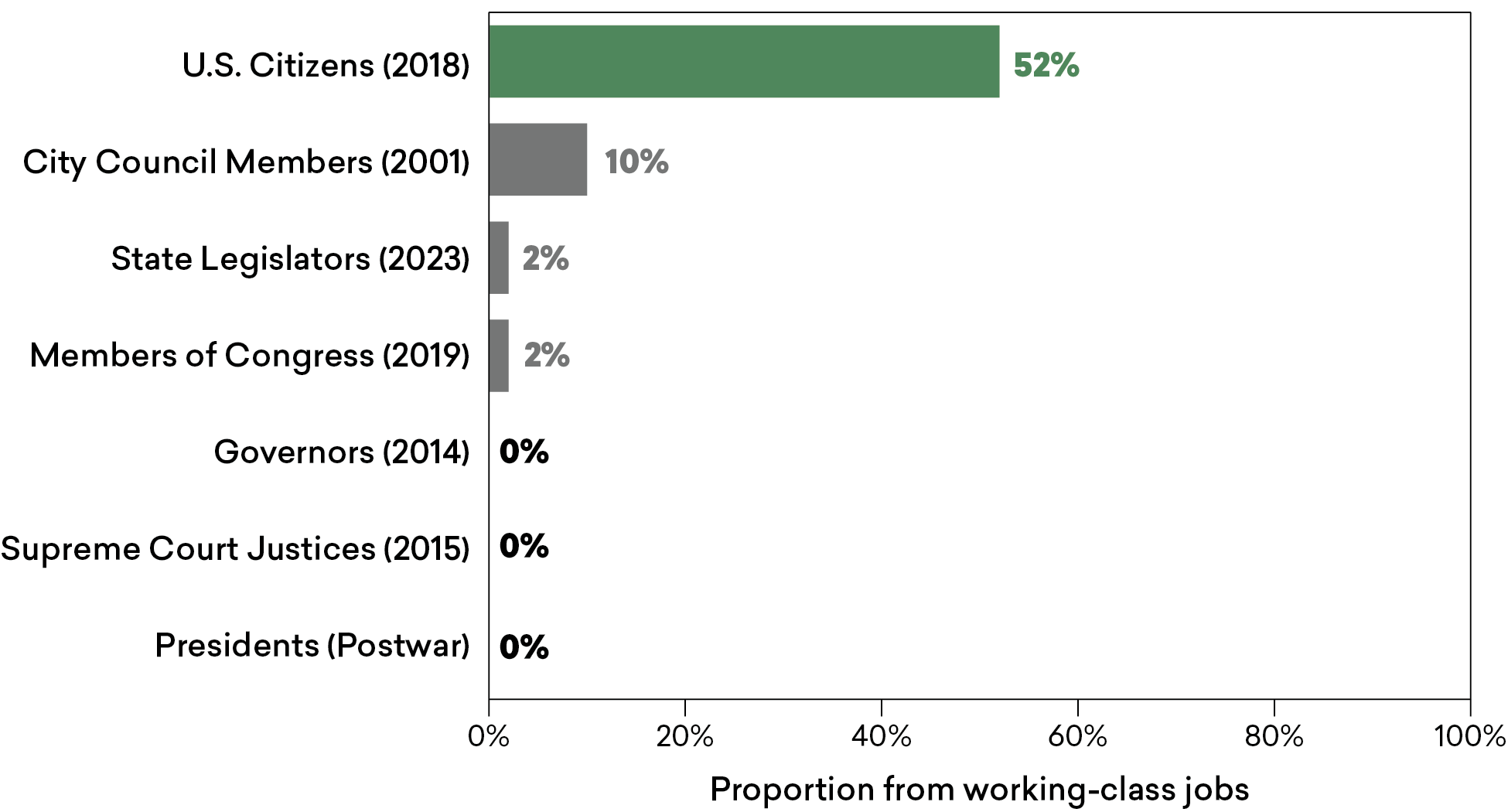
A bar graph that shows the proportion of people from the working class who are U.S. citizens (52 percent, in 2018), city council members (10 percent, in 2001), state legislators (2 percent, in 2023), members of Congress (2 percent, in 2019), governors (0 percent, in 2014), Supreme Court Justices (0 percent, in 2015), and presidents (0 percent, postwar).

Friday, November 1, 2024

The Alien Enemies Act, Explained

Don Wolfensberger at The Hill:
Two things should be understood about the Alien Enemies Act. First, it can only be operable when there is a “declared war between the United States and any foreign nation or government.” The act was not triggered when enacted because the U.S. maintained its neutrality throughout the war between Britain and France.

Second, the legislation authorized the president to “make public proclamation” of his intent to apprehend, restrain, secure and remove foreign male nationals aged 14 and over (since amended in 1918 to include women) as enemy aliens, whether or not they were present in the U.S. legally.

The act has been invoked only three times over the last two- and a quarter centuries: in the War of 1812 against Britain, in World War I and in World War II — the latter being the last war declared by Congress.

The Alien Enemies Act was used to during World War II to arrest and detain in internment camps or military facilities more than 30,000 suspected enemy aliens in the U.S. from Italy and Nazi Germany. The more outrageous occurrence was the internment of over 100,000 ethnic Japanese. But approximately two-thirds of these were U.S. citizens, who therefore had to be detained under different legal authorities than the Alien Enemies Act.

Even if Trump’s threat to utilize the 1798 law to round-up and either detain or deport immigrants, the task would be a hugely costly, litigious and prolonged. Moreover, he would be challenged in the courts that the U.S. is not now engaged in a declared war and the president has no authority under the Constitution to unilaterally declare war on other nations.
 
Several experts have pointed out that the president already has authority to expel undocumented aliens, war or no war, and need not invoke the Alien Enemies Act. So why would he want to jump through all the extra hoops? And even then, it still comes down to the bottom-line question: “Where’s the money?”


Friday, July 19, 2024

Regulation and Messaging Votes


Don Wolfensberger at The Hill:

[On] three consecutive days (July 9-11), the House flexed its anti-over-regulatory chops by passing three measures disapproving executive agency regulations ranging from women’s rights to home appliance energy standards.

Then, on the final day, the House turned around and voted 205-213 to defeat its own funding bill for fiscal 2025, the Legislative Branch Appropriations Act. Ten Republicans and all but three Democrats voted against the measure. To say the House was sending mixed signals as to its self-worth as an institution would be an understatement, though the 15 members who did not vote might have produced a different result. Some leaders are still puzzling over why the House would bite the hand that feeds it — which is to say, its own hand.

 ...
According to a Congressional Research Service brief (updated Feb. 27, 2023), the Congressional review Act has been used to successfully overturn 20 rules: one in the 107th Congress (2001-02), 16 in the 115th Congress (2017-18), and three in the 117th Congress (2021-22).

...
The partisan votes on all three regulation disapproval measures and the legislative branch appropriations bill are telling. The two parties obviously differ on many policy issues these days, and that is reflected in the marked increase in strictly partisan votes. It is also understandable that a House Republican majority will push back on regulations promulgated by a Democratic administration.

The fact remains, though, that in a Congress with split party control of the two chambers, and with a Democratic president to boot, the exercises we witnessed last week were little more than partisan messaging, doomed ultimately to fail.

Until Congress gets serious about strengthening the resources of its committees and support agencies so that it can resume bipartisan deliberations and legislating, finding common ground will be impossible. Last week was a zero-sum game, only spitting-out campaign fodder that doesn’t do a thing about solving the country’s problems.  

Monday, May 27, 2024

Memorial Day 2024

A Proclamation on Prayer for Peace, Memorial Day, 2024

     This Memorial Day, we honor the brave women and men who made the ultimate sacrifice for our Nation’s freedom.  We recommit to keeping our sacred obligation to their survivors, families, and caregivers.  Together, we vow to honor their memories by carrying on their work to forge a more perfect Union.

     Since our Nation’s founding, members of our Armed Forces have been willing to lay down their lives — not for a person or a place but for an idea unlike any other in human history:  the idea of the United States of America.  We are the only Nation in the world founded on the idea that we are all created equal and deserve to be treated equally throughout our entire lives.  Generations of America’s beloved daughters and sons have dared all, risked all, and given all for this idea.  Today, as they lie in eternal peace, we continue to live by the light of liberty they kept burning bright.

     To all those grieving the loss of a loved one who wore the uniform, including our Gold Star Families, and to all those who have a loved one still missing or unaccounted for:  Our country sees you and mourns with you.  I know how painful this day can be — how it can bring you back to the day you lost a piece of your soul.  It is overwhelming.  No words can ease that grief.  But I hope you find a small measure of solace in knowing that we will never forget the price your loved one paid for our freedom — and we will never stop trying to repay the debt of gratitude we owe you and them.

     That is our vow today — and that is our vow always.  May God bless our fallen heroes.  May God bring comfort to their families.  May God protect our troops.

     In honor and recognition of all of our fallen service members, the Congress, by a joint resolution approved May 11, 1950, as amended (36 U.S.C. 116), has requested that the President issue a proclamation calling on the people of the United States to observe each Memorial Day as a day of prayer for permanent peace and designating a period on that day when the people of the United States might unite in prayer and reflection.  The Congress, by Public Law 106-579, has also designated 3:00 p.m. local time on that day as a time for all Americans to observe, in their own way, the National Moment of Remembrance.

     NOW, THEREFORE, I, JOSEPH R. BIDEN JR., President of the United States of America, do hereby proclaim Memorial Day, May 27, 2024, as a day of prayer for permanent peace, and I designate the hour beginning in each locality at 11:00 a.m. of that day as a time when people might unite in prayer and reflection.  I urge the press, radio, television, and all other information media to cooperate in this observance.  I further ask all Americans to observe the National Moment of Remembrance beginning at 3:00 p.m. local time on Memorial Day.

     I request the Governors of the United States and its Commonwealths and Territories, and the appropriate officials of all units of government, to direct that the flag be flown at half-staff until noon on this Memorial Day on all buildings, grounds, and naval vessels throughout the United States and in all areas under its jurisdiction and control.  I encourage families, friends, and neighbors to post tributes to our fallen service members through the Veterans Legacy Memorial at vlm.cem.va.gov so that we may learn more about the lives and contributions of those buried in National, State, and Tribal veteran cemeteries.  I also request the people of the United States to display the flag at half-staff from their homes for the customary forenoon period.

     IN WITNESS WHEREOF, I have hereunto set my hand this twenty-fourth day of May, in the year of our Lord two thousand twenty-four, and of the Independence of the United States of America the two hundred and forty-eighth.


                             JOSEPH R. BIDEN JR.

Sunday, October 1, 2023

Women in Congress

A number of posts have discussed the growing number of women in office.

 Katherine Schaeffer at Pew:


Women in the U.S. Senate, 1965-2023
% of U.S. senators who are women
0%10%20%30%40%50%197019801990200020102020Starting dateofcongressionalterm
Note: Percentages are the share of women senators at the outset of each term of Congress.
Source: Pew Research Center analysis of Congressional Biographical Directory data.
PEW RESEARCH CENTER

At the start of the 118th Congress in 2023, there were 25 women serving in the U.S. Senate, just shy of the record 26 women senators sworn in on the first day of the previous Congress. (The count for the previous Congress includes Vice President Kamala Harris and former Georgia Sen. Kelly Loeffler. Both were sworn in on the first day and left the Senate shortly after.)

Of the 25 women senators:
  • 16 are Democrats and nine are Republicans.
  • 22 are White, two are Asian American and one is Hispanic. No Black women currently serve in the Senate, nor do any American Indian or Alaska Native women.
The first-ever woman in the Senate was Rebecca Latimer Felton, D-Ga., who was appointed to the seat as a political maneuver in 1922 and served just one day. Nancy Kassebaum, R-Kan., who served in the Senate from 1978 to 1997, was the first woman senator who was elected for a full term without having a spousal connection to Congress.

U.S. House


Women in the U.S. House, 1965-2023
% of U.S. representatives who are women
0%10%20%30%40%50%197019801990200020102020Starting dateofcongressionalterm
Note: Percentages are the share of women representatives at the outset of each term of Congress.
Source: Pew Research Center analysis of Congressional Biographical Directory data.
PEW RESEARCH CENTER


On the first day of the 118th Congress, 124 women were voting members in the House of Representatives, making up 28% of the chamber’s voting membership. In addition, four women serve as nonvoting delegates to Congress, representing American Samoa, the District of Columbia, Puerto Rico and the U.S. Virgin Islands.

Of the women voting representatives sworn in on the first day of the session:
  • 91 are Democrats and 33 are Republicans.
  • 26 are Black, 18 are Hispanic, seven are Asian American, two are Native American and one is multiracial.

Jeannette Rankin, R-Mont., was the first woman to be elected to Congress, taking office in 1917. Nancy Pelosi, D-Calif., is the only woman to have served as speaker of the House. She was speaker from 2007 to 2011, served as the minority leader in the Republican-controlled House from 2011 to 2019 and was elected speaker again from 2019 to 2023.

Wednesday, March 22, 2023

Consulting the Public

Kevin Kosar and John Maxwell Hamilton at RCP:

 Fixing Social Security is a straightforward arithmetic problem. Revenues need to cover the outlays. The tricky part is to decide who pays more or gets less.

To see if a mutually acceptable solution was possible, the University of Maryland’s Program for Public Consultation surveyed 2,500 Americans. These women and men received a battery of facts, figures, and policy options. And, lo, a consensus emerged that touched on both the revenue side of the equation and the outlay side.

Strong majorities favored lifting the level of income subject to Social Security taxes, which is currently capped at $160,200. They also favored lifting the payroll tax rate from 6.2 to 6.5 percent. John and Jane Q. Public also thought benefits should be trimmed a little by raising the retirement age from 67 to 68 years.

These solutions would keep Social Security solvent for 75 more years.

...

It is one thing to inveigh against the other side of the aisle, and quite another for individuals on the fringes to argue excluding the great mass of Americans from the political process.

One way to organize such an approach is for legislators to partner with nonpartisan research outfits like Professor Kull’s or Ohio State University’s Connecting to Congress initiative. They can convene cross-sections of Americans to deliberate with members about public problems. These meetings would not be anarchic public townhalls that, as often happens, feature cranks shouting nonsense. Nor would they be like the typical congressional hearings, which are adversarial proceedings that encourage acrimony and showboating. These panels would have legislators and citizens having a structured conversation to better understand a public problem and to come up with solutions.

Monday, March 6, 2023

Lauren Underwood: The Personal Cost of Public Service

 At WP, Ruby Cramer has a remarkable portrait of Rep. Lauren Underwood  (D-IL):   (h/t Cheryl Bonner)

Was this what she signed up for?

Not exactly. But Lauren Underwood was here to do the job, and today, on a Friday at 11 p.m., the job was to sit in the House chamber and to wait, alert, present, attentive, for her name to be called near the end of the alphabet. So that’s what she did. She had her navy-blue blanket draped over her legs. She had cough drops and hard candy in her bag. Underwood came 405th in line, about 40 minutes into each roll call, after four Johnsons, four Smiths, three Thompsons and two Torreses. Fourteen rounds of votes and still no speaker of the House. Four days of anxiety and confusion, waiting to be sworn in. It occurred to her early on that week that the world was watching, and that Congress was not exactly putting its best foot forward. There was a grimness haunting the place. It was not a happy scene. Underwood scrolled through text messages on her phone. Across the aisle sat the new Republican majority. She heard murmurs. Then she heard yelling. The word “combustible” came to mind. She turned and saw two colleagues about to lay hands on one another — an almost-fight breaking out in the House chamber. Was she surprised? After four years in this job, no, not really. She looked back down at her phone and fired off a skull emoji to her sister. One more vote and then she could begin her third term in Congress.

...

 But she was 36 years old now. She was single. She wanted kids. She dated, but life with a member of Congress, she knew, was “not for everyone.” Like a lot of women, she had mapped out what it would mean to raise a child on her own. She had researched the costs of fertility treatments, the timeline she’d need to follow, the financial reality of paying for full-time child care on top of not just one home, in Illinois, but also an apartment in Washington, on a salary of $174,000. Like a lot of women her age, Underwood said, she had health complications that put her “firmly, permanently,” in a “high, high, high risk category” for pregnancy. She knew all the data, all the risks, in part because she had made Black maternal health her signature legislation in Congress. Like a lot of women, Underwood had made sacrifices for her work.

Sunday, January 15, 2023

Women in Congress 2023

 Rebecca Leppert and Drew DeSilver at Pew:

Women make up more than a quarter (28%) of all members of the 118th Congress – the highest percentage in U.S. history and a considerable increase from where things stood even a decade ago.

Counting both the House of Representatives and the Senate, women account for 153 of 540 voting and nonvoting members of Congress. That represents a 59% increase from the 96 women who were serving in the 112th Congress a decade ago, though it remains far below women’s share of the overall U.S. population. A record 128 women are serving in the newly elected House, accounting for 29% of the chamber’s total. In the Senate, women hold 25 of 100 seats, tying the record number they held in the 116th Congress.

The 2022 midterm elections sent nearly two dozen new congresswomen to the House, including Becca Balint, a Vermont Democrat who became both the first woman and openly LGBTQ person elected to Congress from the state. Of the 22 freshman representatives who are women, 15 are Democrats and seven are Republicans.

The Senate gained just one new female member: Republican Katie Britt, who became the first woman senator from Alabama.

Many female incumbents who sought reelection this midterm cycle – 105 representatives and all five senators – kept their seats. Rep. Marcy Kaptur, D-Ohio, who first joined the House in 1983, retained her title as the longest-serving congresswoman in the chamber. California Rep. Nancy Pelosi, who’s served in Congress for 35 years and became the first female speaker of the House in 2007, also won reelection. But she announced she wouldn’t run for another leadership role after Republicans flipped control of the House.

Women make up a much larger share of congressional Democrats (41%) than Republicans (16%). Across both chambers, there are 109 Democratic women and 44 Republican women in the new Congress. Women account for 43% of House Democrats and 31% of Senate Democrats, compared with 16% of House Republicans and 18% of Senate Republicans. Still, the number of GOP women in the House is at its highest total yet: 35, up from 30 in January 2021, when the 117th Congress began.


Monday, February 21, 2022

Yes, Congress Does Still Pass Stuff

 Despite deadlock on high-profile controversial bills, Congress does manage to pass legislation on lower-profile issues. Russell Berman in The Atlantic

The final two-plus years of the Trump administration, for example, began with a government shutdown and featured two presidential impeachments. But they also saw the passage of a major conservation bill, a new trade agreement, significant criminal-justice reform, and several pandemic-relief packages. Lawmakers banned surprise medical billing and raised the age for purchasing tobacco from 18 to 21. Sometimes Congress does get credit for its successes. The $2.2 trillion CARES Act, passed swiftly after the coronavirus shut down huge portions of the U.S. economy in March 2020, provided some form of relief to nearly every American, as did the $1.9 trillion American Rescue Plan that Congress enacted a year later. (Not coincidentally, Gallup found that Congress’s approval rating peaked—at a still dismal 36 percent—around the time it was literally giving cash to most households.) More recently, the passage of a bipartisan infrastructure bill last year was a top story in the news.

...

Last year, Simon Bazelon and Matthew Yglesias identified this dynamic as the “Secret Congress.” Perhaps a better term would be Shadow Congress, borrowing from the label recently affixed to certain “shadow docket” rulings of the Supreme Court. These new bills, after all, are public, but relatively few care to notice. One reason they draw little attention is because the president hasn’t been fighting for them, at least not publicly. Biden has spent no time campaigning for the passage of postal reform or the arbitration ban. He’s issued only a few statements on the Violence Against Women Act, despite the fact that helping write and pass the original landmark law was one of the president’s signature accomplishments as a senator, and something he regularly touted on the 2020 campaign trail.


Contrary to assumptions about the presidential “bully pulpit,” Biden’s silence might have helped these agreements come together. [Frances] Lee’s research has shown that presidential involvement in an issue tends to increase its partisanship, which in a divided Congress usually lowers its chance of passage.

Wednesday, July 28, 2021

Cheney Statement

Liz Cheney at the 1/6 Hearing:

Thank you very much, Chairman Thompson. Thank you to all of my colleagues on this committee, and thank you to each of the witnesses appearing before us today. It is because of you — you held the line, you defended all of us, you defended the Capitol, and you defended the Constitution and our Republic, and every American owes you our undying gratitude. Every American, I hope, will be able to hear your testimony today and will watch the videos. The videos show the unbelievable violence and the inexcusable and intolerable cruelty that you all faced, and people need to know the truth.

I want to begin by reflecting briefly on the investigation that we are launching today. Every one of us here on the dais voted for and would have preferred that these matters be investigated by an independent non-partisan commission, composed of five prominent Americans selected by each party, and modeled on the 9/11 Commission. Although such a commission was opposed by my own leadership in the House, it overwhelmingly passed with the support of 35 Republican members, it was defeated by Republicans in the Senate. And that leaves us where we are today.

We cannot leave the violence of January 6th – and its causes – uninvestigated. The American people deserve the full and open testimony of every person with knowledge of the planning and preparation for January 6th. We must know what happened here at the Capitol. We must also know what happened every minute of that day in the White House – every phone call, every conversation, every meeting leading up to, during, and after the attack. Honorable men and women have an obligation to step forward. If those responsible are not held accountable, and if Congress does not act responsibly, this will remain a cancer on our Constitutional Republic, undermining the peaceful transfer of power at the heart of our democratic system. We will face the threat of more violence in the months to come, and another January 6th every four years.

I have been a conservative Republican since 1984 when I first voted for Ronald Reagan. I have disagreed sharply on policy and politics with almost every Democratic member of this committee. But, in the end, we are one nation under God. The Framers of our Constitution recognized the danger of the vicious factionalism of partisan politics – and they knew that our daily arguments could become so fierce that we might lose track of our most important obligation – to defend the rule of law and the freedom of all Americans. That is why our Framers compelled each of us to swear a solemn oath to preserve and protect the Constitution. When a threat to our constitutional order arises, as it has here, we are obligated to rise above politics. This investigation must be non-partisan.

While we begin today by taking the public testimony of these four heroic men, we must also realize that the task of this committee will require persistence. We must issue and enforce subpoenas promptly. We must get to objective truth. We must overcome the many efforts we are already seeing to cover up and obscure the facts.

On January 6th and in the days thereafter, almost all members of my party recognized the events of that day for what they actually were. One Republican, for example, said: “What is happening at the U.S. Capitol right now is unacceptable and un-American. Those participating in lawlessness and violence must be arrested and prosecuted to the fullest extent of the law.” No Member of Congress should now attempt to defend the indefensible, obstruct this investigation, or whitewash what happened that day. We must act with honor and duty, and in the interest of our nation.

America is great because we preserve our democratic institutions at all costs. Until January 6th, we were proof positive for the world that a nation conceived in liberty could long endure. But now, January 6th threatens our most sacred legacy. The question for every one of us who serves in Congress, for every elected official across this great nation, indeed, for every American is this: Will we adhere to the rule of law? Will we respect the rulings of our courts? Will we preserve the peaceful transition of power? Or will we be so blinded by partisanship that we throw away the miracle of America? Do we hate our political adversaries more than we love our country and revere our Constitution? I pray that that is not the case. I pray that we all remember, our children are watching, as we carry out this solemn and sacred duty entrusted to us. Our children will know who stood for truth, and they will inherit the nation we hand to them – a Republic, if we can keep it.

Friday, January 22, 2021

Notes on the Insurrection


Tom Dreisbach and Meg Anderson at NPR:
As a violent mob descended on the U.S. Capitol on Jan. 6, lawmakers and aides hid wherever they could, waiting for the military and police to arrive. But many of those who stormed the Capitol were military veterans themselves, who had once sworn to protect the Constitution. In fact, an NPR analysis has found that nearly 1 in 5 people charged over their alleged involvement in the attack on the U.S. Capitol appear to have a military history.

NPR compiled a list of individuals facing federal or District of Columbia charges in connection with the events of Jan. 6. Of more than 140 charged so far, a review of military records, social media accounts, court documents and news reports indicate at least 27 of those charged, or nearly 20%, have served or are currently serving in the U.S. military. To put that number in perspective, only about 7% of all American adults are military veterans, according to the U.S. Census Bureau.

Amy Worden and Marisa Iati at WP:

A Pennsylvania woman accused of helping to steal a laptop from House Speaker Nancy Pelosi’s office during the attack on the U.S. Capitol in Washington was ordered released from detention Thursday and placed in her mother’s custody.

Riley June Williams, 22, must stay in the home she shares with her mother and abide by other conditions of release, including avoiding contact with any witnesses or victims of the Jan. 6 Capitol storming. Federal Magistrate Judge Martin Carlson said he was releasing Williams in part because she had no prior criminal record, but he warned her that her mother, Wendy Williams, could be criminally charged if she fails to report to the court any violations of the conditions of release.

Unofficial transcript:

Miss Williams, when we met on Tuesday, one of the first things I did was advise you of your constitutional rights. And then I took steps to protect those rights by appointing aggressive, effective counsel to represent you here. That recital of rights wasn't just some hollow invocation of abstract principles. It was affirmation of the rights guaranteed to you by the United States Constitution. And it strikes me that that guarantee says something extraordinary and extraordinarily good about our Constitution. You are embraced by a presumption of innocence.

You are entitled to the assistance of counsel. You have a right to remain silent. All of these matters guaranteed to you by the Constitution, a constitution that protects the rights of those who are accused of transgressing society's rules. Some of the most basic of those rules are set forth in our Constitution. And one of the fundamental pillars of that constitution is the peaceful transition of power. That obligation that all citizens have to facilitate the peaceful transfer of power, it has been honored by generations of Americans for two hundred and thirty two years, it has become so commonplace that we often think very little of it.

But as President Reagan said in his inaugural, that process is a miracle. The allegations that bring you before me involve conduct that allegedly took place on January 6th of this year as Congress was endeavoring to fulfill its constitutional obligation to certify the will of the people and the votes of the Electoral College. You are cloaked in a presumption of innocence with respect to these matters. But the allegations set forth in the complaint relate to conduct that was antithetical to these constitutional values, conduct that involved a riot, a mob that sought to replace constitutional norms with the howling of a crowd.

We know now that the mob failed and the Constitution prevailed. The Constitution prevailed on January 6th of this year because Congress, stepping over the wreckage of its capital, met. and confirmed the vote of the Electoral College, setting the stage for the latest peaceful transition of power in this country yesterday. In the wake of those events on January 6th, it strikes me that the Constitution prevailed yet again in the wake of those events, the men and women of federal law enforcement, including the federal investigator and the assistant US attorney, the federal prosecutor involved in this case, fulfilled a duty that they had under the Constitution. They have sworn an oath under the Constitution to protect and defend that Constitution against all enemies, foreign and domestic.

And in pursuit of that constitutional obligation, a series of investigations have been launched into the matters that took place on January 6th. And those investigations have brought us here today together. It also occurs to me, Miss Williams, in a very personal and direct way, that the Constitution has is and will be prevailing in your case. As I noted a few moments ago when we first met, I invoked the Constitution on your behalf and I took steps to protect your constitutional rights by appointing counsel for you, your counsel.

Fulfilling the role of the Constitution contemplated has aggressively represented your interests here today. Wouldn't you agree, Miss Oelrich? [The judge at this point turns to the court appointed public defender in this case]. Wouldn't you agree, Miss Oelrich, that you have aggressively represented your client's interests here today?

Yes, Your Honor, I spent the last two days doing a lot of investigating. 

[And the judge turns to the prosecutor] On behalf of the United States, it is my view that over the past two days, you and your colleagues here and elsewhere have endeavored to fulfill your constitutional obligation to provide equal justice under the law to ensure the protection of individual rights and liberties while ensuring adherence to the rule of law.[

[And then the judge turns back to the defendant, Miss Williams, he says] so Miss Williams, in a very real and direct sense, you are being released today because the Constitution has prevailed, because your counsel has fulfilled her constitutional obligation and because the United States is also fulfilling its constitutional duty to strike hard blows but fair blows in the pursuit of justice. So, Miss Williams, I share that thought with you as you leave here today, that your freedom today, conditioned as it is by the orders that I have entered as a result of the prevailing of the Constitution.

And I'll leave you with this final thought, Miss Williams. The judge closes with us. The Constitution prevails here today and the Constitution will always prevail in this country.

Sunday, January 17, 2021

Women in Congress

Many posts have discussed women in politics.

Carrie Elizabeth Blazina and Drew DeSilver at Pew:
Counting both the House of Representatives and the Senate, 144 of 539 seats – or 27% – are held by women. That represents a 50% increase from the 96 women who were serving in the 112th Congress a decade ago, though it remains far below the female share of the overall U.S. population. A record 120 women are serving in the newly elected House, accounting for 27% of the total. In the Senate, women hold 24 of 100 seats, one fewer than the record number of seats they held in the last Congress.

This analysis counts voting as well as nonvoting members of Congress. Figures for the 117th Congress exclude two House seats that were vacant as of early January. It also excludes Sens. Kamala Harris, who is expected to resign her seat ahead of her inauguration as vice president on Jan. 20, and Kelly Loeffler, who lost a runoff election in Georgia earlier this month. Both are set to be replaced by men.
How we did this

Women make up a much bigger share of congressional Democrats (38%) than Republicans (14%). Across both chambers, there are 106 Democratic women and 38 Republican women in the new Congress. Women account for 40% of House Democrats and 32% of Senate Democrats, compared with 14% of House Republicans and 16% of Senate Republicans.

The 2020 general election sent just one new congresswoman to the Senate, Republican Cynthia Lummis of Wyoming, making her the first female senator to represent that state.

Republican women made significant gains in the House in the most recent election cycle. Of the 27 newly elected representatives who are women, two-thirds (18) are Republicans. Between the 115th and 116th Congresses, the number of GOP women in the House fell from 25 to 15. That number doubled this year to 30, the highest total ever.

California Rep. Nancy Pelosi, a Democrat and the first female speaker of the House, is serving her fourth term as speaker after being reelected earlier this month.

The partisan gender division hasn’t always looked this way. Until the 1929 stock market crash, most of the dozen women elected to the House were Republicans, and for several decades afterward the two parties were generally close in numbers in that chamber. But the gap widened in the 1970s and has persisted, despite a temporary narrowing during the Reagan-Bush 1980s. Of the 232 women elected to the House in 1992 or later, 157 (68%) have been Democrats, as have 27 of the 42 women (64%) who have served in the Senate since 1992.