Search This Blog

Showing posts with label divided government. Show all posts

Thursday, January 14, 2021

Belknap and Impeachment Trials

 Andra Belknap (Pitzer `09)  at USA Today:

Can Congress even impeach someone who is no longer in office? What’s the point of voting to impeach and try a man who is headed out the door in a few days’ time? 

The answer to the first question is an emphatic yes. I do have some expertise here; it’s in my last name. 

I was in seventh grade when my class was silently reading a section of Reconstruction-era American history. I came across the name William Worth Belknap, a former United States secretary of War impeached by the U.S. House of Representatives on March 2, 1876. The paragraph recounted how Belknap had tearfully resigned his cabinet position to President Ulysses S. Grant just two hours prior to his impeachment by the U.S. House of Representatives. I had never heard of the man, but I was mortified. There are few things that aren’t embarrassing to a 12-year-old. 

Turns out, he is my ancestor. I learned later that Belknap was accused of effectively selling lucrative government appointments at Fort Sill in modern day Oklahoma — he received approximately $20,000 in payments in return for the appointments. Belknap’s yearly salary at the time was $8,000. Indeed, 20-grand was a substantial sum in the 19th century United States.

 Belknap faced a Senate trial for corruption in office over a period of four months in 1876 — the nation’s centennial. Notably, he was a private citizen at the time. The five articles of impeachment alleged that Belknap had, “criminally disregard(ed) his duty as Secretary of War, and basely prostitut(ed) his high office to his lust for private gain.” A majority of the Senators voted to convict Belknap for his crimes, but they failed to reach the two-thirds majority required for a conviction. 

This brings me to question two. What’s the point of such an impeachment and Senate trial? The question was debated at length by the Congress. Those in favor came to a simple conclusion: high crimes require justice.


Thursday, October 15, 2020

COVID Deaths

The US has experienced more deaths from coronavirus disease 2019 (COVID-19) than any other country and has one of the highest cumulative per capita death rates.1,2 An unanswered question is to what extent high US mortality was driven by the early surge of cases prior to improvements in prevention and patient management vs a poor longer-term response.3 We compared US COVID-19 deaths and excess all-cause mortality in 2020 (vs 2015-2019) to that of 18 countries with diverse COVID-19 responses.
...

Compared with other countries, the US experienced high COVID-19–associated mortality and excess all-cause mortality into September 2020. After the first peak in early spring, US death rates from COVID-19 and from all causes remained higher than even countries with high COVID-19 mortality. This may have been a result of several factors, including weak public health infrastructure and a decentralized, inconsistent US response to the pandemic.4,5

Limitations of this analysis include differences in mortality risk: the US population is younger but has more comorbidities compared with the other countries.6 In addition, since late August death rates have increased in several countries, and how mortality will compare with the US throughout fall remains unknown.

According to data from Johns Hopkins, the US compares poorly with other democracies that have federal systems.  Deaths per 100,000 population:

  • United States ..... 66.29
  • Canada.................26.23
  • Germany..............11.72
  • Australia..............03.62 

Friday, February 1, 2019

Record-Low Trust in Government

At Gallup, Megan Brenan reports:
 Americans' trust in the federal government's ability to handle both domestic and international problems has sunk to the lowest points in more than two decades. Thirty-five percent of Americans have "a great deal" or "a fair amount" of trust and confidence in the U.S. government's ability to deal with domestic issues, down from 45% four months ago. Over the same period, the reading for handling international issues has dropped nine percentage points, to 41%.
...
Nearly all of the decline since September in Americans' trust in government has occurred among Republicans and independents. Republicans' confidence in the government's ability to manage domestic problems has fallen 12 points since September to 59%, and independents' confidence has dropped nine points to 28%. At the same time, Democrats' 28% confidence is essentially unchanged, having already fallen from 71% in 2016 to 30% in 2018.

Saturday, December 15, 2018

Divided Government, Interest Groups, and Diverse Coalitions

How to pass bills during divided government? At LegBranch.org, Geoff Lorenz suggests that building a diverse coalition of interests is important.
Concerns about legislative viability are exacerbated during divided government. Divided government makes many bills less viable in an absolute sense, because it requires a wider range of preferences to be satisfied for any given bill to pass into law. This makes efficient committee agenda-setting that much harder, and thus makes informative cues about legislative viability more valuable. Because such informative cues can be provided by interest diverse lobbying coalitions, diverse coalitions may be more effective during divided government. Indeed, during the periods of divided government (the 110th, 112th, and 113th Congresses) in the data, interest diverse coalitions were more influential than in periods of unified government. Large-but-homogenous coalitions, and coalitions that give high levels of PAC contributions, do not get a similar bump during divided government.
So what does this mean for the next two years of divided government? Some legislators may be reasonably wary to expend too much effort on advancing legislation, fearing it will die quietly in the other chamber if not in their own. Similarly, interest groups building lobbying coalitions might be inclined to focus on defense; after all, defending a preferred legislative status quo is easier when all legislation is harder to pass. But for their top priorities, these and other policy entrepreneurs should consider how they might cultivate diverse coalitions. What industries, or social causes, or other interests might support their legislative priorities? Instead of focusing on satisfying individual interests, they should consider how their legislation might garner support from diverse, if not necessarily strange, bedfellows.
Similarly, diverse coalitions in opposition help bring down GOP health care legislation.

Saturday, October 27, 2018

Divided Government

Matt Glassman at his Five Points newsletter points out that there are different forms of divided government, where the House, the Senate, or both chambers belong to a different party from the president.
Traditionally, same-party control of both chambers of Congress is a much more common variety of divided government. Of the 21 federal elections that produced divided government since 1933, 15 of them featured the dynamic of the Clinton-Gingrich years: one party-controlling both chambers of Congress and the other party controlling the presidency.The other six included five where the president’s party controlled the Senate but not the House (Reagan’s first three Congresses and the two Obama Congresses after the 2010 Tea Party election) and just one where the president’s party controlled the House but not the Senate (the 2000 election, after Jeffords switched parties).
Are there meaningful distinctions between these various forms of divided government? Absolutely. While divided government in America inherently pits Republicans vs. Democrats, there are both structural features built into the legislative process and political dynamics operating in the public sphere that make unified congressional control different than one-chamber congressional control. The most obvious of these is the direct constitutional link between the presidency and the Senate: nominations. As the constitution provides no formal role for the House in the confirmation of judges and executive branch officials, control of the House alone does not actually create divided government in regard to the nomination process (or the treaty process). Particularly now that the filibuster has been eliminated on all nominations, GOP control of the Senate implies that the record-setting pace of judicial nominations under president Trump will continue in the 116th Congress.
A more subtle distinction is the location and control of political conflict.When one party controls both chambers, there’s a stronger possibility of legislation emerging from Congress that the president feels the need to veto. Indeed, of the twelve vetoes President Obama issued, ten of them came in the final Congress of presidency, when the GOP controlled both the House and the Senate. During the two Congresses in which the GOP controlled only the House, Obama didn’t veto a single bill. His other two vetoes came in his first Congress, when the Democrats had unified control.
Lydia Saad at Gallup:
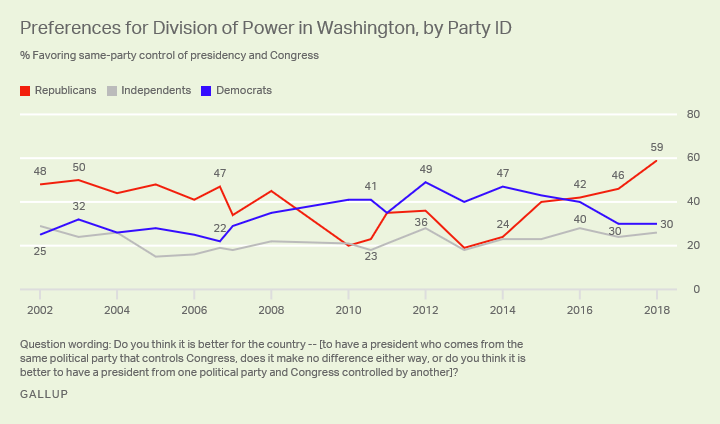
A record-high 59% of Republicans say it is better for the president and majority power in Congress to be from the same political party than for Congress to be controlled by a party different from the president's. That is the highest percentage of Republicans or Democrats favoring one-party control of the federal government in Gallup's trend since 2002. The prior highs saying this were 50% of Republicans in 2003 and 49% of Democrats in 2012.
 The trend makes it clear that members of the president's party are almost always more likely than the opposing party to say it's better to have the same party controlling the White House and Congress.
This finding illustrates Miles' Law: where you stand depends on where you sit.
Line graph. 3-party trend since 2002, previous high 48% of Republicans wanted president, Congress in same party vs. 59% now.

Wednesday, April 27, 2016

Polarization, Education, Generation

Pew reports:
Two years ago, Pew Research Center found that Republicans and Democrats were more divided along ideological lines than at any point in the previous two decades. But growing ideological distance is not confined to partisanship. There are also growing ideological divisions along educational and generational lines.
Highly educated adults – particularly those who have attended graduate school – are far more likely than those with less education to take predominantly liberal positions across a range of political values. And these differences have increased over the past two decades.
...
Over the past decade, ideological differences across generations also have widened. Millennials remain more liberal than older generations – 45% express consistently liberal or mostly liberal views, which is little changed from 2004 (41%). In contrast, growing shares of the oldest cohorts – Boomers and Silents – have conservative political values. About a third of Boomers (36%) and 40% of Silents have at least mostly conservative attitudes, up from 21% and 23%, respectively, in 2004.
This analysis is based on a survey conducted last fall among more than 6,000 adults, and draws from data on Pew Research Center surveys going back to 1994. Responses to 10 political values questions – covering opinions about government performance, the social safety net, the environment, immigration, homosexuality and other topics – asked together in each of these surveys were combined to create a scale of ideological consistency.

Saturday, January 24, 2015

Requiring Students to Take the Citizenship Test

On January 15, Arizona became the first to require students to take the U.S. citizenship test. AP reports:
Fewer than a dozen states currently require students to take a civics exam, and passing it isn't necessary to graduate in all of them. In most states, civic education instead revolves around a one-semester U.S. history course.
...
"This has been building for a long time," said Ted McConnell, executive director of the Campaign for the Civic Mission of Schools, a civic learning coalition co-chaired by former U.S. Supreme Court Justice Sandra Day O'Connor. McConnell said he and others are wary that legislators are only skimming the surface of what students need to know.
"The folks who are civic educators and experts by and large are pushing for a much, much more well-rounded approach," said Paul Baumann, director of the National Center for Learning and Civic Engagement at the Education Commission of the States, a state-led research organization.
For years, education leaders have sounded the alarm on the state of civic education.
Just 13 percent of high school seniors scored as "proficient" or higher in American history on the 2010 National Assessment of Educational Progress. Voter participation in the most recent midterm elections was the lowest in decades, and even entertainers like Jay Leno have tapped into the country's weak civic knowledge with laughable pop quiz history tests.
The Arizona-based Joe Foss Institute has set a goal of having all 50 states adopt the U.S. citizenship requirement for high school students by 2017, the 230th anniversary of the U.S. Constitution. The institute says legislatures in 15 states are expected to consider it this year. The North Dakota House of Representatives overwhelmingly approved the same measure Thursday, but Arizona's proposal was the first to become law.

Tuesday, January 13, 2015

Congressional Demographics

Pew reports:
Almost one-in-five members of the House and Senate are a racial or ethnic minority, making the 114th Congress the most diverse in history. However, Congress remains disproportionately white when compared with the U.S. population, which has grown increasingly diverse in recent decades, according to a Pew Research Center analysis.

Overall, non-whites (including blacks, Hispanics, Asian/Pacific Islanders and Native Americans) make up 17% of the new Congress, but that is below these groups’ 38% share of the nation’s population. This difference also exists among the newly elected members of Congress, as minorities account for 11 of 71 (15%) new members of the House and Senate. (No new senators are a racial or ethnic minority.)

Diversity among congressional members has been growing for decades. But the nation’s population has diversified more quickly. When the 107th Congress took office in 2001, minorities accounted for 12% of Congress, compared with about 31% of the nation’s population. By comparison, in 1981, 6% of Congress was minority (black, Hispanic, Asian/Pacific Islander or Native American), while in the national population about 20% were non-white.
114th Congress, By Race

Sunday, January 5, 2014

The Red and Blue Senate

Many posts have discussed polarization in CongressRonald Brownstein writes at National Journal:
The tightening correlation between presidential and Senate voting represents a back-to-the-future trend in national politics. Through the first half of the 20th century, party-line voting was common. After Franklin Roosevelt's first two victories in 1932 and 1936, for instance, Democrats held 89 percent of the Senate seats in the 40 states that supported him both times.

This relationship frayed later in the century, as more voters split their ticket between presidential and Senate races. That was especially true in the South (and to some extent in the Mountain West), where many voters who had shifted toward GOP presidential candidates still supported Democrats in Senate and House races. The result was that the GOP controlled only about half the Senate seats in the states that twice voted for Richard Nixon (in 1968 and 1972) and Ronald Reagan (1980 and 1984).

The large number of senators elected from states that leaned toward the other party in presidential elections encouraged the Senate's culture of compromise and negotiation from roughly the 1950s through the 1980s. Senators who'd been elected, in effect, from behind enemy lines were natural dealmakers: Representing voters with mixed loyalties, they had a clear self-interest in suppressing partisan conflict.

But those instinctive bridge-builders are vanishing. Since the 1980s, party-line voting between presidential and congressional races has steadily increased. The share of Senate seats controlled by the president's party in the states he carried twice rose to two-thirds after Bill Clinton's reelection and to three-fourths under George W. Bush. Following Obama's two victories, Democrats now hold 83 percent (43 of the 52 seats) in the 26 states he carried twice.

Saturday, October 12, 2013

Americans Like Divided Government

Republicans are taking a hit as a result of the government shutdown, but James Madison may ride to their rescue in the 2014 midterm election.  Madison famously explained the need for each branch of government to check the others. Americans may not have read Federalist 51, but they get the idea.  Gallup reports:
Even as the division of power in Washington between Republicans and Democrats is wreaking havoc with the federal government, Americans' preference for having one political party run both the White House and Congress is at a record low.

At, 25%, the percentage of Americans today favoring one-party control in Washington is virtually equivalent to the 28% who favor splitting power between the two parties. The plurality, 38%, say it makes no difference.

The latest figures are from an Oct. 3-6 Gallup poll, conducted within the first week of the partial federal government shutdown. The freeze on non-essential services resulted from the failure of President Barack Obama and the Republican-led House of Representatives to agree on the latest continuing resolution needed to fund the government.
...

This raises questions about how potent the issue of partisan balance will be in the 2014 midterm elections or the 2016 presidential election. Both parties may invoke the shutdown fiasco to try to persuade voters to install a single party -- their party -- both in the White House and on Capitol Hill. However, if Americans aren't currently convinced this is the best scenario for the country, it may be difficult to kindle that belief in one or three years.

Friday, July 13, 2012

Who Gets Government Assistance?

Some data from a new Census report, Dynamics of Economic Well-Being: Participation in Government Programs, 2004 to 2007 and 2009 Who Gets Assistance?:
In 2009, almost 45 million people, or 18.6 percent of the U.S. population, participated in major means tested assistance programs in each month, on average.

Individuals were more likely to participate in Medicaid than any of the other programs examined in this report, in 2009. Almost 14 percent of individuals participated in Medicaid in an average month in 2009.

Individuals living in poverty in 2009 were more likely to receive at least one type of major means tested benefit than individuals who were not living in poverty. A majority of individuals in poverty (70.7 percent) received benefits in at least one month in 2009 compared with 17.4 percent of those not in poverty.
Individuals living in female householder families were more likely to participate in means-tested
programs in an average month in 2009 (46.3 percent) than were individuals living in married-couple families (12.3 percent) or individuals living in male-householder families (26.5 percent).
Adults (aged 18 and older) who did not graduate from high school were more likely than high school graduates or those with one or more years of college to participate in means-tested programs in an average month in 2009. Participation rates were 33.1 percent, 17.8 percent, and 7.8 percent, respectively, for these groups
Unemployed adults were more likely to receive means-tested benefits in an average month in
2009 than people with full-time jobs (28.3 percent compared with 5.1 percent).
Children under 18 years of age and people aged 65 and older were more likely than people aged 18 to 64 years to receive benefits from at least one means-tested assistance program in all 24 months from January 2004 to December 2005.

Wednesday, April 18, 2012

Kardashian for Mayor?

Our chapter on elections and campaigns explains that different states and communities differ greatly in their electoral rules and in the number and duties of their elected offices.  These differences sometimes surprise political novices.  One California example comes from The Glendale News-Press:
Kim Kardashian apparently wants more than just her regular table at the Carousel restaurant in Glendale.

In a clip for an upcoming episode for her sister’s show “Khloe & Lamar,” Kardashian reveals her newfound political ambitions: “I decided I’m going to run for the mayor of Glendale.”

Representatives for the reality TV star did not immediately respond to requests for comment on her latest musings, published Tuesday by Radaronline.com.

In the clip, Kardashian tells sister Khloe that her candidacy would be a perfect fit, given that Glendale is “like Armenian town.”

Problem: Glendale does not elect its mayor. The largely ceremonial post is decided among the five City Council members on an annual basis — an indication that the Kardashian famous for her curves, pop drama and occasional visit to Carousel restaurant in downtown Glendale may need to brush up on the city she says she wants to represent.

“It’s going to require a little bit of homework and not simply relying on a perceived base of support,” said the city’s elected clerk, Ardy Kassakhian, who runs municipal elections.

Monday, April 16, 2012

Citizen Advocacy on Disabilities

As we note in our chapter on interest groups, grassroots lobbying can be effective.  By writing legislators and visiting offices, citizens have an impact.  The disability community, for instance, has secured passage of key legislation at the state and federal levels.

As part of its "Autism Inside and Out" series, North Metro TV offers a video guide to legislative advocacy, featuring Sherri Radoux of Minnesota:


(Cross-posted from Autism Policy and Politics)

Sunday, July 18, 2010

Divided Government

Ronald Brownstein says that the decline of faith in parties may have contributed to the rise of divided government:

One party simultaneously controlled the White House and Congress for 50 of the 58 years from 1896 through 1954. Republicans held all of Washington's levers for 14 years under three presidents (1896-1910) and for another 10 under three others (1920-30). Democrats held unified control for six years under Woodrow Wilson, and for 14 under Franklin Roosevelt and Harry Truman (1932-46). Truman and Republican Dwight Eisenhower then managed another six years of unified government between them. During the 1960s, Democrats held the House and Senate throughout the eight years that John Kennedy and Lyndon Johnson sat in the White House.

Occasionally during these periods, the governing party lost effective control of Congress (as FDR did after 1938). But mostly, this enduring authority allowed the dominant party to pass, implement, and entrench an agenda that set a distinct and durable direction for the country. From Jefferson and Lincoln to Theodore and Franklin Roosevelt, presidents from these periods of consolidated control have usually left the deepest marks on America.

But since 1968, only Jimmy Carter (1976-80) and George W. Bush (2002-06) have secured unified control for as long as four consecutive years. (Bush added another four months in 2001 until a party-switcher cost Republicans their Senate majority.) Bill Clinton managed only two years with undivided authority until the GOP captured both congressional chambers in 1994. This fall, Barack Obama also could lose one or both chambers after just two years. No other president in this period ever achieved undivided control. Overall, one party has managed unified control for only 12 of the past 42 years (plus those four months).